

metricas
covid
European Journal of Psychiatry Gender differences in 4466 mood disorder patients
Journal Information
Vol. 39. Issue 3.
(July - September 2025)
Share
Download PDF
More article options
Vol. 39. Issue 3.
(July - September 2025)
Original article
Gender differences in 4466 mood disorder patients
Alessandro Miolaa,b,
Corresponding author
alessandro.miola@gmail.com

Corresponding author at: Department of Neuroscience, University of Padova, Via Giustiniani 3, Padua 35128, Italy.
, Leonardo Tondoa,c,d, Ross J. Baldessarinia,c
a International Consortium for Mood & Psychotic Disorders Research, Mailman Research Center, McLean Hospital, Belmont, Massachusetts, USA
b Department of Neuroscience, University of Padova, Padua, Italy
c Department of Psychiatry, Harvard Medical School, Boston, Massachusetts, USA
d Lucio Bini Mood Disorders Centers, Cagliari and Rome, Italy
Article information
Abstract
Full Text
Bibliography
Download PDF
Statistics
Figures (1)
Tables (5)
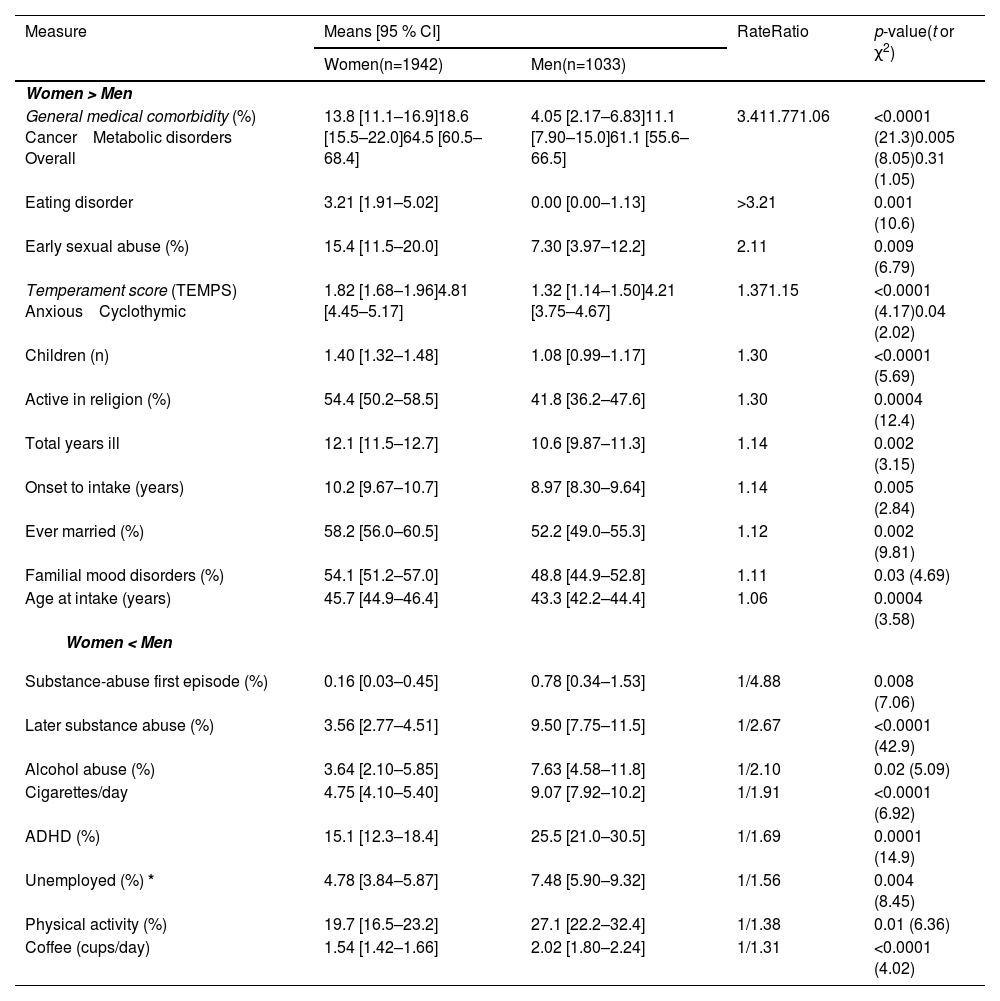
Table 1. Comparisons of women and men with bipolar disorder.
Tables
Table 2. Comparisons of women and men with major depressive disorder.
Tables
Table 3. Prospective morbidity in mood disorder patients.
Tables
Table 4. Suicide attempts, suicides and their ratio (A/S) in women and men with major mood disorders.
Tables
Table 5. Multivariable logistic regression models of female vs. male differences with major mood disorder patients.
Tables
Show moreShow less
Abstract
Background and Objectives

Characteristics of women and men with bipolar disorder (BD) or major depressive disorder (MDD) have been described with inconsistent findings requiring additional assessment.

Methods

We evaluated clinical characteristics in 4466 consecutive, extensively evaluated mood disorder patients (1491 BD, 2975 MDD; 2795 women, 1671 men) using standard bivariate statistics and multivariable logistic regression modeling.

Results

Diagnosis of MDD occurred 2.28- (women) to 1.62- (men) times more than BD, but prevalence of type II BD (BD2) and type I (BD1) did not differ by gender. BD women had more familial mood disorders, early sexual abuse, anxious or cyclothymic temperament, depressive first episodes, depression–[hypo]mania–interval (DMI) and rapid-cycling course, as well as greater %-time depressed in prospective follow-up, with more suicide attempts but fewer suicides than BD men. BD women also showed more co-occurring anxiety disorder, eating disorder and medical comorbidity, including metabolic disorders and cancer, but lower rates of ADHD and substance-abuse than BD men. MDD women experienced more religious activity, sexual abuse, anxious or cyclothymic temperament, co-occurring eating disorder and medical comorbidity as well as less substance-abuse and ADHD than MDD men but did not differ from men in measures of prospective morbidity.

Conclusions

Many characteristics were selectively associated with women with mood disorders, but prospective morbidity was similar by gender except for greater %-time depressed among BD women. Limited ethnic diversity and treatment in specialized centers may affect generalizability of these findings to other settings.

Keywords:
Bipolar disorder
Major depressive disorder
Morbidity
Women

Article

These are the options to access the full texts of the publication European Journal of Psychiatry
Subscriber
Subscriber

If you already have your login data, please click here .

If you have forgotten your password you can you can recover it by clicking here and selecting the option “I have forgotten my password”
Purchase
Purchase article

Purchasing article the PDF version will be downloaded

Purchase now
Contact
Phone for subscriptions and reporting of errors
From Monday to Friday from 9 a.m. to 6 p.m. (GMT + 1) except for the months of July and August which will be from 9 a.m. to 3 p.m.
Calls from Spain
932 415 960
Calls from outside Spain
+34 932 415 960
E-mail
Article options
Tools