

metricas
covid
European Journal of Psychiatry Association between neutrophil-to-lymphocyte ratio and bipolar disorder: A syste...
Journal Information
Vol. 39. Issue 3.
(July - September 2025)
Share
Download PDF
More article options
Vol. 39. Issue 3.
(July - September 2025)
Review article
Association between neutrophil-to-lymphocyte ratio and bipolar disorder: A systematic review and meta-analysis
Ling Guia, Haiyan Yub, Yuxin Weia, Qichao Huanga, Yuyao Liua, Yixiao Fuc,
Corresponding author
fuyixiaoresearch@126.com

Corresponding author at: Department of Psychiatry, The First Affiliated Hospital of Chongqing Medical University, Address: No.1, Youyi Road, Yuanjiagang, Yuzhong District, Chongqing, 400016, China.
a Chongqing Medical University. No. 61, Middle Road, University Town, Shapingba District, Chongqing, 400016, China
b Center for Data and Decision Sciences, Chongqing University of Posts and Telecommunications, No. 2 Chongwen Road, Nan'an District, Chongqing, 400065, China
c Department of Psychiatry, The First Affiliated Hospital of Chongqing Medical University. No.1, Youyi Road, Yuanjiagang, Yuzhong District, Chongqing, 400016, China
Article information
Abstract
Full Text
Bibliography
Download PDF
Statistics
Figures (5)
Show moreShow less
Tables (3)
Table 1. Search strategy.
Tables
Table 2. Characteristics of included studies.
Tables
Table 3. Subgroup analyses of NLR values of BD.
Tables
Show moreShow less
Additional material (6)
Abstract
Objective

The neutrophil-to-lymphocyte ratio (NLR), a systemic indicator of inflammation and stress, shows inconsistent associations with bipolar disorder (BD). This meta-analysis will investigate NLR's diagnostic, prognostic, and therapeutic relevance in BD.

Methods

A systematic search across PubMed, Embase, Web of Science, PsycINFO, and Cochrane Library, using key terms ‘bipolar disorder’, ‘neutrophils’, ‘lymphocytes’, and ‘ratio’ yielded 31 studies assessed via Newcastle-Ottawa Scale. Sensitivity analyses, subgroup analyses and publication bias assessments were conducted to explore heterogeneity sources and result stability.

Results

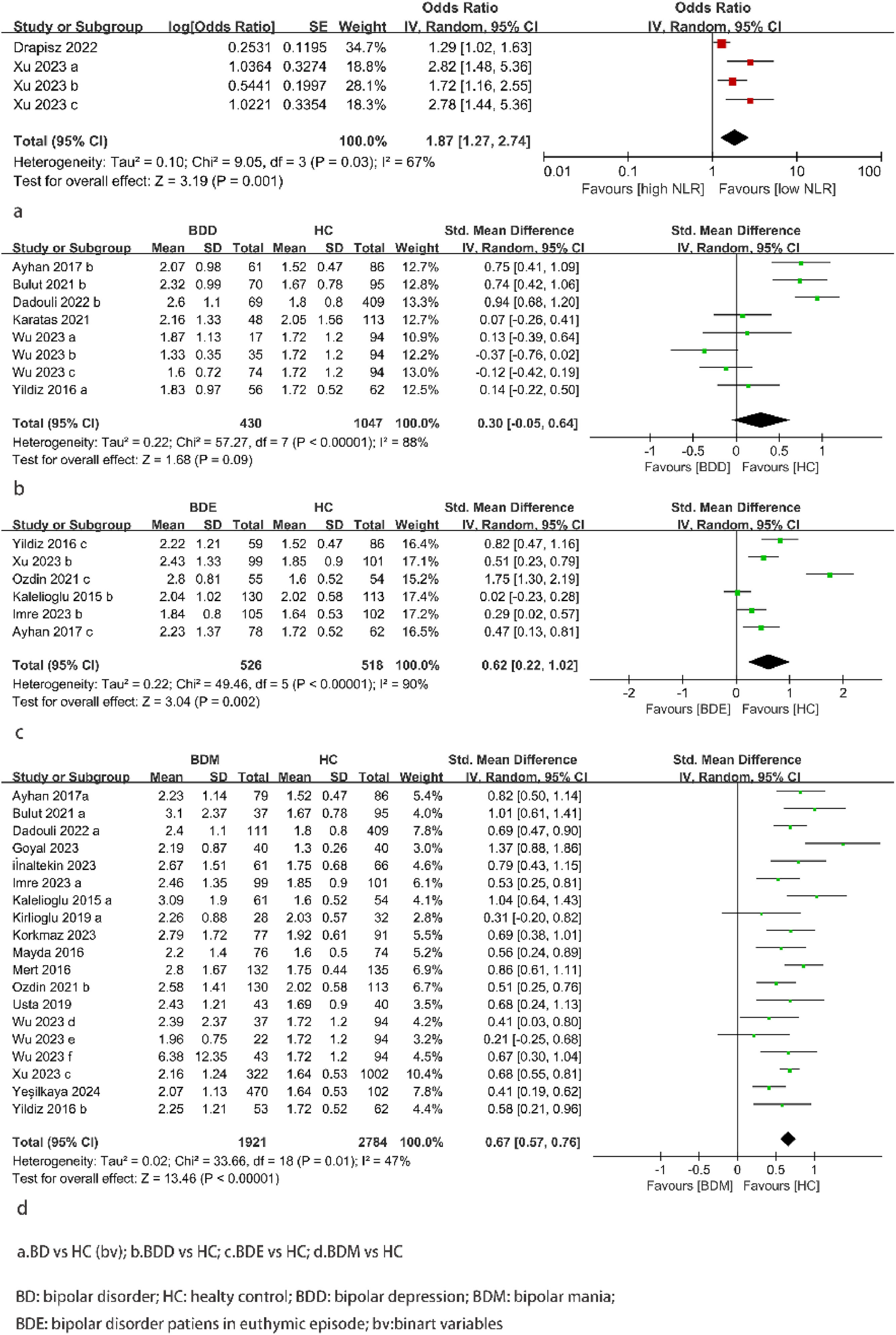
The NLR values in BDs were significantly higher than those in healthy controls (HCs) (standardized mean difference [SMD] = 0.51, 95 % confidence interval [CI]: 0.40–0.62, p < 0.0001; odds ratio [OR] = 1.87, 95 % CI: 1.27–2.74, p = 0.001). The association was most pronounced between bipolar mania (BDM) and HC (SMD = 0.67, 95 % CI: 0.57–0.76, p < 0.0001, I² = 47 %). Additionally, BDM exhibited higher NLR than bipolar depression (BDD) and bipolar patients in euthymic episode (BDE) (SMD = 0.22, 95 % CI: 0.07–0.38, p = 0.04, I² = 42 %; SMD = 0.31, 95 % CI: 0.15–0.48, p = 0.0001, I² = 60 %, respectively). No significant differences were observed between BDD and HC (SMD = 0.30, 95 % CI: -0.05–0.64, p = 0.09). Subgroup analyses suggested that age may influence the association between NLR and BD.

Conclusion

An elevated NLR value is found in BD, particularly in BDM. However, the difference between BDD and HC is not statistically significant. NLR may be a potent biomarker for the identification and evaluation of BD.

Keywords:
Bipolar disorder
Neutrophil-to-lymphocyte ratio
Meta-analysis

Article

These are the options to access the full texts of the publication European Journal of Psychiatry
Subscriber
Subscriber

If you already have your login data, please click here .

If you have forgotten your password you can you can recover it by clicking here and selecting the option “I have forgotten my password”
Purchase
Purchase article

Purchasing article the PDF version will be downloaded

Purchase now
Contact
Phone for subscriptions and reporting of errors
From Monday to Friday from 9 a.m. to 6 p.m. (GMT + 1) except for the months of July and August which will be from 9 a.m. to 3 p.m.
Calls from Spain
932 415 960
Calls from outside Spain
+34 932 415 960
E-mail
Article options
Tools
Supplemental materials