




The critically ill patient is in a state of fragility, helplessness, and vulnerability that hinders the communication of their emotions and feelings. Music therapy could be a valid tool to improve mood. The main objective was to evaluate the effect on mood of an individualised music therapy intervention compared to standard care and analyze the impact on pain and hemodynamic variables.
Methodologyrandomised, parallel, and open clinical trial. Patients were randomised into the experimental group, receiving combined music therapy and standard care, or the control group, receiving standard care only. The study population consisted of patients admitted to the Intensive Care Unit with a Glasgow 15−11 T score, excluding those with confusion, agitation, and significant cognitive deficits. The primary variable was mood, assessed using the Profile of Mood States questionnaire. Secondary variables included pain, heart rate, blood pressure, respiratory rate, and oxygen saturation.
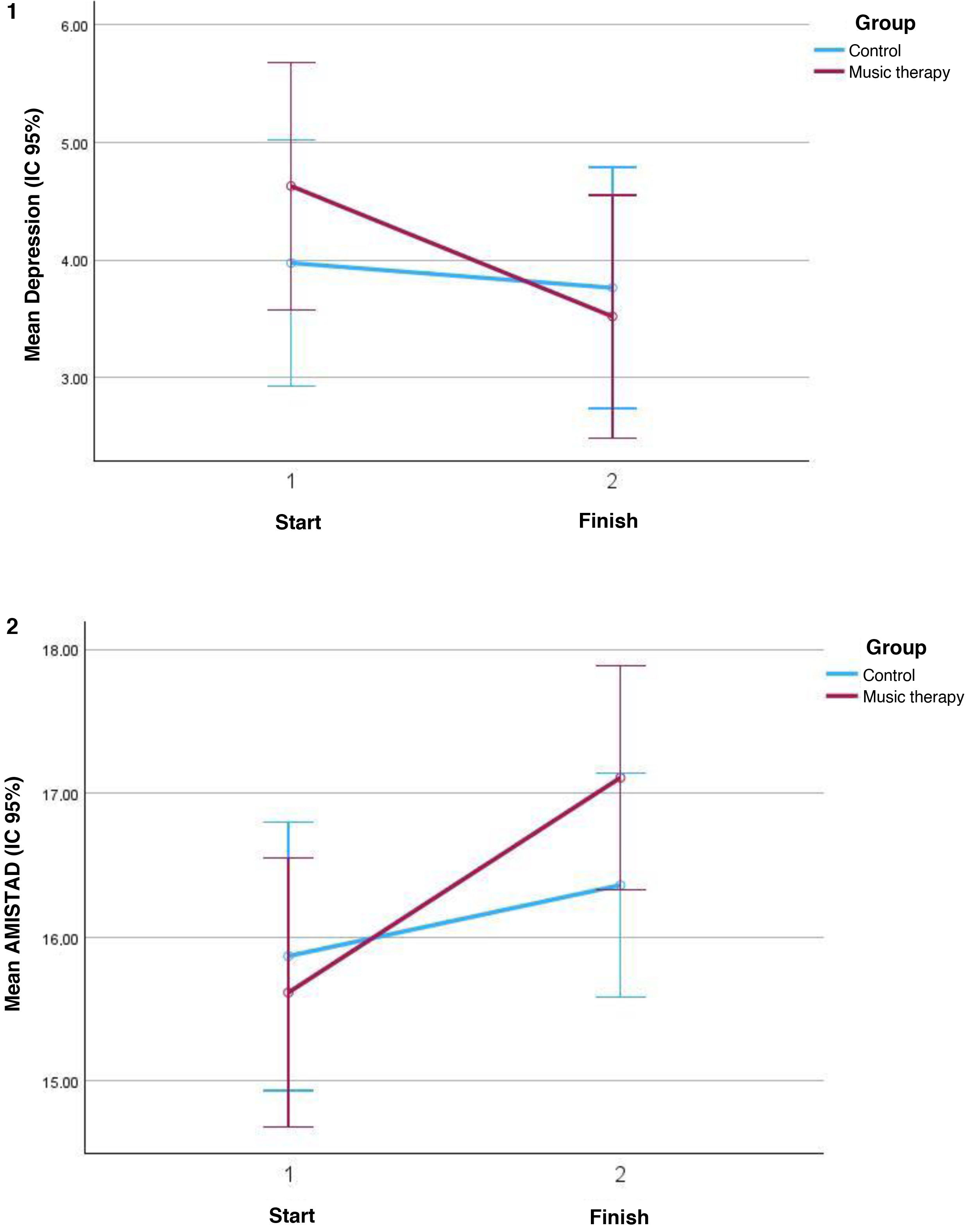
ResultsA total of 151 patients were included, randomly distributed into the EG (n = 75) and CG (n = 76). Mood improvement was significant in all 6 subscales of the POMS, in the time effect between pre- and post-intervention assessment, and in the time effect by group interaction for Anger (p = 0.020), Fatigue (p = 0.002), Vigor (p = 0.029), and Tension (p = 0.042), indicating that the improvement was related to the music therapy intervention in the EG. Following the music therapy intervention, a decrease in pain (p = 0.024) and heart rate (p = 0.017) was observed in the time effect, and an increase in systolic blood pressure (p = 0.004) was related to the music therapy intervention.
DiscussionThis clinical trial demonstrates that music therapy, with a personalised music intervention, has a positive effect on the mood of critically ill patients. Further lines of research are needed to continue advancing scientific knowledge and develop news forms of assistance to improve mood.
El enfermo crítico se encuentra en una situación de fragilidad, impotencia y vulnerabilidad que dificulta la comunicación de sus emociones y sentimientos. La musicoterapia podría ser una herramienta válida para mejorar el estado de ánimo. El objetivo principal fue evaluar el efecto en el estado de ánimo de una intervención individualizada de musicoterapia en comparación con la atención estándar y analizar el impacto sobre el dolor y variables hemodinámicas.
MetodologíaEnsayo clínico aleatorizado, paralelo y abierto. Los enfermos fueron aleatorizados: grupo experimental de musicoterapia combinada con atención estándar o grupo control que recibía la atención estándar. La población de estudio fue enfermos ingresados en la Unidad de Cuidados Intensivos con Glasgow 15−11 T, excluyéndose aquellos que presentaran confusión, agitación y déficits cognitivos significativos. La variable principal fue el estado de ánimo, evaluado mediante el cuestionario Perfil de Estados Emocionales (POMS). Las variables secundarias fueron el dolor, frecuencia cardiaca, tensión arterial, frecuencia respiratoria y saturación de oxígeno.
ResultadosSe incluyeron 151 enfermos, distribuidos aleatoriamente en GE (n = 75) y GC (n = 76). La mejora del estado de ánimo fue significativa en las 6 subescalas del POMS, en el efecto tiempo entre la valoración pre y post intervención y en la interacción efecto tiempo por grupo, en Cólera (p = 0,020), Fatiga (p = 0,002), Vigor (p = 0,029) y Tensión (p = 0,042), indicando que la mejoría estaba relacionada con la intervención de la musicoterapia en el GE. Tras la intervención de musicoterapia se observó disminución del dolor (p = 0,024) y FC (p = 0,017) en el efecto tiempo y aumento en TAS (p = 0,004) relacionado con la intervención de musicoterapia.
DiscusiónEste ensayo clínico demuestra que la musicoterapia, con una intervención de música personalizada tiene un efecto positivo en el estado de ánimo del enfermo crítico. Se requieren más líneas de investigación para seguir avanzando en el conocimiento científico y desarrollar nuevas formas de ayuda para mejorar el estado de ánimo.
Article
Diríjase al área de socios de la web de la SEEIUC, (https://seeiuc.org/mi-cuenta/iniciar-sesion/) y autentifíquese.