
metricas
Enfermedades Infecciosas y Microbiología Clínica Evolution of tuberculosis in Spain: Will the objectives of the End TB Strategy b...

Información de la revista
Vol. 43. Núm. 7.
Páginas 371-458 (Agosto - Septiembre 2025)
Visitas
806
Vol. 43. Núm. 7.
Páginas 371-458 (Agosto - Septiembre 2025)
Original article
Acceso a texto completo

Evolution of tuberculosis in Spain: Will the objectives of the End TB Strategy be achieved in Western European countries?

Evolución de la tuberculosis en España: ¿se lograrán los objetivos de la Estrategia fin de la TB en los países de Europa occidental?
Visitas
806
Teresa Rodrigoa,b,c,
Autor para correspondencia
pii_tb_teresa_rodrigo@separ.es

Corresponding author.
, Joan P. Milleta,b,c,d,e, Mario Bravoe, Eva M. Taberneroa,f, Joan A. Caylàc, Tuberculosis Prevention and Control Programmes of the Autonomous Communities Working Group
a Programa Integrado de Investigación en Tuberculosis y Micobacterias no Tuberculosas (PII-TB&MNT) de SEPAR, Barcelona, Spain
b Centro de Investigación Biomédica en Red de Epidemiología y Salud Pública (CIBERESP), Madrid, Spain
c Barcelona Tuberculosis Research Unit Foundation (fuiTB), Barcelona, Spain
d Agència de Salut Pública de Barcelona, Barcelona, Spain
e Serveis Clínics de Barcelona, Spain
f Hospital Universitario de Cruces, Barakaldo, Spain
Tuberculosis Prevention and Control Programmes of the Autonomous Communities Working Group
Este artículo ha recibido
Información del artículo
Resumen
Texto completo
Bibliografía
Descargar PDF
Estadísticas
Figuras (3)
fig0005
fig0010
fig0015
Tablas (3)
Table 1. Incidence rates of the 17 autonomous communities published by the National Network of Epidemiological Surveillance (RENAVE) (2015–2022).
Tablas
Table 2. Incidence rate variation between the pre- and post-COVID periods (2019–2022).
Tablas
Table 3. Evaluation of Tuberculosis Prevention and Control Programmes of Autonomous regions in Spain and the autonomous cities of Ceuta and Melilla (2022).
Tablas
Abstract
Objectives

End TB Strategy aims to reduce the incidence of tuberculosis between 2015 and 2025 milestone by 50%. We analyse whether the decreasing incidence objectives of this strategy can be achieved in Spain with the impact of COVID-19 pandemic and to review the incidence evolution in Western European countries (WEC).

Study design

Retrospective longitudinal ecological study with forecasting.

Methodology

An exponential curve was fitted to the Spanish and WEC data prior the pandemic period and projected with the model until 2025 using a 90% confidence interval to have better precision due to the sample size.

Results

The mean annual % change in incidence rates of TB in the three most affected WEC during 2018–2022 decreased by 6.5% in Spain, by 6.0% in Portugal, by 3.8% in Belgium and by 5.7% in France. The annual decrease in Spain in the first year of COVID-19 pandemic was 16.6%. Lower declines than in Spain were observed in most WEC. The probability of achieving the objective of reducing the incidence by 50% between 2015 and 2025 in Spain is, with a certainty of 90%, 0%, but with important differences by regions from 0% to 79%. These probabilities in Portugal, Belgium, France and Italy are also 0%.

Conclusion

With this epidemiological evolution, the main objective of the End TB Strategy for 2025 milestone (50% incidence decline) will not be achieved in Spain. The 80% decline will probably not be reached by 2030 unless surveillance and control are improved, and TB Programmes are provided with sufficient resources. The same situation could be happening in other WEC.

Keywords:
Evaluation
Incidence
Control programmes
Elimination
COVID-19
Resumen
Objetivos

La Estrategia fin de la TB tiene como objetivo reducir la incidencia de la tuberculosis entre 2015 y 2025 en un 50%. Analizamos si los objetivos de disminución de la incidencia de esta estrategia pueden lograrse en España con el impacto de la pandemia de COVID-19 y revisamos su evolución en los países de Europa occidental (PEO).

Diseño del estudio

Estudio ecológico longitudinal retrospectivo con pronóstico.

Metodología

Se ajustó una curva exponencial a los datos de España y de los PEO antes del período pandémico y se proyectó con el modelo hasta 2025 utilizando un intervalo de confianza del 90% para tener una mejor precisión debido al tamaño de la muestra.

Resultados

El cambio porcentual medio anual en las tasas de incidencia de TB en los 3 PEO más afectados durante 2018-2022 disminuyó en un 6,5% en España, en un 6,0% en Portugal, en un 3,8% en Bélgica y en un 5,7% en Francia. La disminución anual en España en el primer año de la pandemia de COVID-19 fue del 16,6%. Se observaron descensos menores que en España en la mayoría de los PEO. La probabilidad de alcanzar el objetivo de reducir la incidencia en un 50% entre 2015-2025 en España es, con una certeza del 90%, del 0%, pero con importantes diferencias entre regiones, desde el 0% hasta el 79%. Estas probabilidades en Portugal, Bélgica, Francia e Italia también son del 0%.

Conclusión

Con esta evolución epidemiológica el objetivo principal de la Estrategia fin de la TB para el hito de 2025 (reducción del 50% en la incidencia) no se logrará en España. La disminución del 80% probablemente no se alcanzará para 2030, a menos que se mejoren la vigilancia y el control y se proporcionen suficientes recursos a los programas de TB. La misma situación podría estar ocurriendo en otros PEO.

Palabras clave:
Evaluación
Incidencia
Programas de control
Eliminación
COVID-19
Texto completo
Background

In 1993, tuberculosis (TB) was declared a worldwide public health threat of international concern by the World Health Organization (WHO) due to its high morbidity and mortality rate.1,2 This is despite being a preventable and curable disease. In fact, until the COVID-19 pandemic, TB had been the leading cause of death from a single infectious agent, responsible for twice as many deaths as HIV/AIDS. More than 10 million people still fall ill with TB each year.3 With the progressive reduction in COVID-19-related mortality, TB has re-emerged as the leading cause of death from infection worldwide, causing approximately 1.3 million deaths annually.

This high morbidity and mortality in many contexts, is the result of the low effectiveness of TB prevention and control programmes (PPCTBs).4 In response to this situation, the WHO launched the End TB Strategy in 2015,5 aiming to reduce TB incidence by 50% between 2015 and 2025, by 80% by 2030, and by 90% by 2035, while also aiming to reduce TB mortality by 95% between 2015 and 2035.6

In Spain, the PMIT study (Multicentric Project of TB Investigation), conducted between 1995 and 1996, detected significant underreporting of TB cases.7,8 In the years that followed, TB remains an underreported disease. In 2007 and 2019, two Plans for the Prevention and Control of TB were published, with the main objective of controlling TB transmission through universal access to prevention, diagnosis, and treatment.9,10 However, first the 2009 H1N1 pandemic flu and after the COVID-19 pandemic diverted the focus of many healthcare professionals and services away from TB.11–13

As a result of these challenges, this study was designed with the following objectives: (a) to study the evolution of TB incidence in Spain (both nationally and by autonomous communities (CCAA)); (b) to evaluate the variation in incidence between the pre- and post-COVID periods; (c) to assess whether the objectives about TB incidence of the WHO's End TB Strategy are being met; and (d) to evaluate the status of the main control indicators required from the CCAA.

MethodologyEthical clearance

The authors of this paper declare no conflicts of interest and all data was treated confidentially following the ethical principles of the Declaration of Helsinki and the European General Data Protection Regulation No. 2016/679. This study is part of the project on TB organisation in Spain, which was approved by the Ethics and Clinical Research Committee of the Municipal Institute of Health Assistance (No. 2013/5389/I).

Data source

Crude incidence of TB cases per 100,000 inhabitants in Spain between the years 2015 and 2022, both included, was gathered from the National Network for Epidemiological Surveillance (RENAVE)14 stratified across the 17 CCAA and the autonomous cities of Ceuta and Melilla.

A survey was also prepared with the main control indicators based on the key objectives to be met according to national and international recommendations, and it was sent to the heads of the PPCTBs in the 17 CCAA and the autonomous cities of Melilla and Ceuta, to be completed with data pertaining to 2022. These variables are listed in the Table 3a and 3b.

To compare the results obtained from our study with the evolution of TB incidence in other Western European countries (WEC), the data published in 2024 by the European Centre for Disease Prevention and Control (ECDC) were reviewed.

Statistical analysis

Complementing the descriptive analysis of the crude incidence of TB cases per 100,000 inhabitants in Spain a linear regression was added to the plot creating a line using two points: the incidence at year 2015 and the threshold value expected in 2025 to meet the end TB goals.

To measure the impact of the COVID-19 pandemic period (2020–2022) on TB incidence and evaluate its expected evolution, in order to determine the likelihood of achieving the WHO incidence targets for 2025 in Spain and its CCAA, an exponential curve was fitted to the crude incidence prior to the pandemic period [2015–2019] as the dependent variable and used time as the independent variable, and projected with the model up to 2025, using a 90% confidence interval (to gain greater accuracy given the small sample size) confidence intervals were calculated based on the standard errors of the predicted values derived from the covariance matrix, which accounts for the variability in the estimated coefficients. R2 was used as the measure of the quality of the regression. The same methodology was applied to the other Western European countries (WEC) with the highest TB incidence (Portugal, Italy and Belgium) and to the WEC with the largest population (Germany and France).

Following the projection, the probability of achieving the end TB 2025 incidence reduction goal, was calculated using the prediction intervals (PI) of the exponential model. After checking for the model linearity, normality of residuals, homoscedasticity, and independence of the residuals, the PI was used as a normal distribution, if the area under the curve contained the expected value, the probability was measured as the area under the curve between the expected value and its furthest PI limit, if the expected value fell below the lower PI limit the probability was considered 0%, and if the expected value fell above the upper PI limit the probability was considered 100%.

The first descriptive representations and tables were done with Excel version 16.77.1. All statistical analysis was done using R and R studio, version 4.3.1 Beagle Scouts.

Results

The overall incidence in Spain showed a decrease between 2015 and 2019, but this decrease was greater during the first year of the COVID-19 pandemic (Fig. 1). All CCAA, except Ceuta, Navarra, and the Basque Country, experienced a significant decrease or remained at around the same incidence level (Table 1). When the percentage variation in incidence rates between the pre and post/COVID-19 periods was calculated, it was observed that only Navarra, the Basque Country, and the city of Ceuta saw an increase in incidence, while the country's overall rate decreased by 13.5% (Table 2).

Fig. 1.

On the primary and axis, the evolution of the crude incidence rates per 100,000 inhabitants of tuberculosis in Spain (2015–2022) and estimated linear trend towards achieving the target of reduction of incidence of the WHO End TB Strategy. On the secondary axis, the inter-year.

Table 1.

Incidence rates of the 17 autonomous communities published by the National Network of Epidemiological Surveillance (RENAVE) (2015–2022).

CCAA  2015  2016  2017  2018  2019  2020  2021  2022 
Andalucía  7.85  7.59  6.59  7.19  6.32  6.44  5.53  5.48 
Aragón  10.9  12.9  10.2  8.71  9.9  5.9  7.9  8.1 
Asturias  10.73  12.25  8.35  10.15  9.71  12.01  7.73  5.56 
Baleares  9.91  8.40  8.96  10.77  8.43  6.83  5.82  5.8 
Canarias  7.52  5.32  5.13  7.04  6.30  4.50  3.25  5.37 
Cantabria  9.43  11.18  9.98  13.08  8.42  7.73  6.00  6.32 
C. Mancha  6.52  8.22  6.83  NC  6.08  4.11  3.42  5.17 
C. León  10.06  10.11  8.62  NC  8.45  6.40  6.46  5.64 
Cataluña  14.06  12.82  12.93  12.93  13.3  10.84  12.11  12.61 
C. Valenciana  8.56  8.87  8.60  6.59  8.34  7.25  7.34  5.6 
Extremadura  5.61  6.29  5.13  6.65  4.99  1.98  3.98  2.65 
Galicia  21.58  20.79  19.60  19.60  18.75  14.56  13.08  11.7 
Madrid  10.61  10.44  9.30  NC  8.74  6.54  6.96  7.43 
Murcia  9.49  7.49  8.01  NC  8.70  7.82  7.52  8.28 
Navarra  7.70  6.58  4.05  5.26  3.98  4.87  4.42  6.08 
País Vasco  11.84  12.70  10.47  9.99  9.07  10.64  8.54  10.61 
La Rioja  8.63  11.51  9.28  NC  9.22  6.96  8.55  6.01 
Ceuta*  16.57  23.61  10.59  NC  15.40  1.19  20.53  28.87 
Melilla*  20.08  17.71  9.43  NC  9.49  7.12  7.19  7.2 
Global  10.59  10.38  9.43  9.39  9.33  7.77  7.61  8.07 
*

Autonomous cities.

Table 2.

Incidence rate variation between the pre- and post-COVID periods (2019–2022).

CCAA  2019  2022  Variation pre–post COVID (%) 
Andalucía  6.32  5.48  ↓13.3 
Aragón  9.9  8.1  ↓18.2 
Asturias  9.71  5.56  ↓42.7 
Baleares  8.43  5.8  ↓31.2 
Canarias  6.30  5.37  ↓14.8 
Cantabria  8.42  6.32  ↓24.9 
C. Mancha  6.08  5.17  ↓14.9 
C. León  8.45  5.64  ↓33.3 
Cataluña  13.3  12.61  ↓5.2 
C. Valenciana  8.34  5.6  ↓32.9 
Extremadura  4.99  2.65  ↓46.9 
Galicia  18.75  11.7  ↓37.6 
Madrid  8.74  7.43  ↓14.9 
Murcia  8.70  8.28  ↓4.8 
Navarra  3.98  6.08  ↑52.8 
País Vasco  9.07  10.61  ↑16.9 
La Rioja  9.22  6.01  ↓34.8 
Ceuta*  15.40  28.87  ↑87.5 
Melilla*  9.49  7.2  ↓24.1 
Global  9.33  8.07  ↓13.5 
*

Autonomous cities.

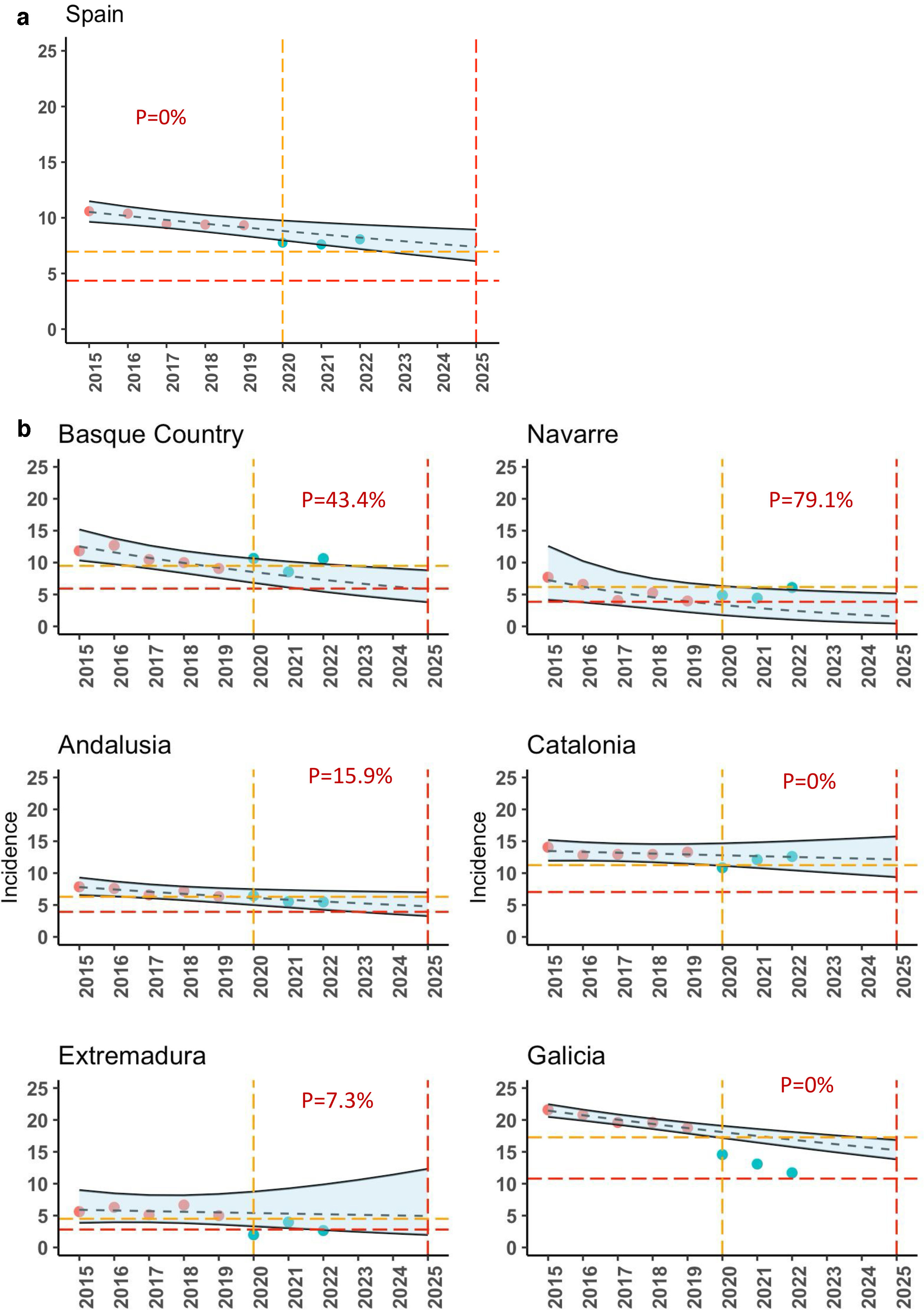
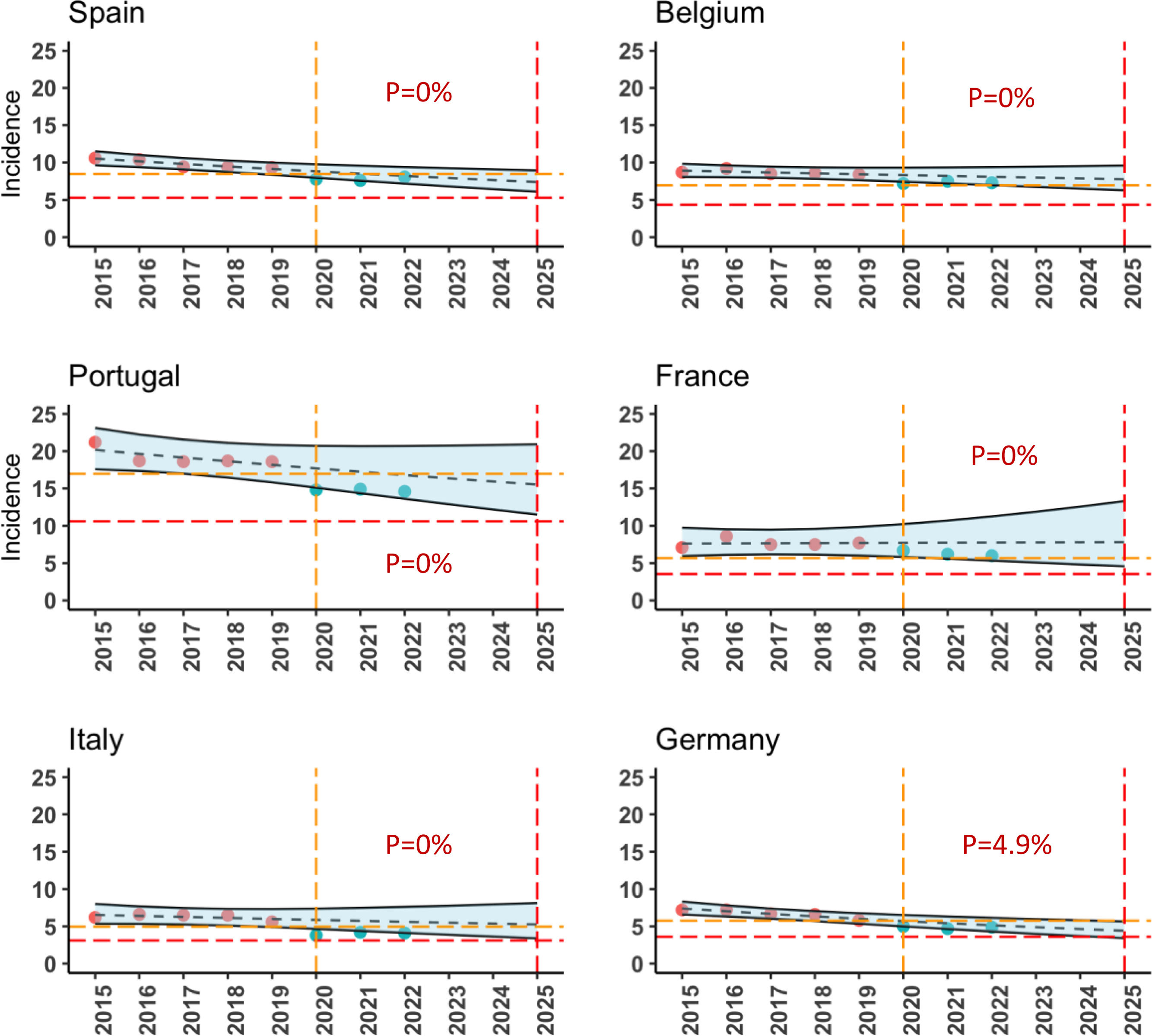
After fitting the exponential curve to each CCAA it was observed that Navarra and the Basque Country were the only regions that showed a significant increase in incidence. CCAA such as Galicia showed a drastic decrease, falling below the lower limit of the confidence interval (Fig. 2b). The probability of reaching the WHO-2025 incidence target, based on the overall trend from pre-pandemic years, was 0% with 90% certainty and an R2 of 0.84 in the fitted exponential curve (Fig. 2a). The probabilities for the three most populous CCAA – Andalusia, Catalonia, and Madrid – were 15.9%, 0%, and 13.7%, respectively, while the highest probabilities were found in Navarra, the Basque Country, and Castilla-León, with 79.1%, 43.4%, and 19.7%, respectively (Fig. 2b). When applying the exponential curve to the WEC referred to in the study, it was observed that the probability of reaching the WHO-2025 incidence target, based on the general trend of the years prior to the pandemic, was also 0% (Fig. 3).

Fig. 2.

(a) Exponential curve adjusted to the evolution pre-COVID (2015–2019) and its projection until year 2025 together with its 90% confidence interval in Spain. Red colour dots represent the pre-COVID period and blue dots the COVID period. The intersection between the yellow lines and between the red dashed lines represent for 2020 and 2025 respectively the WHO incidence reduction targets. The reported value of probability (P) is the estimated according to the prediction intervals to reach the WHO-2025 incidence target. (b) Exponential curve adjusted to the evolution pre-COVID (2015–2019) and its projection until year 2025 together with its 90% confidence interval in six autonomous regions that represent the different patterns observed, from increase of incidence above projected values to incidence reduction below projected values. Red colour dots represent the pre-COVID period and blue dots the COVID period. The intersection between the yellow lines and between the red dashed lines represent for 2020 and 2025 respectively the WHO incidence reduction targets for each autonomous region. The reported value of probability (P) is the estimated according to the prediction intervals to reach the WHO-2025 incidence target, estimated P for each autonomous region is reported either in the plot or below as a footnote. Probability of reaching the WHO-2025 incidence target (P): Andalusia=15.9%; Aragón=11.4%; Asturias=15.9%; Balearic Islands=5.9%; Canary Islands=11.5%; Cantabria=6.0%; Castilla-La Mancha=11.4%; Castilla y León=19.7%; Catalonia=0%; Valencian Community=13.5%; Extremadura=7.3%; Galicia=0%; Madrid=13.7%; Murcia=9.9%; Navarre=79.1%; Basque Country=43.4%; La Rioja=5.8%.

Fig. 3.

Exponential curve adjusted to the evolution pre-COVID (2015–2019) and its projection until year 2025 together with its 90% confidence interval in some Western European countries. Red colour dots represent the pre-COVID period and blue dots the COVID period. The intersection between the yellow lines and between the red dashed lines represent for 2020 and 2025 respectively the WHO incidence reduction targets for each autonomous region. The reported value of probability (P) is the estimated according to the prediction intervals to reach the WHO-2025 incidence target.

The analysis of the impact of COVID-19 on each autonomous community revealed that Galicia was the most affected, with the greatest reduction in incidence, followed by Cantabria, Extremadura, Aragón, and the Balearic Islands, which experienced a smaller reduction. Castile and León, Castile-La Mancha, La Rioja, and the Canary Islands had even lower reductions, while Catalonia, the Valencian Community, Murcia, Andalusia, and Asturias saw a negligible reduction. In contrast, Navarre and the Basque Country had a slight increase in incidence.

The results of the main control indicators for 2022, according to the surveys completed by the PPCTBs, are shown in Table 3a and b. Notably, 94.7% of the programmes carry out active case finding; 100% have sensitivity results (78.9% have recorded cases of drug-resistant TB, with 73.3% of these being RR-MDR or XDR); 89.5% have information on treatment outcomes (with abandonment rates between 1.6% and 6.9%, and mortality rates between 1% and 10.9%). Additionally, 57.9% have TB clinical units, 78.9% offer directly observed treatment (DOT), and only 21.1% have community health workers (CHWs). The median reported diagnostic delay was 44 days (IQR: 26–75); contacts were reviewed in 89.5% of cases (100% of contacts of patients with pulmonary TB and 70.6% of contacts within 5 years); 89.5% of the programmes detect outbreaks; and 57.9% of them perform screening for latent tuberculosis infection (LTBI).

Table 3.

Evaluation of Tuberculosis Prevention and Control Programmes of Autonomous regions in Spain and the autonomous cities of Ceuta and Melilla (2022).

(a)  Andalusia  Aragon  Asturias  Balearic Islands  Canary Islands  Cantabria  Castile la Mancha  Castile and León  Catalonia 
Personnel                  # 
Doctor  10 
Nurse 
Administrative 
Others  2$ 
Number of cases
Total  550  99  58  82  149  39  117  146  1.017 
Pulmonary  412  64  50  56  120  30  84  104  732 
No. of foreigners  237  58  29  57  35  590 
No. of HIV  27  32 
No. meningitis (<5 y/o) 
Incidence rate
Global  5.48  8.1  5.56  5.8*  5.37  6.32  5.17  5.64  12.61 
Smear positive  3.03  NA  2.4  NA  3.10  2.6  4.10  2.9  3.28 
Register availability
Cases  Yes  Yes  Yes  Yes  Yes  Yes  Yes  Yes  Yes 
Contacts  Yes  Yes  Yes  Yes  Yes  Yes  Yes  Yes  Yes 
Link cases/contacts  Yes  Yes  Yes  No  Yes  Yes  Yes  Yes  Yes 
Outbreaks  Yes  Yes  Yes  Yes  Yes  Yes  Yes  Yes  Yes 
LTI screenings  No  Yes  Yes  No  No  Yes  No  No  YesÇ 
Register mode
EDO  Yes  Yes  Yes  Yes  Yes  Yes  Yes  Yes  Yes 
Active search  Yes  Yes  Yes  Yes  Yes  Yes  Yes  Yes  Yes 
Active search source
Microbiology  Yes  Yes  Yes  Yes  Yes  Yes  Yes  Yes  Yes 
Hospital discharge  Yes  No  Yes  Yes  Yes  Yes  Yes  No  Yes 
AIDS registry  Yes  No  No  Yes  Yes  Yes  Yes  No  No 
Mortality registry  No  Ye  Yes  Yes  No  Yes  No  No  Yes 
Others  No  No  No  AP&  No  No  Yes  No  No 
Sensitivity study  Yes  Yes  Yes  Yes  Yes  Yes  Yes  Yes  Yes 
Resistances
No. of resistant cases  40  89 
No. RR-MDR-preXDR-XDR  15 
% of primary resistances  NA  NA  100  75 
% of acquired resistances  NA  NA  25  NA  NA  NA  NA  NA 
Treatment result  Yes  Yes  Yes  Yes  Yes  Yes  Yes  Yes  Yes 
% of dropouts  3.2  6.89  4.4  3.35  6.8  NA  2.4 
% of mortality  7.6  8.62  4.4  4.69  5.1  6.8  NA  NA 
DOT treatment  Yes  Yes  Yes  Yes  Yes  Yes  No  No  Yes 
No. DOT  NA  NA  29      236 
% of DOT from all cases  NA  NA  0.02  4.9  19.5      24.2 
ACS  No  No  No  No  No  No  No  No  Yes 
Clinical units of TB  Yes  No  Yes  Yes  No  Yes  No  Yes  YesÇ 
Diagnostic delay  No  NA  No  Yes  Yes  Yes  Yes  Yes  Yes 
Average of days        36  43  26  51  34  59 
Contacts reviewed                   
% of pulmonary TB  85.5  81.25  39.65  95.7  84.7  100  71.4  51  70.8 
% on extrapulmonary TB  50.7  NA  6.89  NA  23.3  44.4  NA  19  30.9 
% on <5 y/o  100  100  100  100  NA  100  NA  100  NA 
Outbreaks directionality  Yes  Yes  Yes  Yes  Yes  Yes  Yes  Yes  Yes 
No. of localized outbreaks  18  NA  NA  10  56 
Screening of LTI  Yes  NA  Yes  No  No  No  No  NA  Yes 
Public health  Yes  NA  NA          NA  Yes 
TB units  No  NA  NA          NA  Yes 
Primary healthcare  Yes  NA  NA          NA  Yes 
Drug attention center  Yes  NA  NA          NA  Yes 
NGOs  No  NA  NA          NA  Yes 
Other  No  NA  NA          NA  NA 
Report publication date@  2021  2021  2019  2022  2018  No  2019  2018  2021 
(b)  C. Valenciana  Extremadura  Galicia  Madrid  Murcia  Navarra  P. Vasco**  Rioja  Ceuta  Melilla 
Personnel
Doctor 
Nurse 
Administrative 
Others 
Number of cases
Total  292  28  310  502  134  45  183  19  20 
Pulmonary  226  16  191  NA  101  35  118  14  15 
No. of foreigners  114  40  NA  72  34  62 
No. of HIV  14  NA 
No. meningitis (<5 y/o)  25 
Incidence rate
Global  5.64  2.65  11.5  7.43  8.28  6.08  10.61  6.01  28.87  7.2 
Smear positive  2.10  1.13  2.7  1.70  2.3  2.73  2.3  3.2  NA  3.52 
Register availability
Cases  Yes  Yes  Yes  Yes  Yes  Yes  Yes  Yes  Yes  Yes 
Contacts  Yes  Yes  Yes  Yes  Yes  No  Yes  No  Yes  Yes 
Link cases/contacts  Yes  Yes  Yes  No  Yes  No  Yes  No  Yes  No 
Outbreaks  Yes  Yes  Yes  Yes  Yes  Yes  Yes  No  Yes  Yes 
LTI screenings  No  No  Yes  No  Yes  Yes  Yes  No  Yes  Yes 
Register mode
EDO  Yes  Yes  Yes  Yes  Yes  Yes  Yes  Yes  Yes  Yes 
Active search  Yes  Yes  Yes  Yes  Yes  Yes  Yes  Yes  NA  Yes 
Active search source
Microbiology  Yes  Yes  Yes  Yes  Yes  Yes  Yes  Yes  NA  Yes 
Hospital discharge  No  No  Yes  Yes  No  Yes  Yes  Yes  NA  Yes 
AIDS registry  No  No  Yes  Yes  No  Yes  No  No  NA  Yes 
Mortality registry  No  No  Yes  Yes  No  Yes  Yes  Yes  NA  No 
Others  Yes  No  Yes  Yes  No  Yes  Yes  No  NA  No 
Sensitivity study  Yes  Yes  Yes  Yes  Yes  Yes  Yes  Yes  Yes  Yes 
Resistances
No. of resistant cases  30  26  NA  12  NA 
No. RR-MDR-preXDR-XDR  NA  NA 
% of primary resistances  12.8  92.3  NA  100  6.7  NA  NA  NA  100 
% of acquired resistances  15.4  NA  7.7  NA  NA  NA  NA  NA 
Treatment result  Yes  Yes  Yes  Yes  No  Yes  Yes  Yes  No  Yes 
% of dropouts  5.9  3.25  4.2  NA    2.2  1.6  NA    NA 
% of mortality  2.29  1.4  NA    3.7  10.9  NA    NA 
DOT treatment  Yes  No  Yes  Yes  Yes  Yes  Yes  Yes  No  Yes 
No. DOT  25    136  NA  NA  NA   
% of DOT from all cases  6.4    44.6  NA  4.5  4.4  NA  NA    NA 
ACS  No  No  Yes  No  No  Yes  No  No  No  No 
Clinical units of TB  No  Yes  Yes  Yes  No  Yes  Yes  No  No  Yes 
Diagnostic delay  Yes  No  Yes  Yes  Yes  Yes  Yes  No  No  Yes 
Average of days  60    56  NA  33  45.5  37      75 
Contacts reviewed  Yes  Yes  Yes  NA  Yes  Yes  NA  Yes  Yes  Yes 
% of pulmonary TB  70.7  60  77.5  NA  94.2  100  NA  100  69.23  100 
% on extrapulmonary TB  26.9  19.3  NA  9.3  100  NA  100  33.3  100 
% on <5 y/o  33.3  100  NA  NA  100  NA  NA  11.11  NA 
Outbreaks directionality  Yes  Yes  Yes  NA  Yes  Yes  NA  Yes  Yes  Yes 
No. of localized outbreaks  18  11  NA  NA  NA 
Screening of LTI  No  Yes  Yes  NA  Yes  Yes  Yes  Yes  Yes  Yes 
Public health    No  No  NA  NA  No  No  No  No  Yes 
TB units    No  Yes  NA  NA  No  Yes  No  No  No 
Primary healthcare    Yes  No  NA  NA  Yes  No  Yes  No  Yes 
Drug attention center    Yes  No  NA  NA  Yes  No  No  No  No 
NGOs    No  No  NA  NA  Yes  No  No  No  No 
Other    No  No  NA  NA  No  No  No  CETI  CETI 
Report publication date@  2022  No  2021  2021  2022  2022  2021  2020  No  No 

ACS: Community Health Officers; CETI: Temporary Residence Centre for Immigrants.

#

It does not include staff working in the Territorial Epidemiological Surveillance Services or the Barcelona Public Health Agency.

$

Pharmaceutical.

Ç

Not routinely or homogeneously throughout the territory of Catalonia.

&

Primary Care: Electronic Clinical History.

@

Last year of publication of the annual report by the Tuberculosis Prevention and Control Program of each Autonomous Community.

*

In indigenous people.

**

Results year 2021.

Discussion

The incidence of TB in Spain during the period 2015–2022 decreased by 23.8%, possibly influenced by underreporting in the early years of the COVID-19 pandemic observed around the world.12 The increase in Europe in 2022 is likely due to a good recovery after the COVID-19 pandemic in access to and provision of TB services in many countries and the introduction of active TB case-finding activities.15

Nevertheless, this decline, along with the increase observed in 2022, will not be sufficient to meet the End TB Strategy target of incidence reduction by 2025 in Spain and probably in most European countries. According to ECDC data16 Spain had between 2018 and 2022 a mean change in incidence rate of −6.5% while others WEC with the highest incidences experimented lower declines (Portugal −6.0%, Belgium −3.8% or France −5.7%), and worse was the situation in most of the WEC, with lowers declines than Spain. Interestingly, in Spain, Navarre and the Basque Country, the only CCAA that showed an increase in incidence during 2020–2022, are the ones most likely to achieve the 2025 targets.

Regarding the global targets set in 2023 at the second high-level meeting of the United Nations on TB,3 Spain meets the targets for treatment coverage (89.5% vs the target of 90%), drug susceptibility testing for anti-tuberculosis drugs (100%), and healthcare coverage (100%). However, the target for latent TB infection treatment coverage (>90%) is not met, with only 57.9%. This is despite the recommendations of the WHO European Region 2023–2030,16 which advises screening high-risk groups such as migrants, refugees from TB hyperendemic areas, prisoners, healthcare workers, homeless people, and drug users.

All the indicators assessed in the completed surveys, based on a study conducted in 1997 to evaluate the situation of the PPCTBs in the different CCAA,17 have improved in 25 years compared to that study, although not all have reached the recommended targets.

The End TB Strategy, proposed by the WHO in 2015, aims by 2025 – among other objectives – to reduce TB deaths by 75%, reduce the incidence rate by 50%, and ensure that the percentage of families facing catastrophic costs due to TB is 0%.5 The pillars on which this strategy must be based are: integrated patient-centred TB care and prevention, bold policies and supportive systems, and intensified research and innovation.6 Its elimination requires the planning of activities that can contribute to reducing incidence through public health and programmatic care.18 However, the non prioritization of End TB Strategy in Spain complicates the achievement of these objectives, and this probably occurs the same in other countries as well.19

The drop in the number of people diagnosed with TB in 2020 suggested an increase in mortality (7000 excess deaths from TB in the WHO European Region), a decrease in the rate of successful treatment and an increase the burden of RR-TB and TB/HIV in 2021 and 2022.16

TB, within the mandatory declaration diseases, is one of the most demanding in terms of the effort needed for surveillance; a surveillance that should be proactive in case and contact tracing, and in the implementation of prevention and control measures. A good PPCTB is essential for controlling TB, and these programmes must be based on coordination between clinicians, microbiologists, epidemiologists, and others, as well as the link between surveillance, control, and research.20,21 This would help improve the completeness and quality of epidemiological survey data and TB control22–24 without forgetting the need to address social determinants25,26 and conduct ongoing evaluations.27

A limitation of this study is that some of the data analysed has not yet been consolidated, as it is obtained from various sources (RENAVE, SIVIES, or the CCAA).12 Some upward fluctuations could be due to occasional improvements in surveillance in certain CCAA or influenced by diagnostic delays caused by COVID-19. After the COVID-19 pandemic crisis, it is necessary for the CCAA to reach a consensus on the information collected about reported cases, in order to achieve uniformity of this data, improve the quality of the data collected in the national database, and have reliable information on the TB situation in Spain.28

To achieve the End TB Strategy targets for 2030 and 2035 in Spain and probably in most affected WEC, surveillance, prevention, and control measures for TB need to be improved, especially, define objectives that are deemed appropriate, incorporate the definition of the indicators and their calculation in order to obtain quality and comparable information and design a system for monitoring and evaluating indicators and designate individuals responsible for collecting information, analyzing data, and making decisions.28 It is essential to prioritize the TB control with sufficient and experienced personnel.

CRediT authorship contribution statement

TR: conception and design of the study; acquisition, analysis and interpretation of data, and writing of the article, final approval of the version presented.

JPM, EMT, JAC: conception and design of the study, critical review of the intellectual content, final approval of the version presented.

MB: methodology design, statistical analysis of data, and translation, final approval of the version presented.

Tuberculosis Prevention and Control Programmes of the Autonomous Communities Working Group: completion of the survey with the main monitoring indicators evaluated.

Ethical approval

The Biomedical Research Ethics Committees of the different participating centres approved this study.

Funding

The present study has not received funding from any institution.

Conflicts of interest

The authors declare no conflicts of interest.

Appendix A
Tuberculosis Prevention and Control Programmes of the Autonomous Communities Working Group

Isabel Vázquez Rincón y Enric Durán Pla (CA Andalucía); Mª Carmen Montaño Remacha (CA Aragón); Ana Fernández Ibáñez (CA Asturias); Jaume Giménez Durán (CA Islas Baleares); Pilar Pérez Jiménez (CA Castilla-La Mancha); Sandra Pequeño, Mar López y Laura Gavaldà (CA Cataluña); Elena Cruz Ferro (CA Galicia); Mª Elena Rodríguez Baena (CA Madrid); Isidro Guirado Esteban (CA Murcia); Jesús Castilla Catalán (CA Navarra); Daniel Castrillejo Pérez (Ciudad Autónoma Melilla).

References
[1]
World Health Organization Report on the TB Epidemic.
TB: a global emergency. Geneva.
(1994 [accessed Nov 2024]),
[2]
M.C. Raviglione, D.E. Snider Jr., A. Kochi.
Global epidemiology of tuberculosis. Morbidity and mortality of a worldwide epidemic.
JAMA, 273 (1995), pp. 220-226 [accessed Nov 2024]
[3]
WHO.
Global tuberculosis report. Geneva.
(2023 [accessed Nov 2024]),
[4]
P. Sudre, G. ten Dam, A. Kochi.
Tuberculosis: an overview of the current situation.
Bull World Health Organisation, 70 (1992), pp. 149-159 [accessed Nov 2024]
[5]
World Health Organization.
End TB Strategy. Geneva.
(2015 [accessed Nov 2024]),
[6]
World Health Organization.
Implementación de la estrategia fin de la TB: aspectos esenciales. Geneva.
(2016 [accessed Nov 2024]),
[7]
M. Díez, the Multicenter Project for Tuberculosis Research Study Group.
Pilot study for the Multicenter Project to Tuberculosis Research (MPTR).
Int J Tuberc Lung Dis, 1 (1997), pp. 91-92
[8]
Grupo de Trabajo del PMIT.
Incidencia de la tuberculosis en España: resultados del Proyecto Multicéntrico de Investigación en Tuberculosis (PMIT).
Med Clin (Barc), 114 (2000), pp. 530-537 [accessed Nov 2024]
[9]
Grupo de trabajo Plan Prevención y Control de la Tuberculosis.
Plan para la Prevención y Control de la Tuberculosis en España.
Ministerio de Sanidad y Consumo, (2007 [accessed Nov 2024]),
[10]
Grupo de trabajo Plan Prevención y Control de la Tuberculosis.
Plan para la Prevención y Control de la Tuberculosis en España.
Ministerio de Sanidad y Consumo, (2019 [accessed Nov 2024]),
[11]
P.C. Hopewell, L.B. Reichman, K.G. Gastro.
Parallels and mutual lessons in tuberculosis and COVID-19 transmission, prevention, and control.
Emerg Infect Dis, 27 (2021), pp. 681-686
[12]
World Health Organization.
Pulse survey on continuity of essential health services during the Covid-19 pandemic.
(2020 [accessed Nov 2024]),
[13]
G.B. Migliori, P.M. Tanga, O. Akkerman, J.W. Alffenaar, F. Álvarez-Navascués, M.M. Assao-Neino, et al.
Worldwide effects of coronavirus disease pandemic on tuberculosis services, January–April 2020.
Emerg Infect Dis, 26 (2020), pp. 2709-2712
[14]
Red Nacional de Vigilancia Epidemiológica (RENAVE). Informe epidemiológico sobre la situación de la tuberculosis en España. Años del 2015 al 2021. Centro Nacional de Epidemiología. Instituto de Salud Carlos III [Internet] [accessed Nov 2024]. Available from: https://www.isciii.es/QueHacemos/Servicios/VigilanciaSaludPublicaRENAVE/EnfermedadesTransmisibles/Paginas/Resultados_Vigilancia_Tuberculosis.aspx [revised March 2024].
[15]
European Centre for Disease Prevention and Control, WHO Regional Office for Europe.
Tuberculosis surveillance and monitoring in Europe 2024–2022 data.
WHO Regional Office for Europe and Stockholm: European Centre for Disease Prevention and Control, (2024 [accessed Nov 2024]),
[16]
Tuberculosis action plan for the World Health Organization European Region, 2023–2030.
World Health Organization Regional Office for Europe, (2023 [accessed Nov 2024]),
[17]
T. Rodrigo, J.A. Caylà, H. Galdós-Tangüis, J.M. Jansá, T. Brugal, P. García de Olalla.
Evaluación de los programas de control de tuberculosis de las Comunidades Autónomas de España.
Med Clin (Barc), 113 (1999 [accessed Nov 2024]), pp. 604-607
[18]
R. Centis, L. D’Ambrosio, X. Kurhasani, I. Solovic, G.B. Migliori.
Tuberculosis elimination: myth or achievable target?.
Arch Bronconeumol, 59 (2023), pp. 714-716
[19]
Global Burden Diseases 2021 Tuberculosis Collaborators.
Global, regional, and national age-specific progress towards the 2020 milestones of the WHO End TB Strategy: a systematic analysis for the Global Burden of Disease Study 2021.
Lancet Infect Dis, 24 (2024), pp. 698-725 [accessed Nov 2024]
[20]
World Health Organization.
Implementing the End TB Strategy: the essentials. 2022 update. Geneva.
(2022 [accessed Nov 2024]),
[21]
J.P. Millet, A. Moreno, L. Fina, L. Del Baño, A. Orcau, P. García de Olalla, et al.
Factors that influence current tuberculosis epidemiology.
Eur Spine J, 22 (2013), pp. S539-S548
[22]
Red Nacional de Vigilancia Epidemiológica (RENAVE). Informe epidemiológico sobre la situación de la tuberculosis en España. Año 2022. Centro Nacional de Epidemiología. Instituto de Salud Carlos III [Internet] [accessed Nov 2024]. Available from: https://cne.isciii.es/es/servicios/enfermedades-transmisibles/enfermedades-a-z/tuberculosis [revised April 2024].
[23]
World Health Organization.
Information Note. COVID-19: considerations for tuberculosis (TB) care.
WHO, (2021 [accessed Nov 2024]),
[24]
World Health Organization standard: universal access to rapid tuberculosis diagnostics.
World Health Organization, (2023 [accessed Nov 2024]),
[25]
K. Lönnroth, K.G. Castro, J. Muhwa Chakaya, L. Singh Chauhan, K. Floyd, K. Glaziou, et al.
Tuberculosis control and elimination 2010–50: cure, care, and social development.
Lancet, 375 (2010), pp. 1814-1829 [accessed Nov 2024]
[26]
World Health Organization.
Guidance on social protection for people affected by tuberculosis. Geneva.
(2024 [accessed Nov 2024]),
[27]
À. Orcau, J.A. Caylà, J.A. Martínez.
Present epidemiology of tuberculosis. Prevention and control programs.
Enferm Infecc Microbiol Clin, 29 (2011), pp. 2-7 [accessed Nov 2024]
[28]
Ministerio de Sanidad.
Evaluación intermedia del plan para la prevención y control de la tuberculosis en España 2019-2030 [Internet]. Madrid.
(2024 [accessed Nov 2024]),

The names of the members of the Tuberculosis Prevention and Control Programmes of the Autonomous Communities Working Group are listed in Appendix A.

Copyright © 2025. Sociedad Española de Enfermedades Infecciosas y Microbiología Clínica
Opciones de artículo
Herramientas