



metricas
Clínica e Investigación en Ginecología y Obstetricia Atypical umbilical endometriosis: Microscopic and immunohistochemical characteri...
Información de la revista
Visitas
879
Vol. 51. Núm. 1.
(Enero - Marzo 2024)
Case report
Acceso a texto completo

Atypical umbilical endometriosis: Microscopic and immunohistochemical characterization

Endometriosis atípica umbilical. Caracterización microscópica e inmunohistoquímica
Visitas
879
M.P. Marín Sáncheza,
Autor para correspondencia
Ibsyna@hotmail.com

Corresponding author.
, I. Ñiguez Sevillaa, S. Cánovas Sanchisb
a Department of Obstetrics and Gynecology, ‘Virgen de la Arrixaca’ University Clinical Hospital, Murcia, Spain
b Servicio de Cirugía Plástica y Reconstructiva, Hospital Clínico Universitario Virgen de la Arrixaca, Murcia, Spain
Este artículo ha recibido
Información del artículo
Resumen
Texto completo
Bibliografía
Descargar PDF
Estadísticas
Figuras (3)
fig0005
fig0010
fig0015
Tablas (1)
Table 1. Histological and immunohistochemical findings of the specimen.
Tablas
Abstract
Introduction

Atypical endometriosis is considered a precursor lesion to cancer associated with endometriosis. Two types of atypical endometriosis have been proposed: an architectural type with a higher risk of malignancy and a cytological type with a lower potential for malignancy.

Main symptoms and/or clinical findings

A 37-year-old Caucasian woman presented with umbilical bleeding coinciding with menstruation. On physical examination, two small, bluish lesions were observed in the umbilical scar.

Primary diagnosis

This clinical case is of interest because it describes a lesion of atypical architectural endometriosis located in the navel.

Therapeutic interventions and results

The microscopic and immunohistochemical characteristics of the lesion were examined. The presence of nuclear stratification, hyperchromatism, and pleomorphism were observed as microscopic qualities. In terms of the immunohistochemical panel, the degree of cell proliferation was analyzed using Ki 67, BAF250a was used as the surrogate marker of ARID 1A, inflammation was assessed through COX, and estrogen and progesterone receptors were examined. The results showed increased cellular activity, the presence of inflammation, and no mutation of the ARID1a gene, with moderate cell proliferation.

Conclusion

Umbilical endometriosis is rare, and while malignancy is infrequent, it is possible. For this reason, a complete anatomopathological study including an immunohistochemical panel should be performed to diagnose atypical endometriosis.

Keywords:
Umbilical endometriosis
Atypical endometriosis
Endometriosis-associated cancer
Resumen
Introducción

La endometriosis atípica está considerada como una lesión precursora de cáncer asociado a endometriosis. Se han propuesto 2 tipos de endometriosis atípica, una arquitectural con mayor riesgo de malignización y otra citológica cuyo potencial de malignización es menor.

Principales síntomas y/o hallazgos clínicos

Una mujer de 37 años caucásica consulta por sangrado catamenial umbilical. A la exploración física se observan 2 pequeñas lesiones umbilicales azuladas.

Diagnóstico principal

Este caso clínico es interesante porque se describe una lesión de endometriosis atípica arquitectural localizada en el ombligo.

Intervenciones terapéuticas y resultados

Se ha descrito sus características microscópicas e inmunohistoquímicas para caracterizarla. La presencia de estratificación nuclear, hipercromatismo y pleomorfismo como cualidades microscópicas y en cuanto al panel inmunohistoquímico se ha analizado el grado de proliferación celular mediante el Ki-67, BAF250a como el marcador subrogado del ARID1A, el grado de inflamación mediante COX y los receptores estrogénicos y gestagénicos. Los resultados demuestran que tiene una actividad celular aumentada, presencia de inflamación y no mutación del gen ARID1A con moderación proliferación celular.

Conclusión

La endometriosis umbilical es poco frecuente y su malignización, aunque rara es posible. Por esta razón, se debería realizar un estudio anatomopatológico completo que incluya un panel inmunohistoquímico en aras de diagnosticar endometriosis atípica.


Palabras clave:
Endometriosis umbilical
Endometriosis atípica
Cáncer asociado a endometriosis
Texto completo
Introduction

Endometriosis is a chronic inflammatory disease dependent on estrogen, which affects primarily the genital tract. However, extra-pelvic endometriosis, such as the cutaneous form,1 represents a small proportion of cases, with umbilical cutaneous endometriosis accounting for 0.5–1% of all cases.2,3 Although the malignant transformation of umbilical endometriosis is rare, this process remains an enigma, highlighting the importance of precise pathological studies to ensure conservative management.

Patient information

A 37-year-old Caucasoid woman who consulted for umbilical bleeding coinciding with menstruation. As highlights in her clinical history, the patient was allergic to amoxicillin and was diagnosed with endometriosis. She had undergone surgery 17 years ago, performing a left ovarian quistectomy of an endometrioma using a Pfannenstiel incision (laparotomy). Since then the patient had remained asymptomatic and had not required treatment. She had also had breast reduction surgery 9 years ago. There were no previous umbilical surgical manipulations.

She also presented a history of paroxysmal supraventricular tachycardia with several non-effective attempts at ablation, currently without treatment. The patient suffered episodes of migraine without aura, which did not require treatment.

Regarding her gynecological history, the age of the menarche was at 13 years and her menstruations were cyclic every 28 days, with a duration of approximately 8 days. She had had two pregnancies with two normal deliveries.

Among the family history, there was a family aggregation of breast carcinoma (mother, grandmother and two aunts) for which the patient was being monitored by the breast unit.

Clinical findings

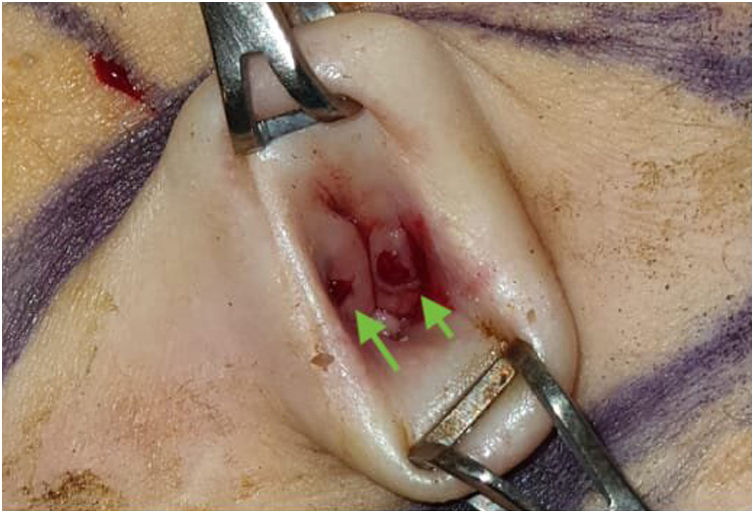
Weight 86.9kg, size 1.69m, BMI 30.431kg/m2. On physical examination, two small, bluish lesions were observed in the umbilical scar (Fig. 1).

Figure 1.

Physical examination: navel with two small and bluish lesions.

Timeline

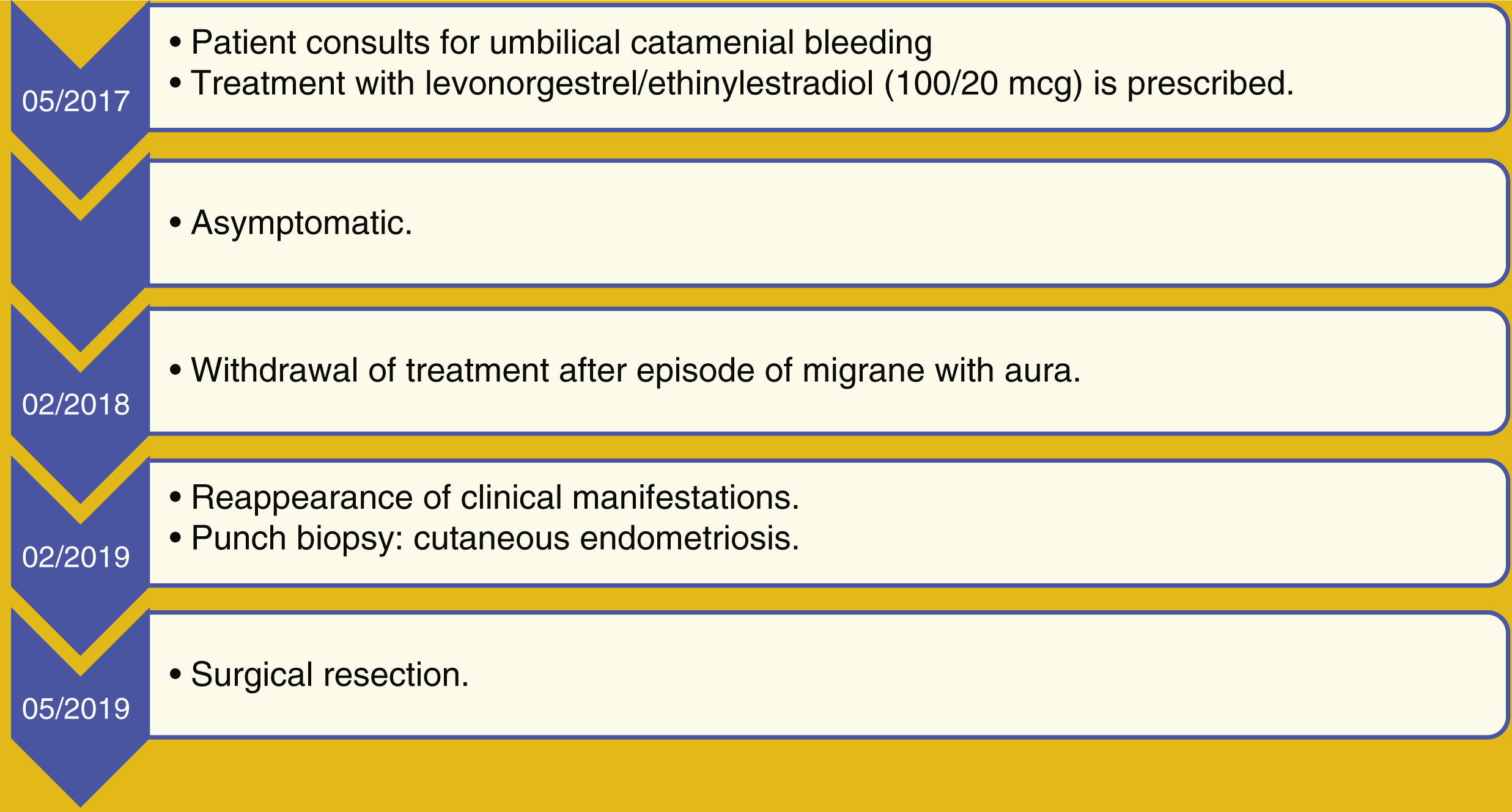
The temporal evolution of the clinic and treatment is reflected in Fig. 2.

Figure 2.

Timeline of clinical evolution and management of the patient.

Diagnostic evaluation

A diagnosis of suspected umbilical endometriosis was established. The gynecological examination and ultrasound evaluation were normal. For the umbilical study, a soft tissue ultrasound was performed, due to personal impossibility of MRI. This reported the existence of a hypoechogenic nodule of spiculated contours, of approximately 1.5cm in the umbilical region, which could correspond to endometriosis. Finally, a punch biopsy was taken, with the result of functionally active endometriosis, of dermal location and affected margins.

Therapeutical interventions

With the diagnosis of umbilical endometriosis, the patient started treatment with oral contraceptives, levonorgestrel/ethinylestradiol (100/20μm) in continuous regimen. This treatment kept the patient asymptomatic, but had to be removed 8 months later after an episode of migraine with aura. After its withdrawal, the pain and catamenial bleeding reappeared. We then proposed a surgical approach, performing a resection of the nodule with immediate reconstruction in the operating room, which the patient accepted. A rhomboidal excision with a major horizontal axis was performed, with convex sides toward the diagonals, binding with a suture centered on the crossing of both diagonals and midpoint of each of the sides, thus umbilizing healthy perilesional tissues and thus recreating a new navel.

Follow-up and results

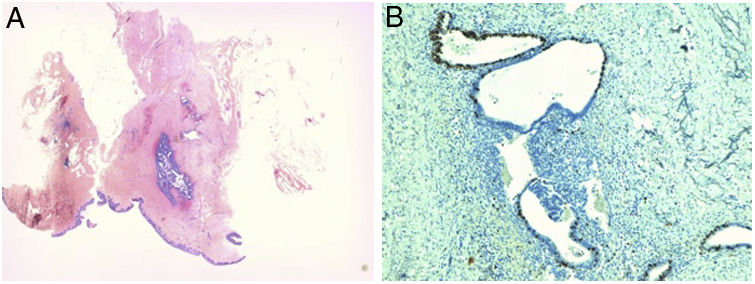
After surgery, the patient was completely asymptomatic, presenting no complications three months after the surgical intervention. The report of the surgical specimen informed of a piece of 2.5cm×2.7cm×1.5cm with a deep dermis lesion showing scattered glandular and cystic formations, some of which were occupied by blood clots, upholstered by a monostratified cubic epithelium, which sits on a rich cellular stroma of non-transformed spiral arterioles. No nucleomegaly or nuclear pleomorphism was observed. There was moderate degree of inflammation (Table 1). Estrogen receptors and CD10 were positive. Moderate Ki67 (10%) and COX-2 and BAF 250 were present (Fig. 3).

Table 1.

Histological and immunohistochemical findings of the specimen.

Architectural atypia  Hyperplasia  SI 
Atypia cellular atypiaPleomorphism  No 
Nuclear stratification  No 
Nucleomegaly  No 
Immunohistochemical studyKi 67  Moderate (10%) 
COX2  Present 
BAF250a  Present 
Estrogen receptors  Positive 
CD10  Positive 
Figure 3.

(A) Hematoxylin–eosin with magnifying glass: a nodule is located within the fibrous tissue revealing an increased number of endometrial glands attached to each other. (B) Ki67 ×100: in the glandular epithelium a moderate cell proliferation index is shown, estimated at 10% of the nuclei.

Discussion

The prevalence of malignancy in umbilical endometriosis is estimated to be between 0.3 and 2.8%.4 While all types of carcinomas and sarcomas have been observed in endometriosis, serum and mucinous subtypes are rare, with reported cases of clear cell carcinoma, endometrioid and adenocarcinoma.5

In the case reported by Obata et al.,5 typical endometriosis, adenocarcinoma and malignant transformation were observed in the same specimen, in accordance with the theory proposed by Sampson and modified by Scott regarding the malignant transformation of endometriosis.

Once malignant transformation of extra-ovarian endometriosis has been established, it is possible that atypical endometriosis may serve as a precursor lesion to this transformation, highlighting the need for detailed analysis of such lesions.6 Atypical endometriosis is defined by the presence of hyperplasia and/or cellular atypia in ectopic endometrium within endometriosis.6 This term also refers to two different histological findings: cellular atypia, or cytologic atypia, and architectural atypia, commonly known as hyperplasia.6

There have been reports of atypical endometriosis in scars,7 including a case of atypical endometrial hyperplasia in the ectopic endometrium located in a previous cesarean section incision,8 and hyperplastic endometriosis at a cutaneous site.9 Leng et al.10 also describe a case of carcinosarcoma and endometrioid carcinoma arising from an atypical endometriosis in a cesarean section scar.

A new protocol for studying atypical endometriosis has been developed, which includes a histological examination for nuclear stratification, hyperchromatism and pleomorphism for cellular atypia, and the presence or absence of hyperplasia for architectural atypical endometriosis. Additionally, the degree of cell proliferation (measured through immunohistochemical staining for Ki-67 and evaluating the percentage of Ki-67 with nuclear staining of cells), COX-2 as an inflammatory marker, and BAF250a as a surrogate marker of the ARID1A gene mutation were included.6

Van den Nouland1 suggests that atypia or malignancy should be excluded if hypertrophy or decisive changes appear through the expression of cytokeratin7+/keratin20−, estrogenic and gestagenic receptors, and Ki67.

Our clinical report presents a case of atypical architectural endometriosis with moderate degree of cell growth, a moderate presence of Ki-67 (10%). On the other hand, our case has presence of COX-2 and BAF 250, as well as positive estrogenic receptors. These results show an increase in cellular activity, the presence of inflammation, and no mutation of the ARID1A gene.

The presence of atypical architecture or hyperplasia is correlated with a greater degree of cell proliferation, as measured by Ki67, low COX2, and absence of the inflammatory marker BAF250a.6 This indicates that our patient's atypical architectural endometriosis based on hyperplasia and Ki67 marker, in correlation with the data presented, could have an increased risk of malignant transformation.

In conclusion, although the presence of umbilical endometriosis is uncommon, its malignant transformation is not negligible. Atypical endometriosis should be considered as a premalignant lesion. Our case report highlights the need for a non-dichotomous approach to lesions, incorporating a panel of intermediate immunohistochemical results, which could help to better manage patients with atypical endometriosis.

Ethical disclosuresProtection of people and animals

The authors declare that for this research no experiments have been carried out in humans or animals.

Data confidentiality

The authors declare that they have followed the protocols of their workplace regarding the publication of patient data.

Right to privacy and informed consent

The authors have obtained informed consent from the patients and/or subjects referred to in the article. This document is in the possession of the corresponding author.

Authors’ contribution

The content of the manuscript has not been published or submitted for publication elsewhere.

I confirm that all the authors fulfill the conditions requires for authorship; they have all made substantial contributions and have approved the final version of the manuscript.

Patient consent

The patient has given her consent to participate in the presented study.

Financing

The authors declare that they have no funding.

Conflicts of interest

There are no potential conflicts of interest of this article.

References
[1]
D. Van den Nouland, M. Kaur.
Primary umbilical endometriosis: a case report.
Facts Views Vis Obgyn, 9 (2017), pp. 115-119
[2]
L.P. Chamié, D.M.F.R. Ribeiro, D.A. Tiferes, A.C. de Macedo Neto, P.C. Serafini.
Atypical sites of deeply infiltrative endometriosis: clinical characteristics and imaging findings.
Radiographics, 38 (2018), pp. 309-328
[3]
R. Victory, M.P. Diamond, D.A. Johns.
Villar's nodule: a case report and systematic literature review of endometriosis externa of the umbilicus.
J Minim Invasive Gynecol, (2017),
[4]
T. Hirata, K. Koga, M. Kitade, S. Fukuma, K. Neriishi, F. Taniguchi, et al.
A national survey of umbilical endometriosis in Japan.
J Minim Invasive Gynecol, 27 (2020), pp. 80-87
[5]
K. Obata, N. Ikoma, G. Oomura, Y. Inoue.
Clear cell adenocarcinoma arising from umbilical endometriosis.
J Obstet Gynaecol Res, 39 (2013), pp. 455-461
[6]
I. Ñiguez, F. Machado, M.P. Marín, J.J. Arense, A. Torroba, A. Nieto Díaz, et al.
Prognostic importance of atypical endometriosis with architectural hyperplasia versus cytologic atypia in endometriosis-associated ovarian cancer.
J Gynecol Oncol, 30 (2019), pp. e63
[7]
S.J. Song, C.M. McGrath, G.H. Yu.
Fine-needle aspiration cytology of endometriosis.
Diagn Cytopathol, 45 (2017), pp. 359-363
[8]
M. Monist, D. Lewkowicz, M. Jóźwik, M. Gogacz, M. Bogusiewicz, T. Rechberger, et al.
Atypical endometrial hyperplasia arising in a cesarean section scar: a mechanism of malignant transformation.
Case Rep Oncol, 12 (2019), pp. 317-321
[9]
Z. Aziz, D. Wang.
Fine-needle aspiration biopsy of endometriosis of the abdominal wall: a potential diagnostic pitfall.
Diagn Cytopathol, 39 (2011), pp. 443-445
[10]
J. Leng, J. Lang, L. Gui, H. Li, Z. Liu.
Carcinosarcoma arising from atypical endometriosis in a cesarean section scar.
Int J Gynecol Cancer, 16 (2006), pp. 432-435
Opciones de artículo
Herramientas