


metricas
covid
Cirugía Española (English Edition) Risk factors for permanent stoma following sphincter-preserving anterior resecti...
Journal Information
Vol. 103. Issue 6.
(June 2025)
Share
Download PDF
More article options
Vol. 103. Issue 6.
(June 2025)
Original article
Risk factors for permanent stoma following sphincter-preserving anterior resection in rectal cancer: A retrospective multicenter observational study
Factores de riesgo de estoma permanente tras resección anterior de recto con preservación de esfínteres en cáncer de recto: estudio observacional retrospectivo multicéntrico
Pere Planellasa,
Corresponding author
, Nair Fernandesb, Sandra Alonso-Gonçalvesc, Thomas Goldad, Júlia Gile, Garazi Elorzaf, Esther Kreislerd, Mayra Rebeka Abad-Camachoc, Lidia Cornejog, Franco Marinellob
a Colorectal Unit, Department of General and Digestive Surgery, University Hospital of Girona; Department of Medical Sciences, Faculty of Medicine, University of Girona; Girona Biomedical Research Institute (IDIBGI), Girona, Spain
b Colorectal Surgery, Vall d'Hebron University Hospital, Universitat Autònoma de Barcelona UAB, Barcelona, Spain
c Colorectal Unit, Department of General and Digestive Surgery, Hospital del Mar; Medical Research Institute (IMIM), Barcelona, Spain
d Colorectal Unit, Department of General and Digestive Surgery, Bellvitge University Hospital, University of Barcelona, IDIBELL (Bellvitge Biomedical Investigation Institute), Barcelona, Spain
e Colorectal Unit, Department of General and Digestive Surgery, Hospital Universitario de Gran Canaria Dr. Negrín, Gran Canaria, Spain
f Colorectal Surgery Unit, Department of General and Digestive Surgery, University Hospital of Donostia, Donostia, Spain
g Girona Biomedical Research Institute (IDIBGI), Girona, Spain
Article information
Abstract
Full Text
Bibliography
Download PDF
Statistics
Figures (4)
Show moreShow less
Tables (4)
Table 1. Preoperative patient characteristics according to the presence of a stoma 2 years after sphincter-sparing surgery.
Tables
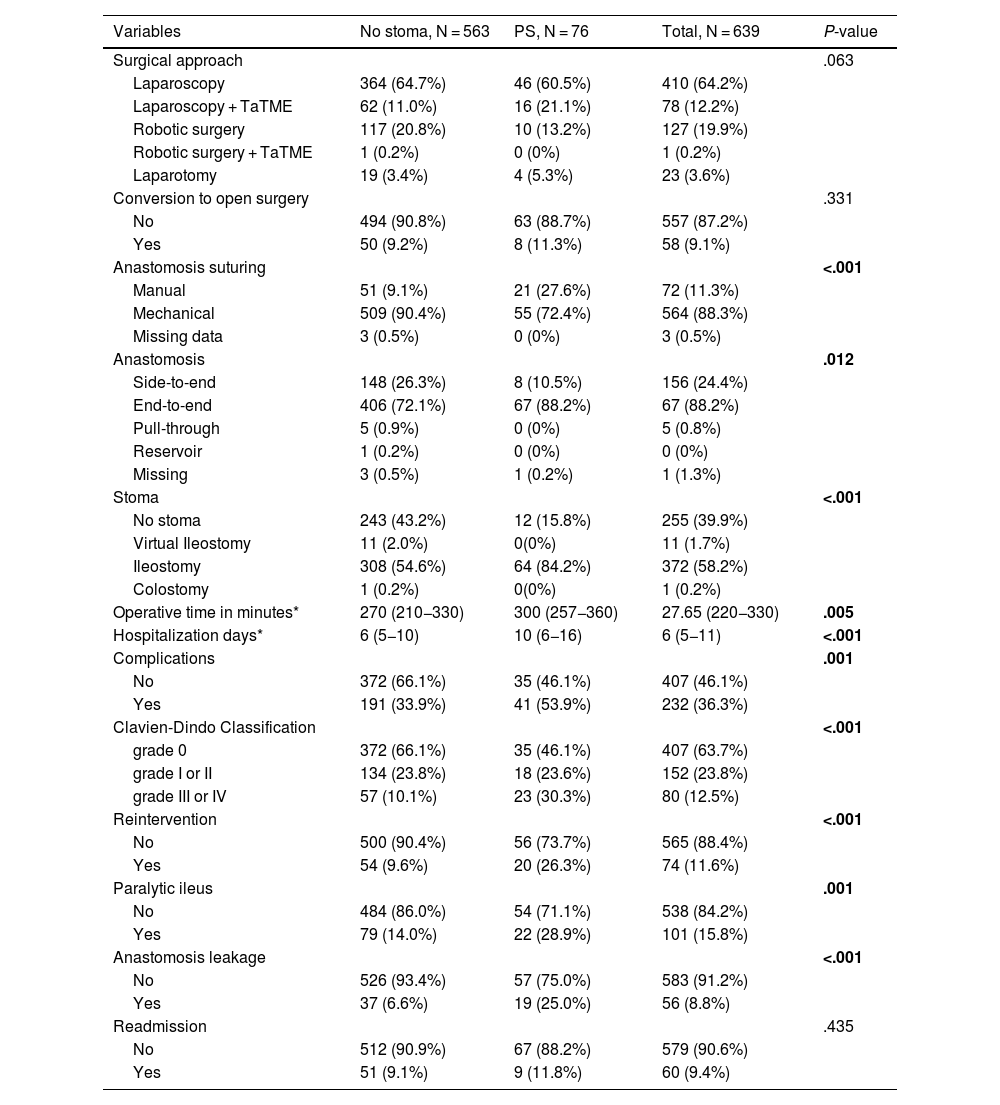
Table 2. Surgical variables and postoperative morbidity according to the presence of a stoma 2 years after sphincter-sparing surgery.
Tables
Table 3. Pathology findings in specimens resected in sphincter-sparing surgery. according to the presence of a stoma 2 years after surgery.
Tables
Table 4. Univariate and multivariate logistic regression analysis of risk factors for having a PS 2 years after sphincter-sparing resection for rectal cancer.
Tables
Show moreShow less
Additional material (1)
Abstract
Background

Sphincter-sparing rectal cancer surgery seeks to avoid terminal stomas, yet they remain common. To identify patients who may benefit from an upfront terminal ostomy, we aimed to determine preoperative risk factors and develop a risk calculator.

Methods

This multicenter observational retrospective cohort study included consecutive patients undergoing sphincter-sparing anterior resection for rectal cancer between January 2016 and January 2020 at 6 tertiary hospitals. The stoma-free status was analyzed 2 years after surgery.

Results

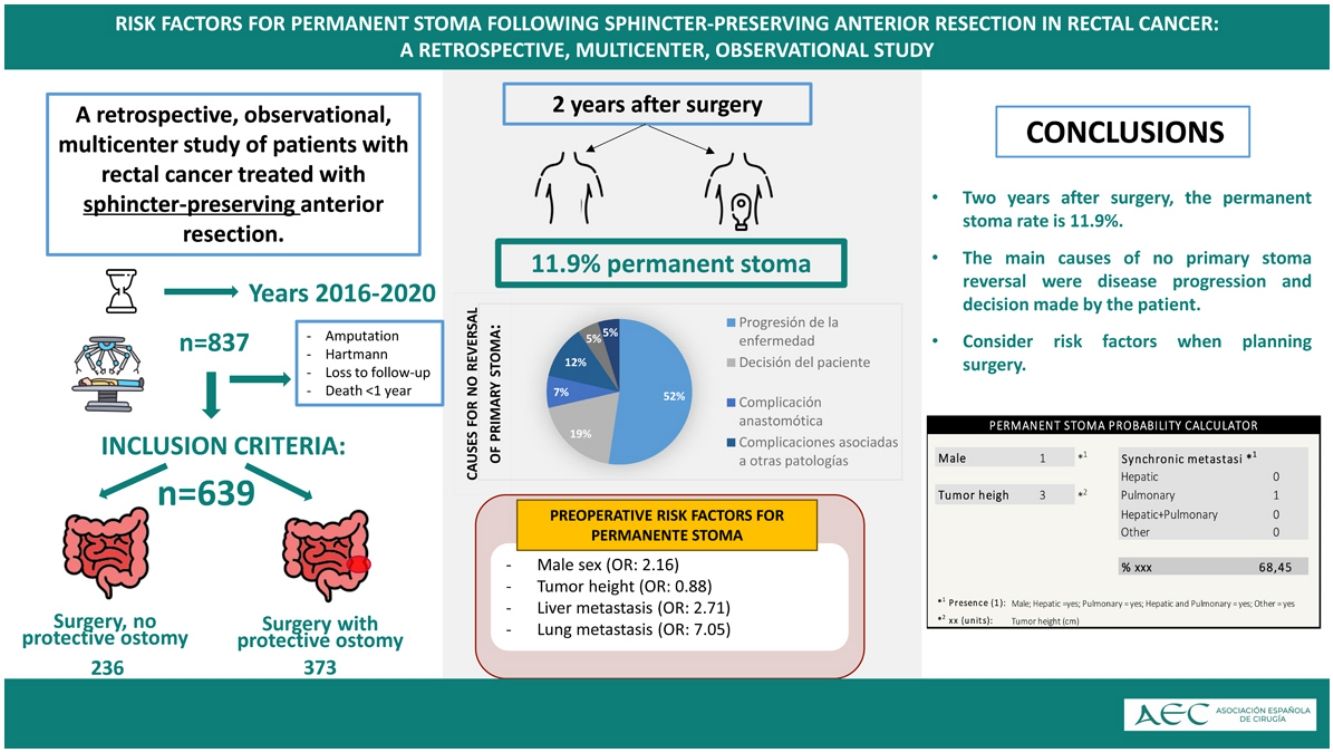
We included 639 patients: 373 with primary stoma (58.4%) and 29 with secondary stoma (4.5%). Two years after surgery, 76 (11.9%) patients had permanent stoma. Patients with anastomotic leakage showed a lower rate of stoma closure 2 years after surgery (No 86.3% vs Yes 69.4%; P = .002). The main causes for non-primary stoma reversal were disease progression (52.4%) and patient decision (19.0%). Preoperative factors independently associated with permanent stoma 2 years after surgery were male sex (P = .016; OR = 2.16), tumor height (P = .001; OR = 0.88), synchronous liver metastases (P = .025; OR = 2.71) and lung metastases (P = .001: OR = 7.05).

Conclusions

Preoperative risk factors associated with permanent stoma in patients undergoing anterior rectal resection include sex, tumor height, and synchronous liver or lung metastases. Surgeons should consider preoperative factors associated with the risk of permanent stoma and inform patients about the potential need for a permanent stoma.

Keywords:
Sphincter-sparing surgery
Rectal cancer
Temporary ostomy
Permanent stoma
Resumen
Introducción

La cirugía para el cáncer de recto que preserva el esfínter busca evitar las ostomías definitivas, pero estas siguen siendo comunes. Para identificar a los pacientes que podrían beneficiarse de una ostomía terminal inicial, nuestro objetivo fue determinar los factores de riesgo preoperatorios y desarrollar una calculadora de riesgo.

Métodos

Estudio de cohorte retrospectivo multicéntrico en 639 pacientes con cáncer de recto tratados con resección anterior con preservación del esfínter en seis hospitales entre 2016 y 2020. Se evaluó el estado libre de estoma a los 2 años.

Resultados

Incluimos a 639 pacientes: 373 con estoma primario (58.4%) y 29 con estoma secundario (4.5%). A los dos años, 76 pacientes (11.9%) mantenían un estoma. Los pacientes con fuga anastomótica tuvieron menor tasa de cierre a los dos años (No. 86.3% vs. Sí. 69.4%. P = .002). Las principales causas de no reversión del estoma primario fueron progresión de la enfermedad (52.4%) y decisión del paciente (19.0%). Los factores preoperatorios asociados a estoma permanente después de dos años de la cirugía fueron sexo masculino (P = .016, OR = 2.16), altura del tumor (P = .001, OR = 0.88), metástasis hepáticas (P = .025, OR = 2.71) y metástasis pulmonares (P = .001, OR = 7.05).

Conclusiones

Los factores preoperatorios asociados a estoma permanente incluyen sexo masculino, altura del tumor y metástasis hepáticas o pulmonares. Los cirujanos deben considerar estos factores preoperatorios al evaluar el riesgo de estoma permanente e informar a los pacientes sobre la posible necesidad de ostomía definitiva.


Palabras clave:
Cirugía de preservación del esfínter
Cáncer de recto
Ostomía temporal
Estoma permanente
Graphical abstract

Article

These are the options to access the full texts of the publication Cirugía Española (English Edition)
Subscriber
Subscriber

If you already have your login data, please click here .

If you have forgotten your password you can you can recover it by clicking here and selecting the option “I have forgotten my password”
Subscribe
Subscribe to

Cirugía Española (English Edition)

Purchase
Purchase article

Purchasing article the PDF version will be downloaded

Purchase now
Contact
Phone for subscriptions and reporting of errors
From Monday to Friday from 9 a.m. to 6 p.m. (GMT + 1) except for the months of July and August which will be from 9 a.m. to 3 p.m.
Calls from Spain
932 415 960
Calls from outside Spain
+34 932 415 960
E-mail
Article options
Tools
Supplemental materials
