



Edited by: Dr. Calos Cerdán
Cirugía General y Aparato Digestivo. Unidad de Cirugía Digestiva. Hospital Universitario de la Princesa. Madrid
Dr. Matteo Frasson
Cirugía general. Hospital Universitario y Politécnico La Fe. Valencia
Last update: November 2025
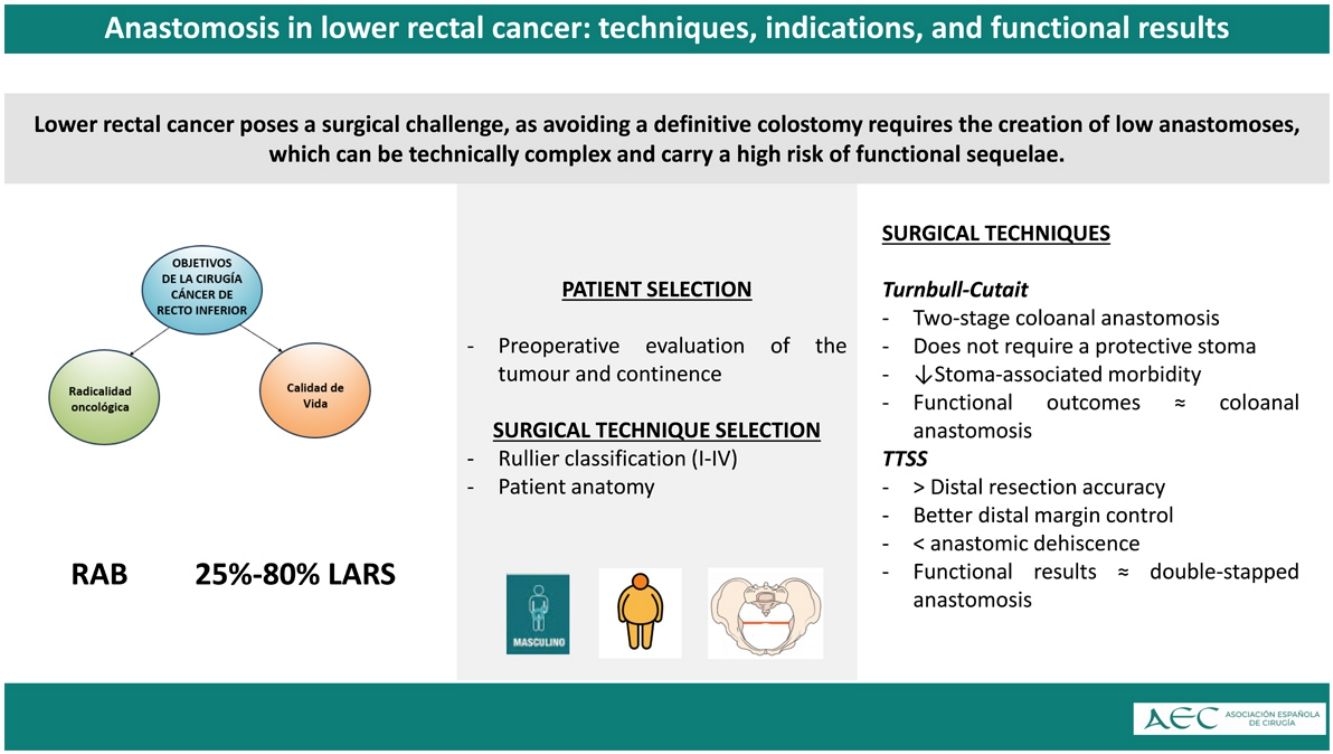
More infoSurgery for lower rectal cancer poses a significant challenge because avoiding a permanent colostomy requires technically complex low anastomosis. This article reviews the different anastomotic techniques following total mesorectal excision (TME), with particular emphasis on the Turnbull-Cutait (T-C) technique and transanal transection with single-stapled anastomosis (TTSS). The T-C technique enables a two-stage coloanal anastomosis without the need for a protective ileostomy, thereby reducing stoma-related morbidity. Meanwhile, TTSS improves precision in distal resection and reduces the incidence of anastomotic leakage. Appropriate patient selection is key to determining the most suitable surgical strategy. Despite technical advances, the incidence of low anterior resection syndrome remains high in this patient group. Surgical decisions should be individualized, taking into account each patient’s profile and the anticipated oncological and functional outcomes.
La cirugía del cáncer de recto inferior representa un desafío, ya que evitar una colostomía definitiva requiere anastomosis bajas, técnicamente complejas. Este artículo analiza las distintas técnicas de anastomosis tras la escisión total del mesorrecto, en especial la técnica de Turnbull-Cutait (T-C) y la transección transanal con anastomosis de grapado único (TTSS). T-C permite realizar una anastomosis coloanal en dos tiempos sin requerir ileostomía de protección, minimizando la morbilidad asociada al estoma. Por su parte, la TTSS optimiza la precisión en la resección distal y reduce la incidencia de dehiscencia anastomótica. La adecuada selección de pacientes es crucial para definir la estrategia quirúrgica más adecuada. A pesar de los avances técnicos, la incidencia del síndrome de resección anterior sigue siendo elevada en este grupo de pacientes. La decisión quirúrgica debe ser personalizada, considerando el perfil del paciente y los resultados oncológicos y funcionales esperados.


