






Indocyanine green (ICG) fluorescence has recently been introduced as an imaging technique to enhance lymphatic mapping in gastric cancer (GC) surgery. This study analyzes the efficacy of this tool in gastric cancer lymphadenectomy and the influence of neoadjuvant chemotherapy (NAC) on its application.
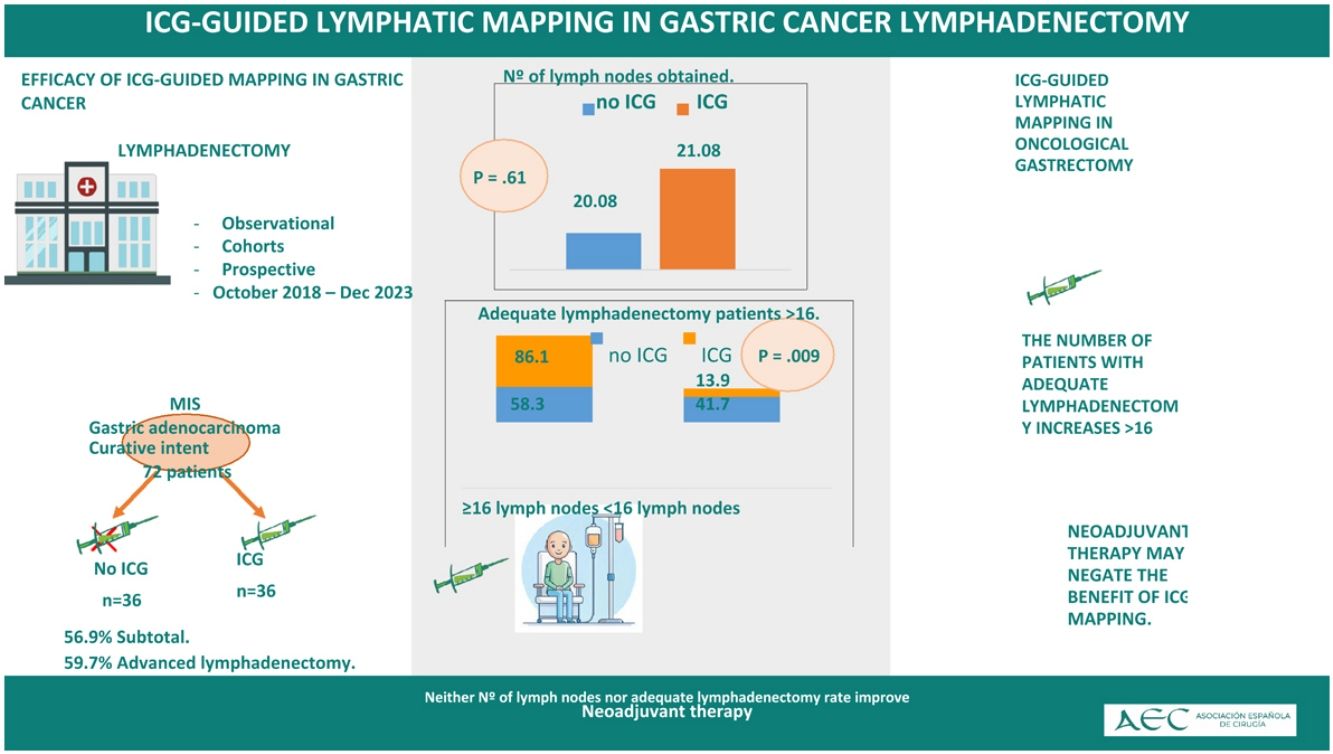
Material and methodsThis study analyzes seventy-two patients from a Spanish center with gastric adenocarcinoma who underwent gastrectomy between October 2018 and December 2023. Two groups were compared: patients undergoing oncologic gastrectomy with ICG-guided lymphadenectomy versus patients with conventional lymphadenectomy. Primary outcomes were the number of lymph nodes (LN) retrieved and adequate lymphadenectomy rates (≥16 LN).
ResultsThe study population comprised 72 patients, of whom 36 belonged to the ICG group and 36 to the non-ICG group. Both groups had similar mean age, BMI, sex ratios, comorbidities, and staging. The rate of adequate lymphadenectomy was significantly higher after intraoperative ICG guidance (86.1% vs. 58.3%; p = 0.009), although this association was not significant after NAC. There were no differences in the mean number of lymph nodes retrieved. A greater number of postoperative complications was observed in the ICG group, although no statistically significant differences were found. None of these complications were directly related to indocyanine green instillation. There were also no differences in the length of hospital stay between the two groups.
ConclusionICG-guided lymphatic mapping appears to be a safe and effective tool for achieving adequate lymphadenectomy in gastric cancer compared to conventional lymphadenectomy. However, NAC may limit the effectiveness of the technique.
La fluorescencia con verde de indocianina (ICG) ha sido introducida recientemente como una técnica de imagen para mejorar el mapeo linfático en la cirugía del cáncer gástrico (CG). Este estudio analiza la eficacia de esta herramienta en la linfadenectomía del cáncer gástrico y la influencia de la quimioterapia neoadyuvante (QNA) en su aplicación.
Material y métodosAnalizamos prospectivamente una serie de pacientes de un único centro español intervenidos de gastrectomía por adenocarcinoma gástrico entre octubre de 2018 y diciembre de 2023. Se compararon dos grupos: pacientes sometidos a gastrectomía oncológica con linfadenectomía guiada con ICG frente a pacientes con linfadenectomía convencional. Los resultados primarios fueron el número de ganglios linfáticos (GL) obtenidos y las tasas de linfadenectomías adecuadas (≥16 GL).
ResultadosSe analizaron 72 pacientes, 36 pertenecían al grupo ICG y otros 36 al grupo no ICG. Ambos grupos presentaron una media de edad, IMC, proporciones de sexo, comorbilidades y estadío similares. La tasa de linfadenectomía adecuada fue significativamente mayor en la cohorte ICG (86,1% vs. 58,3%; p = 0,009), aunque esta asociación no fue significativa después de la QNA. La media de ganglios linfáticos no mostró diferencias significativas entre los grupos. Se observó mayor número de complicaciones postoperatorias en el grupo ICG, aunque no se encontraron diferencias estadísticamente significativas. Ninguna de estas complicaciones se relacionó directamente con la instilación del verde de indocianina. Tampoco se observaron diferencias en la duración de la estancia hospitalaria entre los dos grupos.
ConclusiónEl mapeo linfático guiado por ICG parece una herramienta segura y eficaz para conseguir una linfadenectomía adecuada en el cáncer gástrico en comparación con la linfadenectomía convencional. Sin embargo, la QNA podría limitar la efectividad de la técnica.


