
The world population is aging, with octogenarians expected to reach over 400 million by 2050. Acute cholecystitis is a serious complication in the elderly. Age is not a contraindication for emergency cholecystectomy, an option that can both save lives and preserve quality of life.
MethodsThe present study aimed to compare open and laparoscopic surgical approaches. Over six months, 38 emergency surgery units enrolled all consecutive octogenarians with acute cholecystitis undergoing cholecystectomy. Postoperative outcomes were compared after propensity score matching analysis.
ResultsThe study included 212 patients (84 years [81–86], 47.2% women). The open approach was used in 32.1% of patients, and the laparoscopic approach in 67.9%. After propensity score matching, a decrease in hospital stays (open, 8 days [6–13]; laparoscopic, 5 days [4–8]; P < .001), 30-day morbidity (open, 48.5%; laparoscopic, 26.5%; P = .01), and 30-day mortality (open, 13.2%, laparoscopic, 1.5%; P = .02) was found. Among the specific postoperative complications, a decrease in septicemia (open, 14.7%; laparoscopic, 0%; P = .001) was observed.
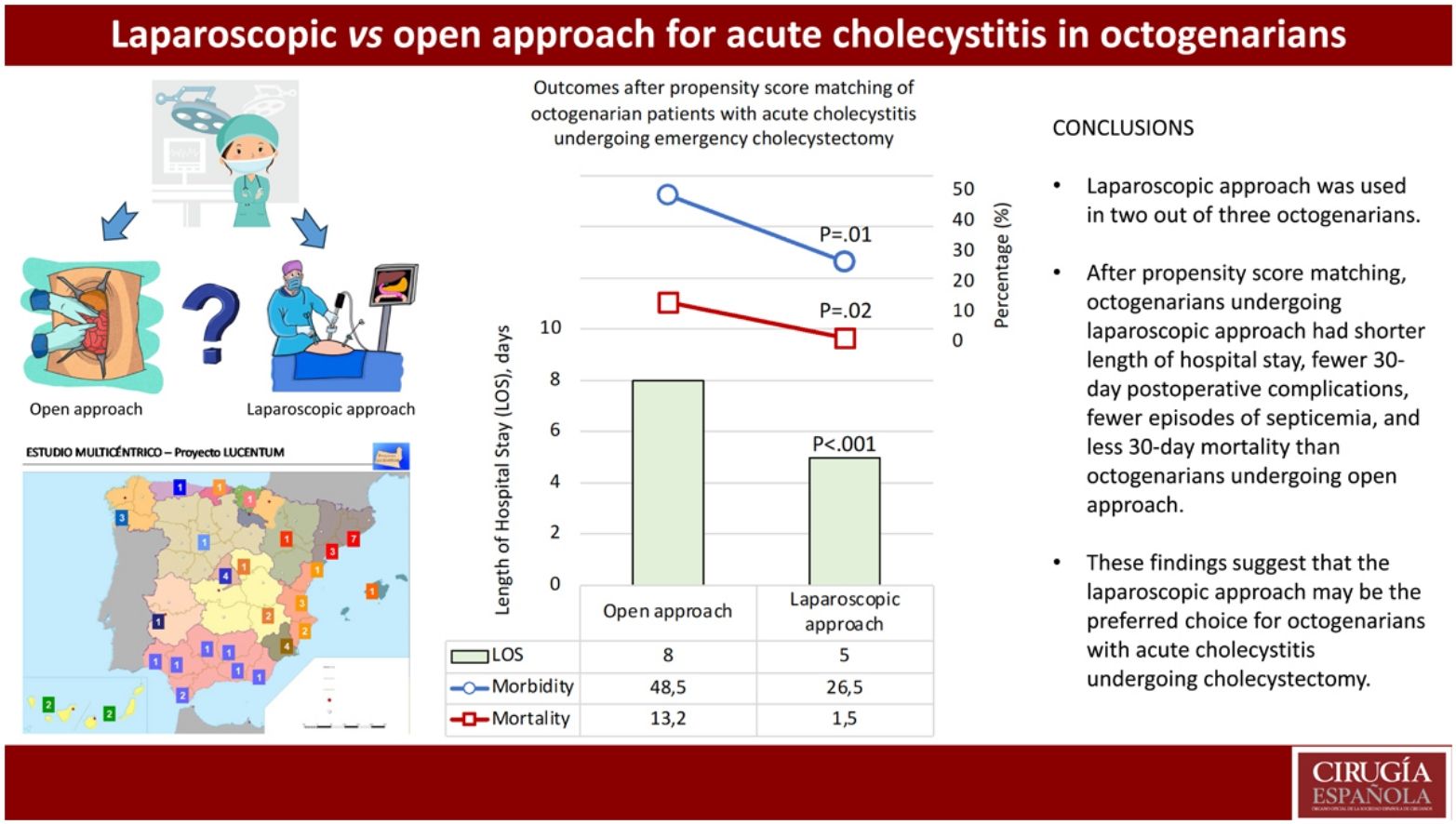
ConclusionsLaparoscopic approach was used in two out of three octogenarians. After propensity score matching, octogenarians undergoing laparoscopic approach had shorter length of hospital stay, fewer 30-day postoperative complications, fewer episodes of septicemia, and less 30-day mortality than octogenarians undergoing open approach. These findings suggest that the laparoscopic approach may be the preferred choice for octogenarians with acute cholecystitis undergoing cholecystectomy.
La población mundial está envejeciendo; se espera que los octogenarios alcancen más de 400 millones en 2050. La colecistitis aguda es una complicación grave en ancianos. La edad no es contraindicación para la colecistectomía de urgencia, una opción que puede salvar vidas y preservar calidad de vida.
MétodosEl presente estudio tuvo como objetivo comparar los abordajes quirúrgicos abierto y laparoscópico. Durante seis meses, 38 unidades de cirugía de urgencia incluyeron octogenarios consecutivos con colecistitis aguda intervenidos de colecistectomía. Los resultados posoperatorios se compararon después de análisis de emparejamiento por puntuación de propensión.
ResultadosSe incluyeron 212 pacientes (84 años [rango inter-cuartil, 81-86], 47,2% mujeres). El abordaje abierto se utilizó en 32,1% de pacientes y el abordaje laparoscópico en 67,9%. Después de emparejamiento por puntuación de propensión, se observó disminución en estancias hospitalarias (abierto, 8 días [6-13]; laparoscópico, 5 días [4-8]; p < 0,001), morbilidad a 30 días (abierto, 48,5%; laparoscópico, 26,5 %; p = 0,01), y mortalidad a 30 días (abierto, 13,2%, laparoscópico, 1,5%; p = 0,02). Asimismo, se observó disminución de septicemia (abierto, 14,7%; laparoscópico, 0%; p = 0,001).
ConclusionesEl abordaje laparoscópico se utilizó en dos de cada tres octogenarios. Después de emparejamiento por puntuación de propensión, los intervenidos mediante abordaje laparoscópico tuvieron estancia hospitalaria más corta, menos complicaciones posoperatorias a 30 días, menos episodios de septicemia y menos mortalidad a 30 días que los octogenarios intervenidos mediante abordaje abierto. Estos hallazgos sugieren que el abordaje laparoscópico puede ser la opción preferida para octogenarios con colecistitis aguda que se intervienen de colecistectomía.
The elderly are increasing in the world. The population over 80 is expected to triple to 426 million by 2050.1 Biliary diseases are among the most common conditions of the digestive tract.2 The prevalence of gallstones is between 14% and 23% in the elderly and reaches 80% in nonagenarians.3 Age itself has no association with the severity of cholecystitis, but the burden of comorbidities these patients have causes rapid disease progression.4,5
Supportive care is the first treatment option in elderly patients with acute cholecystitis.3,6 Percutaneous gallbladder drainage is the most commonly used non-surgical procedure to treat acute cholecystitis in elderly patients.3 Endoscopic ultrasonography (EUS)-guided gallbladder drainage is becoming an alternative to surgery for frail patients with acute cholecystitis.7–9
Early cholecystectomy during index admission remains the best treatment for elderly patients suitable for surgery.10,11 Guidelines for the treatment of acute cholecystitis in people over 65 were published in 2017 by the World Society of Emergency Surgery (WSES) and the Italian Society of Geriatric Surgery.12 The guidelines recommended an initial laparoscopic approach provided there was no anesthetic contraindication or septic shock.
Surgery for acute cholecystitis in octogenarians has benefited from advances in laparoscopic techniques.5,13–30 In 2020, the WSES updated the guidelines31 and noted a lack of quality evidence in octogenarians. Laparoscopic vs open approach in octogenarian patients with acute cholecystitis has not been compared in any randomized controlled trial or prospective multicenter study. The present prospective, multicenter, nationwide study used propensity score matching analysis to compare laparoscopic vs open approach in octogenarians with acute cholecystitis undergoing early cholecystectomy.
Patients and methodsThe present study is a post hoc secondary analysis of the LUCENTUM project endorsed by the Spanish Association of Surgeons (AEC).32–35 The study followed the guidelines for Strengthening the Reporting of Observational Studies in Epidemiology (STROBE).36 The project was registered at www.researchregistry.com/ (UIN-7097). The medical ethics committee waived informed consent due to the observational nature of the study, and approved (Ref CEIm: PI2018/104) the data analysis. Study planning and data analysis were carried out according to the STROCCS Reporting Guidelines for Cohort Studies.37
Thirty-eight centers participated in the project. In most centers, emergency general surgery was attended 24 hours a day, 7 days a week by surgeons who also performed elective surgery. All octogenarians admitted with acute cholecystitis (ICD-10 codes: K81, K82) who underwent cholecystectomy from October 1, 2017 to March 31, 2018 were included. Patients underwent open or laparoscopic cholecystectomy according to routine practice in each center. From the outset, the coordinators of this multicenter study decided not to apply the intention-to-treat principle to the surgical approach. Hence, to avoid additional pressure on surgeons and to accurately reflect current practice, the usual protocols in force in each center prevailed. Thus, conversion was left to the surgeon’s discretion and was not recorded. Conversions were counted as open surgery cases. Patients treated with modalities other than cholecystectomy were excluded. Thirty-day follow-up was performed on all patients.
Demographic variables, vital signs, and laboratory tests on admission were collected. Postoperative events and clinical outcomes were recorded according to POSSUM.33 Collection of anonymized data was carried out online using a specially designed secure web application.
Exposure was open or laparoscopic approach. Length of hospital stay, 30-day morbidity and 30-day mortality were recorded.
Statistical analysisCategorical variables expressed in relative frequencies were analyzed using the chi-square test or Fisher's exact test. Continuous variables were expressed as median and interquartile range. Differences between groups were analyzed using Student's t-test or Mann-Whitney U-test, according to Shapiro-Wilk normality test results. Propensity score matching was conducted using the MatchIt package in R software, employing a 1:1 optimal-match approach. Propensity scores were determined by logistic regression, using the variables shown in Table 1, with a caliper width of 0.1. Effects were estimated by comparing outcomes between open and laparoscopic approaches after matching.38 P values <.05 were considered significant. Rstudio (The R Foundation for Statistical Computing) version 1.2.5001 was used.
Demographic and preoperative characteristics of octogenarian patients undergoing emergency open or laparoscopic cholecystectomy for acute cholecystitis.
| Characteristics | Baseline Population | After Propensity Score Matching | ||||
|---|---|---|---|---|---|---|
| All Patients(n = 212) | Open(n = 68) | Laparoscopy(n = 144) | P value* | Laparoscopy(n = 68) | P value* | |
| Age, years, median (IQR) | 84 (81–86) | 84 (81–86) | 84 (81–86) | .73 | 84 (81–86) | .77 |
| Sex, n (%) | 1.0 | 1.0 | ||||
| Female | 100 (47.2) | 32 (47.1) | 68 (47.2) | 31 (45.6) | ||
| Male | 112 (52.8) | 36 (52.9) | 76 (52.8) | 37 (54.4) | ||
| Cardiac signs, n (%) | .27 | .29 | ||||
| No failure | 93 (43.9) | 32 (47.1) | 61 (42.4) | 29 (42.6) | ||
| Diuretic, digoxin, antianginal or hypertensive therapy | 91 (42.9) | 24 (35.3) | 67 (46.5) | 33 (48.5) | ||
| Peripheral edema, warfarin therapy, borderline cardiomegaly | 23 (10.8) | 9 (13.2) | 14 (9.7) | 5 (7.4) | ||
| Raised jugular venous pressure, cardiomegaly | 5 (2.4) | 3 (4.4) | 2 (1.4) | 1 (1.5) | ||
| Respiratory history, n (%) | .29 | .19 | ||||
| No dyspnea | 156 (73.6) | 47 (69.1) | 109 (75.7) | 54 (79.4) | ||
| Dyspnea on exertion, mild COPD on chest radiograph | 36 (17.0) | 11 (16.2) | 25 (17.4) | 11 (16.2) | ||
| Limiting dyspnea (1 flight), moderate COPD on chest X-ray | 17 (8.0) | 8 (11.8) | 9 (6.3) | 3 (4.4) | ||
| Dyspnea at rest (rate ≥30/min), fibrosis or consolidation on X-ray | 3 (1.4) | 2 (2.9) | 1 (0.7) | 0 | ||
| Blood pressure, systolic, mmHg, n (%) | .044 | .70 | ||||
| 110–129 | 57 (26.9) | 19 (27.9) | 38 (26.4) | 22 (32.4) | ||
| 130–170 or 100–109 | 104 (49.1) | 28 (41.2) | 76 (52.8) | 27 (39.7) | ||
| <170 or 90–99 | 35 (16.5) | 11 (16.2) | 24 (16.7) | 13 (19.1) | ||
| <90 | 16 (7.5) | 10 (14.7) | 6 (4.2) | 6 (8.8) | ||
| Pulse (beats/min), n (%) | .07 | .09 | ||||
| 50–80 | 98 (46.2) | 23 (33.8) | 75 (52.1) | 34 (50.0) | ||
| 81–100 or 40–49 | 83 (39.2) | 31 (45.6) | 52 (36.1) | 29 (42.6) | ||
| 101–120 | 23 (10.8) | 10 (14.7) | 13 (9.0) | 4 (5.9) | ||
| >120 or <40 | 8 (3.8) | 4 (5.9) | 4 (2.8) | 1 (1.5) | ||
| Serum urea, mg/dL, n (%) | .01 | .24 | ||||
| <45 | 88 (41.5) | 22 (32.4) | 66 (45.8) | 28 (41.2) | ||
| ≥45–60 | 57 (26.9) | 19 (27.9) | 38 (26.4) | 15 (22.1) | ||
| >60–90 | 42 (19.8) | 12 (17.6) | 30 (20.8) | 17 (25.0) | ||
| >90 | 25 (11.8) | 15 (22.6) | 10 (6.9) | 8 (11.8) | ||
| Sodium, mg/mL, n (%) | .67 | .57 | ||||
| ≥136 | 149 (70.3) | 49 (72.1) | 100 (69.4) | 43 (63.2) | ||
| 131–135 | 45 (21.2) | 12 (17.6) | 33 (22.9) | 17 (25.0) | ||
| 126–130 | 17 (8.0) | 7 (10.3) | 10 (6.9) | 7 (10.3) | ||
| ≤126 | 1 (0.5) | 0 | 1 (0.7) | 1 (1.5) | ||
| Potassium, mg/dL, n (%) | .51 | .75 | ||||
| 3.5–5 | 177 (83.5) | 54 (79.4) | 123 (85.4) | 57 (83.8) | ||
| 3.1–3.4 or 5.1–5.3 | 21 (9.9) | 8 (11.8) | 13 (9.0) | 5 (7.4) | ||
| 2.9–3.1 or 5.4–5.9 | 11 (5.2) | 4 (5.9) | 7 (4.9) | 5 (7.4) | ||
| <2.9 or >5.9 | 3 (1.4) | 2 (2.9) | 1 (0.7) | 1 (1.5) | ||
| Hemoglobin, g/100 mL, n (%) | .004 | .30 | ||||
| 13–16 | 103 (48.6) | 25 (36.8) | 78 (54.2) | 32 (47.1) | ||
| 11.5–12.9 or 16.1–17 | 61 (28.8) | 21 (30.9) | 40 (27.8) | 22 (32.4) | ||
| 10–11.4 or 17.1–18 | 34 (16.0) | 12 (17.6) | 22 (15.3) | 10 (14.7) | ||
| <10 or >18 | 14 (6.6) | 10 (14.7) | 4 (2.8) | 4 (5.9) | ||
| White cell count (x103), n (%) | .97 | .43 | ||||
| 4–10 | 48 (22.6) | 16 (23.5) | 32 (22.2) | 11 (16.2) | ||
| 10.1–20 or 3.1–3.9 | 124 (58.5) | 39 (57.4) | 85 (59.0) | 46 (67.6) | ||
| >20 or <3.1 | 40 (18.9) | 13 (19.1) | 27 (18.8) | 11 (16.2) | ||
| Electrocardiography, n (%) | .45 | .51 | ||||
| Normal | 173 (81.6) | 53 (77.9) | 120 (83.3) | 57 (83.8) | ||
| Atrial fibrillation (rate 60–90/min), any other abnormal rhythm, or ≥5 ectopic/min, Q waves or ST/T wave changes | 39 (18.4) | 15 (22.1) | 24 (16.7) | 11 (16.2) | ||
| Peritoneal soiling, n (%) | <.001 | .45 | ||||
| None/serous fluid collection | 110 (51.9) | 22 (32.4) | 88 (61.1) | 17 (25.0) | ||
| Local pus, free bowel content, pus or blood | 102 (48.1) | 46 (67.6) | 56 (38.9) | 51 (75.0) | ||
| Hospital size | ||||||
| Beds, n, median (IQR) | 655 (382–802) | 655 (380–784) | 650 (382–802) | .64 | 620 (382–883) | .65 |
| Teaching hospital, n (%) | 1.0 | .78 | ||||
| Yes | 192 (90.6) | 62 (91.2) | 130 (90.3) | 60 (88.2) | ||
| No | 20 (9.4) | 6 (8.8) | 14 (9.7) | 8 (11.8) | ||
We included 212 patients with acute cholecystitis, median age (IQR) 84 years (81–86), women 47.2% (Table 1). A total of 68 patients (32.1%) underwent open cholecystectomy and 144 patients (67.9%) underwent a laparoscopic approach. Physiological status, in terms of blood pressure, kidney function and hemoglobin level were better in patients undergoing laparoscopic approach. In addition, the proportion of patients with peritoneal soiling was higher among those who underwent an open approach than in those who underwent a laparoscopic approach (Table 1).
In the baseline population, length of hospital stay and 30-day morbidity were lower in patients undergoing a laparoscopic approach than in those undergoing an open approach (Table 2). Improvement in 30-day morbidity was observed in 4 of the 15 reported complications. Likewise, 30-day mortality was lower in patients who underwent laparoscopic surgery (Table 2).
Postoperative outcomes of octogenarian patients undergoing emergency open or laparoscopic cholecystectomy for acute cholecystitis.
| Postoperative Outcomes | Baseline Population | After Propensity Score Matching | ||||
|---|---|---|---|---|---|---|
| All Patients(n = 212) | Open(n = 68) | Laparoscopy(n = 144) | P value* | Laparoscopy(n = 68) | P value* | |
| Hospital stays | ||||||
| Total days, median (IQR) | 6 (4–9) | 8 (6–13) | 5 (3–7) | <.001 | 5 (4–8) | <.001 |
| 30-day morbidity | ||||||
| Patients who developed morbidity events, n (%) | 62 (29.2) | 33 (48.5) | 29 (20.1) | <.001 | 18 (26.5) | .01 |
| Postoperative complications, n (%) | ||||||
| Anastomotic leak/dehiscence | 6 (2.8) | 5 (7.4) | 1 (0.7) | .02 | 0 | .06 |
| Wound dehiscence | 1 (0.5) | 1 (1.5) | 0 | .32 | 0 | 1.0 |
| Cardiac failure | 17 (8.0) | 10 (14.7) | 7 (4.9) | .03 | 5 (7.4) | .27 |
| Fever/pyrexia of unknown origin | 1 (0.5) | 1 (1.5) | 0 | .32 | 0 | 1.0 |
| Wound hemorrhage | 0 | 0 | 0 | --- | 0 | --- |
| Deep wound hemorrhage | 1 (0.5) | 1 (1.5) | 0 | .32 | 0 | 1.0 |
| Hypotension | 11 (5.2) | 8 (11.8) | 3 (2.1) | .008 | 1 (1.5) | .04 |
| Wound infection | 5 (2.4) | 3 (4.4) | 2 (1.4) | .38 | 1 (1.5) | .61 |
| Deep wound infection | 14 (6.6) | 5 (7.4) | 9 (6.3) | 1.0 | 5 (7.4) | 1.0 |
| Chest infection | 8 (3,8) | 3 (4.4) | 5 (3.5) | 1.0 | 4 (5.9) | 1.0 |
| Urinary tract infection | 3 (1.4) | 3 (4.4) | 0 | .03 | 0 | .24 |
| Renal failure | 19 (9.0) | 12 (17.6) | 7 (4.9) | .005 | 4 (5.9) | .06 |
| Respiratory failure | 13 (6.1) | 7 (10.3) | 6 (4.2) | .15 | 4 (5.9) | .53 |
| Septicemia | 12 (5.7) | 10 (14.7) | 2 (1.4) | <.001 | 0 | .001 |
| Deep vein thrombosis, pulmonary embolism | 0 | 0 | 0 | --- | 0 | --- |
| 30-day mortality | ||||||
| Patients who died, n (%) | 10 (4.7) | 9 (13.2) | 1 (0.7) | <.001 | 1 (1.5) | .02 |
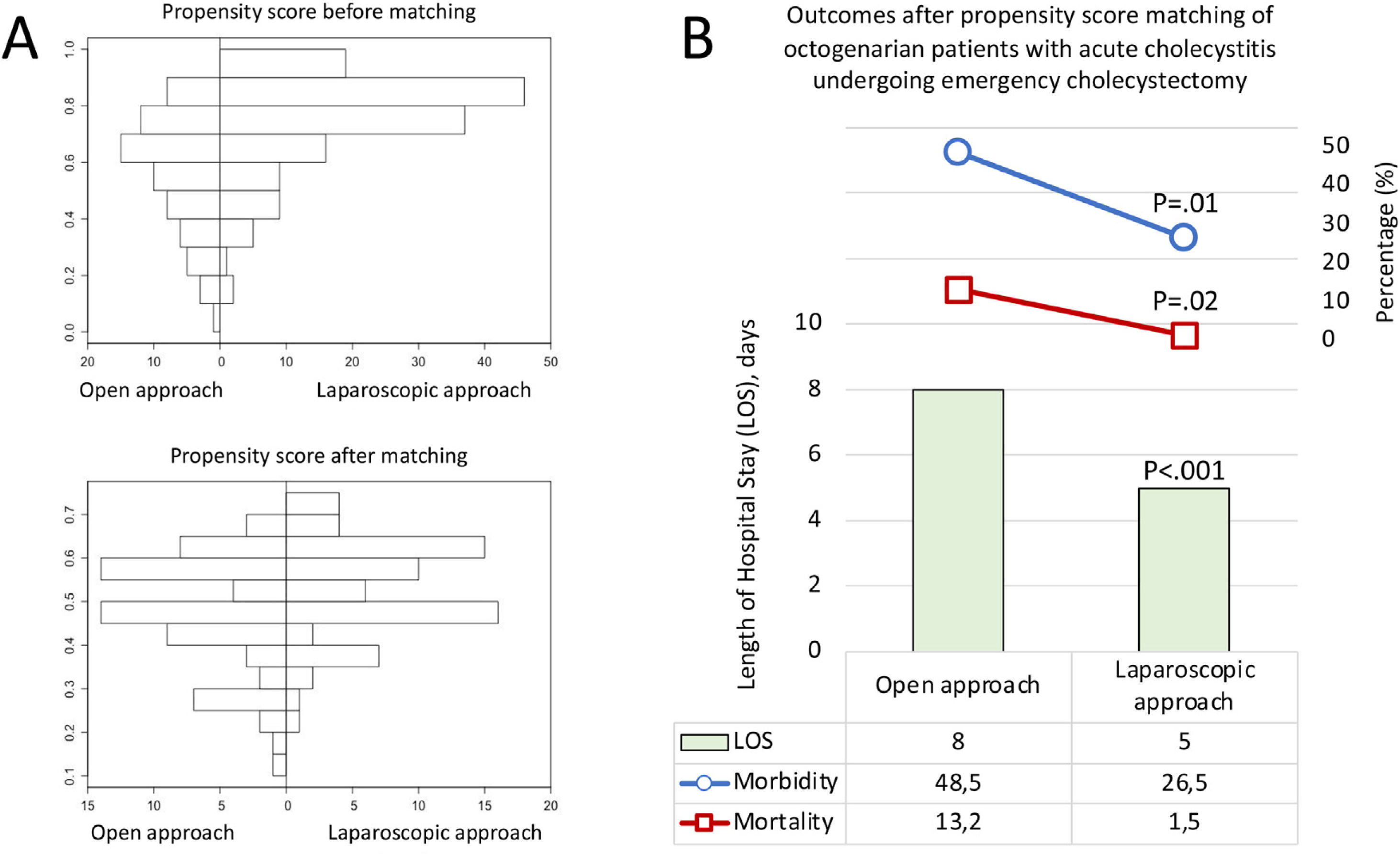
After propensity score matching (Fig. 1A), length of hospital stay was shorter in patients undergoing laparoscopic approach compared to those undergoing open approach (5 days [4–8] vs 8 days [6–13], P < .001) (Table 2, and Fig. 1B). Likewise, 30-day morbidity was lower among patients undergoing laparoscopic approach compared to those undergoing open approach (Table 2, and Fig. 1B). Specifically, the morbidity rate decreased by nearly half (48.5% in open approach vs 26.5% in laparoscopic approach; P = .01). Overall, the incidence of postoperative complications was low. The utilization of the laparoscopic resulted in a reduction in the incidence of hypotension (open, 11.8% vs lap, 1.5%; P = .04) as well as septicemia (open, 14.7% vs lap, 0.0%; P = .001). Finally, 30-day mortality was lower in patients undergoing laparoscopic approach (open, 13.2% vs lap, 1.5%; P = .02) (Table 2, and Fig. 1B).
Panel A: Octogenarian patients with acute cholecystitis distributed according to the open approach or laparoscopy, before (baseline population) or after propensity score matching. Panel B: Length of stay (LOS), 30-day morbidity and 30-day mortality of octogenarian patients with acute cholecystitis distributed according to the open or laparoscopic approach after propensity score matching.
In summary, propensity score matching analysis of a multicenter prospective series showed that laparoscopic approach was better than open approach in octogenarian patients with acute cholecystitis undergoing early cholecystectomy. The laparoscopic approach was associated with shorter hospital stays, decreased incidence of postoperative complications, particularly a reduced occurrence of sepsis, and lower mortality rates.
Similar evidence comes from a systematic review and meta-analysis in elderly patients with acute cholecystitis.22 This review looked at eight studies involving 592 patients. Overall, laparoscopic approach was used in 53% of patients, open approach in 47%, and conversion rate was 23%. The duration of hospital stay ranged from 7 to 13 days. The pooled morbidity rate was 24% (95% CI, 20.5–27.5) and the pooled mortality rate was 3.5% (95% CI, 2.3–5.4). Hospital stay and mortality were higher than the corresponding figures observed in the present study using the laparoscopic approach after propensity score matching.
Studies reporting on length of hospital stays, 30-day morbidity and 30-day mortality in octogenarian patients with acute cholecystitis undergoing early or delayed cholecystectomy during index admission are shown in Table 3. All these studies were retrospective, single center, and were published within the past two decades. However, none of them compared hospital stays, morbidity, or mortality according to surgical approach after propensity scores matching analysis.
Studies reporting on hospital stays, 30-day morbidity, and 30-day mortality of octogenarian patients with acute cholecystitis who underwent emergency or delayed --during index admission-- cholecystectomy by laparoscopic or open approach.a
| First author | Year | Country | n | Approachφ | LOS, days | Morbidity, % | Mortality, % |
|---|---|---|---|---|---|---|---|
| Uecker, et al.13 | 2001 | U.S. | 53 | Lap 34%, Open 47% | 11.7–15.7‡ | 14.0–56.0‡ | 8.6–22‡ |
| Fukami, et al.25 | 2014 | Japan | 24 | Both, unspecified | 8.6 ± 5.1† | 16.9 | 2.9 |
| Nikfarjam, et al.21 | 2014 | Australia | 71 | Lap 89%, Open 4% | 7 (1–33)¶ | 31.0 | 4.0 |
| Oldani, et al.27 | 2019 | Italy | 56 | Primarily lap | 5* | 14.3 | 5.4 |
| Escartín, et al.5 | 2019 | Spain | 113 | Lap 87.4% | 6.8** | 22.1 | 5.3 |
| Vaccari, et al.29 | 2019 | Italy | 63 | Lap 44%, Open 40% | 7.2 ± 6.8† | 25.0 | 3.0 |
| De la Serna, et al.17 | 2019 | Spain | 113 | Lap 68%, Open 13% | 7 (1–39)¶ | 22.0ϕ | 9.7 |
| Park, et al.28 | 2020 | Korea | 120 | Lap 100% | 4* | 28.3 | 1.7 |
| Kim, et al.18 | 2021 | Korea | 352§ | Lap 97%, Open 3% | 13 ± 7.2† | 14.7 | 2.3 |
| D’Acapito, et al.30 | 2022 | Italy | 174 | Lap 54%, Open 22% | NA | 28.7 | 4.0 |
In the present study, the rate of early laparoscopic cholecystectomy in patients with acute cholecystitis was 81.6% in the entire series.35 Among the 212 octogenarian patients included in the present study, 67.9% underwent a laparoscopic approach, while 32.1% underwent a final open approach. Therefore, the percentage of octogenarians undergoing the laparoscopic approach in our study was lower compared to entire population. In this regard, the studies compiled in Table 3 showed laparoscopic approach rates ranging from 34% to 100%.
Although it is difficult to establish a numerical pattern given that data are presented in different statistical formats, length of hospital stay decreased over the years in the studies reviewed in Table 3. The present multicenter prospective study found that length of hospital stay was shorter using laparoscopic approach than open approach, both in the baseline population and after propensity score matching analysis.
Excluding the study by Uecker et al.,13 as it only reported Clavien-Dindo ≥ III complications, 30-day morbidity in the studies reviewed in Table 3 reached a median of 22.1% (16.9–28.3).17,18,21,25,27–30 Our study prospectively recorded fifteen different types of complications, including some minor (i.e., fever, hypotension) and major (i.e., renal failure, septicemia) complications. As a result, 30-day morbidity rate of all patients in our baseline population was 29.2% and reached 48.5% in patients undergoing an open approach. After propensity score matching, 30-day morbidity decreased to 25.5% in patients undergoing a laparoscopic approach, a figure clearly lower than the morbidity achieved by the open approach. Therefore, regardless of the metric used, the present study showed that the laparoscopic approach resulted in less morbidity than the open approach in this cohort of octogenarian patients with acute cholecystitis undergoing emergency cholecystectomy. Regarding specific complications, patients undergoing laparoscopic approach had significantly fewer episodes of hypotension and septicemia than patients undergoing an open approach.
A Finnish study showed that acute cholecystitis was the most frequent cause of intensive care unit admission among elderly patients after gastrointestinal surgery.39 In that study, sepsis was often fatal in elderly patients, as it was associated with higher in-hospital and 1-year mortality rates. Notably, our study revealed a noteworthy disparity in the occurrence of postoperative sepsis between the two approaches. In patients who underwent the open approach, postoperative sepsis was observed in 14.7% of cases, while no instances of sepsis were reported in the laparoscopic approach group.
The single-center retrospective studies depicted in Table 3 demonstrated a median 30-day mortality rate of 4% (2.9–5.3). It is important to note that these studies included patients who underwent cholecystectomy via laparoscopic, open, or converted approaches. In our multicenter study, which also encompassed laparoscopic, open and converted approaches, the 30-day mortality rate among the 212 patients was 4.7%, falling within the interquartile range observed in the aforementioned studies. However, when examining our baseline population based on the type of approach, the 30-day mortality increased to 13.2% for patients undergoing the open approach, while it decreased to 0.7% for those undergoing the laparoscopic approach. After propensity score matching, the 30-day mortality slightly increased to 1.5% for the laparoscopic approach. These observed differences were statistically significant.
Although a formal correlation between sepsis and mortality cannot be established with data from the present study, it is tempting to speculate that the dramatic decrease in postoperative sepsis found in patients who underwent laparoscopic cholecystectomy could explain the significant decrease in 30-day mortality observed in these patients compared with the 30-day mortality rate observed in patients who underwent an open approach.
The present study employed two strategies to enhance the analysis of outcomes: disaggregating results based on approach type and employing propensity score matching. Both strategies consistently favored the utilization of an initial laparoscopic approach in octogenarian patients with acute cholecystitis undergoing emergency cholecystectomy. It is noteworthy that the patients undergoing laparoscopic approach in our study were specifically selected to match the patients undergoing open approach. Importantly, the latter group had higher levels of physiological derangement and greater peritoneal contamination. Thus, the matching process was performed on the basis of high-risk patients, lending greater strength and reliability to the study results.
There are several limitations to our study that should be acknowledged. Firstly, our analysis focused solely on short-term outcomes following surgery, thereby excluding any assessment of medium- or long-term outcomes. Long-term follow-up, health care-related quality of life, and functional status are important in the elderly population. The study was designed for adult patients of all ages and was not specifically tailored for octogenarians. Hence, only data during the first 30 days following surgery were collected. Furthermore, we did no capture conversion rates, as patients who required conversion were included in the open approach group. Similarly, data on readmission and patient-reported outcomes were not collected. Additionally, patients who underwent other treatment modalities for acute cholecystitis, including supportive care, percutaneous gallbladder drainage, or EUS-guided gallbladder drainage were not considered in the present study.
In conclusion, the laparoscopic approach was used in two out of three octogenarian patients with acute cholecystitis undergoing early cholecystectomy. Notably, octogenarians undergoing laparoscopic approach had shorter length of hospital stay, fewer 30-day postoperative complications, especially postoperative sepsis, and less 30-day mortality than octogenarians undergoing open approach. These data suggest that the laparoscopic approach might be the preferred option for octogenarians with acute cholecystitis undergoing early cholecystectomy.
Ethics approval and consent to participateThe medical ethics committee of the Dr. Balmis General University Hospital judged that no informed consent from the patients was necessary because of the observational nature of the study without additional burden for the patient. Subsequently, the ethics committee approved (Ref CEIm: PI2018/104) the analysis of data.
FundingThis research was partially supported by research funds from the Institute of Health and Biomedical Research of Alicante (ISABIAL), Alicante, Spain (BOLA00060).
Conflicts of interestsThe authors declare that they have no conflict of interest
The authors acknowledge Mrs. Susana Macías-Carrasco, Mr. José Manuel Soto-Martínez, Mr. Javier Santamaría, and Mr. Manuel Arnau-Sabatés for their invaluable contribution to the project, and appreciate the vision, commitment, work and trust that they contributed to make the study possible.
The LUCENTUM Project Collaborative Group members who provided study patients and collected data: N. Afonso (Hospital Gran Canaria Doctor Negrín, Las Palmas de Gran Canarias), V. Aguilella (Hospital Clínico Universitario Lozano Blesa, Zaragoza), J. Aguiló (Hospital Lluís Alcanyís de Xàtiva, Valencia), J. C. Alados (Hospital Universitario de Badajoz, Badajoz), M. Alberich (Hospital Universitario de Bellvitge, Barcelona), A. B. Apio (Hospital Marina Baixa, Alicante), R. Balongo (Hospital Juan Ramón Jiménez /Infanta Elena, Huelva), E. Bra (Hospital Infanta Cristina, Parla, Madrid), A. Bravo-Gutiérrez (Hospital Universitario de Canarias, Tenerife), F. J. Briceño (Hospital Reina Sofía de Córdoba, Córdoba), J. Cabañas (H. Ramón y Cajal, Madrid), G. Cánovas (Hospital Parc Taulí de Sabadell, Barcelona), I. Caravaca (Hospital General Universitario de Alicante, Alicante), S. Carbonell (Hospital de Elda, Elda), E. Carrera-Dacosta (Complejo Hospitalario Universitario de Vigo / Hospital Pontevedra), E. Castro E (Hospital Trueta de Girona, Girona), C. Caula (Hospital Trueta de Girona, Girona), E. Choolani-Bhojwani (Hospital Universitario Rio Hortega, Valladolid), A. Codina (Hospital Trueta de Girona, Girona), S. Corral (H. Ramón y Cajal, Madrid), C. Cuenca (Hospital Mutua Terrassa, Barcelona), Y. Curbelo (Consorci Hospitalari de Vic, Barcelona), M. M. Delgado-Morales (Hospital Juan Ramón Jiménez /Infanta Elena, Huelva), L. Delgado-Plasencia (Hospital Universitario de Canarias, Tenerife), E. Doménech (Hospital General Universitario de Alicante, Alicante), A. M. Estévez (POVISA, Pontevedra), A. M. Feria (Hospital Universitario Nuestra Señora de Candelaria, Tenerife), M. A. Gascón-Domínguez (Hospital Clínico Universitario Lozano Blesa, Zaragoza), R. Gianchandani (Hospital Universitario Nuestra Señora de Candelaria, Tenerife), C. González (Hospital Universitario Basurto, Bizkaia), M. A. González (Hospital Universitario Marqués de Valdecilla, Santander), R. J. Hevia (Hospital de Viladecans, Barcelona), J. M. Hidalgo (Hospital Parc Taulí de Sabadell, Barcelona), M. Lainez (Hospital Universitario Marqués de Valdecilla, Santander), F. López (Hospital Clínico de Valencia, Valencia), J. López-Fernández (Hospital Universitario Insular de Gran Canaria, Las Palmas), J. A. López-Ruíz (Hospital Vírgen de la Macarena, Sevilla), P. Lora-Cumplido (Hospital Cabueñes, Gijón), Z. Madrazo (Hospital Universitario de Bellvitge, Barcelona), J. Marchena (Hospital Gran Canaria Doctor Negrín, Las Palmas de Gran Canarias), B. Marenco de la Cuadra (Hospital Vírgen de la Macarena, Sevilla), S. Martín (Hospital de Viladecans, Barcelona), I. Martínez Casas (Complejo Hospitalario de Jaén, Jaén), P. Martínez (Hospital Universitari Sant Joan de Reus, Tarragona), A. Mena-Mateos (H. Ramón y Cajal, Madrid), D. Morales-García (Hospital Universitario Marqués de Valdecilla, Santander), C. Mulas (Hospital Lluís Alcanyís de Xàtiva, Valencia), E. Muñoz-Forner (Hospital Clínico de Valencia, Valencia), A. Naranjo (Hospital Reina Sofía de Córdoba, Córdoba), A. Navarro-Sánchez (Hospital Universitario Insular de Gran Canaria, Las Palmas), I. Oliver (Hospital Marina Baixa, Alicante), I. Ortega (Hospital Universitario Infanta Sofía, Madrid), R. Ortega-Higueruelo (Complejo Hospitalario de Jaén, Jaén), S. Ortega-Ruiz (Complejo Hospitalario Torrecárdenas, Almería), J. Osorio (Hospital Mutua Terrassa, Barcelona), M. H. Padín (Hospital Cabueñes, Gijón), J. J. Pamies (Hospital Sant Pau i Santa Tecla, Tarragona), M. Paredes (Hospital General Rafael Méndez de Lorca, Murcia), F. Pareja-Ciuró (Hospital Vírgen del Rocío, Sevilla), C. V. Pérez-Guarinós (Hospital Morales Meseguer, Murcia), B. Pérez-Saborido (Hospital Universitario Rio Hortega, Valladolid), J. Pintor-Tortolero (Hospital Reina Sofía de Córdoba, Córdoba), K. Plua-Muñiz (Hospital Universitario Rio Hortega, Valladolid), M. Rey (Hospital del Vinalopó, Alicante), I. Rodríguez (Hospital Infanta Cristina, Parla, Madrid), C. Ruiz (Hospital Sant Pau i Santa Tecla, Tarragona), R. Ruíz (Hospital Marina Baixa, Alicante), S. Ruiz (Hospital Universitario Basurto, Bizkaia), A. Sánchez (Hospital Universitari Sant Joan de Reus, Tarragona), D. Sánchez (Hospital Universitario Infanta Sofía, Madrid), R. Sánchez (Hospital Universitario Marqués de Valdecilla, Santander), F. Sánchez-Cabezudo (Hospital Universitario Infanta Sofía, Madrid), R. Sánchez-Santos (Complejo Hospitalario Universitario de Vigo / Hospital Pontevedra), J. Santos (Hospital Universitario de Badajoz, Badajoz), M. P. Serrano-Paz (Hospital Universitario del Vinalopó, Alicante), V. Soria-Aledo (Hospital Morales Meseguer, Murcia), L. Taccogna (Hospital General Universitario de Alicante, Alicante), L. Tallón-Aguilar (Hospital Vírgen del Rocío, Sevilla), J. H. Valdivia-Risco (Hospital Universitario Virgen de las Nieves, Granada), H. Vallverdú-Cartié (Consorci Hospitalari de Vic, Barcelona), C. Varela (POVISA, Pontevedra), J. Villar-del-Moral (Hospital Universitario Virgen de las Nieves, Granada), N. Zambudio (Hospital Universitario Virgen de las Nieves, Granada).