
Patient safety and delivery of high-quality surgical care is dependent on acquisition of both technical skills and non-technical skills. Non-technical skills encompass cognitive and social abilities necessary for good surgical practice. Root Cause Analyses of adverse and untoward events in surgery reveal that underlying causes are often the result of failure to recognise the role of non-technical skills rather than failure of technical skills in the complex work environment of the operating theatre.1 Comprehension of these elements of behaviour can help promote a safer environment for patients and act as a tool to analyse adverse outcomes.2
The effective collaboration among those in the operating theatre has consistently shown to have a positive impact on patient outcomes. Indeed, poor scoring on teamwork metrics have shown to have a significant negative impact on patient outcomes, more so than an individual patient’s ASA grade.3 This suggests that the cohesiveness of the team around the patient outweighs their physiology.
The acquisition of non-technical skills is necessary to create a high-performance team. In the UK, Intercollegiate Surgical Curriculum Programme (ISCP) standards of training state that, “Surgeons need to be able to perform in differing conditions and circumstances, respond to the unpredictable, and make decisions under pressure, frequently in the absence of all the desirable data. They use professional judgement, insight and leadership in everyday practice, working within multi-professional teams.” The need to demonstrate proficiency in this area has been made core to the curriculum through adaption of Generic Professional Capabilities (GPC), which is evaluated at the completion of training. Although it is widely acknowledged, the teaching of these skills to the surgeons of tomorrow has been slowly adopted, and the infrastructure to deliver them is sparse.
The Non-Technical Skills for Surgeons (NOTSS) Masterclass course has been run by the Royal College of Surgeons of Edinburgh since 2007, targeting senior trainees and consultants.
Non-technical skills incorporating human factors have been identified to contribute to efficiency and patient safety in the operating theatres. These include:
Social skills - communication, teamwork and leadership
Cognitive skills - decision making and situational awareness
Personal skills - managing stress and coping with fatigue and wellbeing3
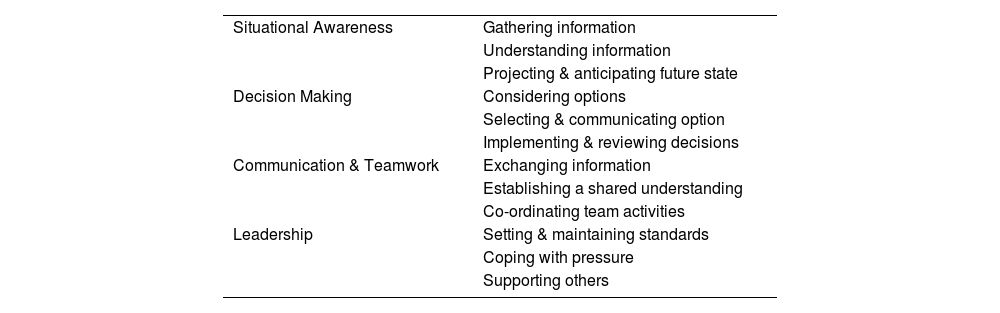
The non-technical skills for surgeons (NOTSS) behaviour rating system is the most commonly used method in surgical practice4 (Table 1).
The NOTSS system comprises a 3-level hierarchy of categories (at the highest level), elements and behaviours. Four skill categories and 12 elements make up the taxonomy.
| Situational Awareness | Gathering information |
| Understanding information | |
| Projecting & anticipating future state | |
| Decision Making | Considering options |
| Selecting & communicating option | |
| Implementing & reviewing decisions | |
| Communication & Teamwork | Exchanging information |
| Establishing a shared understanding | |
| Co-ordinating team activities | |
| Leadership | Setting & maintaining standards |
| Coping with pressure | |
| Supporting others |
Simulation has become established as a core tool in clinical education. It enables learners to acquire the necessary non-technical skills in a setting that does not compromise the safety of patients while also maximising their learning potential. The experience from experts involved in a simulation enables us to examine and transform our own practice beyond the application of core medicine to the science of practicing medicine. Emerging research shows simulation-based learning to be a useful tool to teach non-technical skills to surgeons, which in turn improves patient safety outcomes.5
Simulation can range from the use of manikins, standardised patients and low-fidelity bench models to high-fidelity technologically advanced virtual reality (VR) systems.6 Simulation has been used and is currently well established in several other disciplines, including the military, aviation and astronautics.
High-fidelity (highly realistic) simulation-based education (SBE) is now well established in university undergraduate and early postgraduate training. This includes the use of simulated patients (specially trained role-players) and advanced manikins.7
Briefing is provided for a subset activity within a simulation session (e.g., before a scenario or before practising a new procedure). Providing a context stimulates the learners to relate the simulation activity to a real clinical encounter. For example, “In this scenario, implement the SBAR (Situation/Background/Assessment/Recommendation) communication tool when your colleague arrives to see the patient.” The brief also provides an opportunity to create an environment of psychological safety within the simulation through ground rules.
Debriefing or feedback is the process of evaluating and analysing simulation performance and is the focus of this learning experience. It does not focus on whether the learner’s actions were correct or incorrect, but on the participant’s comprehension of how they approached the scenario. This is the most powerful tool in delivering non-technical education. Analysing the group’s immediate understanding and subsequently incorporating their past experiences in relation to the scenario provides a wider context for practical application of non-technical skills.
In-situ simulation (high environmental fidelity) is an extension of this, where the simulated patient or the manikin is brought into the real clinical setting.8 This enables teams to not only have deliberate practice with their non-technical skills, but to identify latent system errors and human factors in their everyday clinical environment before they impact real patients. In-situ simulation tends to be more focused on team performance than the individual, and therefore has a key role in enhancing the performance of the entire team.9
Recent advances in virtual reality (VR) technology have led to rapidly progressing immersive environments that can be delivered with a VR headset. These are often combined with artificial intelligence programmes which can enable virtual avatars to react and converse with the learner in a meaningful and realistic manner.10
Simulation-based training for non-technical skills is growing in popularity in surgery and can be delivered to replicate an operating theatre environment. These will likely become a normal part of surgical training and surgical team skills maintenance. As such, it is vital that surgical trainers and trainees develop an understanding and utilisation of these tools to ultimately make us better surgeons, be a part of a high-performance team and improve patient safety.