
Editado por: Dr. Calos Cerdán
Cirugía General y Aparato Digestivo. Unidad de Cirugía Digestiva. Hospital Universitario de la Princesa. Madrid
Dr. Matteo Frasson
Cirugía general. Hospital Universitario y Politécnico La Fe. Valencia
Última actualización: Febrero 2026
Más datosThe management of rectal cancer has undergone significant evolution, driven by advancements in staging, treatment strategies, and understanding tumor biology. Initially dominated by total mesorectal excision (TME) with or without neoadjuvant chemoradiation (nCRT), the landscape shifted with the advent of high-resolution magnetic resonance imaging (MRI), which refined locoregional staging and identified prognostic markers such as extramural venous invasion (EMVI) and mesorectal fascia involvement. Tumor response to therapy, particularly complete clinical response (cCR), enabled organ-preserving strategies like the Watch & Wait approach and transanal local excision. Total neoadjuvant therapy (TNT) emerged as a strategy to improve systemic outcomes, though controversies persist regarding its optimal sequencing and survival benefits. Recent breakthroughs, such as immunotherapy for microsatellite instability-high tumors, demonstrate promising non-surgical management options. Current treatment objectives prioritize personalized approaches based on tumor location, risk factors, and the potential for organ preservation, reflecting a nuanced balance between efficacy, functional outcomes, and patient quality of life.
El manejo del cáncer de recto ha experimentado una evolución significativa, impulsada por avances en la estadificación, estrategias de tratamiento y comprensión de la biología tumoral. Inicialmente dominado por la escisión total del mesorrecto (TME) con o sin quimiorradioterapia neoadyuvante (nCRT), el panorama cambió con la introducción de la resonancia magnética de alta resolución (RM), que mejoró la estadificación locorregional e identificó marcadores pronósticos como la invasión venosa extramural (EMVI) y el compromiso de la fascia mesorrectal. La respuesta tumoral al tratamiento, particularmente la respuesta clínica completa (cCR), permitió estrategias de preservación de órganos como el enfoque de Observación y Espera y la escisión local transanal. La terapia neoadyuvante total (TNT) surgió como una estrategia para mejorar los resultados sistémicos, aunque persisten controversias sobre su secuenciación óptima y los beneficios en la supervivencia. Avances recientes, como la inmunoterapia para tumores con inestabilidad de microsatélites alta, demuestran opciones prometedoras de manejo no quirúrgico. Los objetivos actuales del tratamiento priorizan enfoques personalizados basados en la ubicación del tumor, factores de riesgo y el potencial de preservación de órganos, reflejando un equilibrio matizado entre eficacia, resultados funcionales y calidad de vida del paciente.
Contemporary management of rectal cancer has become increasingly challenging and complex over recent years. Until very recently, radical surgery with total mesorectal excision (TME), either with or without neoadjuvant chemoradiation (nCRT), were considered the main pillars of treatment, and there was very little variation in treatment alternatives.1–3 At this point, local staging of rectal cancer was done almost exclusively with endorectal ultrasound (ERUS) to assess cT and cN status.1 Early-stage disease (cT1-2N0) was usually managed by straight-forward TME, while the recommendation for cT3/T4 or cN + was nCRT (even though the optional use of short-course RT therapy alone, without concomitant chemotherapy, was still being debated).1,2,4 Several potential benefits were considered relevant for the use of preoperative nCRT among these patients, including increased local disease control, decreased toxicity (compared to postoperative treatment) and increased chances for sphincter preservation. However, several variables introduced over the last 3 decades have had a significant impact on rectal cancer management.
Magnetic resonance-based managementFirst, widespread introduction of dedicated high-resolution magnetic resonance (MR) for locoregional staging drastically changed the way we stage rectal cancer. MR provided an objective, reproducible risk estimate of positive radial resection margins (pCRM) when performing TME.5,6 Distances of the invasive tumor border to the mesorectal fascia (MRF) ≤1 mm were highly predictive of pCRM + during TME.7 In addition, when controlled for other features such as cT or cN status, mrMRF status remained the sole predictor of local failures following TME.8
MR also provided additional information for management decisions in rectal cancer that were not accurately offered by ERUS. First, MR provides exact tumor location in relation to the peritoneal cavity and pelvic floor. The anterior peritoneal reflection is accurately identified in MR, allowing for the distinction between intraperitoneal and extraperitoneal tumors.6 Notably, this distinction has always an important feature for Japanese surgeons, as the Japanese Society of Colorectal Surgeons uses the Ra abbreviation for cancers above the peritoneal reflection, as opposed to Rb rectal cancers below the peritoneal reflection (despite the rather less precise imaging modality used in the past compared to contemporary high-resolution MR).9 Tumors that are considerably close to the pelvic floor muscles are also clearly assessed by MR. The clear identification of the anorectal ring provides another important feature for contemporary management decision. Tumors located in the distal rectum (defined as being at the same level as or below the anorectal ring) require additional assessment of the intersphincteric plane status.10 Sequences oriented parallel to the anal canal (coronal view) provide a clear estimate of the intersphincteric plane and therefore allow for safe decisions made between sphincter-preserving procedures (clear intersphincteric plane) or abdominal perineal resections (APR – threatened/compromised intersphincteric plane).11
Finally, MR provided information regarding the dissemination of cancer cells within the mesorectal and lateral pelvic compartments. The presence of mixed signal intensity areas along vessels (extramural venous invasion – EMVI) in direct contact with the primary tumor or in nodular/spiculated structures (tumor deposits – TD) seem to correlate with worse oncological outcomes and may also threaten the MRF. These findings, in addition to the possibility of metastatic lymph nodes, may also occur within the lateral pelvic area – defined as the internal iliac and obturator areas.
In short, multiple features provided by MR have challenged the way rectal cancer was being managed previously based on simple cT and/or cN staging features provided by ERUS.
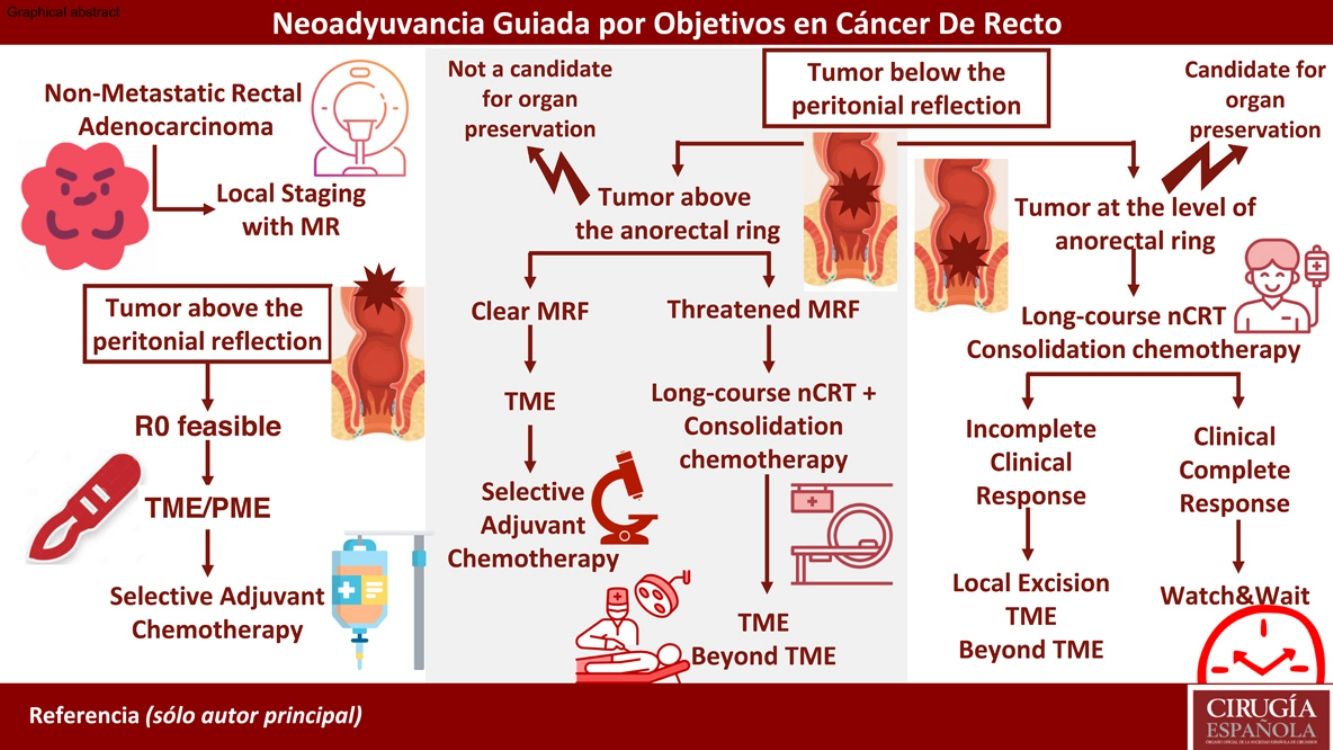
In Fig. 1, we suggest an algorithm for the treatment of rectal cancer, guided by MR findings.
Response to treatmentWhile preoperative RT or nCRT was mainly driven to decrease local recurrence rates and treatment-related toxicity, possibly increasing the chances of sphincter-preservation, an unanticipated outcome changed the way we currently manage rectal cancer. In some patients, tumor response to treatment resulted in complete disappearance of the cancer after radical surgery.12 Complete pathological response (pCR) (defined as the absence of residual microscopic cancer cells within the resected specimens) led surgeons to consider clinical assessment of treatment prior to definitive surgery.13 As expected, a proportion of these patients exhibited complete disappearance of clinical findings (no palpable tumor) and a perfect white scar with no ulceration or mass at the site of the primary disease – coined a clinical complete response (cCR).14 Even though originally described as a clinical/endoscopic entity, subsequent studies using MR shortly provided objective radiological findings consistent with cCR in patients treated with preoperative RT or nCRT.15–17 In an attempt to avoid the functional consequences and the significant morbidity/mortality associated with TME – in additional to the need of temporary or definitive stomas – patients with cCR were offered no immediate surgery and kept under a strict surveillance program, known as the Watch & Wait strategy (WW).13,18 As many patients were successfully treated non-operatively under WW with acceptable oncological outcomes and very attractive functional results, organ-preservation (through no-surgery with WW) became an important variable for management decisions in rectal cancer.19
In addition to non-operative management with WW, tumor response allowed for another alternative management to TME, by full-thickness transanal local excision of residual tumors in cases of significant tumor response. Select patients with rectal cancer and specific MR features at baseline were successfully treated by local excision alone in cases of significant tumor response estimated by clinical and radiological assessment.20,21
In short, the possibility of significant tumor response also became a significant variable relevant to the selection of optimal preoperative treatment in rectal cancer.
Total neoadjuvant therapyThe remaining issue in rectal cancer was improved survival. While preoperative RT or nCRT in the setting of TME seemed to provide optimal local disease control, disease-free (DFS) and overall survival (OS) were not improved. In this setting, preoperative regimens suggested the incorporation of systemic chemotherapy (routinely offered postoperatively, as adjuvant therapy) during preoperative treatment. Different combinations of chemotherapy (doublet or triplet) offered before (induction) or after (consolidation) RT/CRT were introduced and used in clinical trials to demonstrate a survival benefit compared to the standard of care nCRT.22
In fact, TNT trials comparing TNT regimens to the standard CRT did result in improved survival.23,24 While the benefits in DFS are very consistent among trials, a few issues need to be considered here. First, trials used different RT strategies within study arms, such as short-course RT in the experimental arm and long-course RT in the control arm. While one particular study did demonstrate a benefit in distant metastasis-free survival (DMFS) in the experimental arm (consolidation chemotherapy), the control arm exhibited a worse local recurrence rate.25 Subsequent analyses have attempted to attribute these findings to worse quality of surgery and RT in the experimental arm. Still, the superiority in DMFS was somewhat “compensated” by worse local disease control, which was “solved” in rectal cancer management with TNT studies, although this remains disturbing.26
Another study comparing similar RT strategies (in both arms) failed to provide similar chemotherapy regimens in the experimental (induction triplet) and control (selective adjuvant doublet) arms. While this study did demonstrate a benefit in OS, the discrepancies between the chemotherapy administered and the quite toxic triplet profile still raises questions whether this should be the preferred regimen to obtain survival advantages.24
Finally, a few trials compared TNT to other types of TNT regimens. Initiating treatment with chemotherapy would have the hypothetical benefit of addressing upfront micrometastatic disease without the delay of completing long-course CRT. However, the comparison of induction to consolidation chemotherapy in TNT regimens failed to demonstrate any survival differences.27,28
Chemotherapy aloneRT (with or without concomitant chemotherapy) did demonstrate a benefit in local disease control.1,2,29 It also demonstrated significant primary tumor response to allow for organ-preservation strategies.12 However, this was at the cost of significant postoperative morbidity and functional consequences.30 Patients treated with preoperative RT are more likely to have worse functional outcomes and a higher risk for anastomotic complications.30 Therefore, one study posed the question whether chemotherapy alone delivered preoperatively could be non-inferior to regular nCRT in terms of local control and survival.31
This study selected patients based on locoregional staging to include stage II and III rectal cancers with clear margins (mrMRF) located above the anorectal ring (not requiring APR) to receive doublet-chemotherapy versus regular nCRT. As expected, local control was excellent in both arms, and all tumors were MRF-clear at baseline. Surprisingly however, there was no survival benefit (which had been observed in TNT studies) among patients receiving preoperative chemotherapy. The study concluded that select patients could be spared unnecessary RT, with no oncological compromise. However, one could argue that these patients could have been treated with TME alone (as they were MRF-clear above the anorectal ring) and selective adjuvant chemotherapy (to potentially avoid chemotherapy overtreatment with the preoperative approach) in the absence of any observed survival benefit.31
TNT & tumor responseEven though TNT was originally designed to improve survival, it also improved primary tumor response.22 Early studies suggested higher rates of complete pathological response among patients treated with TNT versus regular nCRT. Retrospective data also suggested improved cCR among patients treated by TNT compared to regular nCRT.22,32,33 Finally, the only study comparing 2 TNT regimens using avoidance of TME as a primary endpoint showed a higher chance of successful organ preservation with WW among patients undergoing long-course RT and doublet consolidation chemotherapy.28
Microsatellite instability and immunotherapyMicrosatellite instability (MSI-high) may be present in nearly 5% of all rectal adenocarcinomas. Although these MSI-high tumors may also show significant primary tumor response to nCRT, nearly one-third of MSI-high tumors experience disease progression during neoadjuvant chemotherapy. The introduction of PD-1 checkpoint inhibitors has revolutionized the therapeutic landscape, demonstrating significant efficacy in MSI-high tumors by activating the host immune system to mount a strong anti-tumor response.34 This approach was particularly highlighted in a clinical trial involving patients with primary MSI-high rectal adenocarcinoma. Remarkably, all 14 participants (100%) achieved cCR using PD-1 inhibitors alone, without requiring additional radiation therapy or conventional chemotherapy. So far, these patients have been successfully managed non-operatively without the need for TME. Although these findings are groundbreaking, further research with larger cohorts and extended follow-up is needed. Nevertheless, this represents a transformative step in rectal cancer treatment, where molecular profiling, such as MSI status, could guide immunotherapy strategies and potentially eliminate the need for RT, standard chemotherapy or even invasive procedures like TME.34
Treatment objectives and selection – putting it all togetherFor the subdivision of this section, we will classify rectal tumors according to the Japanese Society for Colorectal Surgeons as follows: Tumors above the peritoneal reflection (Ra) and tumors below the peritoneal reflection (Rb). Rb tumors will be further subdivided into Rb(1) for tumors located superior to the anorectal ring and Rb(2) for those located at the anorectal ring level.9
- 1
Local disease control
Ra – Tumors above the peritoneal reflection
Clearly, RT has a role in local disease control for rectal cancer. In patients with tumors above the peritoneal reflection, this benefit is less clear for multiple reasons. First, intraperitoneal tumors including T4a are at increased risk for peritoneal dissemination, and it remains unclear whether RT provides any benefit for decreasing the risk of subsequent carcinomatosis.35 Second, RT fields are likely to include intraperitoneal structures (including the small bowel) and result in significant toxicity.36 Third, because intraperitoneal tumors often offer the possibility of an R0 resection – an important surrogate marker for local disease control. Unless considered unresectable (with an R0 resection), one could favor no preoperative RT. Furthermore, in the absence of a demonstrated benefit of chemotherapy alone delivered preoperatively in any trial, one could argue for going straight to surgery in this setting.31
Rb – below the peritoneal reflection
Rb(1) – above the anorectal ring
MRF – clearThese patients clearly require TME. In the absence of a threatened MRF (tumor distance of ≥2 mm from MRF), local control has reportedly been excellent after upfront TME without preoperative RT.8,37 Again, in the absence of a survival benefit demonstrated by chemotherapy alone, one could favor TME alone for Rb, above the anorectal ring, and clear MRF for most patients.31
Threatened MRFTME alone here is probably insufficient. These patients appear to be at a higher risk for local recurrence, and RT therapy delivered preoperatively is likely to be beneficial.38 Patients with threatened MRF are also at risk for metastatic disease, and these patients may also benefit from preoperative systemic chemotherapy, with either induction or consolidation.39 Since the German trial did demonstrate a higher pCR rate among patients undergoing consolidation chemotherapy (compared to induction), long-course RT with consolidation chemotherapy would be the preferred approach.27
Considering the disappointing results with short-course RT and consolidation chemotherapy in the RAPIDO trial, such a regimen should be considered with caution in this setting.23,25,26
In instances of T4-staged tumors, characterized by unequivocal extension into contiguous anatomical structures, the implementation of a ‘beyond TME’ may be deemed necessary. The beyond TME is indicated in cases of rectal cancer where neoplastic invasion extends beyond the mesorectal fascia, necessitating en bloc resection of contiguous pelvic organs or structures.
Rb(2) – at the level of the anorectal ring
As the rectum reaches the pelvic floor, anatomical and functional details become relevant. Anatomically, the mesorectal fat around the rectal tube progressively disappears. This means that the distance from the invasive border of tumors become shorter and closer to the MRF. At the level of the anorectal ring even tumors restricted to the entirety of the muscularis propriae may threaten the MRF. In addition, in order to perform an oncologically sound procedure and obtain a proper distal margin, an intersphincteric resection (at least partial) is probably required, leading to significant functional consequences.40 Finally, tumors that grow beyond the muscularis propriae will frequently threaten or compromise the intersphincteric plane, and therefore require an APR. In this setting, organ preservation – with either WW or local excision – is an attractive alternative. Therefore, most of these patients will benefit from preoperative treatment in order to minimize the risk of an R1 resection and/or to achieve significant tumor regression to allow for organ preservation.
Based on the data provided by the studies comparing TNT to standard CRT, TNT clearly offers a higher chance of primary tumor regression.27,28 Among TNT regimens, consolidation chemotherapy is apparently superior – both in terms of pathological and clinical response. In addition, the vast majority of the clinical experience with WW and organ preservation is with the use of long-course RT.41 While short-course RT may allow for organ-preservation, studies performing a head-to-head comparison are still lacking, and long-term results are eagerly awaited.42,43
- 2
Organ-preservation (WW)
While both RT and chemotherapy may lead to complete pathological response in rectal cancer, there is only anecdotal experiences with organ preservation with chemotherapy only. Therefore, RT seems to be a crucial part of treatment when organ preservation is envisioned.
Ra – Tumors above the peritoneal reflection
These tumors could potentially be treated with partial mesorectal excision. This means the majority of these patients will have the anastomosis at a higher level, with fewer functional consequences.44 In addition, these patients are likely to be spared from a temporary stoma. Finally, as intraperitoneal tumors are beyond the reach of the finger during digital rectal examination, surveillance in the eventuality of a cCR may become jeopardized and increase the risk of undetected local regrowth.45 Therefore, preoperative treatment to achieve cCR in Ra rectal tumors is probably not recommended.
Rb – below the peritoneal reflection
Rb(1) – above the anorectal ring
Rb tumors require proper TME. However, these tumors are frequently beyond the reach of DRE and would therefore fall into the category of Ra tumors, not being appropriate for WW due to the risk of undetected local regrowth.45 Therefore, preoperative treatment to achieve cCR in Rb rectal tumors above the anorectal ring (beyond the reach of DRE) is probably not recommended.
Rb(2) – at the level of the anorectal ring
These patients are probably the best candidates for receiving preoperative treatment for the purpose of achieving cCR or organ preservation. TME is required here, often with intersphincteric resections or even with APR. The majority of these patients will harbor tumors within the reach of DRE. However, some degree of controversy has arisen around Rb at the level of the anorectal ring among morbidly obese patients. This is because DRE will often NOT allow full reach to the tumor among these patients. In our practice, we have considered many of these patients on a case-by-case basis, despite the challenges in tactile assessment of baseline and treatment response.
Based on the results of the OPRA trial and retrospective data, TNT regimens, and consolidation chemotherapy in particular, appear to be the best chances of achieving cCR and organ preservation.22,28,32,33
- 3
Survival (DFS)
Even in patients who are not candidates for organ preservation and at low-risk for local recurrence, risk factors for systemic recurrence may be present – EMVI, tumor deposits or cN2 disease. TNT clearly has resulted in an impact in DFS, despite the significant limitations inherent to the TNT trials’ design, as discussed previously.23,24 Even though one could argue that patients with high-risk for metastatic disease would benefit from induction chemotherapy (in order to address micrometastatic disease upfront), no trial comparing induction to consolidation chemotherapy has demonstrated any survival benefit. While this may be a reasonable strategy hypothetically, the clinical evidence has yet to be provided.
In this setting, patients at low-risk for local recurrence (clear MRF) and high-risk for metastatic disease could be offered either induction or consolidation TNT regimens, indistinctively. However, in the absence of risk factors for local recurrence, one may argue for sparing these patients from the unnecessary toxicity of RT. As the single chemotherapy-only trial for rectal cancer patients failed to demonstrate any survival benefit, chemotherapy alone in the presence of a clear MRF tumor, even in the presence of high-risk features for systemic recurrence, remains controversial.
The controversy arises from the fact that many of these patients may be overtreated with unnecessary chemotherapy. Clear-MRF tumors may harbor high-risk stage II or stage III disease. Initially, overtreatment was an important argument for avoiding preoperative chemotherapy in high-risk stage II rectal cancer patients, derived from data of stage II colorectal cancer patients.46 Staging may considerably overestimate the presence of high-risk features among these patients. More recently, patients with high-risk stage II colorectal cancer were tested for the presence of circulating tumor DNA (ctDNA). Patients with high-risk stage II cancer and negative postoperative ctDNA apparently did not benefit from adjuvant chemotherapy.47 Even more recently, similar findings have been reported for stage III colorectal cancer patients.48 Altogether, adjuvant chemotherapy may only benefit patients with positive postoperative ctDNA in stage II and stage III. If this is also true for rectal cancer, routine preoperative chemotherapy would overtreat a significant proportion of patients.
In summary, in patients that DO NOT have clear indications (benefits) from preoperative treatment for the purpose of local disease control or organ preservation, the benefits for use of preoperative TNT or chemotherapy alone may be limited (leading to significant overtreatment).
- 4
Sphincter-preservation
One of the alleged benefits of preoperative treatment with RT or CRT is the potential to increase the chances for sphincter preservation (SP) in rectal cancer. Unfortunately, this observation was derived from early studies, where locoregional staging was performed by ERUS and the decision between APR and SP was based on clinical assessment, frequently intraoperatively. In one of the earliest studies reporting on increased chances of SP after preoperative nCRT, there was an intraoperative change in surgical procedure performed in nearly 20% of patients managed by TME alone. This suggests that clinical assessment for the decision between APR and SP was largely imprecise.1,49 In addition, none of the RCT or subsequently performed meta-analysis could demonstrate higher rates of SP surgery among patients managed by neoadjuvant treatment.50
Currently, MR and intersphincteric plane status provide an objective indication for the choice of the procedure.51 While tumors compromising the intersphincteric plane may exhibit significant tumor response, avoiding APR would only be possible among patients with cCR, and therefore organ preservation instead of sphincter preservation. This is because, in the setting of incomplete clinical response (ie, in the presence of residual cancer within the rectal wall), it becomes nearly impossible to safely enter the originally compromised intersphincteric plane, now replaced by a low-signal intensity area (fibrotic changes). Ruling out the presence of microscopic residual cancer in the intersphincteric plane in the presence of residual cancer within the rectal wall would be an unsafe assumption due to the possibility of fragmented pattern of tumor regression.52–54
- 5
Unanswered issues for future research
The preferred initial treatment strategy for rectal cancer remains unresolved in various clinical situations. Patients with metastatic disease are perhaps the most challenging. One of the issues is the heterogeneity among metastatic disease, both in terms of extension of metastatic disease and of specific sites, including peritoneal, liver/lung and others. In most cases, indications for RT would follow the same principles used for non-metastatic settings: high-risk for local failure, or the interest in organ preservation. However, in the presence of uncurable disease, one could argue that chemotherapy alone is likely to provide sufficient tumor response rendering RT unnecessary in the setting of limited survival expectancy.
Another challenging clinical scenario is the presence of early-stage disease. Potentially, patients with mrT2N0 may only benefit from preoperative treatment for the purpose of achieving cCR and entering an organ-preservation program.55 Therefore, one has to consider the paradox of intensifying treatment with additional chemotherapy for the sole purpose of increasing primary tumor response in the absence of any anticipated survival benefit. In this context, trials that de-escalate treatment regimens are warranted to minimize toxicity without compromising cCR and organ-preservation rates.56
ConclusionsContemporary management of rectal cancer remains challenging. Molecular profiling and locoregional staging/assessment using clinical assessment and radiological imaging (MR) play a key role in optimal initial treatment selection. Ultimately, however, clinicians/surgeons should consider treatment objectives in the light of molecular profiling and locoregional staging in this management decision process, including optimal local disease control, risk of distant metastases and the “desire” to avoid radical surgery – with all its functional and morbidity consequences. Patients with tumors above the anorectal ring may benefit the most from preoperative treatment when high-risk features for local recurrence are present. Patients with tumors at the level of the anorectal ring may benefit from preoperative treatment even in the presence of low-risk features for the purpose of achieving cCR and organ preservation. Molecular profiling (MSI status) may guide preoperative treatment management in these patients as immune checkpoint inhibitors have shown promising outcomes in MSI-high tumors and are currently being prospectively evaluated in clinical trials. Instead, MSS tumors requiring preoperative treatment – either for the purpose of optimizing local control or achieving a cCR – are best treated by long-course nCRT followed by consolidation chemotherapy. The role of preoperative treatment with chemotherapy alone remains elusive for the purpose of achieving improved DMFS.
The authors declare no conflicts of interest.