




Primary congenital glaucoma (PCG) is a significant cause of childhood vision loss. While visual acuity can be measured, it does not always reflect visual functioning in daily life, particularly as oculomotor skills are often compromised in ocular disorders. This pilot study assesses oculomotor behavior in children with PCG compared to healthy peers using the Device for an Integral Visual Examination (DIVE).
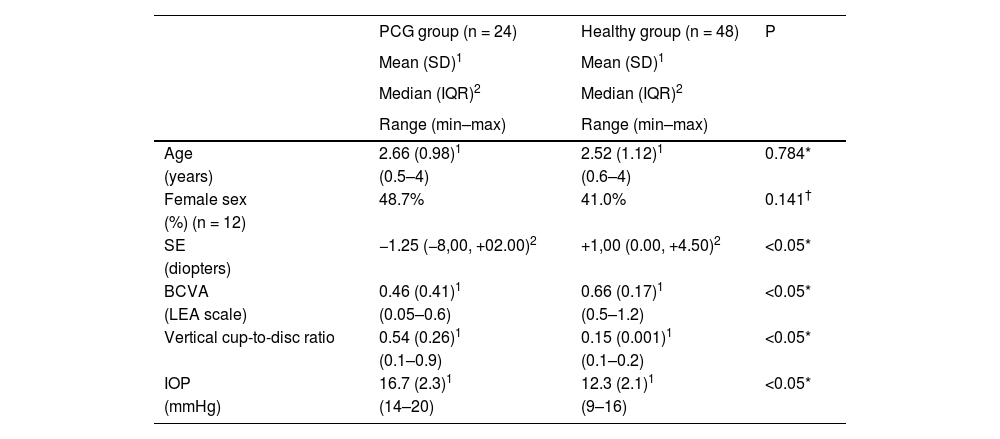
MethodsTwelve children with PCG (n = 24 eyes) and 24 healthy children (n = 48 eyes), aged 6 months to 4 years, were recruited. DIVE was used for automated oculomotor assessments, measuring fixation (gaze stability, fixation stability, and duration of fixation), saccadic movements (reaction time, peak velocity), and smooth pursuit (latency, gain).
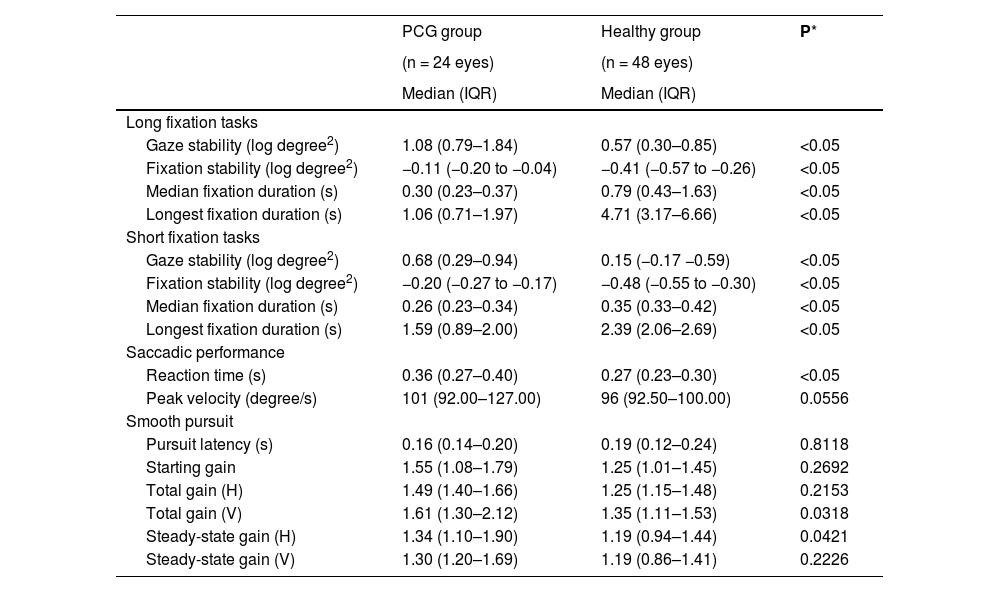
ResultsPCG children showed significantly poorer gaze stability in both short (0.68 log degree2, 0.29–0.94 frente a 0.15 log degree2, −0.17–0.59; p < 0.05) and long tasks (1.08 log degree2, 0.79–1.84 frente a 0.57 log degree2, 0.30–0.85; p < 0.05), and poorer fixation stability in short (−0.20 log degree2, −0.27 to −0.17 frente a −0.48 log degree2, −0.55 to −0.30; p < 0.05) and long tasks (−0.11 log degree2, −0.20 to −0.04 frente a −0.41 log degree2, −0.57 to −0.26; p < 0.05). Fixation durations were shorter, and saccadic reaction times were longer in the PCG group, while pursuit latency showed no significant difference (p = 0.8118).
ConclusionsChildren with PCG have significantly impaired oculomotor behavior, including greater instability in gaze and fixation, shorter fixation durations, and longer saccadic reaction times compared to healthy peers.
El glaucoma congénito primario (GCP) es una causa importante de pérdida visual en la infancia. Aunque se puede medir la agudeza visual, esta no siempre refleja el funcionamiento visual en la vida diaria, especialmente cuando las habilidades oculomotoras están comprometidas en los trastornos oculares. Este estudio piloto evalúa el comportamiento oculomotor en niños con GCP en comparación con niños sanos utilizando el dispositivo de examen visual integral.
MétodosSe seleccionaron 12 niños con GCP (n = 24 ojos) y 24 sanos (n = 48 ojos), con edades comprendidas entre los 6 meses y los 4 años. Se utilizó el dispositivo de examen visual integral para realizar evaluaciones oculomotoras automatizadas, midiendo fijación (estabilidad de la mirada, estabilidad de la fijación y duración de la fijación), movimientos sacádicos (tiempo de reacción, velocidad máxima) y seguimiento ocular (latencia de seguimiento, ganancia).
ResultadosLos niños con GCP mostraron una estabilidad de la mirada significativamente peor en tareas cortas (0,68 log grado2 [0,29 a 0,94] frente a 0,15 log grado2 [−0,17 a 0,59]; p < 0,05) y largas (1,08 log grado2 [0,79 a 1,84] frente a 0,57 log grado2 [0,30 a 0,85]; p < 0,05), así como una peor estabilidad de fijación en tareas cortas (−0,20 log grado2 [−0,27 a −0,17] frente a −0,48 log grado2 [−0,55 a −0,30]; p < 0,05) y largas (−0,11 log grado2 [−0,20 a −0,04] frente a −0,41 log grado2 [−0,57 a −0,26]; p < 0,05). Las duraciones de fijación fueron más cortas y los tiempos de reacción sacádicos más largos en el grupo con GCP, mientras que la latencia de seguimiento no mostró una diferencia significativa (p = 0,8118).
ConclusionesLos niños con GCP tienen un comportamiento oculomotor significativamente deteriorado, que incluye una mayor inestabilidad en la mirada y la fijación, duraciones de fijación más cortas y tiempos de reacción sacádicos más largos en comparación con sus pares sanos.

