




The flood in Valencia (Spain) has so far caused 224 casualties, making it the catastrophic event with the highest number of fatalities in Spain's recent history. This catastrophe involving a high number of victims, a large geographical extension and the destruction of infrastructures posed a major challenge to the forensic response. This article presents the work carried out during an open disaster, following the adhesion of the Institute of Legal Medicine and Forensic Science of Valencia to the application of ‘Real Decreto 32/2009 approving the National Protocol for Forensic and Scientific Police intervention in multiple casualties events’ in Spain. The excellent performance of the members of the Institute of Legal Medicine and Forensic Science of Valencia and the rest of Institutes of Legal Medicine and Forensic Science of Spain, together with the specialists of the Civil Guard and National Police corps, allowed the fast and efficient location, transfer, autopsy, identification and delivery of all the victims to their relatives. Likewise, some recommendations for action are suggested as a result of the experience acquired to face future events of similar characteristics.
La riada sufrida en Valencia (España) ha ocasionado, hasta el momento, 224 víctimas mortales, siendo el evento catastrófico con mayor número de fallecidos en la historia reciente de España. Al tratarse de una catástrofe con un elevado número de víctimas, gran extensión geográfica y destrucción de infraestructuras, la actuación médico forense supuso un reto mayor. Este artículo expone el trabajo realizado durante una catástrofe abierta, tras la adhesión del Instituto de Medicina Legal y Ciencias Forenses (IMLCF) de Valencia a la aplicación del Real Decreto 32/2009 por el que se aprueba el Protocolo nacional de actuación médico-forense y de policía científica en sucesos con víctimas múltiples en España. Gracias a la excelente actuación de los integrantes del IMLCF de Valencia y del resto de IMLCF de España, junto a los especialistas de la Guardia Civil y del Cuerpo Nacional de Policía, pudo realizarse de forma rápida y eficaz la localización, traslado, autopsia, identificación y entrega a los familiares de todas las víctimas. Asimismo, se proponen algunas recomendaciones de actuación, fruto de la experiencia adquirida, para afrontar futuros sucesos de características similares.
Few events pose such a serious crisis for an Institute of Legal Medicine and Forensic Science (IMLCF) as incidents involving multiple victims. Such events test not only the IMLCF's own management and operational capabilities but also its ability to coordinate and collaborate with other professional bodies. These bodies range from local and national law enforcement agencies and the armed forces to civil protection. The challenge presented by an event of this nature is twofold. Firstly, it is necessary to be able to absorb and manage a large number of deceased persons in a short period of time, whose state of preservation is unknown. Secondly, the identification work is crucial in order to meet the legal requirements for all violent deaths.1 However, this effort should not only focus solely on the deceased but also on their families, who come to the ante mortem (AM) offices expecting answers, professionalism, and comfort.
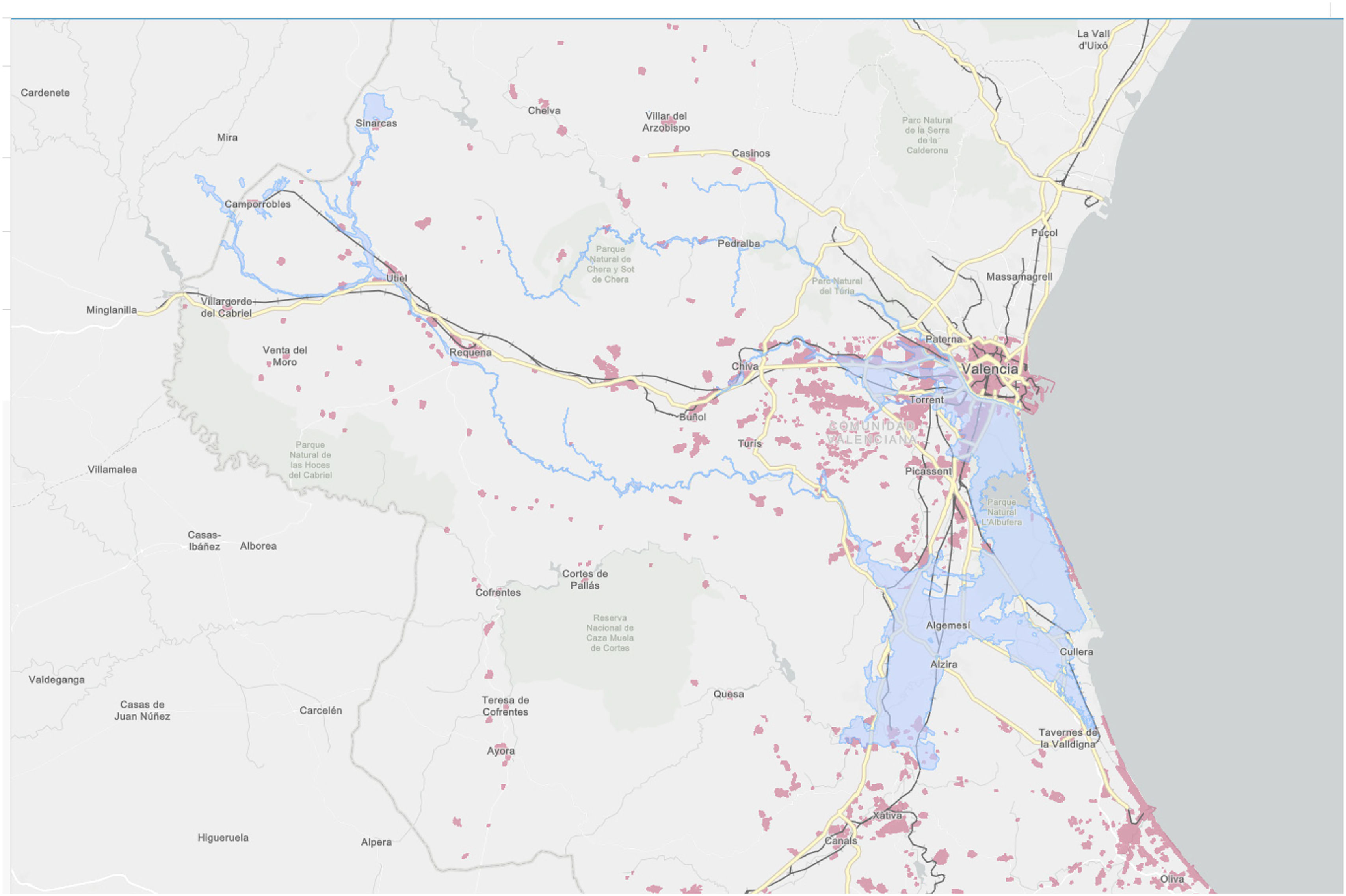
On 29 October, heavy rainfall in the interior of Valencia province, on Spain's east coast, caused several rivers and ravines to overflow, flooding neighbouring towns. The Turia River, the Gayo ravine that continues into the Chiva and Poio ravines, the L'Horteta ravine, and the Mijares and Magro rivers, including the Forata reservoir, were the areas most affected (Fig. 1).2

Map showing the affected riverbeds and rivers, and flooded areas. Taken from MapDANA.2
Since the approval of Spain's Royal Decree 32/2009 on 16 January, which approved the National Protocol for Forensic Medical and Scientific Police Action in Events with Multiple Victims,3 the IMLCF in Valencia has found it necessary to implement the protocol on two occasions in 2024. The first was during the serious fire that occurred in Valencia in January 2024, resulting in 10 fatalities. The second occasion was in response to the flooding caused by the isolated low-pressure system (DANA)4 in October 2024, resulting in 224 fatalities. These victims have been located, identified, and handed over to their families, with three AM files still open. Therefore, it is clear that the implementation of this protocol depends not only on the number of deaths but also on the characteristics of the event and the difficulty in identifying the victims.
Action and response to the flash floodFollowing the flash flood on 29 October 2024, the forensic doctor on duty in the judicial district of Torrente (Valencia) was called out in the early hours of 30 October after notification from the Integrated Operational Coordination Centre (CECOPI). Information about the event and potential victims was received gradually. Upon receiving this information, the Judicial Commission was activated and travelled to Paiporta to assess the situation, arriving at 4:00 a.m. During the initial hours, efforts were made to coordinate the response with the emergency services and police in attendance. However, coordination became particularly complicated due to difficulties in travel caused by damage to infrastructure and communications. Those present moved to a service station near Paiporta, one of the few places with electricity thanks to its own generator. This petrol station later became the advanced command post (PMA),5 from which the evacuation of neighbouring towns was coordinated, among other operations.
In the early hours of the morning, the Civil Guard and National Police Corps responsible for multiple victim incidents in the province of Valencia were contacted by telephone. It was agreed that a coordination meeting would be held at 8:00 a.m. at the IMLCF. During the meeting, the following organisational guidelines were established: the location and start-up of the Data Integration Centre (CID), the coordination of teams for the removal and coding of bodies, the location and putting into operation of the AM offices, the location of the body-holding area and, finally, the coordination of both AM and post mortem (PM) DNA sampling.
Data integration centre (CID)It was agreed that the CID would be located in the City of Justice in Valencia, in a room close to the IMLCF headquarters, and that it would be operational immediately. There, personnel trained in multiple victim incidents from the Civil Guard (GC), the National Police (CNP), and the IMLCF itself, worked together to cross-check information obtained from bodies and families. In accordance with Royal Decree 32/2009, the CID would officially and exclusively release information on the number of deceased individuals who had been identified and returned to their families through the press officer of the High Court of Justice of Valencia.3
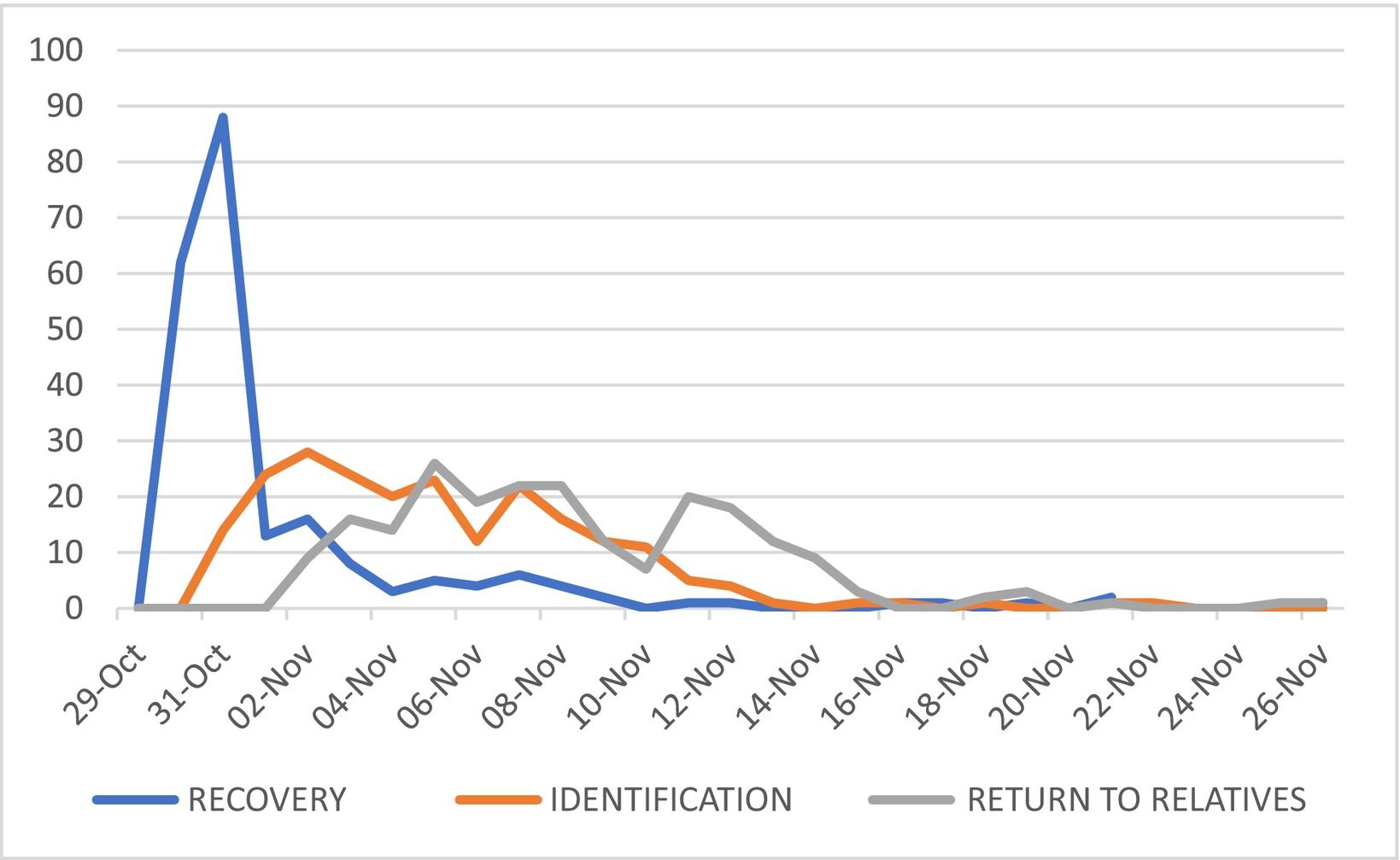
Prior to the judicial notification of identification based on primary identification elements (dentistry, DNA, and lofoscopy), it was agreed that the secondary identification elements obtained from the AM offices and the PM area would also be verified. This reinforced the identification of the bodies prior to official notification and avoided discrepancies. Once verified, a joint identification report was issued by the state security forces (FCSE) and the IMLCF. This was sent to the investigating court, together with the autopsy report, via our computer application after receiving the judicial request (Fig. 2).

At the same time, the CID informed the body-holding area of the full identification of each body. The bodies were then transferred from the ‘unidentified bodies’ area to the area reserved for ‘identified bodies’, pending judicial authorisation for their return to relatives. Throughout this process, the different work areas shared AM and PM information, which once again corroborated the absence of discrepancies in the various identification elements.
One of the obstacles encountered during work at the CID was the lack of a ‘common’ computer programme in which the various organisations involved (the FCSE and the IMLCF) could enter the data obtained in each phase. This was particularly challenging given that the information came from two police forces with different AM offices collecting data, as well as from the IMLCF in the PM phase. This meant that a double coordination effort was required when sharing and comparing the information obtained. This was handled with great professionalism by all members of the CID.
The CID remained available ‘in person’ until 12 November 2024. It is currently operating virtually until the pending AM files have been resolved.
Ante mortem officesAs with the other work areas, they were planned from the outset of the response.3 One of the biggest problems that arose was the considerable size of the affected population and the lack of a list of potential victims, given that this was an ‘open’ disaster.6 This made it difficult to decide where to locate the ante mortem (AM) offices. Initially, the FCSE set up two offices in two different locations in the city of Valencia (one for the CNP and one for the GC). These offices were staffed by professionals from the FCSE and the IMLCF, as well as victim support staff sent by the Regional Ministry of Justice and Public Service. However, difficulties in accessing and sharing information with the affected population meant that new satellite MA offices had to be set up in different towns on 6 November 2024. In the days that followed, a total of five MA offices were in operation until 13 November 2024 (Fig. 3).

From a medical-forensic point of view, one of the basic aspects of AM offices is to highlight the importance of all medical data that can be obtained from relatives, with special emphasis on the dental records of the deceased (one of the three primary elements of identification7). All this medical information has triple value. Firstly, it enables direct identification through the CID by comparing dental data8; secondly, it allows the information obtained during the autopsy to be compared with the information obtained at the AM office (secondary elements), thus reinforcing the matching primary elements. Finally, the presence of easily identifiable medical elements (e.g., prostheses or pacemakers) can facilitate the identification process by enabling the association of a potential identity with the other primary elements obtained from the body. This provides central identification laboratories with a potential candidate for identity verification.
Judicial actionOn 23 November 2011, the plenary session of the General Council of the Judiciary (CGPJ) approved the Protocol for Judicial Action in Cases of Major Disasters.9 This protocol improves coordination and knowledge of judicial, forensic medical and scientific police action on the part of the investigating judge. In the Province of Valencia, the judicial officer appointed to these cases was invited to the initial coordination meeting on the response so that they would be aware of all decisions taken at the meeting and, where necessary, give their approval. The task of recovering bodies was delegated to the recovery teams. However, another major problem encountered during the response to the flood was geographical dispersion, which led to 10 judicial districts being involved at the same time, many of which had infrastructure severely affected by the flood itself (Fig. 4). Due to the time required for recovery, autopsy and identification work, there was also the logical changeover of duty courts in these judicial districts. This again required extra coordination efforts by the FCSE and the IMLCF with the various judicial bodies involved.

Map of affected judicial districts. Taken from the Ministry of Justice.10
Initially, body recovery teams (ELCs) comprising IMLCF staff from Valencia were set up to cover the entire affected area. These teams were activated in coordination with the FCSE. The number of ELCs was managed according to the reported possible findings. On 30 October 2024, work began with 18 recovery teams, each comprising a forensic doctor acting as coordinator, as well as psychologists and social workers from the IMLCF in Valencia and disaster victim identification teams (IVDs) from the FCSE. Table 1 shows how the number of ELCs changed during the response. The number of teams and the length of time involved required a significant investment of personnel for this type of work.
Starting on the afternoon of 30 October 2024, and with invaluable help from colleagues at other IMLCFs across Spain, the number of teams was increased, and their members were reorganised.
Due to the difficulty of accessing the bodies, and for safety reasons, it was decided that the recovery work would be carried out during daylight hours. From 5 November 2024, however, with the support of the Military Emergency Unit (UME) teams, the ELCs remained on duty 24 h a day in case more fatalities were found during night-time clean-up and debris removal work.
Due to the scale of the disaster and the lack of exact recovery points, a code was assigned to each recovery team each day for the identification of bodies during the recovery process. The ELCs kept this code throughout the day, and it was never used again. This made it possible to trace the day and area of recovery associated with a particular team. The coding system was established as ‘tens’ for the teams, followed by the serial number of the body or remains recovered (e.g., C-2201). Based on experience, it is suggested that, for future operations, team codes take the form of registration numbers with letters inserted between the team number and the number of the body/remains in order to avoid coding errors.
Taking into account the evolution of the discovery of bodies (Fig. 2), it was decided that, from 12 November 2024, the recovery work would be carried out by the forensic doctors on duty at the IMLCF in Valencia. These doctors were assigned a recovery team code based on the day and area in which they were on duty.
Body-holding areaThe body-holding area is another key aspect of the response to a major disaster. It is essential to create a team responsible for managing this area in order to properly control the workflow involving the bodies (registration of entry, work to be carried out, quality control, and exit), and this team must remain active at all times during the response. Initially, in accordance with the IMLCF's Forensic Action Plan for cases involving multiple fatalities in Valencia,11 this holding area included not only the areas for working with the bodies but also the area for preserving and storing bodies and human remains. The Territorial Emergency Plan of the Valencian Community5 establishes that the garage adjacent to the IMLCF in the City of Justice should be fitted out to preserve bodies using refrigerated trucks. However, due to the increasing number of victims, on 30 October 2024, it was decided to transfer the area for the preservation and custody of bodies on which medical-forensic and technical-police work had been completed to the Valencia trade fair centre.
The management team's role in the body-holding area was to control entry, check documentation generated during removal, manage workflow, and order transfer to storage once all work had been checked and found to be in order.
Although Royal Decree 32/2009 establishes that bodies must be classified as ‘fingerprinted/fingerprinting imminent’ or ‘unidentified’ upon arrival at the IMLCF,3 which entails different workflows for each, it was deemed more practical to classify them all as ‘unidentified’ to avoid overlooking identification work that would subsequently require the body to be recovered to complete such work (dentistry, radioscopy, etc.) if no positive results are obtained through lofoscopy.
Area for postmortem identification and autopsyAll autopsies of victims of the DANA were performed at the IMLCF Pathology Service in Valencia. Five autopsy tables were set up for this purpose, plus a ‘portable’ autopsy room with two additional tables, installed by the UME.
The work areas were set up as follows: a reception area for bodies and human remains, where the arrival of bodies and workflow were recorded. This was essential for coordinating all the teams involved in the Pathology Service. There was also a postmortem identification area for the National Police and Civil Guard, a radiology room with postmortem radiology and portable dental radiology equipment, and autopsy rooms. In the area for the preservation of corpses and remains, a room was also set up for dental studies with portable dental radiology equipment.
A protocol was established for all autopsies and all teams involved to follow, with particular emphasis on photographic reporting and taking samples for DNA analysis, which varied depending on the condition of the bodies.
On 30 October 2024, the pathology team began performing autopsies on bodies arriving at the IMLCF, with the support of additional forensic doctors from the IMLCF in Alicante and Murcia. This formed four additional autopsy teams, each comprising two forensic doctors and an autopsy technician/assistant.
Over the following days, given the volume of bodies arriving at the holding area and with the reinforcement of forensic doctors and autopsy technicians from all over Spain, up to ten autopsy teams were formed each day, working in continuous morning and afternoon shifts.
Once the body had been received, the FCSE began the workflow by conducting a lofoscopic study. This was followed by an autopsy. Once this was complete, the bodies were transferred to the preservation and holding area.
Initially, due to a large number of deceased individuals and the good condition of the bodies, a lofoscopic study was carried out and samples were taken for DNA comparison. Once the flow of incoming bodies had stabilised and forensic dentists were present reinforcing the forensic dentist from the IMLCF in Valencia, a forensic dentistry unit was set up to carry out post-mortem examinations on bodies for which identification could be achieved using dental records. To this end, two portable dental radiology teams were provided, and dental records were made for all bodies received.
In the following days, as bodies in various stages of decomposition arrived, a lofoscopic study was carried out, alongside a complete postmortem radiological study, autopsy, dental records, and DNA sampling, if possible.
The highest number of autopsies performed in one day was 83 on 31 October 2024, and the number of bodies recorded stabilised in the following days with the number of autopsies performed daily. This enabled a gradual reduction in the number of autopsy teams to be scheduled, with the staff of the IMLCF Pathology Service in Valencia taking over.
Throughout the period in which the protocol was activated by the DANA, the IMLCF Pathology Service in Valencia continued to perform forensic autopsies not related to the disaster.
Body-holding and preservation areaInitially set up at the IMLCF in Valencia, it was moved to the Valencia Trade Fair on 30 October 2024 and began operating the following day, due to the impossibility of absorbing the volume of bodies arriving at the City of Justice facilities despite the extraordinary measures put in place (refrigerated trucks in basement – 1 car park).11
Two teams were sent from the IMLCF to manage the facility and worked tirelessly throughout the disaster response. They created two work areas: one for the reception and distribution of bodies, and another for preparing and managing the delivery of bodies to funeral services. The infrastructure was distributed according to the needs established by the IMLCF teams on site, thanks to the hard work of the UME professionals present.
The victim holding and distributing area was mapped to allow strict control of the location of each body in the cold storage rooms provided. This information was noted on the doors of each chamber and computerised management began during the reception of bodies from the IMLCF's body storage area. Additionally, a work area was set up to conduct studies in the body storage area in the event of any deficiencies being detected.
Once the CID had identified any of the corpses, they were transferred from the unidentified corpses area to the identified corpses area, pending judicial authorisation for delivery to funeral services.
In area for preparing and managing delivery of the bodies, the team maintained constant communication with the CID, investigating courts, and funeral services. This enabled the exit of the bodies in an orderly manner. Once this had been arranged, the identification details were checked again to ensure there were no discrepancies. The bodies were then prepared for delivery to the funeral services, and the chain of custody of any personal items found on them was managed.
Finally, all documentation generated during the removal process was scanned and compiled for proper preservation.3
Collection of DNA samplesRoyal Decree 32/2009 establishes that samples for DNA analysis shall be distributed between the different laboratories (INTCF, CNP, and GC) with the knowledge of the judicial authority, in order to ensure efficiency and speed.3 During the coordination meeting on 30 October 2024, it was decided that taking into account the dispersion, the number of victims, and the actions of two different police forces in both the morning and afternoon, each police force would be responsible for managing the samples obtained within the scope of its powers. Consequently, the IMLCF genetics laboratory in Valencia was designated as the location for preserving and storing samples on the day they were collected. The samples were transported daily by air to the central laboratories of the CNP and GC. The results of the investigations were then notified to the CID for inclusion in the database.
DiscussionOf the objectives established by the Criminal Procedure Act, identification takes on special importance in cases of violent death involving multiple victims due to the peculiarities and magnitude of the event. The implementation of Royal Decree 32/2009 on forensic medical and scientific police action in such incidents has represented a significant improvement in the coordination of the response. The organised and coordinated work of the various professional bodies involved in dealing with fatalities in incidents of this nature is essential to ensure that the legal objectives are correctly and swiftly achieved.1 It should be noted that of the primary identifiers indicated,3,7 DNA and lofoscopy are the most commonly used (Table 2). However, bearing in mind that information for comparison may not always be available for these elements, and that there may be exceptions to each of them, the importance of dentistry should not be overlooked; dentistry is also considered a primary element. In dentistry, gathering information begins in the AM offices with information provided by family members, culminating in a comparison of this information with that obtained from dental examinations of corpses. Proper management of this information in the CID, AM offices and autopsy area requires personnel trained in the subject. Secondary elements are also important because, although they are considered exclusionary but not definitive, they must be collected and processed due to their value in reinforcing primary elements or acting as a starting point for identification work and guiding the investigation of primary elements. The correct collection of secondary elements, most of which are easily accessible, provides a fundamental database for identification work. Finally, the large amount of data obtained during the response to an incident of this nature requires rigorous coordination between the various professional bodies involved. Many areas of work generate information, such as AM and PM files, but there is currently no computer programme that can bring this information together in a synchronised and orderly manner. However, this has been proposed to the Spanish National Technical Board for Mass Disasters.
ConclusionsIn response to the flash flood that hit Valencia on 29 October 2024, 224 bodies were recovered, subjected to autopsy, identified, and returned to their families. This makes it the deadliest catastrophic event in Spain's recent history, surpassing the number of deaths resulting from the 11 March 2004 attack in Madrid. At the time of writing, three AM files remain open and unresolved. The greatest difficulties encountered were the large number of victims, their geographical dispersion, the time required to locate and recover bodies, and the destruction of infrastructure in the affected areas. This has required an unprecedented investment of material and human resources for an event of this nature at a national level since Royal Decree 32/2009 was implemented. It should be noted that, apart from those involved in the incident, other judicial bodies unaffected by the incident continue with their normal work and on-call duties. Therefore, personnel must be managed in such a way that the ‘ordinary’ work of the IMLCF is not overlooked.
Royal Decree 32/2009, approving the National Protocol for Forensic Medical and Scientific Police Action in Events with Multiple Victims, provides a fundamental framework for coordinating the efforts of the various professional bodies involved. However, it should be considered a generic protocol that must be adapted to the specific characteristics of each IMLCF and each event. All organisations involved must be familiar with how it works, which is achieved through training courses and drills that highlight any uncertainties or deficiencies that could arise during a real incident. It should also be borne in mind that activating it means activating all phases of the work simultaneously, which requires properly coordinated and trained personnel from the outset.
Finally, it is important to highlight that incidents involving multiple victims are highly stressful and emotionally impactful events. Although IMLCF and FCSE members are trained professionals, they cannot separate themselves from the human and social aspects associated with such events. It is therefore also crucial to consider how to manage the emotional impact on those involved during and after the incident to protect their health.
FundingThis research received no specific grant from any funding agency in the public, commercial, or not-for-profit sectors.
The authors have no conflict of interest to declare.
We would like to thank the Directorate-General for Justice and Self-Government, the Valencian Health Agency Hospitals, Civil Protection, and the City of Justice Management, together with the Infrastructure and Maintenance Service, for their constant support. Thanks also to the Hospitality and Cleaning Services of the City of Justice for their dedication and care. Thanks also go to the funeral services and TRAGSA staff for their tireless work. We would also like to thank the professionals of the Civil Guard, the National Police Corps, and the Military Emergency Unit, whose excellent work has once again highlighted their professionalism. Thanks also to our colleagues from the IMLCF throughout Spain, whose tireless collaboration and presence were essential in responding to the disaster. Thanks also to all those colleagues and associations who offered their help, either individually or collectively. Finally, we would like to thank the forensic medical staff and other colleagues who make up the IMLCF in Valencia for their exemplary commitment and work from the outset.
Please cite this article as: Colorado Casado de Amezúa A, Garrido-Lestache López-Belmonte E, Giner Blasco J. Medical forensic response during the flood in Valencia (Spain), October 29th, 2024. Revista Española de Medicina Legal. 2025. https://doi.org/10.1016/j.reml.2025.500459.
