


metricas
Cirugía Española (English Edition) And after surgery, what’s new for the rectal cancer survivor?
Journal Information
Visits
670
Vol. 103. Issue 4.
Pages 179-254 (April 2025)
Special article
Full text access

And after surgery, what’s new for the rectal cancer survivor?

Y después de la cirugía, ¿qué hay de nuevo para el superviviente de cáncer de recto?
Visits
670
Arturo Cirera de Tudela, Franco Marinello
Corresponding author
franco.marinello@vallhebron.cat

Corresponding author.
, Eloy Espín Basany
Unidad de Cirugía Colorrectal, Servicio de Cirugía General y Digestiva, Hospital Universitari Vall d’Hebron, Universitat Autònoma de Barcelona, Barcelona, Spain
This item has received
Article information
Abstract
Full Text
Bibliography
Download PDF
Statistics
Figures (1)
fig0005
Special issue
This article is part of special issue:
Rectal Cancer Treatment: The Future is already the Present

Edited by: Dr. Calos Cerdán
Cirugía General y Aparato Digestivo. Unidad de Cirugía Digestiva. Hospital Universitario de la Princesa. Madrid
Dr. Matteo Frasson
Cirugía general. Hospital Universitario y Politécnico La Fe. Valencia

Last update: January 2026

More info
Abstract

Low anterior resection syndrome is a common but underestimated complication after rectal cancer surgery that significantly impacts the quality of life of the surviving patient. It is characterised by symptoms such as faecal incontinence and voiding dysfunction and affects up to 90% of patients undergoing low anterior rectal resection. The aetiology of the syndrome is multifactorial with no clear determining factor. It includes the use of preoperative radiotherapy, the indication for a protective ileostomy, sphincteric lesions, nerve damage to the rectal autonomic plexuses, and changes in left colon motor function. Although various therapeutic modalities have been shown to be effective in the management of the symptoms of the syndrome, there is still no standard treatment or patient selection pattern. In this article, a critical review of the therapeutic possibilities for patients who have survived rectal surgery will be made.

Resumen

El síndrome de resección anterior baja es una complicación común pero subestimada después de la cirugía de cáncer de recto, que impacta significativamente en la calidad de vida del paciente sobreviviente. Está caracterizado por síntomas como incontinencia fecal y la disfunción evacuatoria, y afecta hasta el 90% de los pacientes sometidos a resección anterior baja de recto. La etiología del síndrome es multifactorial sin un factor claro determinante. Se incluye el uso de radioterapia preoperatoria, la indicación de una ileostomía de protección, las lesiones esfinterianas, el daño nervioso de los plexos autonómicos rectales y cambios en la función motora del colon izquierdo. Aunque diversas modalidades terapéuticas han demostrado ser efectivas en el manejo de los síntomas del síndrome, aún no existe un tratamiento estándar ni patrón de selección de pacientes. En este artículo se hará una revisión crítica de las posibilidades terapéuticas para pacientes sobrevivientes de la cirugía rectal.


Palabras clave:
Síndrome de resección anterior baja
LARS
Incontinencia fecal
Cáncer de recto low anterior resection syndrome
Fecal incontinence
Rectal cancer
Full Text
Introduction

Today, surgery remains the cornerstone of rectal cancer treatment. The introduction of total mesorectal excision (TME) by Heald et al.1 significantly improved local recurrence and overall survival. In addition, complementary therapies such as perioperative chemo-radiotherapy have improved survival and reduced the need for aggressive surgeries such as abdominoperineal amputation.1–3

However, this progress has increased the incidence of postoperative functional disorders in the digestive, urinary, and sexual spheres, affecting patients’ quality of life. This situation affects both those who have received rectal surgery and those undergoing organ-sparing treatment. Given the complexity and significant nuances of each of them, their evaluation and management require highly specialised teams.4,5 It is crucial to address both the treatment of cancer and the management of these long-term functional disorders to improve the patient's well-being and adaptation to their new reality.6,7 In this article, we will focus exclusively on the digestive sphere, an area directly relevant to the surgeon. It is therefore important to ask: what are the functional challenges faced by the survivor of rectal cancer after treatment?

Low anterior resection syndrome: definition and incidence

Low anterior resection syndrome, also known as LARS, refers to all the alterations in defaecation function produced by rectal resection surgery. At the digestive level, it is characterised by symptoms such as faecal urgency and incontinence, increased bowel frequency and incomplete evacuations. These symptoms affect the patient's quality of life and may even persist long term, although the patient may present some adaptation during a period of 1–2 years after surgery. The prevalence of the syndrome is highly variable, but is considered to range between 50% and 90% of patients undergoing anterior rectal resection.8–11

Pathophysiology and aetiology

Many studies have attempted to elucidate the exact cause of low anterior resection syndrome and several theories have been proposed, but the exact mechanism remains unclear. Broadly speaking, the aetiology of LARS could be said to be multifactorial, including direct injury to the anal sphincters; damage to the nerves involved in defaecation; decreased compliance and denervation of colonic plasty; the use of preoperative radiotherapy (leading to decreased tissue elasticity) and the creation of a diverting ileostomy.7,8,11

Low anterior resection, with colorectal or coloanal anastomosis, requires mobilising the left and transverse colon to gain length and bring the descending colon to the anus. This involves freeing the left colon and splenic flexure, ligating the inferior mesenteric artery to the aorta, and dividing the inferior mesenteric vein near the pancreas. The goal is to achieve complete oncologic resection and tension-free anastomosis. For this reason, one hypothesis for the aetiopathogenesis of LARS would be the result of motility changes observed in the left colon after the inevitable extrinsic autonomic denervation and destruction of inhibitory sympathetic innervation that occurs with the extensive mobilisation previously described.11–13

The cyclic motor pattern, the most intense motor activity in the colon, consists of repetitive contractions that propagate at a frequency of 2–6 cycles per minute.14 Originating in the distal colon, especially at the rectosigmoid junction, this pattern tends to propagate retrogradely after meals, preventing overfilling of the rectum and maintaining faecal continence until evacuation, which is called rectosigmoid brake.13,15 Excision of the rectosigmoid junction during anterior rectal resection may result in aberrant motility of the distal and neorectal colon due to the loss of the rectosigmoid brake and parasympathetic denervation, which is associated with LARS symptoms and faster colonic transit in symptomatic patients compared to asymptomatic patients.12–14,16

Several studies have investigated anal sphincter function before and after anterior rectal resection. A common finding is a reduction in average resting anal pressure after resection (reflecting internal anal sphincter dysfunction) that does not recover over time.17 Reductions in maximum contraction pressures (reflecting external sphincter dysfunction) have also been reported. Apparently, the internal sphincter could suffer direct damage due to endoanal instrumentation in up to 18% of cases, in addition to injury to the intramural nerve plexus during rectal mobilisation.10,17

Another cause that leads to the clinical manifestations of LARS is the loss of the rectal reservoir function that occurs after its resection and is artificially “replaced” by creating a colorectal (or coloanal) anastomosis. Although it has been suggested that side-to-end reconstruction techniques, transversoplasty, and even the J-pouch may have better functional outcomes than end-to-end anastomosis, several clinical trials have not found statistically significant differences in this regard.18–20

The creation of a protective stoma – usually as a lateral ileostomy – could have a negative effect on defaecation function, even when the height of the tumour is considered the main confounding factor.21 The aetiopathogenic mechanism is not entirely clear; it seems that the unused or untraversed colon could suffer a process of low-grade inflammation and intestinal dysbiosis, with consequent enteritis or atrophy of the colonocytes, changes in hormone production, and malabsorption of bile acids, all of which may persist even after the stoma is closed.22–24

Finally, it should be mentioned that neoadjuvant radiotherapy treatment for rectal cancer, together with any radiotherapy applied to the pelvis, may present alterations in defecatory function. Although the radiation is directed at the tumour, it can disperse to nearby organs and structures, causing ischaemic changes that result in fibrosis. This can generate pelvic fibrosis and the residual rectum and rectal neoduct to lose flexibility. Likewise, irradiation of the mesorectum can produce direct damage to the pelvic and autonomic nerves. In addition, the dispersion of radiation to the small bowel loops can affect proximal intestinal function, causing bile acid malabsorption and bacterial overgrowth, although this is uncommon with modern radiation field planning.24

Evaluation and classification

Diagnosis of LARS is based primarily on clinical evaluation; additional tests are rarely required. Early identification and treatment of LARS helps to implement strategies such as dietary changes, pharmacological therapy, pelvic floor rehabilitation and other interventions, thereby reducing the severity of symptoms and facilitating better postoperative adaptation. All of this is achieved by actively seeking out the characteristic symptoms.8–10,25,26

Despite the variety of studies on the functional outcomes of LARS, the terminology used is inconsistent. To address this issue, Emmertsen and Laurberg developed a scoring scale based on the presence of symptoms and their impact on quality of life,9 thus identifying the most common symptoms: gas incontinence, liquid incontinence, evacuation frequency, incomplete evacuation or "clustering" and defecatory urgency. The LARS scale consists of these five items, each rated from 0 to 42 according to frequency, severity and impact on the patient's daily life. Patients are classified into three categories: "No LARS" (0–20 points), "Minor LARS" (21–29 points) and "Major LARS" (30–42 points). However, it is important to mention that this scale is validated for screening or early detection of those patients who may suffer from LARS symptoms, but it is not useful for monitoring and controlling their progress. Likewise, it can significantly underestimate the impact of evacuation dysfunction and assess with little precision the impact of these symptoms on the patient's quality of life.27

For all these reasons, Keane et al. conducted a Delphi survey with the aim of reaching a more precise and consensual definition of LARS. It is concluded that, to meet the definition of “low anterior resection syndrome”, the patient must have undergone anterior rectal resection surgery with sphincter preservation and suffer from at least one of the symptoms that results in at least one of the clinical consequences.26

Treatment

There is currently still no specific treatment considered as the gold standard for anterior rectal resection syndrome. Therapeutic options include the introduction of hygiene and dietary measures, secretagogue drugs, pelvic floor exercises, transanal irrigation, percutaneous stimulation of the tibial nerve and sacral neuromodulation. It is important to note that, in those patients who present symptoms refractory to all these treatments (around 6%), the creation of a permanent stoma may be indicated.24,28,29

Hygiene and dietary recommendations

First of all, modifications of daily and dietary habits are the easiest and earliest interventions for patients who experience postoperative intestinal dysfunction. Although there is little evidence to support their effectiveness in symptom control, they do not cause real inconvenience and can help train patients to manage their own symptoms. Some of these actions include: sitz baths, adequate fibre intake, adequate defaecation habits (e.g. elevating knees), avoiding stimulants (caffeine, alcohol, spicy food…), use of perianal skin creams/barriers, avoiding certain fruits and vegetables, and gradually introducing new foods.24 Despite the aforementioned hypothesis that LARS could be caused by an alteration of the intestinal microbiome secondary to post-surgical changes, the use of probiotics has not shown statistically significant differences in terms of improvement in the LARS Score.30

Pharmacological treatment

Some secretagogue drugs such as ondansetron and ramosetron have demonstrated efficacy in symptom control.31,32 These 5-Hydroxytryptamine (5-HT) receptor antagonists, with an optimal safety profile, are used in LARS due to their ability to decrease colonic motility, similar to their use in the treatment of irritable bowel syndrome associated with diarrhoea.33,34 In a randomised placebo-controlled clinical trial, Popeskou et al. observed a 25% reduction in the LARS score in the experimental group, and the incidence of major LARS decreased significantly from 88% to 41%. In contrast, in the placebo group, the proportion of patients with severe LARS only decreased by 14%.31

Pelvic floor rehabilitation therapy

Pelvic floor rehabilitation, including exercises, biofeedback and rectal balloon training, is a standard technique for the treatment of faecal incontinence, improving structural support, timing and strength of automatic contractions. It is also used to improve rectal sensitivity in order to distinguish smaller rectal volumes and to resist urgency through progressive distension.35 Although a Dutch study did not find benefit for all patients with LARS, several subgroups were identified, particularly those with defaecation urgency or moderate incontinence, who benefited from it.36 Furthermore, pelvic floor physiotherapy has beneficial effects if started early after surgery, increasing its effect gradually up to 6 months, but with a subsequent reduction from one year after the intervention.30,37 The obstacles to pelvic floor rehabilitation are, on the one hand, poor adherence to it and, related to this, the lack of availability of resources and the long waiting lists that exist in many centres.

Transanal irrigation

Transanal irrigation is a procedure used to produce complete retrograde emptying of the colon using water or special liquid solutions through devices that are self-administered by the patient via the rectum. This can help empty the colon in a more predictable and controlled manner, which can help prevent episodes of incontinence. Compared with treatment using hygiene and dietary measures without irrigation, patients treated with transanal irrigation have a lower rate of constipation, less faecal incontinence and a better quality of life.28 However, it is important to highlight the high dropout rate, which is why good prior education and close monitoring by specialised nursing are recommended.

Percutaneous posterior tibial nerve stimulation (PTNS)

Over the past decade, other therapeutic modalities have been studied for LARS, including percutaneous posterior tibial nerve stimulation (known as PTNS). This procedure involves inserting a small electrode above the medial malleolus adjacent to the posterior tibial nerve. An adhesive surface electrode is placed under the arch of the foot. Both electrodes are connected to the neurostimulator. PTNS can be performed percutaneously or transdermally; however, most of the available evidence comes from studies using the percutaneous technique. In a clinical trial comparing functional outcomes in patients undergoing PTNS versus placebo therapy, improvement in LARS symptoms was seen in both groups, but only patients receiving PTNS maintained the effect long-term. In fact, a mean decrease in the LARS score of 15.7% was found at 12-month follow-up in the PTNS group, with no morbidity observed in either group. The authors of the study themselves conclude that PTNS is best integrated as a pelvic floor rehabilitation tool.38 Transanal irrigation also appears to reduce the main symptoms of low anterior resection syndrome by 61.5% compared to 28.6% after posterior tibial nerve stimulation (PTNS), with a significantly lower follow-up score of low anterior resection syndrome at 6 months.30

Sacral neuromodulation (SNM)

Finally, having demonstrated optimal results in the treatment of faecal incontinence in general, sacral neuromodulation (SNM) has been proposed as a therapeutic modality to alleviate the symptoms of LARS after failure of conservative treatment. SNM is a procedure that is performed in two stages: firstly, a test phase and once clinical improvement has been confirmed the subsequent placement of the definitive implantable pulse generator. The SNM mechanism of action is poorly understood, but it is known that it acts by activating multiple nerve pathways at both the spinal and cerebral levels. It seems that NMS could initiate the cyclic motor pattern and recover, to a certain extent, the rectosigmoid brake.39 Several systematic reviews and meta-analyses of retrospective studies and case series have shown successful results for sacral neuromodulation in LARS symptoms with an implantation rate between 74% and 83%, with a reduction in faecal incontinence scores, defaecation frequency and, therefore, an improvement in quality of life.39–42 In addition, it should be remembered that LARS may involve extraintestinal symptoms such as urinary incontinence and sexual dysfunction. Since sacral neuromodulation constitutes a multidimensional approach to pelvic disorders, it might be useful to alleviate other non-intestinal symptoms in LARS, although further research in this direction is required.29

The recently published SANLARS clinical trial by Marinello et al.7 is a prospective, multicentre, randomised, double-blind study that prospectively analyses the efficacy of SNM in patients with low anterior resection syndrome. Patients who showed a 50% or greater improvement in the LARS Score after the test phase underwent implantation of the device generator. Immediately after this, patients entered the randomised, double-blind crossover phase to receive four weeks of active modulation (generator on, "ON") or sham stimulation (generator off, "OFF"). After a 2-week period, the sequence was changed and the generator was turned on or off for an additional four weeks. Overall, both groups showed a decrease in the LARS Score during the active modulation ("ON") phase compared to the "OFF" phase. At 6- and 12-month follow-up, the LARS Score was reduced by 16.3% and 18.4% overall, respectively. Not only that, but a statistically significant improvement was also observed in terms of faecal continence, defaecation urgency, number of fragmentation episodes and quality of life.7

Selection of most appropriate treatment

It is essential to adapt the treatment to each patient and their predominant symptoms. For example, a possible therapeutic strategy in patients who are refractory to conservative treatment would include recommending that those patients in whom the symptoms of incontinence predominate, could be better candidates for SNM. On the other hand, if what prevails is fragmentation or evacuation symptoms, transanal irrigation could be more beneficial. In any case, there is no established clinical pattern and it is essential that decisions are shared. Currently, the POLARiS clinical trial (Clinicaltrials.gov CT05319054), still ongoing, seeks to compare the results between conservative medical treatment, transanal irrigation and SNM.

The standard approach is based on a stepwise model of progressive treatments. An example is the BOREAL programme, which implements this strategy starting with hygiene and dietary measures and medical management (steps 0–1), followed by pelvic floor physiotherapy, biofeedback and transanal irrigation (step 2). If necessary, progress is made to sacral nerve neuromodulation (step 3); percutaneous endoscopic cecostomy and antegrade enema (step 4). As a last resort, if symptoms persist for more than 12 months, definitive colostomy is considered (step 5). This strategy demonstrated, according to the authors, a significant reduction in severe LARS from 48% to 12% in 12 months, and an improvement in global function from 33% to 77%.43

Moreover, in a recent systematic review and meta-analysis published by Wexner et al.,30 7 randomised clinical trials with sample sizes between 12 and 104 patients were reviewed. PTNS was the most commonly evaluated treatment, but showed no significant difference compared to medical treatment or placebo in LARS score at follow-up. Transanal irrigation reduced severe LARS symptoms by 61.5%, compared with 28.6% after tibial nerve stimulation, at 6 months. Pelvic floor training improved LARS more than dietary-hygienic measures at 6 months (47.8% vs 21.3%), but this improvement was not maintained at 12 months. The use of probiotics did not show significant improvement in bowel function compared to placebo, as both interventions had similar LARS scores at follow-up. In any case, the authors state that it is not possible to draw firm conclusions due to the small number of published studies).30

Implementation of a personalised approach for comprehensive LARS management

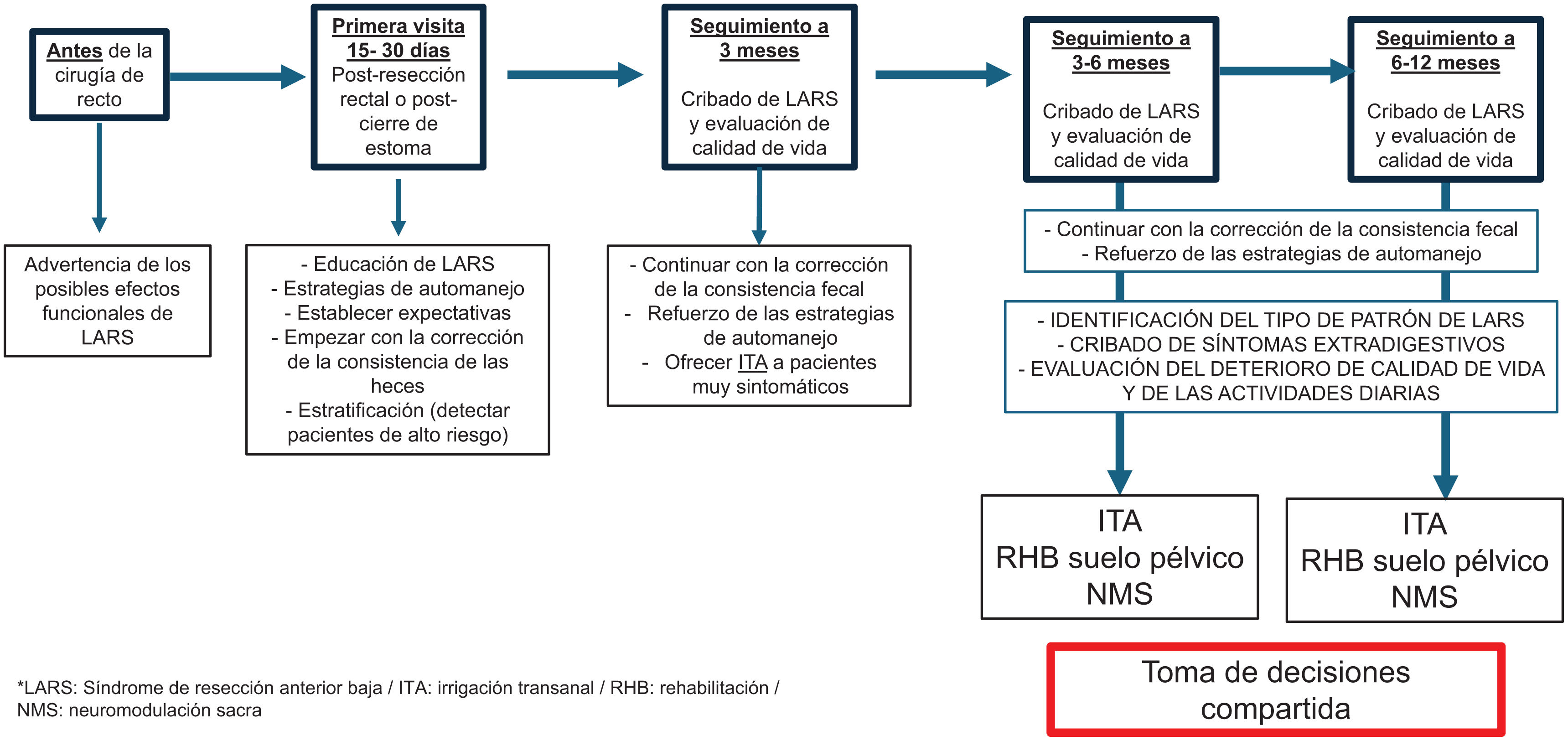
A prospective consultation for the evaluation, detection and follow-up of patients with LARS has recently been implemented in our centre. This comprehensive approach is designed to identify early signs and symptoms associated with the syndrome. Far from traditional pyramid schemes, our treatment is based on a purely personalised approach. Each patient is presented with the different options available, along with their pros and cons, and decisions are made in a shared manner. Through this methodology, not only is a more accurate and timely diagnosis facilitated, but also the individualised management of each patient is guided, thus improving long-term results and optimising comprehensive care. Fig. 1 shows the aforementioned algorithm.

Fig. 1.

Prospective evaluation and screening of patients with LARS.

It is essential to emphasize the relevance of the different preventive strategies. Among them, the careful selection of patients stands out, evaluating risk factors such as the extent of the resection, proximity to the anal margin and individual characteristics that may predispose to the development of severe LARS. Likewise, considering the creation of a temporary or permanent stoma may be a valuable option for those high-risk patients who prefer to avoid severe functional sequelae.

As noted, this algorithm begins before rectal resection surgery, informing the patient about the potential functional sequelae after surgery. The first postoperative visit occurs at 2–4 weeks, and involves the surgeon and the stoma nurse. During this visit, education about LARS is provided, self-management strategies (such as scheduling) are taught, high-risk patients are identified, and medical treatment is initiated with the goal of improving stool consistency using fibre, Plantago Ovata, methylcellulose, ondansetron, among others. In our team, we take a proactive approach and begin transanal irrigations at 3 months postoperatively in high-risk patients. Six months after surgery, the focus is on continuing to adjust stool consistency and reinforcing self-management strategies. At this stage, it is crucial to identify the specific pattern of LARS, screen for extra-digestive symptoms, and assess the impact on the patient's quality of life. Based on this assessment, three modalities are presented based on the characteristics and severity of LARS, as well as patient preferences: transanal irrigation, pelvic floor rehabilitation, and sacral neuromodulation, which can be combined as needed.

Conclusions

To sum up, colorectal cancer represents a significant global burden with predicted increases in incidence and mortality. Although surgery remains essential, an increase in postoperative functional disorders, such as low anterior resection syndrome (LARS), which affect quality of life, has been observed. These disorders also occur as sequelae of other less aggressive treatments, such as organ-sparing strategies and pelvic radiotherapy.10,44 Various therapeutic modalities, such as pelvic floor rehabilitation, transanal irrigations, posterior tibial nerve stimulation and sacral neuromodulation, have demonstrated efficacy in reducing LARS symptoms and improving quality of life. Therefore, it is crucial to adapt treatment to the specific characteristics and symptoms of each patient, through an individualised approach and a shared decision-making model. Future research focuses on preoperative prehabilitation, limiting the use of radiotherapy, the development of organ-sparing strategies and the effects of sacral neuromodulation on extra-digestive symptoms, which could open new avenues to address broader aspects of patient well-being. These combined approaches offer a hopeful horizon for improving the quality of life of patients suffering from LARS.

References
[1]
R.J. Heald, B.J. Moran, R.D.H. Ryall, R. Sexton, J.K. MacFarlane.
Rectal cancer.
Arch Surg, 133 (1998),
[2]
A. Martínez-Pérez, M.C. Carra, F. Brunetti, N. de’Angelis.
Pathologic outcomes of laparoscopic vs open mesorectal excision for rectal cancer.
JAMA Surg, 152 (2017),
[3]
H.S. Tilney, S. Rasheed, J.M. Northover, P.P. Tekkis.
The influence of circumferential resection margins on long-term outcomes following rectal cancer surgery.
Dis Colon Rectum, 52 (2009), pp. 1723-1729
[4]
M.H. Kristensen, H. Elfeki, S. Sinimäki, S. Laurberg, K.J. Emmertsen.
Urinary dysfunction after colorectal cancer treatment and impact on quality of life—a national cross‐sectional study in males.
Colorectal Dis, 23 (2021), pp. 394-404
[5]
A. Dulskas, N.E. Samalavicius.
A prospective study of sexual and urinary function before and after total mesorectal excision.
Int J Colorectal Dis, 31 (2016), pp. 1125-1130
[6]
E. Kapiteijn, C.A.M. Marijnen, I.D. Nagtegaal, H. Putter, W.H. Steup, T. Wiggers, et al.
Preoperative radiotherapy combined with total mesorectal excision for resectable rectal cancer.
N Engl J Med, 345 (2001), pp. 638-646
[7]
F.G. Marinello, D. Fraccalvieri, P. Planellas, M. Adell, J. Gil, E. Kreisler, et al.
Sacral neuromodulation in patients with low anterior resection syndrome: the SANLARS randomized clinical trial.
Dis Colon Rectum, 67 (2024), pp. 435-447
[8]
C.L. Bryant, P.J. Lunniss, C.H. Knowles, M.A. Thaha, C.L. Chan.
Anterior resection syndrome.
Lancet Oncol, 13 (2012), pp. e403-8
[9]
K.J. Emmertsen, S. Laurberg.
Low anterior resection syndrome score: development and validation of a symptom-based scoring system for bowel dysfunction after low anterior resection for rectal cancer.
Ann Surg, 255 (2012), pp. 922-928
[10]
A. Annicchiarico, J. Martellucci, S. Solari, M. Scheiterle, C. Bergamini, P. Prosperi.
Low anterior resection syndrome: can it be prevented?.
Int J Colorectal Dis, 36 (2021), pp. 2535-2552
[11]
W.Y. Lee, T. Takahashi, T. Pappas, C.R. Mantyh, K.A. Ludwig.
Surgical autonomic denervation results in altered colonic motility: an explanation for low anterior resection syndrome?.
Surgery, 143 (2008), pp. 778-783
[12]
C. Varghese, C.I. Wells, I.P. Bissett, G. O’Grady, C. Keane.
The role of colonic motility in low anterior resection syndrome.
Front Oncol, 12 (2022),
[13]
C. Keane, N. Paskaranandavadivel, R. Vather, D. Rowbotham, J. Arkwright, P. Dinning, et al.
Altered colonic motility is associated with low anterior resection syndrome.
Colorectal Dis, 23 (2021), pp. 415-423
[14]
P.G. Dinning, L. Wiklendt, L. Maslen, I. Gibbins, V. Patton, J.W. Arkwright, et al.
Quantification of in vivo colonic motor patterns in healthy humans before and after a meal revealed by high‐resolution fiber‐optic manometry.
Neurogastroenterol Motil, 26 (2014), pp. 1443-1457
[15]
A.Y. Lin, P.G. Dinning, T. Milne, I.P. Bissett, G. O’Grady.
The “rectosigmoid brake”: review of an emerging neuromodulation target for colorectal functional disorders.
Clin Exp Pharmacol Physiol, 44 (2017), pp. 719-728
[16]
K.S. Ng, R. Russo, M.A. Gladman.
Colonic transit in patients after anterior resection: prospective, comparative study using single-photon emission CT/CT scintigraphy.
Br J Surg, 107 (2020), pp. 567-579
[17]
P.G. Horgan, P.R. O’Connell, C.A. Shinkwin, W.O. Kirwan.
Effect of anterior resection on anal sphincter function.
Br J Surg, 76 (2005), pp. 783-786
[18]
W.R. Marti, G. Curti, H. Wehrli, F. Grieder, M. Graf, B. Gloor, et al.
Clinical outcome after rectal replacement with side-to-end, colon-J-pouch, or straight colorectal anastomosis following total mesorectal excision.
Ann Surg, 269 (2019), pp. 827-835
[19]
Y. Parc, R. Ruppert, A. Fuerst, H. Golcher, M. Zutshi, T. Hull, et al.
Better function with a colonic J-pouch or a side-to-end anastomosis?.
Ann Surg, 269 (2019), pp. 815-826
[20]
P. Planellas, R. Farrés, L. Cornejo, J.I. Rodríguez-Hermosa, A. Pigem, A. Timoteo, et al.
Randomized clinical trial comparing side to end vs end to end techniques for colorectal anastomosis.
Int J Surg, 83 (2020), pp. 220-229
[21]
M.S. Walma, V.N.N. Kornmann, D. Boerma, M.A.J. de Roos, H.L. van Westreenen.
Predictors of fecal incontinence and related quality of life after a total mesorectal excision with primary anastomosis for patients with rectal cancer.
Ann Coloproctol, 31 (2015), pp. 23
[22]
P.K. Garg, A. Goel, S. Sharma, N. Chishi, M.K. Gaur.
Protective diversion stoma in low anterior resection for rectal cancer: a meta-analysis of randomized controlled trials.
Visc Med, 35 (2019), pp. 156-160
[23]
E.L. Beamish, J. Johnson, E.J. Shaw, N.A. Scott, A. Bhowmick, R.J. Rigby.
Loop ileostomy-mediated fecal stream diversion is associated with microbial dysbiosis.
Gut Microbes, 8 (2017), pp. 467-478
[24]
R. Garfinkle, M. Boutros.
Low anterior resection syndrome: predisposing factors and treatment.
Surg Oncol, 43 (2022),
[25]
X.Y. Zhang, K.L. Yang, Y. Li, R.S. Li, S.Q. Wang, X.N. Liu, et al.
Preventive strategies for low anterior resection syndrome: a protocol for systematic review and evidence mapping.
BMJ Open, 13 (2023),
[26]
C. Keane, N.S. Fearnhead, L.G. Bordeianou, P. Christensen, E.E. Basany, S. Laurberg, et al.
International consensus definition of low anterior resection syndrome.
Dis Colon Rectum, 63 (2020), pp. 274-284
[27]
Y. Ribas, F. Aguilar, E. Jovell-Fernández, L. Cayetano, A. Navarro-Luna, A. Muñoz-Duyos.
Clinical application of the LARS score: results from a pilot study.
Int J Colorectal Dis, 32 (2017), pp. 409-418
[28]
A. Dulskas, E. Smolskas, I. Kildusiene, N.E. Samalavicius.
Treatment possibilities for low anterior resection syndrome: a review of the literature.
Int J Colorectal Dis, 33 (2018), pp. 251-260
[29]
F. Marinello, G. Pellino, E. Espín-Basany.
Low anterior resection syndrome: an unavoidable price to pay to preserve the rectum?.
Front Oncol, 12 (2022),
[30]
S.H. Emile, Z. Garoufalia, S. Barsom, N. Horesh, R. Gefen, P. Zhou, et al.
Systematic review and meta-analysis of randomized clinical trials on the treatment of low anterior resection syndrome.
Surgery, 173 (2023), pp. 1352-1358
[31]
S.G. Popeskou, R. Roesel, S. Faes, A. Vanoni, J. Galafassi, A.F. di Tor Vajana, et al.
Ondansetron for low anterior resection syndrome (LARS).
Ann Surg, 279 (2024), pp. 196-202
[32]
S.B. Ryoo, J.W. Park, D.W. Lee, M.A. Lee, Y.H. Kwon, M.J. Kim, et al.
Anterior resection syndrome: a randomized clinical trial of a 5-HT3 receptor antagonist (ramosetron) in male patients with rectal cancer.
Br J Surg, 108 (2021), pp. 644-651
[33]
F. Jing, J. Zhang.
Metabolic kinetics of 5-hydroxytryptamine and the research targets of functional gastrointestinal disorders.
Dig Dis Sci, 59 (2014), pp. 2642-2648
[34]
K. Garsed, J. Chernova, M. Hastings, C. Lam, L. Marciani, G. Singh, et al.
A randomised trial of ondansetron for the treatment of irritable bowel syndrome with diarrhoea.
[35]
E. Bols, B. Berghmans, R. de Bie, B. Govaert, B. van Wunnik, M. Heymans, et al.
Rectal balloon training as add‐on therapy to pelvic floor muscle training in adults with fecal incontinence: a randomized controlled trial.
Neurourol Urodyn, 31 (2012), pp. 132-138
[36]
J.A.G. van der Heijden, A.J. Kalkdijk-Dijkstra, J.P.E.N. Pierie, H.L. van Westreenen, P.M.A. Broens, B.R. Klarenbeek.
Pelvic floor rehabilitation after rectal cancer surgery.
[37]
A. Asnong, A. D’Hoore, M. Van Kampen, A. Wolthuis, Y. Van Molhem, B. Van Geluwe, et al.
The role of pelvic floor muscle training on low anterior resection syndrome.
Ann Surg, 276 (2022), pp. 761-768
[38]
F.G. Marinello, L.M. Jiménez, E. Talavera, D. Fraccalvieri, P. Alberti, F. Ostiz, et al.
Percutaneous tibial nerve stimulation in patients with severe low anterior resection syndrome: randomized clinical trial.
Br J Surg, 108 (2021), pp. 380-387
[39]
L. Brusciano, A. Brillantino, G. Pellino, F. Marinello, C.I. Baeten, A. Digesu, et al.
Sacral nerve modulation for patients with fecal incontinence: long-term outcome and effects on sexual function.
Updates Surg, 75 (2023), pp. 1187-1195
[40]
E. Ram, R. Meyer, D. Carter, M. Gutman, D. Rosin, N. Horesh.
The efficacy of sacral neuromodulation in the treatment of low anterior resection syndrome: a systematic review and meta-analysis.
Tech Coloproctol, 24 (2020), pp. 803-815
[41]
Y. Huang, C.E. Koh.
Sacral nerve stimulation for bowel dysfunction following low anterior resection: a systematic review and meta‐analysis.
Colorectal Dis, 21 (2019), pp. 1240-1248
[42]
L. Ramage, S. Qiu, C. Kontovounisios, P. Tekkis, S. Rasheed, E. Tan.
A systematic review of sacral nerve stimulation for low anterior resection syndrome.
Colorectal Dis, 17 (2015), pp. 762-771
[43]
D. Harji, B. Fernandez, L. Boissieras, A. Berger, M. Capdepont, F. Zerbib, et al.
A novel bowel rehabilitation programme after total mesorectal excision for rectal cancer: the BOREAL pilot study.
Colorectal Dis, 23 (2021), pp. 2619-2626
[44]
P.A. Custers, M.E. van der Sande, B.A. Grotenhuis, F.P. Peters, S.M.J. van Kuijk, G.L. Beets, et al.
Long-term quality of life and functional outcome of patients with rectal cancer following a watch-and-wait approach.
JAMA Surg, 158 (2023),
Article options
Tools