






To assess the perception and management of central serous chorioretinopathy (CSCR) in Spain through a survey aimed at retinal specialists.
Material and methodsThe working group designed an original online survey, including 42 questions categorized into 4 sections: clinical perception, diagnosis, clinical management, and prognosis.
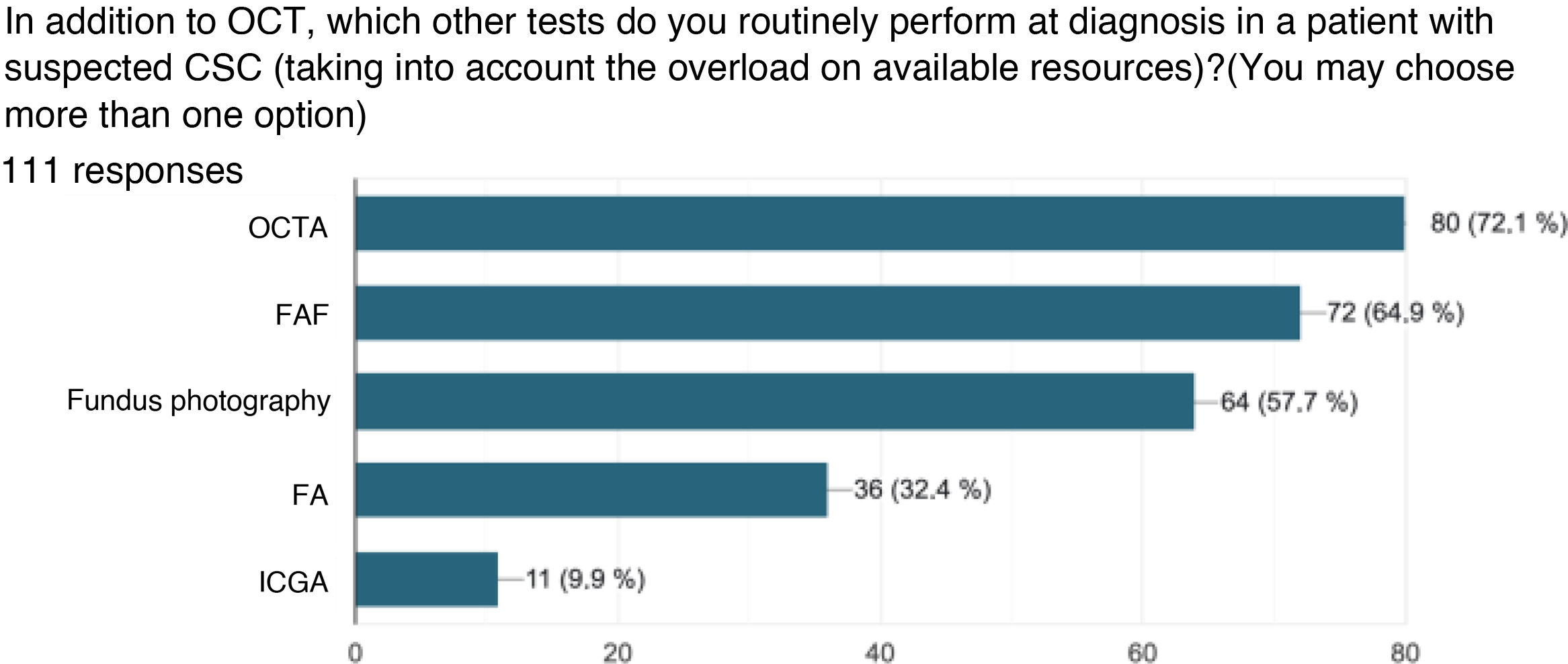
ResultsA total of 114 ophthalmologists completed the survey. The mean age was 46 years (range, 26–72), 54.5% were men, and the mean post-residency experience was 17.5 years. CSCR was perceived as a growing condition by 80% of participants. While 75% believed acute CSCR tends to resolve spontaneously, 63% estimated chronicity in <25% of cases; however, if chronicity occurs, 77% considered spontaneous resolution unlikely without treatment. Besides OCT, OCT angiography was the most used diagnostic imaging modalitu (72%), followed by fundus autofluorescence (65%). Systemic work-up was never considered by 30%, while 62% would only consider it in the presence of bilateral or multifocal cases, with cortisol being the most frequently investigated parameter. Observation is preferred in acute CSCR, while photodynamic therapy is favored in chronic forms. Focal laser and anti-VEGF agents are preferred for extrafoveal leaks and neovascular membranes, respectively. While 80% expect anatomical improvement with treatment, there is consensus on its limited functional benefits.
ConclusionsThis survey highlights that CSCR is perceived as an increasingly prevalent disease with high recurrence and potential for chronicity. It also reveals preferences and variability in its management among specialists.
Evaluar la percepción y manejo de la Coriorretinopatía Serosa Central (CSC) en España mediante una encuesta.
Material y métodosEncuesta original en línea diseñada por el grupo de trabajo, consistiendo en 42 preguntas divididas en 4 grandes bloques: percepción en la práctica clínica, diagnóstico, manejo clínico y pronóstico.
ResultadosFue completada por 114 oftalmólogos, con edad media de 46 años (rango 26–72), 54,5% varones y una experiencia promedio de 17,5 años post-residencia. El 80% de los participantes consideran la CSC una entidad en crecimiento. El 75% cree que la CSC aguda tiende a autorresolverse, mientras que el 63% estima una cronificación en <25%, pero si ocurre, el 77% ve improbable su resolución sin intervención. Respecto al diagnóstico, además de la OCT, la angiografía por OCT es la técnica más empleada (72%), seguida de la autofluorescencia (65%). El 30% nunca plantea estudios sistémicos mientras que un 62% solo lo plantea si existe bilateralidad o multifocalidad, siendo el parámetro más investigado el cortisol. Como tratamiento, es de elección la observación en CSC aguda y la terapia fotodinámica en formas crónicas, excepto en fugas extrafoveales o membranas neovasculares, donde optan por fotocoagulación y fármacos antiangiogénicos respectivamente. El 80% confía en la mejoría anatómica con los tratamientos, pero hay consenso en su limitada mejoría funcional.
ConclusionesLos resultados de esta encuesta muestran que la CSC es percibida como una enfermedad en auge, con alta recurrencia y potencial de cronificación, y muestra las preferencias y variabilidad en el manejo de esta enfermedad.

