





To assess prevalence of classic clinical signs of Pigment Dispersion Syndrome (PDS) in PDS and Pigmentary Glaucoma (PG) in caucasian patients from Southern Spain.
Materials and methodsCross-sectional observational case-series study evaluating the prevalence of characteristic clinical signs of PDS: Krukenberg spindle (KS), Trabecular meshwork pigmentation (TMP) and Iris transillumination defects (ITD). Differences between PDS and PG patients are evaluated and the probability of association with PG of clinical signs with statistically significant differences is also calculated (Odds Ratio OR in logistic regression analysis).
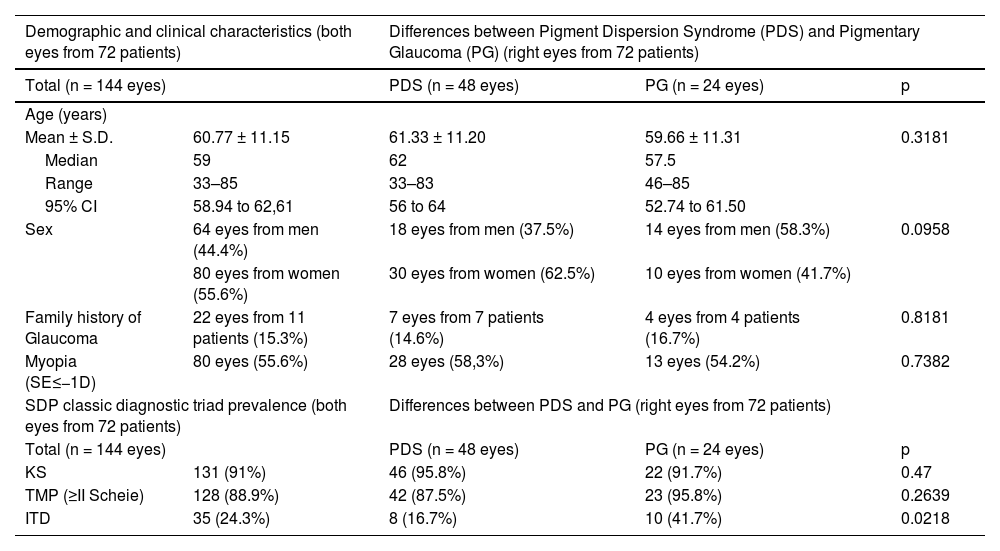
Results144 PDS/PG patients. Prevalence of KS, TMP and ITD is 91%, 88.9% and 24.3%. 48 right eyes (66.7%) were PDS and 24 right eyes (33.3%) were considered PG patients. Prevalence of KS is 95.8% in PDS and 91.7% in PG (p = 0.47). Prevalence of TMP is 87.5% in PDS and 95.8% in PG (p = 0.26). Prevalence of ITD is 16.7% in PDS and 41.7% in PG (p = 0.02). OR of those presenting PG is 3.57 for ITD (95% CI 1.17 to 10.85) (p = 0.02).
ConclusionsThere are no major differences in the prevalence of KS and TMP in our population of patients with PDS/PG compared to published data in the Caucasian population (91% vs 95% for KS and 88.9% vs 86% for TMP) but there are differences in the prevalence of ITD (24.3% vs 86%).
Evaluar la prevalencia de los signos clínicos clásicos del Síndrome de Dispersión Pigmentaria (SDP) en el SDP y del Glaucoma Pigmentario (GP) en pacientes caucásicos del sur de España.
Material y métodosEstudio transversal observacional de serie de casos en el que se evalúa la prevalencia de los signos clínicos característicos del SDP: huso de Krukenberg (HK), pigmentación de la malla trabecular (PMT) y defectos de transiluminación del iris (DTI). Se estudian las diferencias entre pacientes con SDP y GP y se calcula también la probabilidad de asociación con GP de signos clínicos con las diferencias estadísticamente significativas (Odds Ratio OR en análisis de regresión logística).
Resultados144 pacientes SDP/GP. La prevalencia de SK, PMT y DTI es del 91%, 88,9% y 24,3%. 48 ojos derechos (66.7%) eran PDS and 24 ojos derechos (33.3%) se consideraron pacientes GP. La prevalencia del HK es del 95.8% en el SDP y del 91.7% en el GP (p = 0.47). La prevalencia de PMT es del 87.5% en SDP y del 95.8% en GP (p = 0.26). La prevalencia de DTI es del 16,7% en SDP y del 41.7% en GP (p = 0.02). La OR de los que presentan GP es de 3.57 para DTI (IC 95% 1.17-10.85) (p = 0.02).
ConclusionesNo existen grandes diferencias en la prevalencia de HK y PMT en nuestra población de pacientes con SDP/GP respecto a los datos publicados en población caucásica (91% vs 95% de HK y 88,9% vs 86% de PMT) pero sí en la prevalencia de DTI (24,3 vs 86%).

