



To analyse the coverage and main bibliometric indicators of Spanish Journal of Legal Medicine (SJLM) in the Scopus database.
MethodsWe identified the evolution of the journal's production between 2008 and 2024 and the citation and impact indicators (number of citations, CiteScore, Scimago Journal Rank-SJR, quartile, h-index, most cited and read papers).
Results515 papers were included in Scopus (27.1 annual average) with an h-index of 15 and a self-citation rate of 21.5% for the period studied. The number of citations received in Scopus was 1510, reaching the peak of citations in 2022. In the category “Pathology and Forensic Medicine”, for the year 2023, SJLM obtained an h-index of 13, with an SJR of 0.217 corresponding to the third quartile. In 2023, the percentage of female authors was 53.85%. The most productive institutions were the Institute of Legal Medicine and Forensic Sciences of Catalonia and the National Institute of Toxicology and Forensic Sciences. The article with the best metrics was the one related to gender violence and confinement due to the SARS-CoV-2 pandemic published in 2020.
ConclusionsA positive evolution of SJLM metrics is observed during the period studied. The improvement of the journal's indicators would benefit from its indexing in other international databases.
Analizar la cobertura y los principales indicadores bibliométricos de REVISTA ESPAÑOLA DE MEDICINA LEGAL (REML) en la base de datos Scopus.
Material y métodoSe identificó la evolución de la producción de la revista entre los años 2008–2024 y los indicadores de citación e impacto (número de citas, CiteScore, Scimago Journal Rank-SJR, cuartil, índice h, trabajos más citados y leídos).
ResultadosSe incluyeron 515 trabajos en Scopus (27,1 de media anual) con un índice h de 15 y un porcentaje de autocitas del 21,5% para el período estudiado. El número de citas recibidas en Scopus fue de 1.510, alcanzando el pico de citas en 2022. En la categoría “Pathology and Forensic Medicine”, para el año 2023, REML obtuvo un índice h de 13, con un SJR de 0,217 que corresponde al tercer cuartil. En 2023 el porcentaje de autoras fue del 53,85%. Las instituciones más productivas fueron el Instituto de Medicina Legal y Ciencias Forenses de Cataluña y el Instituto Nacional de Toxicología y Ciencias Forenses. El artículo que mejores métricas obtuvo fue el relacionado con la violencia de género y el confinamiento por la pandemia por SARS-CoV-2 publicado en 2020.
ConclusionesSe observa una evolución positiva de las métricas de REML durante el período estudiado. La mejora de los indicadores de la revista se vería beneficiada por su indexación en otras bases de datos internacionales.
Fifty years ago, in October 1974, the Spanish Journal of Legal Medicine, (REML for its initials in Spanish), a body of the National Association of Forensic Physicians (ANMF for its initials in Spanish), was founded as a vehicle for the expression of forensic medicine in Spain.1 Over the course of this half-century, it has traversed different stages, with periods during which it has not been published. In 2008, the new board of directors of the ANMF decided to promote the REML again with a new editorial team leading, presided over by Elsevier, one of the most prestigious biomedical publishing houses worldwide.2
REML is a journal that is indexed in Scopus, Embase/Excerpta Medica, Latindex, and IBECS, and access to its contents is by subscription, except for ANMF members and affiliated associations, who may freely use it through the ANMF website (www.anmf-reml.es). REML does not charge authors for publishing and the current open access conditions for its contents are3:
- •
For the published version of the article: not available (unless the Article Processing Charge [APC]) has been paid.
- •
For the accepted version of the manuscript:
- •
No restrictions for the author's web page which must include a link to the publisher's versión with DOI.
- •
With a 12-month embargo period for non-commercial institutional repositories which must include a link to the publisher's version with DOI.
- •
- •
For the submitted versión of the manuscript: there are no restrictions.
Throughout this most recent stage of REML, the editorial team has periodically published editorial articles that reported on and analysed the journal's evolution (number and type of articles published, rejection rates, evolution of downloads, and views, etc.), as well as significant developments that occurred at the editorial level, including, for example, the translation of articles into English4 and the elimination of the paper version to be published only in online format.5
Although the evolution of REML's bibliometric indicators has been reported at successive ANMF meetings and assemblies, a descriptive study of its evolution in the main international database in which REML is indexed – Scopus - had not been addressed. Scopus is a database of bibliographic references and citations from the company Elsevier, of peer-reviewed literature and quality web content, with tools for monitoring, analysing, and visualising research.6 It provides data and indicators of citation and impact, resulting in its analysis offering interesting information on REML metrics and its comparison with other journals in the same area of knowledge.
Another database that includes REML is Google Scholar, which calculates the h-index for scientific journals. The h-index is a balance between the number of citations received by a researcher (or journal) and the number of publications (for example, an h-index of 25 corresponds to 25 publications having received at least 25 citations each). In April 2012, Google launched its information and evaluation system for scientific journals: Google Scholar Metrics.
Currently, Google offers its general rankings by language (it shows the 100 with the greatest impact), allowing only for English-language journals, and rankings by subject areas and disciplines. As a result, in the case of Spanish-language journals, only the list of the 100 journals with the highest h-index can be consulted7 In the 2019 study by Delgado and Martín-Martín on the h-index of Spanish scientific journals according to Google Scholar Metrics for the period 2014–2018, with the inclusion criteria of at least 100 published articles and one citation, 1449 Spanish scientific journals were identified, 204 of them in health sciences. In this study, in the table corresponding to biomedical scientific journals, REML, with an h-index of 9, was ranked 67 out of 156 journals. In the table, the other forensic science journal that appeared was Gaceta Internacional de Ciencias Forenses.8
Against this backdrop, on the occasion of the 50th anniversary of its publication, our objective was to analyse the evolution of the main bibliometric indicators of REML in the Scopus database in its most recent stage.
Material and methodsOn 29 July 2024, the data and records corresponding to REML were downloaded from the Scopus database. The data that were duplicated, incomplete, or defective were then eliminated. Information was completed from the REML9 website. The information from the REML website was also used to find the most read articles.
In addition to the h-index, Scopus provides the impact metric (CiteScore) and the normalised metric (SCImago Journal Rank [SJR]). The CiteScore would be the equivalent of the Journal Impact Factor of Web of Science (WOS), but the citations analysed cover a period of 4 years, in addition to expanding the typology of citable articles. It is updated annually and the percentiles are presented together with the indicator.
The SJR enables the metrics of the journal to be contextualised with respect to other journals with similar characteristics. The SJR covers a previous period of 3 years, giving greater weight to citations from highly prestigious journals.10REML is classified in the Pathology and Forensic Medicine category and the SJR for 2023 (latest available) was consulted in August 2024.11
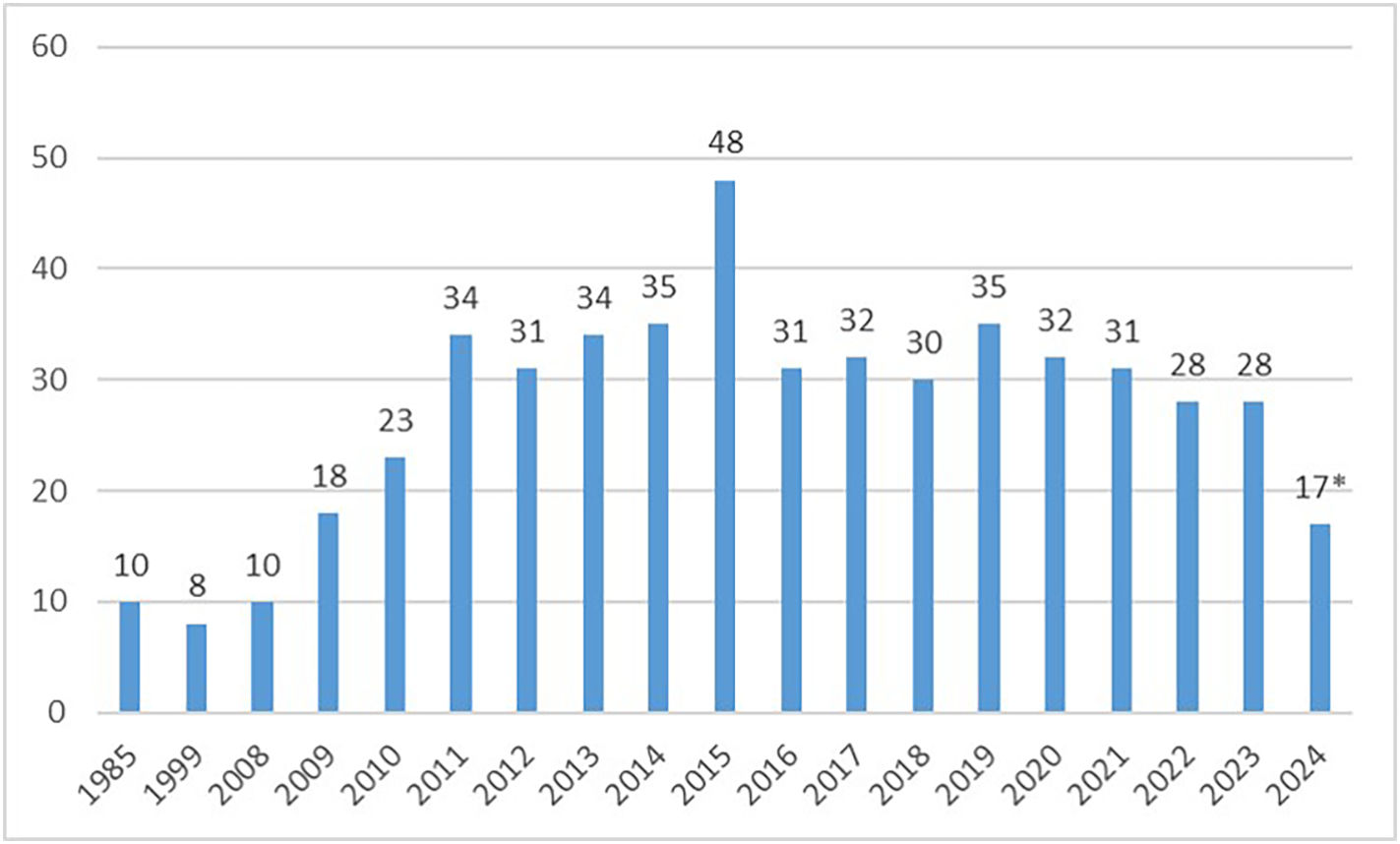
ResultsScopus collects results from REML for the years 1985, 1999, and between 2008 and 2024. In the period studied, REML published 515 articles, with an average of 27.1 articles per year. Fig. 1 shows the distribution of articles per year. The journal was suspended between 2000 and 2007. Since 2011, the publication of articles has remained stable with the publication of 4 issues per volume, reaching the peak of articles published in 2015 with 48 articles, due to the special issue on the new scale of Law 35/2015 that included 23 publications.

In total, for the entire period, REML received 1510 citations, with a h-index of 15 and a percentage of self-citations of 21.5%. The peak of citations (187) was reached in 2022, culminating an upward trend only interrupted in 2015, 2016, and 2018.
Table 1 shows the evolution of REML's CiteScore since 2011, with the percentile and quartile (Q) in the Pathology and Forensic Medicine category. In that category, the SJR includes 206 journals. REML has an h-index of 13, with an SJR of 0.217, which corresponds to the third quartile. The first journal in that category, with an h-index of 147, is Annual Review of Pathology: Mechanisms of Disease, from the USA. In Spain, the following 5 journals are indexed in that category (SJR; h-index; Q): Anuario de Psicología Jurídica (0.599; 14; Q2), Histology and Histopathology (0.571; 104; Q2), Actas Dermo-Sifiliográficas (0.297; 47; Q3), Revista Española de Medicina Legal (0.217; 13; Q3), and Revista Española de Patología (0.15; 7; Q4). In general, SJR includes 467 Spanish journals, among which REML occupies position 115.
Evolution of the Spanish Journal of Legal Medicine citescore between 2011 and 2023.
| Year | Citescore | Ranking | Percentile | Quartile |
|---|---|---|---|---|
| 2011 | 0.2 | 146/170 | 14 | Q4 |
| 2012 | 0.4 | 143/171 | 16 | Q4 |
| 2013 | 0.6 | 137/176 | 22 | Q4 |
| 2014 | 1 | 124/181 | 31 | Q3 |
| 2015 | 1.1 | 127/184 | 31 | Q3 |
| 2016 | 1 | 135/185 | 27 | Q3 |
| 2017 | 0.8 | 145/188 | 23 | Q4 |
| 2018 | 0.7 | 150/190 | 21 | Q4 |
| 2019 | 0.8 | 147/191 | 23 | Q4 |
| 2020 | 1 | 142/121 | 25 | Q4 |
| 2021 | 1.3 | 133/193 | 31 | Q3 |
| 2022 | 1.8 | 122/193 | 37 | Q3 |
| 2023 | 1.9 | 127/208 | 39 | Q3 |
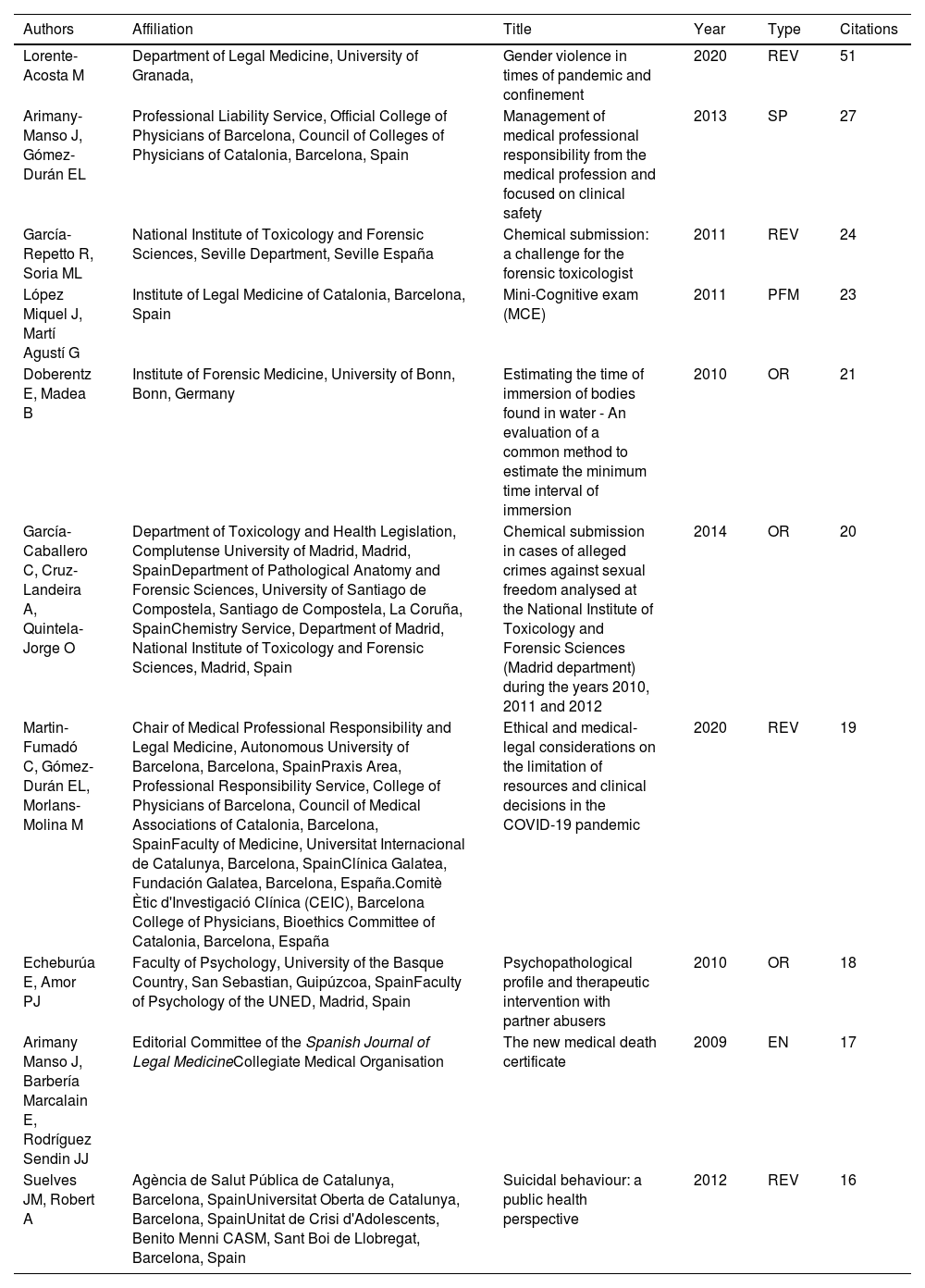
The most cited article, with 51 citations, was Violencia de género en tiempos de pandemia y confinamient (Gender violence in times of pandemic and confinement) by Lorente Acosta,12 published in 2020. According to Google Scholar, this article has 268 citations. Many of the articles in the monograph published in 2020 on Aspectos médico-legales de la pandemia por COVID-1913 (Medical–legal aspects of the COVID-19 pandemic) performed well, totalling 142 citations. Table 2 shows the 10 most cited articles in REML.
The 10 most cited articles in the Spanish Journal of Legal Medicine.
| Authors | Affiliation | Title | Year | Type | Citations |
|---|---|---|---|---|---|
| Lorente-Acosta M | Department of Legal Medicine, University of Granada, | Gender violence in times of pandemic and confinement | 2020 | REV | 51 |
| Arimany-Manso J, Gómez-Durán EL | Professional Liability Service, Official College of Physicians of Barcelona, Council of Colleges of Physicians of Catalonia, Barcelona, Spain | Management of medical professional responsibility from the medical profession and focused on clinical safety | 2013 | SP | 27 |
| García-Repetto R, Soria ML | National Institute of Toxicology and Forensic Sciences, Seville Department, Seville España | Chemical submission: a challenge for the forensic toxicologist | 2011 | REV | 24 |
| López Miquel J, Martí Agustí G | Institute of Legal Medicine of Catalonia, Barcelona, Spain | Mini-Cognitive exam (MCE) | 2011 | PFM | 23 |
| Doberentz E, Madea B | Institute of Forensic Medicine, University of Bonn, Bonn, Germany | Estimating the time of immersion of bodies found in water - An evaluation of a common method to estimate the minimum time interval of immersion | 2010 | OR | 21 |
| García-Caballero C, Cruz-Landeira A, Quintela-Jorge O | Department of Toxicology and Health Legislation, Complutense University of Madrid, Madrid, SpainDepartment of Pathological Anatomy and Forensic Sciences, University of Santiago de Compostela, Santiago de Compostela, La Coruña, SpainChemistry Service, Department of Madrid, National Institute of Toxicology and Forensic Sciences, Madrid, Spain | Chemical submission in cases of alleged crimes against sexual freedom analysed at the National Institute of Toxicology and Forensic Sciences (Madrid department) during the years 2010, 2011 and 2012 | 2014 | OR | 20 |
| Martin-Fumadó C, Gómez-Durán EL, Morlans-Molina M | Chair of Medical Professional Responsibility and Legal Medicine, Autonomous University of Barcelona, Barcelona, SpainPraxis Area, Professional Responsibility Service, College of Physicians of Barcelona, Council of Medical Associations of Catalonia, Barcelona, SpainFaculty of Medicine, Universitat Internacional de Catalunya, Barcelona, SpainClínica Galatea, Fundación Galatea, Barcelona, España.Comitè Ètic d'Investigació Clínica (CEIC), Barcelona College of Physicians, Bioethics Committee of Catalonia, Barcelona, España | Ethical and medical-legal considerations on the limitation of resources and clinical decisions in the COVID-19 pandemic | 2020 | REV | 19 |
| Echeburúa E, Amor PJ | Faculty of Psychology, University of the Basque Country, San Sebastian, Guipúzcoa, SpainFaculty of Psychology of the UNED, Madrid, Spain | Psychopathological profile and therapeutic intervention with partner abusers | 2010 | OR | 18 |
| Arimany Manso J, Barbería Marcalain E, Rodríguez Sendin JJ | Editorial Committee of the Spanish Journal of Legal MedicineCollegiate Medical Organisation | The new medical death certificate | 2009 | EN | 17 |
| Suelves JM, Robert A | Agència de Salut Pública de Catalunya, Barcelona, SpainUniversitat Oberta de Catalunya, Barcelona, SpainUnitat de Crisi d'Adolescents, Benito Menni CASM, Sant Boi de Llobregat, Barcelona, Spain | Suicidal behaviour: a public health perspective | 2012 | REV | 16 |
SP: special article; PFM: practical forensic medicine; EN: editorial note; OR: original; REV: review.
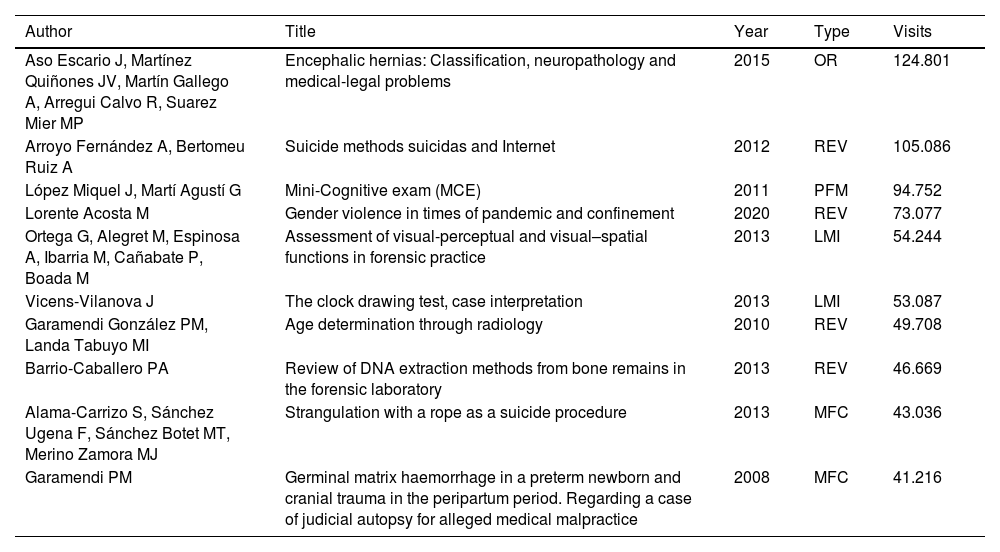
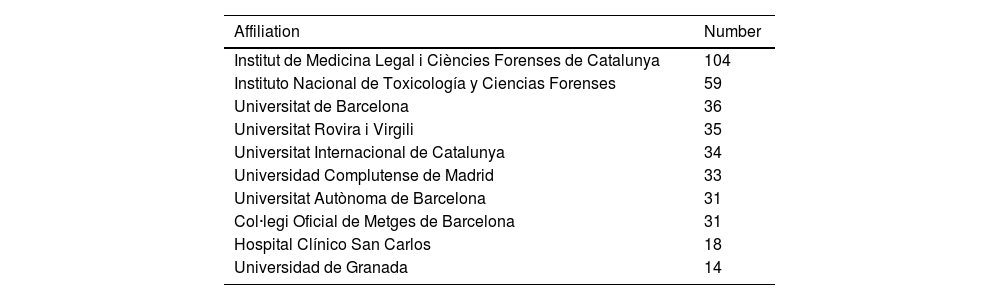
Table 3 contains the 10 most read articles. Table 4 lists the institutions whose affiliation has appeared most frequently, with the Institut de Medicina Legal i Ciències Forenses de Catalunya (IMLCFC) and the Instituto Nacional de Toxicología y Ciencias Forenses (INTCF) at the top, although it should be noted that an author may have several affiliations. In 1999, the percentage of female authors was 28.57%, while in 2023, this percentage was 53.85%.
The 10 most read articles between 2008 and 2024.
| Author | Title | Year | Type | Visits |
|---|---|---|---|---|
| Aso Escario J, Martínez Quiñones JV, Martín Gallego A, Arregui Calvo R, Suarez Mier MP | Encephalic hernias: Classification, neuropathology and medical-legal problems | 2015 | OR | 124.801 |
| Arroyo Fernández A, Bertomeu Ruiz A | Suicide methods suicidas and Internet | 2012 | REV | 105.086 |
| López Miquel J, Martí Agustí G | Mini-Cognitive exam (MCE) | 2011 | PFM | 94.752 |
| Lorente Acosta M | Gender violence in times of pandemic and confinement | 2020 | REV | 73.077 |
| Ortega G, Alegret M, Espinosa A, Ibarria M, Cañabate P, Boada M | Assessment of visual-perceptual and visual–spatial functions in forensic practice | 2013 | LMI | 54.244 |
| Vicens-Vilanova J | The clock drawing test, case interpretation | 2013 | LMI | 53.087 |
| Garamendi González PM, Landa Tabuyo MI | Age determination through radiology | 2010 | REV | 49.708 |
| Barrio-Caballero PA | Review of DNA extraction methods from bone remains in the forensic laboratory | 2013 | REV | 46.669 |
| Alama-Carrizo S, Sánchez Ugena F, Sánchez Botet MT, Merino Zamora MJ | Strangulation with a rope as a suicide procedure | 2013 | MFC | 43.036 |
| Garamendi PM | Germinal matrix haemorrhage in a preterm newborn and cranial trauma in the peripartum period. Regarding a case of judicial autopsy for alleged medical malpractice | 2008 | MFC | 41.216 |
MFC: medical–forensic case; PFM: practical forensic medicine, LMI: legal medicine in images; OR: original; REV: review.
Affiliation of the 10 institutions with the most articles published in the Spanish Journal of Legal Medicine.
| Affiliation | Number |
|---|---|
| Institut de Medicina Legal i Ciències Forenses de Catalunya | 104 |
| Instituto Nacional de Toxicología y Ciencias Forenses | 59 |
| Universitat de Barcelona | 36 |
| Universitat Rovira i Virgili | 35 |
| Universitat Internacional de Catalunya | 34 |
| Universidad Complutense de Madrid | 33 |
| Universitat Autònoma de Barcelona | 31 |
| Col·legi Oficial de Metges de Barcelona | 31 |
| Hospital Clínico San Carlos | 18 |
| Universidad de Granada | 14 |
Source: own, based on information obtained from Scopus.
The main country of origin of the authors is Spain (86.5%), followed by Argentina (2.6%), Mexico (2.2%), Peru (1.5%), the USA (1.3%), Chile, and Colombia (both with 1.1%). Among those articles by foreign authors with 10 or more citations, there is an article from Germany14 with 21 citations, from Mexico15 with13 citations and from Peru16 with 10 citations.
DiscussionThis bibliometric study, the first in Scopus, covers the evolution of REML indexing in its most recent stage. Although it presents an irregular inclusion of articles between 1985 and 2008, from this year, and especially from 2011, its publication establishes a positive evolution of indicators. The average number of articles per year has been 27.1; slightly higher than the 24.3 articles per year of the Etxeberría study for the first 20 years of REML.17 This has led it to position itself as a benchmark publication in Spanish in the area of forensic medicine and in the forensic sciences themselves. The evolution of the CiteScore impact index reaches its maximum in 2023 with a score of 1.9 (almost double that of 2020). This metric places REML in Q3 and in the 39th percentile. This favourable evolution in recent years was undoubtedly influenced by the special issue published in 2020 on medical–legal aspects of the COVID-19 pandemic,13 since the most cited article in Scopus by REML was precisely published in that special issue, with good performance by the rest of the articles in the issue. From 2024, the impact of this special issue on the CiteScore will no longer have an effect (2024 will include the citations between 2021 and 2024 of articles published in the same period in the numerator), so a downward correction is expected. It will have to be assessed whether this downward correction is specific to REML or will also occur in other scientific publications. It is known that the SARS-CoV-2 pandemic exponentially increased scientific production and had a great impact on bibliometric indicators. For example, in Spanish-speaking medical journals, the citations received for the publication of articles on the SARS-CoV-2 pandemic influenced the increase in the impact factor in the Journal Citation Reports (JCR)-Web of Science of 2021.18
Scientific publication has become a highly competitive process to achieve professional recognition, if not a requirement to consolidate positions in the academic world and even in one's professional career. One hears of the publish or perish19 culture and the impact metrics, which also measure journal quality are criticised and questioned, despite the numerous influencing factors that can lead to various dishonest or manifestly fraudulent practices.
REML is currently the only specific publication in legal and forensic medicine in Spanish and published in Spain that has an impact index in Scopus. The latest CiteScore for Cuadernos de Medicina Forense, a journal published by the Andalusian Association of Forensic Doctors, is from 2019. Other journals published in Spain in the same area of knowledge, such as Gaceta Internacional de Ciencias Forenses (Universitat de València), Boletín Galego de Medicina Legal e Forense (Asociación Galega de Médicos Forenses) and Ciencia Forense, Revista Aragonesa de Medicina Legal (Institución Fernando el Católico) are not included in Scopus. At the moment, REML is not included in the Journal Citation Reports JCR of WOS (Clarivate) that measures the Impact Factor (IF) index, nor is it indexed in PubMed, both of which would significantly increase its impact metrics, despite the difficulty of being included in these databases and of obtaining high impact indices and occupying the first quartile in journals published in Spanish. For example, in the case of Spain, the IF 2023 includes 725 journals from all disciplines, and they are in Q1 in the field of medicine: Archivos de Bronconeumología (IF: 8.7), Revista Española de Cardiología (IF: 7.2), Journal of Investigational Allergology and Clinical Immunology (IF: 6.1), Emergencias (IF: 5.4), Revista de Psiquiatría y Salud Mental (IF: 5.2), and Medicina Clínica (IF: 2.6).
In this context, REML fulfils its objective of remaining a high quality scientific journal published in Spanish (although some articles are translated into English and included in ScienceDirect). It is also aimed at the narrow and highly specialised area of knowledge of legal and forensic medicine. In Spain, the body of forensic doctors comprises around 1250 members, 500 professionals of whom work at the INTCF. It is also true that the Latin America public cannot be forgotten, as REML arouses great interest there (2 out of 3 visits to the REML website come from abroad),5 although, to date, manuscripts from these countries have little impact on the journal's metrics.
Furthermore, the proportion of female authors in the years of the study has evolved positively to reach 53.85% in 2023, reflecting the impact of female figures in medicine, and in the field of publications, which is a field historically dominated by men. This percentage will surely increase in upcoming years, but it is slightly higher, for example, than the Medicina Clínica study, which for the years 2021 and 2022 observed percentages of female authors of 49% and 47%, respectively.20 It would also be fitting to analyse the future percentage of female authors based on the position of the signature, a limitation of the information provided by Scopus.
Among the 10 most cited articles, it is of note that, except for the 2 corresponding to the 2020 special issue, the majority are from before 2015. It is undoubtedly logical that those articles that have a longer chronological history are more likely to be cited, and also that editorial policies could also have had an influence, since the journal went through stages in which its contents were freely accessible after an embargo period, to the current stage since 2015, in which they are only accessible by subscription or through the document retrieval services offered by specialised libraries through library cooperation networks.
Editorial policies regarding open access can affect journal impact.21 The Open Access movement has recently reached its 20th year, and although the evolution can be considered globally positive, it also has its darker side, since it has caused an increase in the global cost of scientific communication due to the double payments generated by hybrid journals (subscription and APC) and the growth of APCs.22 We do not yet know the bibliometric impact of the fact that REML is a hybrid journal will have (access by subscription, except for members of the ANMF and their affiliated associations, and the possibility of publishing openly through APC), although it will surely negatively impact the visibility and metrics of its contents.
Among the most cited articles are those related to chemical submission, medical professional responsibility, forensic psychiatry, gender violence, and suicide. The most cited articles provide an overview of the topics with the greatest scientific impact, allow for comparison of the topics with previous periods and also with other international journals in the field. In the case of REML, in 1996, Etxeberría already established the general index of the first 20 years of REML after analysing the 461 published articles.17 In the case of the International Journal of Legal Medicine, on its centenary, it published various articles on how the themes of the main fields of forensic medicine were evolving, together with those of related and non-related disciplines.23
There are only 2 articles that coincide between the most cited and the most read, and there is a change in the typology of the articles, The most read articles are more greatly distributed between reviews, forensic medicine in images, and originals, although the top most read one is the original article by Escario et al.24 These articles were also published before 2015, except for the one by Lorente Acosta. This discrepancy between the most cited and the most read must be taken into account by the editors, since a journal like REML must combine the quality indexes without neglecting those contents that readers value as more interesting or useful.
With regards to institutions, the top-ranking ones are the IMLCFC and the INTCF, with the others being mainly universities. There are very few studies on the scientific impact of the Institutes of Legal Medicine and Forensic Sciences (IMLCF) and the INTCF itself. The only publication we know of is from 2013 and analyses research in Spain over the previous 5 years in the specific field of forensic pathology.25,26 The study by Molina and Garamendi analysed Medlin for international journals and, using the search criteria, found 29 publications, with the first institution being the INTCF, followed by the IMLCF of Seville, the University of Murcia, the IMLCF of the Basque Country, the University of Santiago de Compostela, and the IMLCFC. For publications in Spanish journals, they analysed publications in REML, Cuadernos de Medicina Forense, and Boletín Galego de Medicina Legal e Forense. They identified 84 articles, with the first institution being the IMLCFC, followed by the IMLCF of Seville, the IMLCF of Malaga, the INTCF, and the IMLCF of Huelva. The IMLCFC also ranked first for papers presented at national and international conferences, while the Universities of Murcia and Complutense of Madrid ranked first for theses.
The data are therefore similar to our bibliometric analysis of REML, although with a prominent role of the IMLCF of Andalusia (Seville, Malaga, and Huelva), influenced by the natural tendency to publish in their journal, Cuadernos de Medicina Forense. The interpretation of this comparison must be made with caution, however, since different methodologies were used and different chronological periods were involved. Our study covers a period of 16 years, while that of Molina and Garamendi covers a period of 5 years and for a specific area of legal and forensic medicine.
Our study has its limitations. Only the Scopus database was used, which is indeed a benchmark, but may contain errors or omissions derived from poor indexing of content, and particularly authors and affiliations. This limitation is attenuated by the study methodology of unifying incorrect or duplicate authors and affiliations.
ConclusionsThe bibliometric evolution of REML during its most recent stage can be considered highly positive within the difficulty of positioning itself in the world of scientific publications, which are mostly in English. The improvement of the journal's metric and other impact indicators would benefit from its indexation in other international databases, as well as from the its inclusion in professional projects from the institutions that have been most productive to date.
FundingThe authors declare they did not receive any funding.
Please cite this article as: Barbería E, Xifró A, Martin-Fumadó C, Rudilla-Soler C. Spanish Journal of Legal Medicine: Bibliometric analysis in Scopus for the period 2008–2024. Revista Española de Medicina Legal. 2024. https://doi.org/10.1016/j.remle.2024.10.001.
