






Diabetes is deemed to be a main health problem globally, and this metabolic disorder has numerous causes. which is described as a chronic excess of glucose in the bloodstream with upsets of carbohydrate, fat, and protein metabolism resulting from a fault in insulin secretion, action, or both of them.
MethodsIn order to investigate acupuncture's effect on glucose levels, 40 wistar rats were used in the current study and divided into four groups: negative control, dexamethasone with fat, dexamethasone with fat combined with acupuncture, and acupuncture only treated rats. The acupuncture was done once weekly for an 8-week period at ST-36, SP-6, and ear shenmen acupuncture points.
ResultsIn groups 2 and 3, rats' weights were elevated due to dexamethasone and fat administration and a significant increase in glucose levels in comparison with the control group. Additionally, fat deposition was obvious on macroscopic examination. The most important result of the current study was that the glucose levels in the group treated with dexamethasone and fat combined with acupuncture were significantly lower than those in the group treated with dexamethasone and fat only without acupuncture.
ConclusionsAlthough the acupuncture using ST-36, SP-6, and ear shenmen may moderately reduce glucose levels, future studies using other point combinations or stimulation methods are needed to gain better effects.
La diabetes se considera un problema de salud principal a nivel mundial, y este trastorno metabólico tiene numerosas causas. que se describe como un exceso crónico de glucosa en el torrente sanguíneo con trastornos del metabolismo de los carbohidratos, las grasas y las proteínas como resultado de una falla en la secreción o acción de la insulina, o en ambos.
MétodoPara investigar el efecto de la acupuntura en los niveles de glucosa, las 40 ratas Wistar utilizadas en el presente estudio se dividieron en cuatro grupos: control negativo, dexametasona con grasa, dexametasona con grasa combinada con acupuntura y ratas tratadas solo con acupuntura. La acupuntura se realiza una vez a la semana durante un período de 8 semanas en los puntos de acupuntura ST-36, SP-6 y oído shenmen.
ResultadoEn los grupos 2 y 3, los pesos de las ratas se elevaron debido a la administración de dexametasona y grasa y un aumento significativo en los niveles de glucosa en comparación con el grupo de control. Además, el depósito de grasa es evidente en el examen macroscópico. El resultado más importante del estudio actual es que los niveles de glucosa en el grupo tratado con dexametasona y grasas combinadas con acupuntura fueron significativamente más bajos que los del grupo tratado con dexametasona y grasas solo sin acupuntura.
ConclusiónAunque la acupuntura con ST-36, SP-6 y shenmen del oído puede reducir moderadamente los niveles de glucosa, se necesitan estudios futuros que utilicen otras combinaciones de puntos o métodos de estimulación para obtener mejores efectos.
The World Health Organization (WHO) recommends acupuncture as a viable therapeutic approach.1 It has been demonstrated to exhibit a hypoglycemic impact and is observed to have specific effects on type 2 diabetes.2 In addition, it may enhance glucose tolerance,3 though further research is still needed to identify the underlying processes.4 On the other hand, for more than a thousand years, diabetes has been shown in many Chinese medical writings to be a waste of thirst. They connect it to overindulging in rich foods. Additionally, acupuncture is currently a widely used therapeutic strategy in China for the treatment of diabetes. Anyhow, randomized controlled trials are virtually as uncommon as research. Furthermore, peripheral neuropathy has been a focus of the majority of clinical studies. Nevertheless, there is preliminary proof of an effect.5 This type of treatment may help to treat the obesity, which is considered the primary risk factor for developing type two diabetes, in addition to depression.
Acupuncture may regulate insulin synthesis and blood sugar levels, according to studies on physiological pathways in both lab animals and humans. and improve the lipid profile in the blood. Moreover, it increases blood circulation, which helps to moderately reduce stress while delaying the start and progression of diabetic circulatory problems.6
This study focused on SP6, ST 36 and the ear Shenmen acupoints to evaluate their effect on glucose level in type 2 diabetic Wistar rats.
Materials and methodsLab animalsFour groups of ten Wistar male rats each were formed from the forty total, with the first group serving as the control. The rats in the second group received dexamethasone and fat while The third group received acupuncture, dexamethasone, and fat injections. the fourth group rats , received simply acupuncture treatment.
A blood glucose monitoring device (Accucheck, Germany), 0.3 mm-wide acupuncture needles, a Dexamethasone ampule, and food with animal-origin butter (as a fat source) were used in the study.
All animal experiments comply with the Ethical Guidelines for the Use of Animals in Research Given by the National Committee for Research Ethics in Science and Technology (NENT) 2018. The guidelines stated that Animals have an intrinsic value which must be respected and the Animals are sentient creatures with the capacity to feel pain, and the interests of animals must therefore be taken into consideration.also Our treatment of animals, including the use of animals in research, is an expression of our attitudes and influences us as moral actors.
Drug and fat dosingThe dexamethasone treatment was introduced as a 10 mg/kg intraperitoneal injection. 0.5 ml of fat treatment was given orally by daily gavage for 42 days.
AcupunctureFor eight weeks, there was one acupuncture session every week. The acupuncture was done on ST-36, SP-6, and ear shenmen acupoints. The concept of traditional Chinese medicine, the rat skeleton atlas and acupoints, and the anatomical location described in a previous study7 and were used to estimate the depth and placement of acupuncture. Needles were placed perpendicularly as deep as 2–3 mm at ST-36 and SP-6. Moreover, pins were used during each session of ear shenmen acupuncture, and both the pins and the acupuncture needles were left in for two minutes.
Blood glucose monitoringAt weekly intervals, blood was drawn from the rats' tails to test the glucose level before and after the acupuncture sessions using a blood glucose monitoring system.
ResultsRats mean weight differencesTable 1 shows the rat’s group mean weight (mg) differences before and after the treatment and Fig. 1 displays the fat deposition on the internal organs of the experimental rats.

Table 2 and Fig. 2 show the experimental groups own pattern of glucose concentration with a statistical comparison between them.
glucose levels in the experimental rats.
| Weeks | Group 1control (mean ±SD) significance | Group 2Fat and dexamethasone (mean ±SD) significance | Group 3Fat and dexamethasone and acupuncture (mean ±SD) significance | Group 4Acupuncture (mean ±SD) significance |
|---|---|---|---|---|
| 1 | ab A103 ±7.020 | efg A112 ±10.252 | ab A110 ±25.163 | ab A112 ±3.098 |
| 2 | abc AB102 ±7.771 | g B99 ±9.711 | ab AB104.1 ±19.001 | a A119.25 ±7.67 |
| 3 | a AB105 ±12.747 | fg B102 ±9.347 | ab A124 ±25.416 | b AB104 ±6.799 |
| 4 | abc B101 ±6.045 | ef AB114 ±11.402 | ab A126 ±25.163 | b B103 ±4.433 |
| 5 | c C89 ±6.620 | d AB123 ±7.453 | ab A130.5 ±21.879 | ab B110 ±5.121 |
| 6 | bc D90 ±6.077 | c A163 ±5.88784 | ab B131.5 ±21.824 | ab C109 ±6.275 |
| 7 | abc BC95 ±6.999 | b A180 ±3.091 | a B134 ±14.704 | ab BC107 ±5.380 |
| 8 | abc BC98 ±7.795 | a A292 ±7.922 | ab B132 ±18.018 | ab BC108 ± 6.896 |
Letters a, b, c, d, e, f and g, means results bearing similar superscript within column do not differ at (p < 0.01). Letters A, B, C and D, means bearing similar superscript between row do not differ at (p < 0.01). Yellow colored superscript refers to highly significant difference between rows results.

Following an acupuncture session, glucose levels slightly rise for a few minutes before starting to fall after some time. (Table 3).
Average blood glucose levels in groups 3 and 4 before and after acupuncture.
| Weeks | Group 3(fat + dexamethasone + acupuncture) | Group 4(acupuncture) | ||||
|---|---|---|---|---|---|---|
| Before acupuncture | After acupuncture | Difference n. (%) | Before acupuncture | After acupuncture | Difference n. (%) | |
| 1 | 110 | 113.5 | 3.5 (3.1) | 112 | 123 | 12 (9.8) |
| 2 | 104 | 134.3 | 30 (29.1) | 119 | 120.7 | 1.7 (0.8) |
| 3 | 124 | 126 | 2 (1.6) | 104 | 122 | 18 (17.3) |
| 4 | 126 | 134 | 8 (6.3) | 103 | 118.5 | 15.5 (15.0) |
| 5 | 130 | 138 | 8 (6.3) | 110 | 152.2 | 42(38.1) |
| 6 | 131 | 141 | 10 (7.6) | 109 | 115 | 6 (5.5) |
| 7 | 134 | 139 | 5 (3.7) | 107 | 116.7 | 9.7 (9.0) |
| 8 | 132 | 155 | 23 (17.4) | 108 | 119 | 11 (10.1) |
| Mean | 123.9 | 135.1 | 11.2 (9) | 109 | 123.4 | 14.5 (13) |
In addition, the lowest glucose level in group 2 (fat plus dexamethasone treatment) was observed in week 2, while the highest level was observed in week 8. The progressive rise in glucose level also causes a considerable difference between sessions.
On the other hand, there is no discernible change in group 3 (fat plus dexamethasone plus acupuncture treatment). The hypothesis that acupuncture on specific points does not drop glucose levels in healthy rats lower than negative control was supported by the fact that the greatest level was in week 2 and the lowest level was in week 3 for group 4 (acupuncture only therapy).
Moreover, if we compared groups 2, 3, and 4 with group 1(control) at weeks 1, 2 and 3 there were no significant difference (P > 0.001), while, in weeks 5, 6, 7 and 8 there was a significant difference between control group and group 2 (fat, dexamethasone) and group 3 (fat, dexamethasone and acupuncture) the (P < 0.001) and there was no difference in comparison with acupuncture only treatment group 4 (P > 0.001), this means glucose levels starts to elevate in week 5, due to fat+ dexamethasone application.
Finally, In group 3 (fat+ dexamethasone+ acupuncture), glucose levels at the end of the three sessions were marginally lower than in group 2 (fat+ dexamethasone), indicating that acupuncture was successfully counteracting the negative effects of the fat+ dexamethasone application.
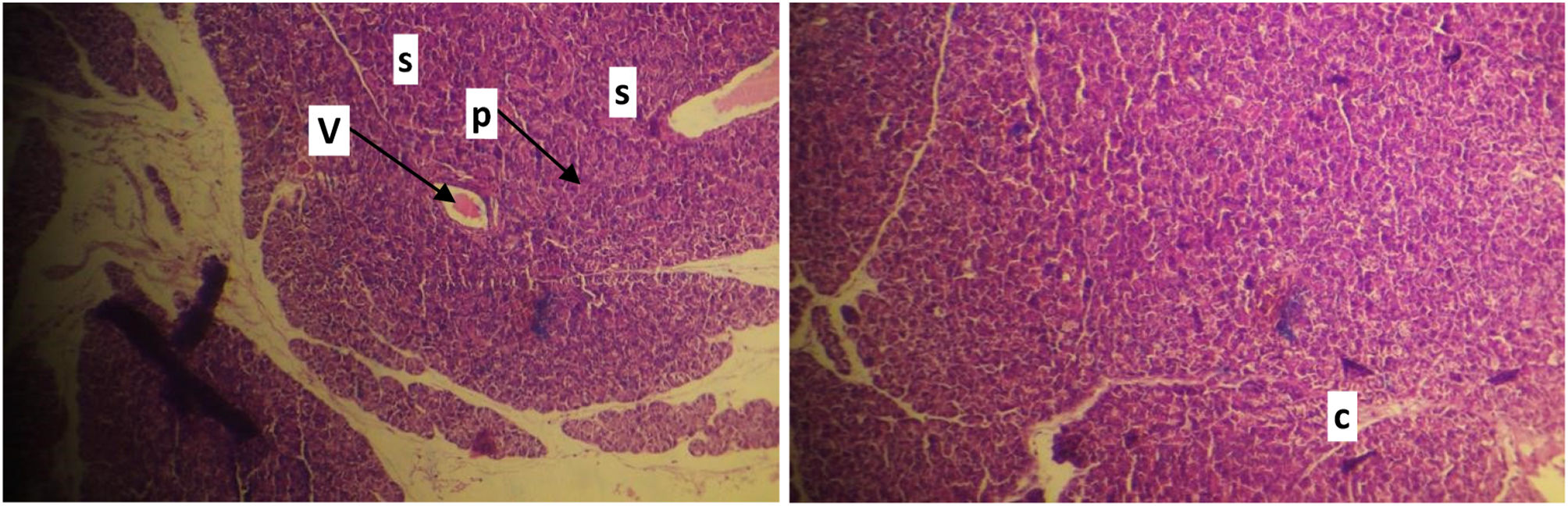
Rats pancrease histopathological testsThe pancreatic tissue of the control groups remained normal, as seen in Figs. 3. The serous acini in the exocrine portion of the pancreas are closely packed and resemble those in the digestive glands. Thus, it secretes an alkaline fluid that is rich in enzymes into the duodenum through the pancreatic duct. In addition, the endocrine portion of the pancreas is made up of separate islands with lighter-staining cells (Langerhans islets). The acini's secretions drain into ducts that are covered in a simple, low cuboidal epithelium that develops into a stratified cuboidal epithilium in the bigger ducts.

Left: normal pancreatic tissue includes several islets (p) surrounded by many serous acini (s) blood vessels (v). Right: normal pancreatic tissue, connective tissue (c), which also provides a thin capsule to the entire gland and thin septa separating the lobules of secretory acini. H&E 400X.
And fat deposition is oblivious in microscopic examination of pancreatic tissue in group 2. as well as lipid deposition in the cells (intracellular), which reduced the number of acini that have the ability to secrete insulin hormone as a result of cell destruction (Fig. 4).

In group 3, certain areas exhibited lipid deposition, while the rest were normal. Additionally, no lipid droplet deposition occurred inside the cell. Although there was destruction, it seemed less severe than what occurred in Group 2 (Fig. 5).

While the pancreatic tissues of the rats received acupuncture therapy are normal (Fig. 6).

Table 4 showed the association between the experimental groups in the glugose levels.
DiscussionsAcupuncture has just been approved by the World Health Organization (WHO) as a treatment for a range of illnesses.8 Acupuncture increases whole-body glucose tolerance in people of all ages and genders, according to several studies and researches.9,10 Acupuncture also has the similar objective of assisting patients with type 2 diabetes to lessen their symptoms, such as neuropathy,11 and avoid complications.12
there are numerous routes by which glucocorticoids affect the processes involved in lipid metabolism. Which, are clearly defined while others require explanation.13 By administering glucocorticoids, which also have anti-hormonogenic actions15,16 and accelerate the deposition of body fat and visceral fat, or by increasing caloric and dietary fat intake, diabetes can be induced, which can be the cause of the weight gain in groups 2 and 3 in Table 1. Chylomicrons and extremely low-density lipoproteins are involved in the blood's increased hydrolysis of triglycerides. By stimulating lipoprotein lipase, GCs increase the levels of fatty acids in the blood. The distribution of ectopic fat in the liver, muscles, and central adipocytes will thereafter be possible. However, GCs also enhance the production of new lipids in liver cells by increasing the expression of the fatty acid synthase enzyme,17 as shown in Fig. 1.
Additionally, the analysis of the glucose levels over the course of the sessions with the control group showed that, aside from the highest and lowest levels, there was no statistically significant difference between the sessions with the control group. The highest and lowest levels were on days 21 and 35, respectively.as shown in Table 2.
The current study's findings reveal that acupuncture on the bilateral ST-36, Sp6, and ear shenmen produced a hypoglycemic impact. The fact that the ears are where the channels converge may have caused this, and this suggests that channels and collateral connect the ears to the interior organs, and they may therefore be connected, either directly or indirectly, to the twelve pairs of meridians that run throughout the human body.18,19 Acupuncture may also help Wistar rats with insulin resistance, this may be accomplished by controlling the expression of important molecules involved to insulin signaling.11,20
Insulin synthesis is mostly impacted by parasympathetic activity.21 In diabetes-induced rats, insulin production is detrimental in some way. An increase in blood glucose levels will result from this. Additionally, rats' non-insulin dependent glucose uptake is stimulated by glucose elevation pressure. On the other hand, acupuncture's ability to excite the nervous system may help that pathway by causing the release of proteins that are involved in the insulin signaling cascade. Examples include -endorphin molecules and insulin-like growth factor22 and additional studies have shown the non-insulin dependent glucose reducing impact.23
All the research's findings supported the hypothesis that ST-36 point stimulation may cause a hypoglycemic response in diabetic rats by activating their neurons and adrenal glands. These may have taken place as a result of increased insulin gene expression.24
A Chinese clinical study evaluated the therapeutic effectiveness of acupuncture for the treatment of senile diabetes. It was discovered that the observation group received acupuncture and dietary therapy whereas the control group received dietary therapy alone. Thy discovered that patients receiving acupuncture treatment decreased their postprandial blood sugar levels more than patients in the control group did after two rounds of treatment. These findings demonstrated that acupuncture had a consistent impact on diabetic patients when used in conjunction with food therapy.25
In contrast to control group, there was a substantial drop in random glucose level in studies comparing acupressure at zusanli (St-36) acupoints as a pleasant treatment for diabetes mellitus. Only the ST-36 point was used in the study on humans.26
However, using a different combination of acupoints, including ST-36, St-46, LI-11, Sp-9, RN-3, RN-6, SP-10, LR-3, and KI-3, along with other Chinese and Western treatments, led to the discovery that the drug complex and needle conditioning are helpful in myasthenia gravis patients with regard to weight, waist circumference, blood pressure, blood lipids, and the improvement of insulin resistance function.27
ConclusionsThe current study found that acupuncture had a hypoglycemic effect in rats given fat plus dexamethasone (using ST-36, Sp6, and ear shenmen acupoints bilaterally) compared to the other groups, which had no significant differences from the control group and had a compensatory effect for the negative effects of fat and dexamethasone on glucose levels. And the mechanism of this effect still needs to be investigated on a molecular basis.
