


Post-traumatic stress disorder (PTSD) is a mental illness triggered by a horrific event that one has either experienced or witnessed. People with PTSD are more likely to suffer from chronic pain than people who have not experienced trauma. The pain associated with PTSD may be caused by changes in the way the body processes pain signals. Auricular chromotherapy is a new treatment method that combines auriculotherapy, chromotherapy, and eye movement desensitization and reprocessing (EMDR) techniques. The purpose of this study was to report on four cases of chronic pain that were successfully treated with auricular chromotherapy.
Four patients with chronic pain were selected for this study. Auricular chromotherapy sessions were performed on each patient three times at one-week intervals. After the third session, a three-month follow-up was performed. After the treatments, all four patients reported that their pain had disappeared without any side effects.
These case reports suggest that auricular chromotherapy may be effective in treating chronic pain due to PTSD. Further preclinical and clinical studies are needed to investigate the mechanism of action of auricular chromotherapy in the treatment of pain.
El trastorno de estrés postraumático (TEPT) es una enfermedad mental desencadenada por un suceso horrible que uno ha vivido o presenciado. Las personas con TEPT tienen más probabilidades de padecer dolor crónico que las que no han sufrido traumas. El dolor asociado al TEPT puede deberse a cambios en la forma en que el organismo procesa las señales de dolor. La cromoterapia auricular es un nuevo método de tratamiento que combina la auriculoterapia, la cromoterapia y las técnicas de desensibilización y reprocesamiento por movimientos oculares (EMDR). El propósito de este estudio era informar sobre cuatro casos de dolor crónico tratados con éxito con cromoterapia auricular.
Para este estudio se seleccionaron cuatro pacientes con dolor crónico. Se realizaron sesiones de cromoterapia auricular en cada paciente tres veces a intervalos de una semana. Después de la tercera sesión, se realizó un seguimiento de tres meses. Tras los tratamientos, los cuatro pacientes informaron de que su dolor había desaparecido sin efectos secundarios.
Estos informes de casos sugieren que la cromoterapia auricular puede ser eficaz en el tratamiento del dolor crónico debido al TEPT. Se necesitan más estudios preclínicos y clínicos para investigar el mecanismo de acción de la cromoterapia auricular en el tratamiento del dolor.
Post-traumatic stress disorder (PTSD) is a mental disorder that can develop after a very stressful, frightening, or upsetting event or after a prolonged traumatic experience.1–4 People with PTSD may have difficulty coping with the memories and emotions associated with the traumatic event, which can lead to a variety of physical and psychological symptoms.1–4
Chronic pain is a common symptom of PTSD.1,3 There is consistent evidence of an association between chronic pain and PTSD.5,6 Research has shown that people with PTSD are more likely to suffer from chronic pain than people who have not experienced trauma. The pain associated with PTSD may be caused by changes in the way the body processes pain signals. For example, the body's stress response triggered by traumatic events can lead to chronic inflammation and muscle tension, both of which can cause pain. Insular activation is associated with physical, sensory, and emotional sensations.1,3,4,6 Structural and functional neuroimaging studies of PTSD have examined the neural circuitry of fear conditioning and extinction. The major structures of the fear neural circuit include the amygdala, medial prefrontal cortex, anterior cingulate cortex (ACC), hippocampus, and anterior insula. Some of the interoceptive stimuli that have been shown to be associated with the activation of the insular cortex include muscle pain, skin pain, and joint pain.1,6
Furthermore, people with PTSD may develop conditions that cause chronic pain, such as fibromyalgia or chronic fatigue syndrome, which are related to changes in the body's pain threshold.7 In addition to physical pain, people with PTSD may also suffer from emotional pain, which can exacerbate the severity of their symptoms.1,2,7
Treatment for PTSD often involves a combination of therapy and medication. Various forms of therapy such as cognitive behavioral therapy (CBT), which helps individuals manage their thoughts and feelings related to the trauma, eye movement desensitization and reprocessing (EMDR), and auricular chromotherapy, which helps individuals process traumatic memories, as well as other forms of talk therapy, may be helpful.3,4,8 In addition, medications such as antidepressants, anti-anxiety medications, etc. can be helpful in managing the symptoms of PTSD.8
Chronic pain is pain that persists beyond the normal healing phase and therefore lacks the acute warning function of physiological nociception.9 Chronic pain is multifactorial in nature: biological, psychological, and social factors contribute to the pain syndrome. Chronic pain is pain that lasts longer than 3 months or recurs.10 A systematic classification of chronic pain was developed by a working group of the International Association for the Study of Pain (IASP). This classification distinguishes between chronic primary and chronic secondary pain syndromes, integrates existing pain diagnoses, including headache, and provides precise definitions and other characteristic features of each diagnosis according to the WHO content model for ICD-11, including the severity of pain, its time course, and evidence of psychological and social factors.11
Auriculotherapy-also called auricular therapy or ear acupuncture-is an acupuncture microsystem in which physical, emotional, and neurological dysfunctions are identified and reflexively treated via specific zones on the ear that reflect these dysfunctions. Brain areas involved in the stress response include the amygdala, hippocampus, and medial prefrontal cortex. Traumatic stress may be associated with permanent changes in these brain regions.12 The amygdala is involved in memory for the emotional valence of events and plays a critical role in the acquisition of fear responses.12 The hippocampus is essential for the formation and retrieval of episodic and contextual memories of past events.13 The medial prefrontal cortex modulates emotional reactivity by inhibiting amygdala function.12 Because their role in PTSD is well known, these points are frequently used in auricular acupuncture and auricular chromotherapy.
Color is derived from the spectrum of light, which is a form of electromagnetic radiation visible to the human eye. Light waves have wavelengths between about 400 and 700 nm. Our eyes perceive the different wavelengths of light as rainbow hues. Red light has relatively long waves, about 700 nm long. Blue and violet light has short waves, about 400 nm. Shorter waves vibrate at higher frequencies and have higher energy. Red light has a frequency of about 430 THz, while the frequency of blue light is closer to 750 THz. Red light photons have an energy of about 1.8 eV (eV), while each blue photon emits about 3.1 eV.14 Colors are known to influence human behavior, cognitive functions, emotions, purchase decisions, pain perception, appetite, odor perception, and other physiological functions.15–17 The wavelength, frequency, and amount of energy of each colored beam are fixed for each color, i.e., a specific wavelength, a specific frequency, and a specific amount of energy in that wave have been referred to as a specific color.18 Chromotherapy uses the interaction of specific electromagnetic wavelengths with biological systems to treat various diseases.
It is important to understand that the relationship between PTSD and chronic pain is complex and multifactorial and that treatment of one condition does not always completely control the other, but must be treated together to achieve better results. Asis et al. have developed a new treatment method that combines auriculotherapy, chromotherapy, and EMDR techniques. They reported the treatment of psychological trauma, phobias, and panic disorders with auriculotherapy.3,4
MethodsThe first question is whether trauma is associated with the occurrence of chronic pain. If trauma is associated with pain, a modified protocol by Asis and Zarragoecoechea3 is used. Auricular chromotherapy sessions were performed three times in each patient, one week apart. After the third session, a three-month follow-up was performed. Only what occurred during the first auricular chromotherapy session is described in the case reports.
The specifications of the LEDs used in this study were: 10 mm LED diode, 465–470 nm wavelength (blue), 20 mA, 3.4 V, 120–130 degree beam angle; 10 mm LED diode, 620–625 nm wavelength (yellow), 20 mA, 2.2 V, 120–130 degree beam angle.
Auricular chromotherapy intervention.
A modified ‘Asis and Zarragoecoechea protocol’ was applied to all subjects:
1. Both earlobes are touched alternately, first the edges and then the antitragus zone, applying gentle pressure with the thumb and index finger.
2. Continue palpation and ask the patient which ear is most sensitive to pain. Generally, the left ear is more painful if the trauma is older than 6 months; the opposite is true for left-handed patients.
3. End the palpation and ask the patient to close his or her eyes and try to remember the most horrific image of the trauma for at least one minute.
4. Then ask the patient to say what emotion accompanies the image (e.g., anger, fear, sadness) and describe the intensity of that emotional disturbance on a scale of 0 to 10, called the Subjective Units of Distress Scale (SUDS).
5. Then the patient indicates what negative words or thoughts accompany the image, e.g., “I will never get over his/her death” (Negative Cognition).
6. The patient is asked what bodily sensation is associated with the emotion (e.g., tightness in the chest).
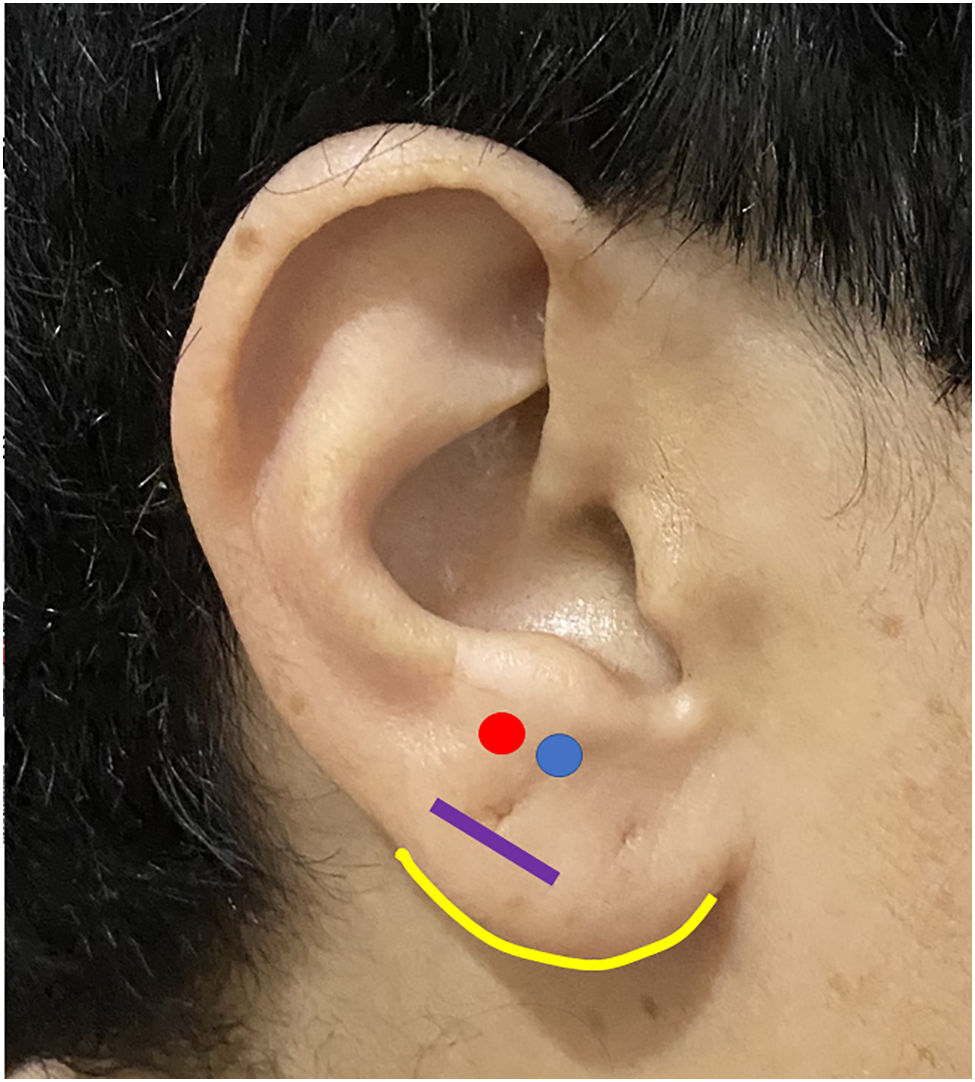
7. The hippocampus, amygdala, and psychic scar areas of the most sensitive earlobe (previously determined) are then probed with a pressure probe set at 250 g to locate the sensitive ear points (blue pressure probe - Sedatelec). In these case series, a combination of the hippocampus, amygdala, and scar areas has been shown to be sensitive (Fig. 1).

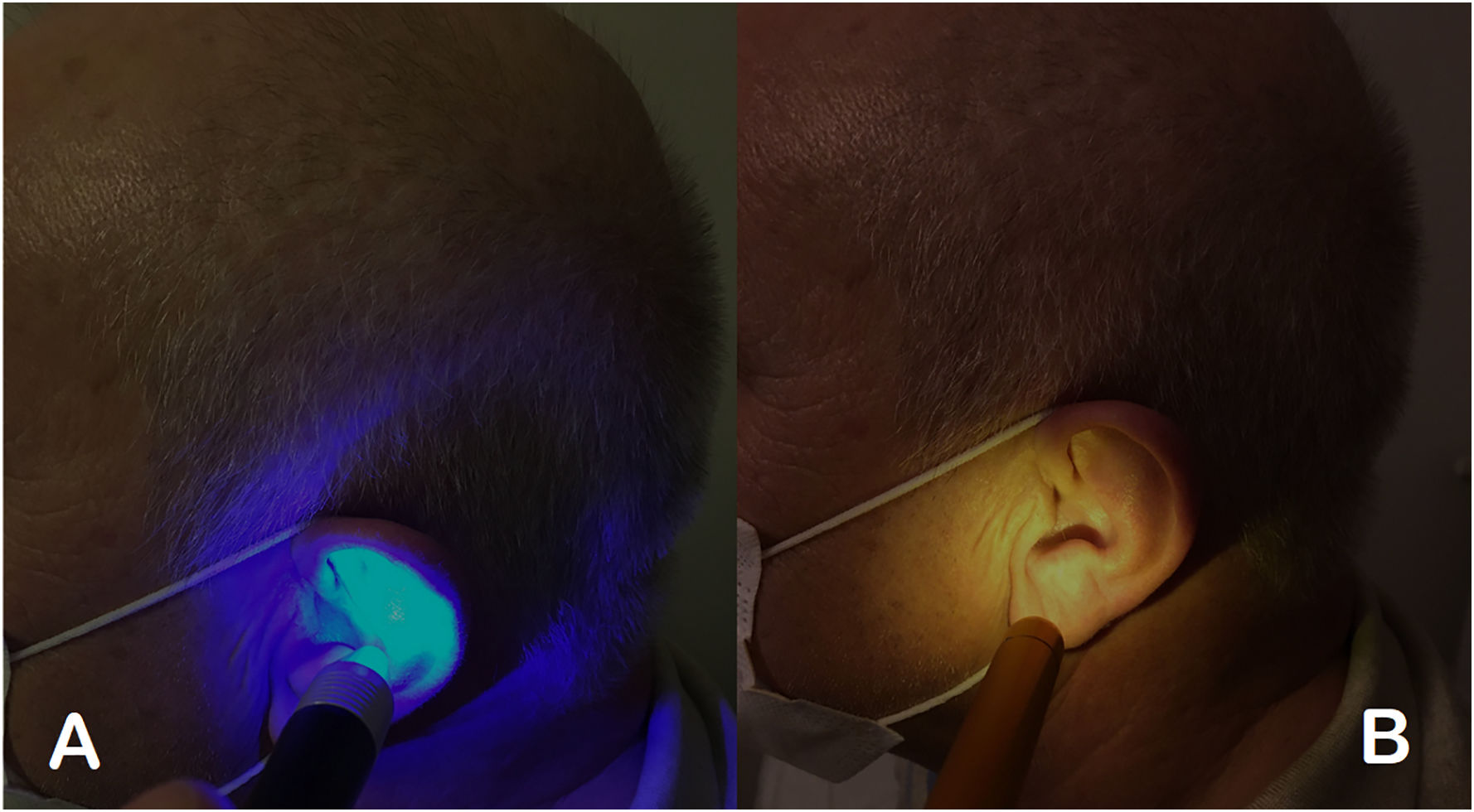
8. A yellow LED light (620–625 nm) is then directed at these points and the patient is asked to imagine the traumatic image. Facial expression, breathing, and gestures are observed (Fig. 2a).

9. In step 6, we learned which part of the body is associated with the traumatic emotion (chest, head, etc.). The blue LED (465–470 nm) is also directed to the areas in the auricle where that part of the body is represented (Fig. 2b).
10. The yellow and blue LED lights are directed to the corresponding areas in the auricle for 2–3 min while the patient continues to imagine the trauma.
11. After 2–3 min, the patient is asked to describe the image. Usually, the image disappears or the patient has difficulty remembering the image.
12. Measure the emotional disturbance again using the SUDS, which should give a very low score (0–2).
13. The patient is then asked what word(s) or phrase(s) accompany the newly obscured image (e.g., “I can overcome his/her death”). Observe if any disturbing body sensation remains.
ResultsFour participants (two males and two females) with a mean age ± standard deviation of 50.75 ± 11.79 years who suffered from chronic pain underwent auricular chromotherapy. The mean of the SUDS was 9.75 ± 0.5 before auricular chromotherapy sessions and 2.25 ± 0.96 after treatment (mean ± SD).
Case 155-year-old woman. She had occasional headaches for about 15 years. In the last 1 year, she had severe headaches (weekly visits to the emergency room). She described pain coming mainly from the neck and affecting the temporal region. A year ago, her mother died suddenly and unexpectedly. After her death, she was shown her mother's face in the morgue. She could not get this image out of her mind.
She felt “sadness” and “pressure in her chest” when she remembered that moment. She described the area of the body where she felt the emotion as follows: a feeling of warmth spreading from my chest to my neck and the sides of my head.
After the auricular chromotherapy session, she recalled the event but did not feel any negative emotions or thoughts when she refocused on the traumatic image. She described the intensity of sadness as a 10 on a scale of SUDS. After the session, she lowered the scale to 3.
Case 238-year-old man. He has had complaints of headaches and teeth grinding for about 3 years. He describes pain in the temporal region. Before the onset of his complaints, he was financially ripped off by his brother and was on the verge of bankruptcy. His brother's behavior affected him greatly.
The emotion he felt at this traumatic moment was “anger.” He describes the area of the body where he felt this emotion as follows: a spasm and fever spreading upward from the sides of his head.
After the auricular chromotherapy session, he recalled the traumatic incident but indicated that his anger was at a lower level (the SUDS decreased from 10 to 2). Headaches improved and discomfort with teeth grinding decreased.
Case 345-year-old man. He has had pain in the abdomen and groin for about 7 years. He described a burning sensation in the sacral region and inner thigh. The fact that his discomfort did not go away by any method aggravated his psychological condition. He has a psychological trauma he does not want to discuss before his discomfort occurs.
The feeling he feels when he relives the moment of trauma is “despair” and “sadness”. He described the feeling in his body as warmth that started in his groin and abdomen and spread to his thighs.
He described the intensity of despair and sadness as a 9 on the scale of SUDS. After the auricular chromotherapy session, the intensity of despair and sadness he felt when experiencing the moment of trauma decreased to 1.
Case 465-year-old woman. She has been suffering from severe pain for a long time. All treatments have been of no use. She feels widespread pain all over her body, especially in her back. She describes her life as very challenging and difficult.
She was subjected to domestic violence. She could not tell anyone about this abuse. She thought she would not be believed. When she experienced the moment of trauma, she felt “anger, helplessness” and “coldness in her back” What she felt in her body was coldness and a contraction of her back.
After auricular chromotherapy, she remembered the event but had no negative feelings or thoughts. Her pain complaints disappeared with a speed that surprised her. She stated that the scale SUDS, which she rated 10 before treatment, decreased to 3 after auricular chromotherapy.
Side effectsNo adverse events related to auricular chromotherapy treatment were reported during the sessions.
DiscussionOne of the possible explanations for the mechanism of auriculotherapy is hypersensitive neuronal reflex pathways connecting the auricular microsystem with the corresponding somatotopic region in the brain, which reaches the corresponding painful area via the spinal cord19 Underlying the effects of auriculotherapy is not only the penetration of the needle into the auricle but also the selection of the right ear sites.20
In their review of 24 articles on auriculotherapy, Correa et al. reported that there is sufficient scientific evidence to support the efficacy of auriculotherapy in the treatment of stress, anxiety, and depression.21 Kwon et al. found limited evidence of the benefits of auricular acupuncture for trauma-related mental disorders after major disasters. This is because the number of relevant studies is small and heterogeneous.22 The anxiety-relieving effect of auricular acupuncture has been demonstrated in many studies.
Saklecha et al. reported that patients who underwent blue and pink color therapy showed a statistically significant reduction in anxiety after chromotherapy and after endodontic treatment compared with the control group.23 The blue color is considered effective in reducing heart rate and blood pressure.24 In the study by Clarke et al., the colors green, blue, and violet are generally perceived as cool, pleasant, relaxing, peaceful, and calming; therefore, these colors may lower anxiety levels.25 Stimulation of the Shenmen ear point with the yellow laser (589 nm) significantly lowered the subject's systolic blood pressure. Although this was also true for the green laser (532 nm), significance was found only for the yellow laser. This could be due to the yellow laser's higher absorbed dose of energy.23
To study the cellular and molecular changes induced by photobiomodulation (PBM), an 808 nm near-infrared laser was used in rats to observe changes in neuronal activity. They reported that PBM specifically affected this population of inhibitory neurons in the hippocampus and amygdala.26 Application of PBM to acupuncture points on both legs of rats reduced anxiety-like symptoms and increased neuronal activation in the anterior cingulate cortex.27 In another study, green LEDs significantly reduced the number of headache days in people with episodic or chronic migraine.28 Laser puncture with infrared light at the depressing, tranquilizer, and master cerebral points of the ear decreased anxiety levels in patients undergoing dental procedures.29 Li et al. reported that photobiomodulation may prevent PTSD-like memory disorders in rats. They concluded that PBM can be used immediately after the involuntary recall of the traumatic memory by the PTSD patient. As an adjunctive therapy during exposure psychotherapy for PTSD, PBM can be used immediately after the patient recalls the fear and help prevent the patient from discontinuing psychotherapy due to excessive fear.30 These recommendations are similar to the technique we used with the patients in our study. The results of this study may have been obtained by stimulating points in the ear with the energy doses of the blue and yellow LED lights used in this study.
When psychological trauma is present in the pathogenesis of pain, auricular chromotherapy can provide very rapid and satisfactory results. Auricular chromotherapy, whose use in the treatment of PTSD and phobias has been reported in the literature, can also be successfully used in the treatment of chronic pain as a non-pharmacological therapy.
In conclusion, this procedure demonstrates the possibility of finding a pathway from the auricle to traumatic memories in the brain. A connection is made between the auricle and the structures of the central nervous system by directing yellow light to the areas of the auricle representing the psychic scars, hippocampus, and amygdala, where the emotion of the traumatic moment is processed, and blue light to the areas of the body where the emotion of the traumatic moment is felt.
FundingThe author received no financial support for this article's research, authorship, and/or publication.
Patient consentWritten informed consents were obtained from the patients for publication of this manuscript and any accompanying images.
