




Patellar instability is a complex and multifactorial problem that poses difficulties in treatment decision-making. The treatment algorithm proposed by the Lyon School of Knee Surgery aims to guide surgeons in identifying imaging risk factors for failure and proposing a therapeutic plan focused on correcting major risk factors present in specific case.
La inestabilidad patelar recurrente es un problema complejo y multifactorial de difícil manejo. El algoritmo de tratamiento propuesto por la Escuela Lyonesa de Cirugía de Rodilla busca orientar a los cirujanos al momento de identificar los factores de riesgo imagenológicos más importantes de fracaso y dar un plan terapéutico enfocado a corregirlos de manera personalizada.
Patellar instability is a complex and multifactorial problem. Its clinical presentation and physical examination must be correlated with an imaging study that is difficult to interpret in order to identify multiple risk factors that determine the risk of recurrence, the risk of failure, and the therapeutic plan.
Despite significant progress in understanding the anatomical alterations that predispose individuals to this pathology, determining the presence of these risk factors and estimating the importance of each in defining the surgical plan remain a subject of debate.1
The main aim of this article is to propose an updated approach to evaluating imaging risk factors in patients with recurrent patellar instability, based on the senior author's experience and recent scientific evidence.
DefinitionPatellar instability has been defined as a symptomatic deficiency of the stabilisers of the patella.2 In clinical practice, this can be subclassified as recurrent dislocation (where at least two episodes have occurred), forced or habitual dislocation (where dislocation occurs with every knee flexion), and permanent dislocation (where the patella is dislocated throughout the entire range of flexion).3 The latter two scenarios are less common in clinical practice and require more complex surgical procedures that are beyond the scope of this review.
StabilisersThe primary restraint of the patella from 20° to 30° of knee flexion is the femoral trochlea and its congruence with the articular surface of the patella, while in the first degrees of flexion, soft tissue restraints play a key role. The latter can be divided into dynamic (muscular) and static (ligamentous) restraints. Within the latter group is the medial patellofemoral complex, comprising the medial patellofemoral ligaments (MPFL) and medial patello-quadricipital ligaments, and the distal medial restraint complex, comprising the medial patellomeniscal ligaments and medial patellotibial ligaments.4 Of these, the MPFL is considered the main static restraint of patellar lateral translation and, therefore, has been the subject of extensive study.5 However, it is important to note that MPFL rupture is a consequence, rather than a cause, of patellar dislocation. Therefore, its reconstruction should not be considered a realignment procedure, but rather a means of reinforcement in the context of other present and potentially correctable risk factors.
The remaining structures that make up the proximal and distal medial complexes play secondary roles in stability, and the need for their reconstruction remains controversial.
Imaging studyThe imaging study of all patients with recurrent patellar instability should begin with an adequate radiographic evaluation. This should consist of anteroposterior and lateral knee projections (the latter taken at 30° flexion with the posterior and distal condyles superimposed), as well as an axial radiograph of the patella at 30° flexion.6
Axial radiographs of the patellofemoral joint are useful for evaluating the shape of the patella and identifying osteochondral lesions or bone avulsions. However, they are not very helpful for assessing the shape of the trochlea, as they show an area that is more distal than the dysplastic area.
Lower limb teleradiography or telemetry to assess alterations in the coronal plane is not routinely indicated; however, we recommend its use in cases of severe coronal deformity during physical examination.
Finally, a CT, or preferably MRI scan, with axial sections will allow us to assess concomitant lesions, evaluate, and classify the shape of the trochlea and establish other risk factors for patellar instability.6
Risk factors on imagingDejour et al.3 described four ‘major’ risk factors in images that predispose to patellar instability: trochlear dysplasia (TD), patella alta, increased tibial tuberosity-trochlear groove (TT-TG) distance, and patellar tilt. In recent years, multiple publications have confirmed the importance of these risk factors, with the exception of patellar tilt, which is currently considered a consequence of the aforementioned factors and not a risk factor per se.7,8
On the other hand, ‘minor’ factors have been described, such as increased femoral anteversion or external tibial rotation, genu valgum or genu recurvatum. However, cut-off values to determine the need for surgical correction of these have not yet been determined. Their relevance within the clinical picture must be assessed on a case-by-case basis.9–11
Abnormalities in any of these factors may contribute to varying degrees, to patellofemoral instability, and therefore they must be clearly identified and considered when determining a surgical plan.
Trochlear dysplasiaTrochlear dysplasia is recognised as the main risk factor for recurrent patellar instability and is present in up to 96% of cases.3,7
The initial assessment should be performed using a lateral knee X-ray, supplemented with axial CT or MRI sections. Three potential radiological signs may be observed:
- •
The crossing sign. The line of the trochlear groove crosses the anterior border of the femoral condyles. This represents the exact point where the groove and the femoral condyles are at the same height, indicating that the trochlea has become flat.
- •
The double contour sign. Hypoplasia of the medial femoral condyle results in a radiographic contour positioned more posteriorly than the lateral condyle.
- •
Supratrochlear spur. This indicates the prominence of the trochlea in the sagittal plane in relation to the anterior cortex of the femur.
Considering these three radiographic signs, and using axial sections, trochanteric dysplasia can be classified into four types, according to David Dejour (v.2.0)12 (Fig. 1).
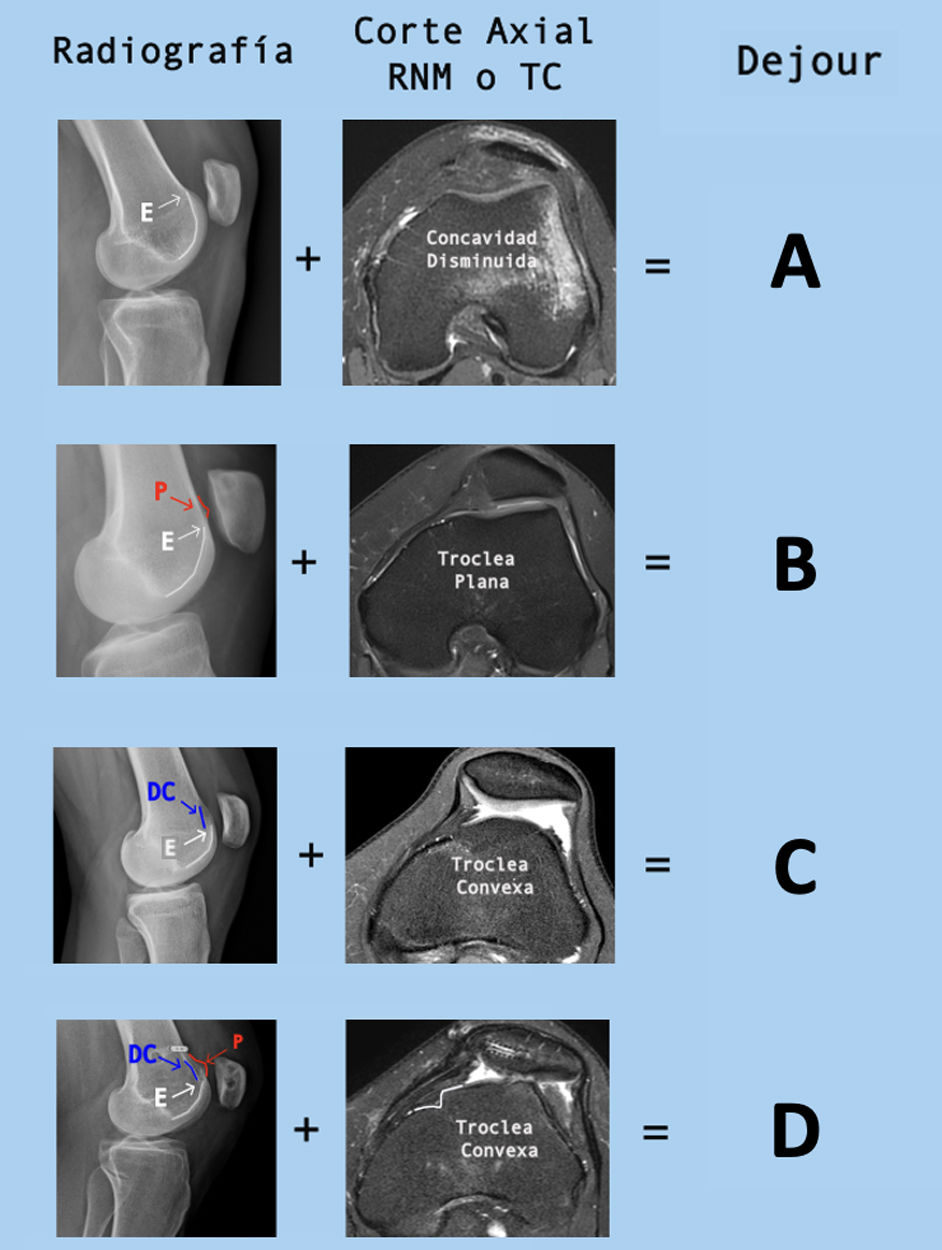
D. Dejour classification (v.2.0) for trochlear dysplasia. DC: double contour; E: crossing; P: spur.13
This classification has been shown to have adequate intra- and interobserver correlation and is particularly useful for differentiating between low-grade (types A and C) and high-grade (types B and D) dysplasia.14,15
The combination of both images is mandatory when using version 2.0 of D. Dejour's classification, as it has been shown to increase reproducibility when compared to radiography as the sole imaging study.13,15
Recently, Dr. David Dejour has proposed a new classification of trochlear dysplasia (v.3.0). This classification is based exclusively on MRI and is characterised by the use of objective measurements and a progressive order of severity16:
- •
Type 0 (no dysplasia). Sulcus angle (SA) <157° and lateral trochlear inclination (LTI) ≥14°.
- •
Type 1 (low-grade dysplasia). (SA ≥157° or LTI <14°) and central bump <5mm.
- •
Type 2 (moderate-grade dysplasia). (SA or LTI “unmeasurable‿) and central bump <5mm.
- •
Type 3 (high-grade dysplasia). (SA ≥157° or “unmeasurable‿), LTI <14° or “unmeasurable‿ and central bump ≥5mm.
Patella alta is the second most relevant risk factor described in the literature.3 Its height determines the degree of flexion required for the patella to fit into the trochlear groove, a phenomenon that is further exacerbated in cases of trochlear dysplasia, where the groove begins more distally than usual. In exceptional cases, a very high-riding patella can predispose to instability even in the absence of trochlear dysplasia.
Several methods have been described for quantifying patellar height on radiographs. The most widely used index in the literature is currently the Caton–Deschamps Index (CDI)1,17 (Fig. 2), calculated as the ratio of the distance from the inferior pole of the patellar articular surface to the anterosuperior tibial plateau (AT) and the length of the patellar articular surface (AP). The advantage of this index is that it is unaffected by distalisation osteotomies of the anterior tibial tuberosity (TT), thus enabling postoperative correction of patellar height to be assessed. Values >1.2 are considered to indicate a patella alta.3

There is currently no clear correlation between patellar height measurements obtained from radiographs, CT scans, and MRIs. This is because the latter are affected by the degree of knee flexion, quadriceps contraction, and the imaging modality used. Therefore, caution should be exercised when using these imaging modalities.
TT-TG distanceThe increase in TT-TG distance is the third major risk factor3 (Fig. 3). Unlike trochlear dysplasia and patella alta, this has not been shown to cause patellar dislocation on its own. This measurement is an axial plane representation of the Q angle, so its measurement is affected by both femoral/tibial rotation and coronal alignment of the limb.18

Measurement in axial MRI sections of the TT-TG distance using the posterior condyles as a reference. (A) Most posterior point of the trochlear groove (TG). (B) Central point of the patellar tendon on the anterior tibial tuberosity (TT). (C) Measurement of the TT-TG distance in the same axial section.
Increased values have been shown to alter patellar tracking by increasing the forces between the patella and the lateral facet of the trochlea. It can be measured using both CT and MRI, with different cut-off values for each.19
The lead author of this article has recently published a standardised method for determining the posterior reference for measuring the TT-TG distance. This method can be used in MRI to take multiple measurements in cases of patellofemoral pathology16 (Fig. 4).

Determination of the posterior bicondylar line (PBL) in three steps. (a) The orthogonal image passing through the centre of the medial condyle is determined in the axial section. (b) Then, the axial section crossing the most posterior point of the medial condyle is identified in the sagittal image. (c) Finally, the line tangent to the subchondral bone at the posterior part of the medial and lateral femoral condyles is identified in the axial section.
Knowledge of the patient's medical history and physical examination are necessary but not sufficient conditions for therapeutic decision-making. This must be based on a careful analysis of images using objective, reliable, and measurable data.6
Patients should be divided into categories based on their anatomical characteristics, and an ‘à la carte menu’ should be applied to correct each abnormality by performing the appropriate surgical procedure (Fig. 5).

Correction is indicated in cases of severe trochlear dysplasia, defined as dysplasia with supratrochlear spur >4mm.13
Although multiple techniques have been proposed, thick-flap trochleoplasty, as described by the Lyon School of Knee Surgery, is currently the most widely used.20–22 This technique has the advantage of not only eliminating supratrochlear spur, thereby reducing the reaction force in the patellofemoral joint, but also modifying the shape of the trochlea, allowing proximal realignment and reducing the TT-TG distance.
Trochleoplasty, when appropriately indicated, has shown good clinical results in the medium and long term, with low rates of re-dislocation.20,23–25 However, as it is a technically demanding and uncommon procedure, it is recommended that it be performed by surgeons with experience in this type of intervention.
Although recent long-term follow-up studies have shown slow progression to patellofemoral osteoarthritis, this procedure should be avoided in cases of patellofemoral osteoarthritis (Iwano >2) due to the unpredictable progression to osteoarthritis in these cases and the lack of healthy cartilage to obtain an adequate postoperative trochlear shape.13,21,22
Patella altaCorrection is indicated in patients with an CDI >1.2. In these cases, distalisation of the anterior tibial tuberosity can be performed with the aim of achieving a postoperative index of 1.1,3
Higher values have recently been proposed to determine the need for correction, based on the low dislocation rates in patients with CDI <1.4 with isolated reconstruction of the MPFL (LPFMR).26 However, further studies are still needed to determine the need for a change in this cut-off value.
TT-TG distanceMedialisation osteotomy of the anterior tibial tuberosity reduces the valgus force of the extensor mechanism. Traditionally, the pathological TT-TG distance for CT is greater than 20mm, whereas various authors propose values above 13mm for MRI.3,27
The clinical benefit of TT medialisation is currently a controversial topic.26,28 Although its correction has been shown to reduce failure rates and provide some benefits in terms of clinical assessment scales, when corrections are made in the presence of values lower than those mentioned above, they have not been shown to reduce re-fracture rates. We therefore suggest maintaining the classically proposed cut-off value.28,29
The aim of surgical correction is to obtain postoperative TT-TG values in a range of 10–15mm for CT and 8–13mm for MRI.1,30
Minor factorsAlthough the minor risk factors mentioned above are not uncommon, they play a minor role in patellofemoral instability. There is still little literature on which to base widely accepted and reproducible cut-off values for determining surgical treatment. For this reason, the Lyon School recommends addressing the major factors and only considering the surgical correction of minor factors in specially selected cases.
Medial patellofemoral ligamentReconstruction of the MPFL is considered one of the fundamental pillars of the therapeutic algorithm for this pathology and is currently replacing vastus medialis obliquus plasty.1,30 Combined with other surgical procedures, its reconstruction has been shown to reduce dislocation rates, and it is currently considered the treatment of choice in all surgical cases.
External releaseExternal retinaculotomy or lateral retinacular release have been proposed as additional surgical procedures to reduce external patellofemoral pressure and the traction vector of the retinaculum on the patella. Although clinical studies have shown that its routine use in patients undergoing MPFL reconstruction is not beneficial,31 we recommend its use when manual reduction of patellar tilt is impossible, to prevent increased patellofemoral pressure following MPFL reconstruction.32 Due to the ease of the procedure, the lack of difference in clinical outcomes and the possibility of performing it arthroscopically, the authors of this article prefer external retinaculotomy in selected cases.
ConclusionThe updated treatment algorithm for patellar instability reflects decades of experience in treating this complex knee condition. The approach developed by the Lyon team in 1987 has evolved in response to new scientific evidence regarding imaging techniques and surgical procedures, while maintaining a focus on the major intrinsic factors of patellar instability which have been shown to significantly impact the prognosis of this condition.
Level of evidenceLevel of evidence v.
Ethical considerationsNone declared.
FundingNo specific support from public sector agencies, commercial sector, or not-for-profit organisations was received for this research study.
Conflict of interestThe authors have no conflict of interest to declare.

