


metricas
covid
Buscar en
Revista Española de Anestesiología y Reanimación (English Edition)
Toda la web
Revista Española de Anestesiología y Reanimación (English Edition) Macklin effect in critically COVID-19 patients: Observational single-center anal...
Información de la revista
Visitas
3
Original article
Disponible online el 24 de octubre de 2025
Macklin effect in critically COVID-19 patients: Observational single-center analysis
Efecto Macklin en pacientes de COVID-19 críticos: análisis unicéntrico observacional
Visitas
3
G. Melegaria,
, F. Arturib, G. Vaccarib, F. Gazzottia, E. Bertellinia, L. Astorec, G. Della Casad, A. Pecchic, A. Barbierib
a Department of Anaesthesia and Intensive Care, Azienda Ospedaliero Universitaria, Modena, Italy
b School of Anaesthesia and Intensive Care, University of Modena and Reggio Emilia, Italy
c School of Radiology, University of Modena and Reggio Emilia, Italy
d Department of Radiology, Azienda Ospedaliero Universitaria, Modena, Italy
Este artículo ha recibido
Información del artículo
Resumen
Texto completo
Bibliografía
Descargar PDF
Estadísticas
Figuras (2)
Tablas (5)
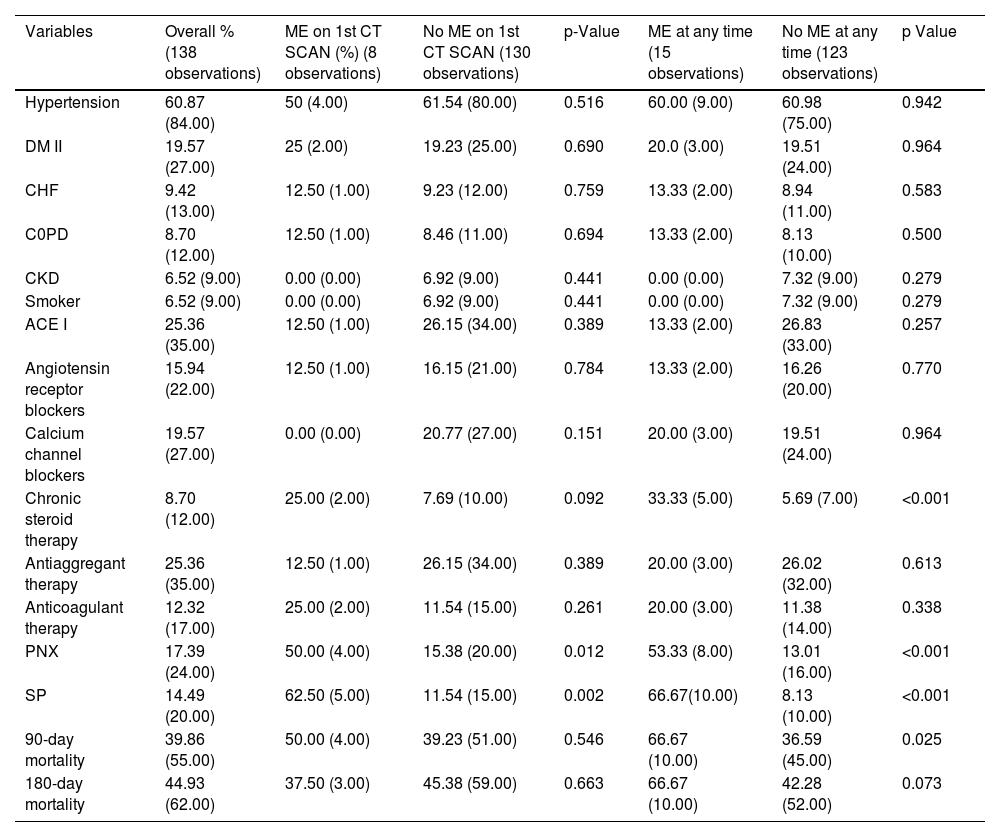
Table 1a. Baseline characteristics and comorbidities of the study population, comparing patients with Macklin Effect (ME) on the first computed tomography (CT) scan and those without the ME at baseline.
Tablas
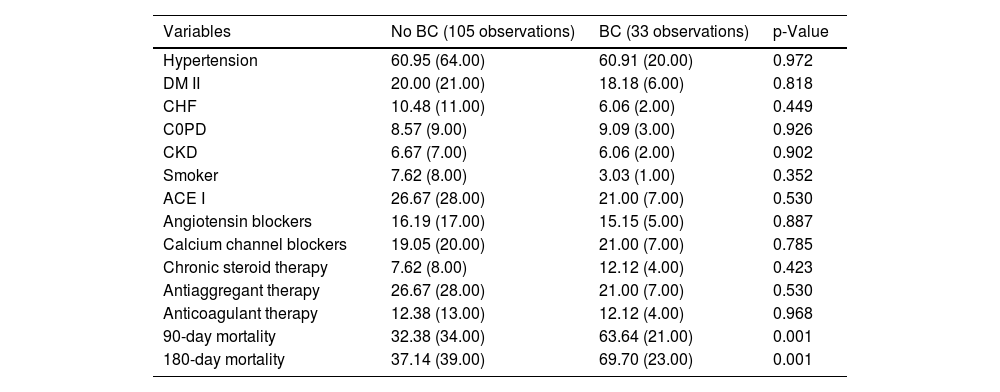
Table 1b. Comparison of baseline characteristics between patients with and without barotrauma complications (BC), defined as the occurrence of either spontaneous pneumomediastinum (SP) or pneumothorax (PNX).
Tablas
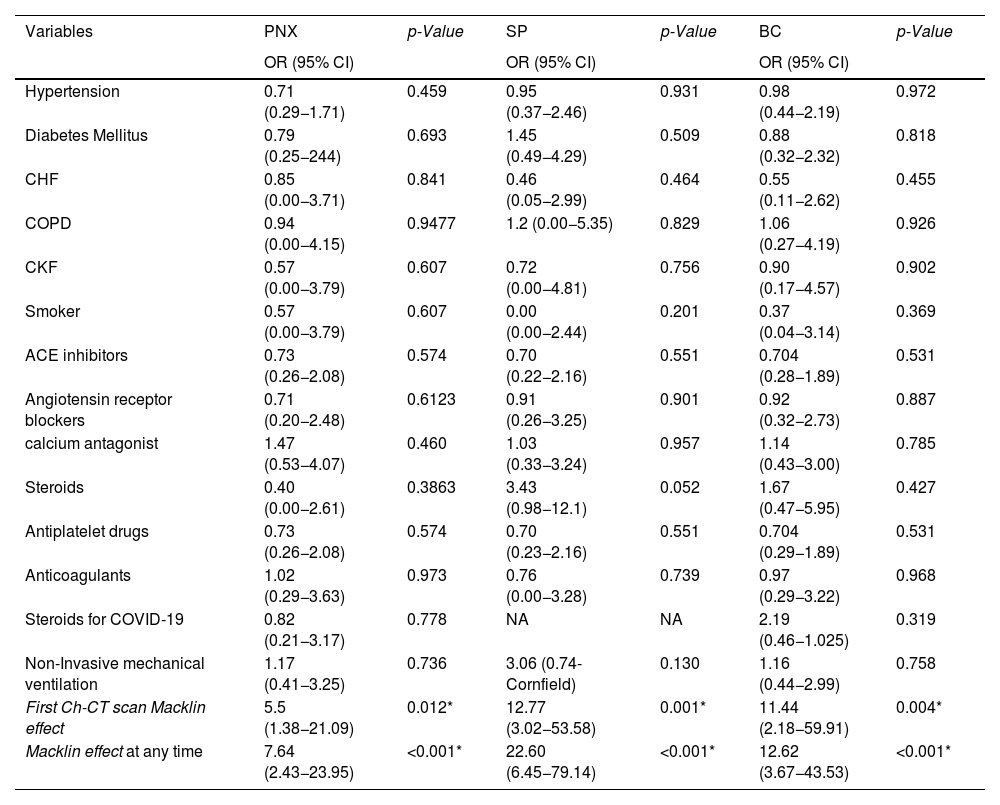
Table 2. Univariate analysis of factors associated with the development of pneumothorax (PNX), spontaneous pneumomediastinum (SP), and barotrauma complications (BC).
Tablas
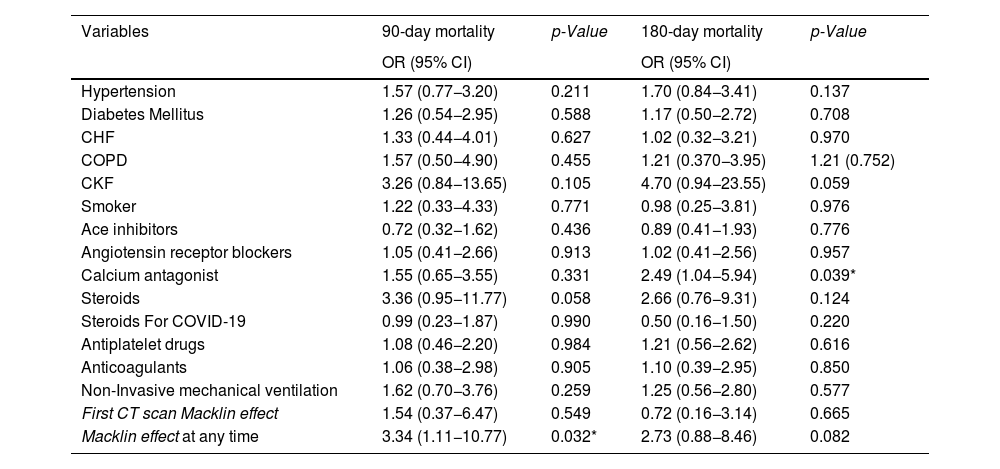
Table 3. Univariate analysis of predictors of 90-day and 180-day mortality in critically ill COVID-19 patients.
Tablas
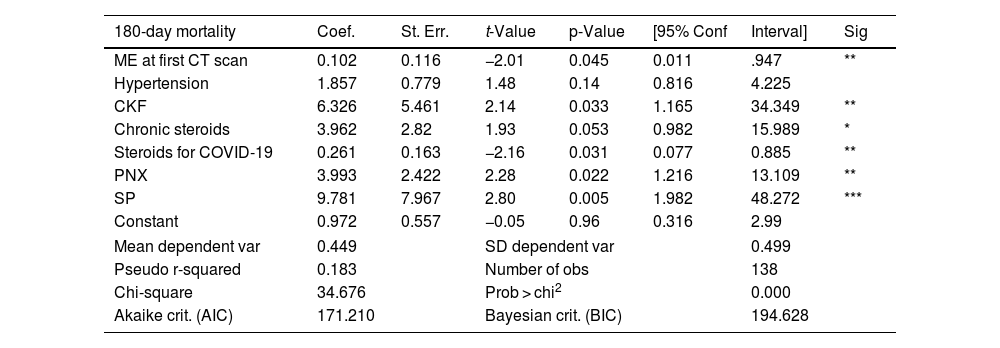
Table 4. Multivariate analysis of factors associated with 180-day mortality. Statistically significant variables are highlighted, including chronic steroid therapy and Macklin effect (ME) at first Ch-CT scan.
Tablas
Mostrar másMostrar menos
Material adicional (1)
Abstract
Objective

To analyze the incidence and impact of the Macklin effect (ME) in critically ill COVID-19 patients and its correlation with pneumothorax (PNX), spontaneous pneumomediastinum (SP), and barotraumatic complications (BC).

Design

Observational single-center study.

Setting

Intensive Care Unit (ICU) of a single Italian hospital.

Patients or participants

Critically ill COVID-19 patients aged ≥18 years, with at least one chest computed tomography (Ch-CT) scan and undergoing mechanical ventilation. Patients with pre-existing PNX, SP, or tracheal lesions at ICU admission were excluded.

Interventions

Retrospective analysis of Ch-CT scans to detect ME.

Main variables of interest

ME incidence, its correlation with barotrauma development and mortality.

Results

Among 138 patients, ME was detected in 5.80% (8 cases) on the first Ch-CT scan and in 10.87% (15 cases) at any time during ICU stay. PNX occurred in 17.39% (24 cases) and subcutaneous emphysema in 14.49% (20 cases), with a total BC incidence of 23.91% (33 cases). ME presence on the first Ch-CT scan was significantly associated with PNX (OR 5.5, p = 0.012), SP (OR 12.77, p < 0.001), and BC (OR 11.44, p = 0.004). ME detection on the first Ch-CT scan showed a hazard ratio (HR) of 5.91 (CI 2.41–14.50, p < 0.001) for BC development.

Conclusions

Early ME detection in critically ill COVID-19 patients is crucial, as it is significantly associated with PNX, SP, and BC. Recognizing ME could play a role in improving clinical management and outcomes.

Keywords:
Macklin effect
Barotraumatic complications
Pneumothorax
Spontaneous pneumomediastinum
COVID-19
Intensive care unit
Abbreviations:
ARDS
ICU
ACE Inhibitors
ARBs
BC
CHF
CKD
CKF
COPD
Ch-CT
CIs
IHD
DM II
LASSO
ME
OR
PCR
PNX
SE
SP
Resumen
Objetivo

Analizar la incidencia e impacto del efecto Macklin (EM) en pacientes críticos con COVID-19 y su correlación con neumotórax (PNX), neumomediastino espontáneo (NME) y complicaciones barotraumáticas (CB).

Diseño

Estudio observacional unicéntrico.

Ámbito

Unidad de Cuidados Intensivos (UCI) de un hospital en Italia.

Pacientes o participantes

Pacientes críticos con COVID-19, ≥18 años, con al menos una tomografía computarizada de tórax (TC) y sometidos a ventilación mecánica. Se excluyeron pacientes con PNX, NE o lesiones traqueales preexistentes al ingreso en UCI.

Intervenciones

Análisis retrospectivo de TC para detectar EM.

Variables de interés principales

Incidencia de EM, su correlación con el desarrollo de barotrauma y mortalidad.

Resultados

Se analizaron 138 pacientes. El EM se detectó en el 5,80 % (8 casos) en la primera TC y en el 10,87% (15 casos) en cualquier momento durante la estancia en UCI. Se observó PNX en el 17,39% (24 casos) y enfisema subcutáneo en el 14,49% (20 casos), con una incidencia total de CB del 23,91% (33 casos). La presencia de EM en la primera TC se asoció significativamente con PNX (OR 5,5; p = 0,012), NE (OR 12,77; p < 0,001) y CB (OR 11,44; p = 0,004). Además, el EM en la primera TC mostró un HR de 5,91 (IC 2,41-14,50; p < 0,001) para el desarrollo de CB.

Conclusiones

La detección temprana del EM en pacientes críticos con COVID-19 es crucial, ya que se asocia significativamente con PNX, NE y CB. Su reconocimiento podría desempeñar un papel en la mejora de la gestión clínica y los resultados.


Palabras clave:
Efecto Macklin
Complicaciones barotraumáticas
Neumotórax
Neumomediastino espontáneo
COVID-19
Unidad de Cuidados Intensivos (UCI)

Artículo

Opciones para acceder a los textos completos de la publicación Revista Española de Anestesiología y Reanimación (English Edition)
Suscriptor
Suscriptor de la revista

Si ya tiene sus datos de acceso, clique aquí.

Si olvidó su clave de acceso puede recuperarla clicando aquí y seleccionando la opción "He olvidado mi contraseña".
Suscribirse
Suscribirse a:

Revista Española de Anestesiología y Reanimación (English Edition)

Comprar
Comprar acceso al artículo

Comprando el artículo el PDF del mismo podrá ser descargado

Comprar ahora
Contactar
Teléfono para suscripciones e incidencias
De lunes a viernes de 9h a 18h (GMT+1) excepto los meses de julio y agosto que será de 9 a 15h
Llamadas desde España
932 415 960
Llamadas desde fuera de España
+34 932 415 960
E-mail
Opciones de artículo
Herramientas
Material suplementario