






Ultrasound-guided ISB is the most widely-used nerve block in upper limb surgery. The aim of this study was to determine the MEV90 of 0.5% ropivacaine in ISB for analgesia in arthroscopic shoulder surgery.
MethodologyDouble-blind observational post-authorization study of a medicinal product for human use. Thirty-two ASA I-III patients aged between 18 and 75 years undergoing arthroscopic shoulder surgery were recruited. We used the Dixon up-down method, whereby the dose is increased or decreased by 1 ml depending on the failure or success of the block. The initial dose was 20 ml of 0.5% ropivacaine. The study was stopped after achieving the minimum 5 negative-positive deflections. Secondary variables were the duration of the block, total analgesia consumption over the first 24 h, and incidence of DP.
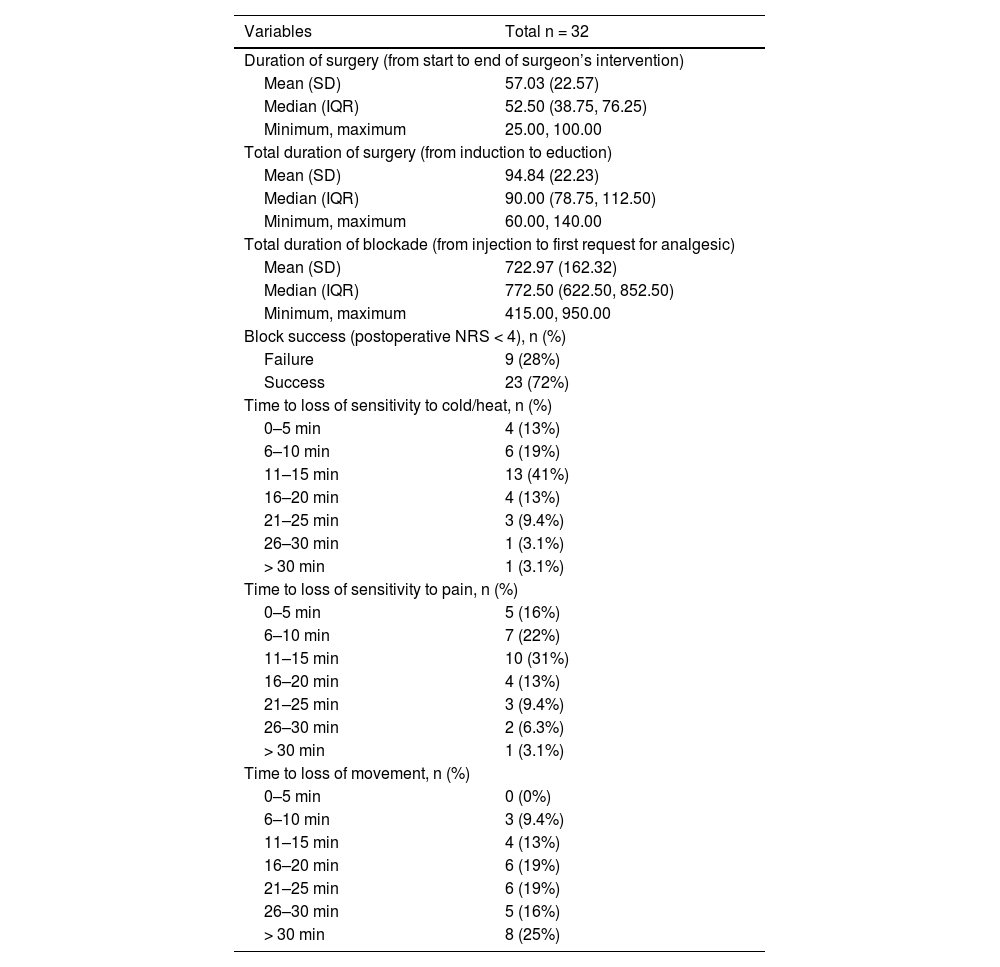
ResultsThe effective LA dose for postoperative analgesia in arthroscopic shoulder surgery was 6.8 ml in 50% of patients (MEV50) (90% CI 6.234–7.465) and 7.733 ml in 90% of patients (MEV90) (90% CI 7.393–9.109). Median sensory block duration was 772.5 min. The incidence of partial and total DP in QB was 34% and 41%, respectively.
ConclusionA dose of 7.733 ml of 0.5% ropivacaine provides effective postoperative analgesia in arthroscopic shoulder surgery in 90% of patients. This lower dose reduces the likelihood of side effects.
El bloqueo interescalénico (BIE) es el más utilizado en la cirugía demiembros superiores. El objetivo de este estudio es determinar el VEM90 de Ropivacaína® al 0,5% en el BIE para la analgesia en cirugía artroscópica de hombro.
MetodologíaEstudio postautorización doble ciego observacional para medicamentos de usohumano. Se reclutaron 32 pacientes con un estado físico I-III de la ASA, con edades entre 18 y75 años sometidos a cirugía artroscópica de hombro. Se utilizó la metodología step up-step downde Dixon por la cual se aumentaba o disminuía en 1 ml el volumen administrado, según el fracasoo el éxito del bloqueo, respectivamente. La dosis inicial fue 20 ml de Ropivacaína® al 0,5%. Elestudio se detuvo tras lograr el mínimo de desviaciones negativas-positivas. Como variablessecundarias se obtuvieron el tiempo de duración del bloqueo, consumo total de analgésicosdurante las primeras 24 h e incidencia de hemiparesia (HP).
ResultadosEl volumen de anestésico local (AL) efectivo en el 50% de los pacientes (VEM50)para la analgesia postoperatoria en cirugía artroscópica de hombro, fue de 6,8 ml (IC 90%: 6,234-7,465) y en el 90% de los pacientes (VEM90) fue de 7,733 ml (IC 90%: 7,393-9,109). La medianade duración del bloqueo sensitivo fue de 772,5 min. La incidencia de hemiparesia diafragmática(HPD) parcial fue del 34% y total del 41% en respiración tranquila (RT).
ConclusiónUn volumen de 7,733 ml de Ropivacaína® al 0,5% sería suficiente para una anal-gesia postoperatoria efectiva en cirugía artroscópica de hombro para el 90% de los pacientes;disminuyendo así la probabilidad de efectos secundarios.

