


metricas
covid
Revista Española de Anestesiología y Reanimación (English Edition) Anaesthesetic considerations in the perioperative management of patients with he...
Journal Information
Visits
3
Vol. 72. Issue 5.
(May 2025)
Case report
Anaesthesetic considerations in the perioperative management of patients with hereditary angioedema-FXII
Consideraciones anestésicas en el manejo perioperatorio del paciente con angioedema hereditario FXII
Visits
3
P. García Robledoa,
Corresponding author
patrigarrob@gmail.com

Corresponding author.
, J.C. García Ortizb
a Servicio de Anestesiología, Reanimación y Terapéutica del Dolor, Hospital Universitario 12 de Octubre, Madrid, Spain
b Unidad de Alergología, Hospital Universitario Río Hortega, Valladolid, Spain
This item has received
Article information
Abstract
Full Text
Bibliography
Download PDF
Statistics
Tables (1)
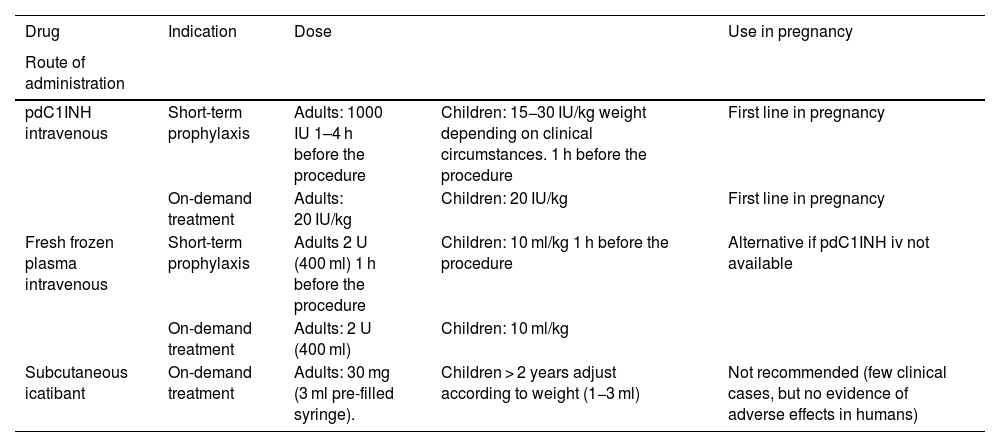
Table 1. Drugs and doses in the perioperative management of FXII-HAE: short-term prophylaxis and on-demand treatment.
Tables
Abstract

Hereditary angioedema (HAE) is of interest to anaesthesiologists due to its impact on perioperative management. HAE manifests as episodic, self-limiting oedema in the deep subcutaneous or submucosal tissue that can be fatal if it involves the airway. It is usually caused by C1 esterase inhibitor deficiency. HAE episodes can be triggered by trauma, including surgical and medical procedures associated with mechanical trauma. Our understanding of HAE has evolved in recent years following the development of new genetic sequencing technologies that have made it possible to differentiate variants with normal C1 esterase inhibitor levels. In Spain, the most frequent of these is HAE due to a mutation in FXII, previously known as HAE type III. There are as yet no good quality studies on perioperative management and treatment of these patients. The admission of a patient with FXII-HAE for labour induction has given us the opportunity to review the perioperative management of these cases.

Keywords:
Hereditary angioedema
Surgical procedures
Preprocedural prophylaxis
Hereditary angioedema with normal C1-esterase inhibitor
Factor XII mutation
Pregnancy
Resumen

El angioedema hereditario (AEH) tiene interés para el anestesista por sus implicaciones en el manejo perioperatorio. Se manifiesta como episodios de edema transitorio en el tejido subcutáneo o submucoso profundo, que si afecta a la vía aérea puede ser mortal. La forma más conocida se debe al déficit del factor inhibidor de la C1 esterasa. Uno de los desencadenantes de las crisis son los traumatismos, incluyendo los procedimientos quirúrgicos y médicos asociados a un impacto mecánico. Recientemente, ha habido avances en el conocimiento del AEH, especialmente por las nuevas tecnologías de secuenciación genética que han permitido diferenciar variantes con C1 inhibidor normal. En España, la más frecuente de ellas es el AEH por mutación en el FXII, antes denominado AEH tipo III, del que no existen estudios de calidad en cuanto al manejo perioperatorio y tratamiento. Con motivo de una paciente con AEH-FXII que ingresa para inducción al parto, revisamos el manejo perioperatorio de estos casos.


Palabras clave:
Angioedema hereditario
Procedimientos quirúrgicos
Profilaxis preoperatoria
Angioedema hereditario con C1 inhibidor normal
Mutación factor XII
Embarazo

Article

These are the options to access the full texts of the publication Revista Española de Anestesiología y Reanimación (English Edition)
Subscriber
Subscriber

If you already have your login data, please click here .

If you have forgotten your password you can you can recover it by clicking here and selecting the option “I have forgotten my password”
Subscribe
Subscribe to

Revista Española de Anestesiología y Reanimación (English Edition)

Purchase
Purchase article

Purchasing article the PDF version will be downloaded

Purchase now
Contact
Phone for subscriptions and reporting of errors
From Monday to Friday from 9 a.m. to 6 p.m. (GMT + 1) except for the months of July and August which will be from 9 a.m. to 3 p.m.
Calls from Spain
932 415 960
Calls from outside Spain
+34 932 415 960
E-mail
Article options
Tools