



metricas
Sugerencias
Revista Colombiana de Psiquiatría Prevalence and Clinical and Polygraphic Characteristics of Patients With Postura...
Información de la revista
Vol. 54. Núm. 1.
Páginas 67-72 (Enero - Marzo 2025)
Visitas
79
Vol. 54. Núm. 1.
Páginas 67-72 (Enero - Marzo 2025)
Original article
Acceso a texto completo

Prevalence and Clinical and Polygraphic Characteristics of Patients With Postural Sleep Apnea Attended by a Colombian Health Institute in Bogotá, Colombia

Prevalencia y características clínicas y poligráficas de pacientes con apnea postural atendidos en una institución de salud en Bogotá, Colombia
Visitas
79
Juan Darío Jiménez-Meléndeza,
Autor para correspondencia
jujimenezme@unal.edu.co

Corresponding author.
, Juan Manuel Hernández-Mirandab, Camilo Andrés Escobar-Sarmientob, Luis Felipe Romero-Morenoa, Franklin Escobar-Córdobab,c
a Universidad Nacional de Colombia, Faculty of Medicine, Department of Surgery – Otorhinolaryngology, Bogota D.C., Colombia
b Fundación Sueño Vigilia Colombiana, Bogota D.C., Colombia
c Universidad Nacional de Colombia, Faculty of Medicine, Department of Psychiatry, Bogota D.C., Colombia
Este artículo ha recibido
Información del artículo
Resumen
Texto completo
Bibliografía
Descargar PDF
Estadísticas
Figuras (1)
fig0005
Tablas (4)
Table 1. Clinical characteristics of patients included in the study.
Tablas
Table 2. Polygraphic characteristics of patients included in the study (n=255).
Tablas
Table 3. Clinical differences for patients with positional and non-positional sleep apnea (n=255).
Tablas
Table 4. Polygraphic differences for patients with positional and non-positional sleep apnea.
Tablas
Mostrar másMostrar menos
Abstract
Objective

To determine the prevalence and polygraphic and clinical characteristics of patients with postural sleep apnea attended on a Colombian health institute at Bogotá, Colombia.

Methods

Prospective descriptive observational study of patients older than 18 years old who underwent a polygraphic study because of a suspected OSA during a 6-month period between 2022 and 2023.

Results

A total of 233 polygraphic recordings were done in different patients who met criteria for the study. Ninety-seven patients (43%) met criteria for positional apnea and 126 (57%) for non-positional apnea. Patients with postural apnea had lower AHI (p<0.001), lower body mass index (p=0.002) and less hypertension (p=0.002). NADIR was lower in patients with non-positional apnea, 75% vs 72% (p=0.039). No significant statistical differences were found when comparing groups by age, sex or by Epworth, STOP-BANG, FOSQ-10, or Friedman's tongue position scales.

Conclusions

Postural apnea is a prevalent condition in Colombian population. According to our results these patients tend to have a lower severity of sleep apnea measured by AHI, lower BMI and less high blood pressure.

Keywords:
Sleep apnea
Supine position
Polysomnography
Prevalence
Resumen
Objetivo

Determinar la prevalencia y las características clínicas y poligráficas de pacientes con apnea postural atendidos en una institución de salud en Bogotá, Colombia.

Metodología

Estudio observacional descriptivo prospectivo de pacientes mayores de 18 años a quienes se les realizó una poligrafía respiratoria por sospecha de apnea obstructiva del sueño en un periodo de 6 meses entre el 2022 y 2023.

Resultados

Un total de 255 estudios poligráficos fueron realizados en pacientes diferentes; 97 pacientes (43%) cumplieron criterios para apnea postural y 126 (57%) para apnea no postural. Los pacientes con apnea postural tuvieron niveles de IAH más bajos (p<0,001), menor índice de masa corporal (p=0,002) y menor historia de hipertensión arterial (p=0,049). La saturación mínima registrada durante el estudio fue más baja en pacientes con apnea no postural, 72% vs. 75% (p=0,039). No hubo diferencias estadísticamente significativas entre los dos grupos al compararlos por edad, sexo ni al comparar las puntuaciones en las escalas de Epworth, STOP-BANG, FOSQ-10 o Friedman.

Conclusiones

La apnea postural es una condición prevalente en la población colombiana. De acuerdo a nuestros resultados, estos pacientes tienden a tener menor severidad de la apnea, menor índice de masa corporal y menor historia de hipertensión arterial.


Palabras clave:
Apnea obstructiva del sueño
Posición supina
Polisomnografía
Prevalencia
Texto completo
Introduction

Obstructive sleep apnea (OSA) is one of the most prevalent sleep disorders, with a global prevalence that varies from 4 to 30%.1 In Colombia, sleep disorders affect approximately 27% of the general population.2 This condition is characterized by recurrent episodes of upper airway obstruction during sleep leading to airflow reduction. Patients often notice excessive daytime sleepiness which increases accidents at work and while driving. It has also been related to the development of cognitive, metabolic, and cardiovascular diseases, thus, worsening the quality of life of patients and with a huge economic burden for health systems.3

Based on the pathogenic mechanism, polysomnographic characteristics, and clinical presentation, different phenotypes for OSA have been described. One of them, postural sleep apnea (POSA), refers to a group of patients whose obstructive respiratory events occur more frequently in a certain sleep position, notably in the supine position, and in whom positional therapy may play a role as a primary treatment. Although in-laboratory polysomnography remains the gold standard for the diagnosis, due to the marked changes in sleep position patterns related to the use of multiple electrodes, home sleep apnea tests such as polygraphies, which resembles a more natural sleep environment, are other validated sleep tests used for diagnosis of POSA.4

Mostly based on Caucasian and Asian people studies POSA patients have shown to be younger, skinnier, with lower neck perimeters and body mass index (BMI) scores, and with less high blood pressure. They also tend to have less severe sleep apneas based on Apnea-Hypopnea Index (AHI) scores, fewer arousals and snoring but better total sleep time and sleep efficiency.5,6 The prevalence of POSA has been reported in the global literature to be between 50 and 60% of patients with OSA.7–9 In Colombia and South America, few studies describe the prevalence, demographic, clinical, and polysomnographic characteristics of the different phenotypes of patients with sleep apnea.

Distinguishing between postural and non-postural sleep apnea has relevant therapeutic implications since positional therapy in the first group has shown that it is a safe and effective method to reduce obstructive respiratory events and the economic burden for health institutions.3,8–10 Different studies suggest that positional therapy can work as a primary treatment in 30–50% of POSA patients.11 Therefore, the objective of this study was to determine the prevalence and polygraphic and clinical characteristics of patients with postural sleep apnea attended by a Colombian health institute in Bogotá, Colombia.

Methods

Prospective descriptive observational study of patients older than 18 years old who underwent a polygraphic study because of a suspected OSA at a Colombian health institute in Bogotá, Colombia (2460m), between November 2022 and May 2023. On the day of the training for the use of the type III sleep study (ApneaLink Air – ResMed) different clinical and demographic variables were interrogated and measured. Polygraphic findings were obtained and analyzed after a somnologist interpreted the results.

Variables

The following variables were obtained for all patients.

Demographic and clinical: Age, sex, comorbidities (hypertension, diabetes mellitus and dyslipidemia), body mass index (BMI), neck perimeter.

Polygraphic: Apnea-Hypopnea Index (AHI), AHI in supine, AHI in non-supine, cumulative time percentage with SpO2 <90% (CT-90), lowest oxygen saturation drops registered (NADIR) and the number of snores.

Other: Epworth sleepiness scale (ESS),12,13 STOP-BANG,14,15 Functional Outcomes Sleep Questionnaire (FOSQ-10),15,17 and Friedman's tongue position scale.

Exclusion criteria and statistical analysis

Patients who met criteria for POSA were compared to those with sole criteria for OSA. Criteria for POSA were AHI ≥5 and a supine AHI at least twice the non-supine AHI, spending at least 10% of the total registered time on the polygraph in both the best and worst position for sleep (positions in which the lowest and highest number of obstructive respiratory events occurred, respectively). Patients that had a central AHI ≥5/h or with technically inadequate studies (e.g., less than 180min of total registration time) were excluded. The T-Student test was used for analyzing continuous variables and χ2 for categorical variables, assuming significant differences when p values were <0.05.

Ethical considerations

Participants provided informed consent. This research adhered to the ethical principles outlined in the Declaration of Helsinki by the World Medical Association (Fortaleza, Brazil, October 2013) regarding medical research involving human subjects.18 Participants’ data confidentiality was strictly maintained with unique identifying codes within the database. Moreover, following Resolution 8430 of 1993 issued by the Colombian Ministry of Health,19 which establishes scientific, technical, and administrative standards for health research, this study was classified as a non-risk. This study received approval from the Ethics Committee Act B.FM.1.002-CE-0048-23 at the Faculty of Medicine, Universidad Nacional de Colombia.

Results

A total of 255 patients were evaluated with a polygraphic study. After inclusion and exclusion criteria were applied, 233 patients met criteria for OSA. Excluded patients were 32 in total, 20 patients because they had an AHI <5 or central AHI >5, 10 patients because no neck perimeter was obtained and 2 patients because their sleep study was insufficient. Of the 223 patients included, 97 (43%) had POSA and 126 (57%) had OSA without postural criteria (Fig. 1).

Fig. 1.

Flow chart of the population studied (n=255).

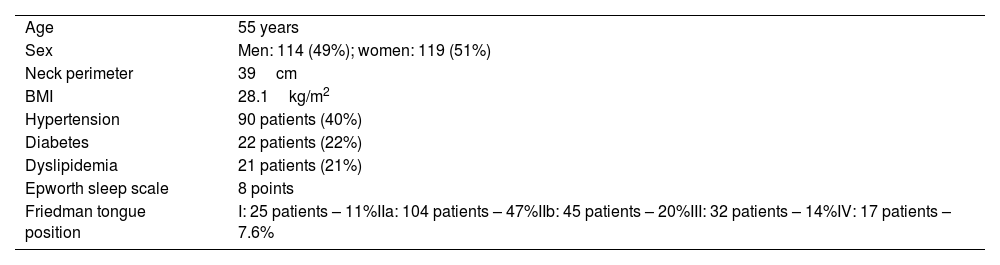
Participants average age was 55 years and there were 119 women (51%) and 114 men (49%). Regarding clinical comorbidities, 90 (40%) had hypertension, 22 (10%) diabetes and 21 (9.4%) dyslipidemia. Mean BMI, neck perimeter and Epworth sleepiness scale were 28.1kg/m2, 39cm and 8 points, respectively. Most patients (47%) had a IIa Friedman's tongue position (Table 1). Regarding polygraphic characteristics, 25/h was the mean AHI, with a mean CT-90 of 80% and 245 snoring (Table 2).

Table 1.

Clinical characteristics of patients included in the study.

Age  55 years 
Sex  Men: 114 (49%); women: 119 (51%) 
Neck perimeter  39cm 
BMI  28.1kg/m2 
Hypertension  90 patients (40%) 
Diabetes  22 patients (22%) 
Dyslipidemia  21 patients (21%) 
Epworth sleep scale  8 points 
Friedman tongue position  I: 25 patients – 11%IIa: 104 patients – 47%IIb: 45 patients – 20%III: 32 patients – 14%IV: 17 patients – 7.6% 
Table 2.

Polygraphic characteristics of patients included in the study (n=255).

Total AHI  25/h 
CT-90  80% 
NADIR  73% 
Snores  245 

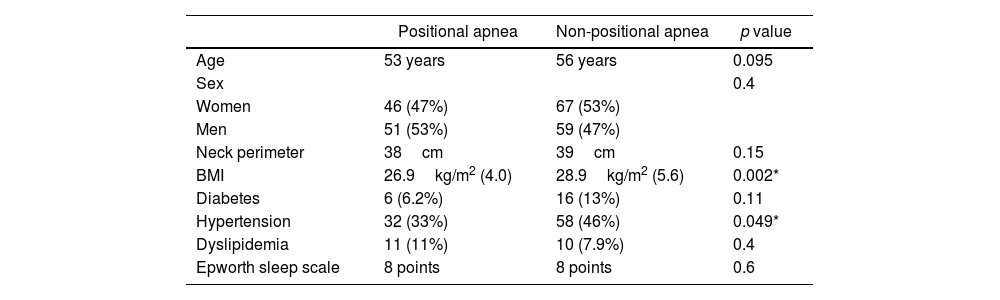
When comparing POSA participants with the control group significant differences were found in the following variables: BMI 26.9kg/m2 vs 28.9kg/m2 (p=0.002), hypertension 33% vs 46% (p=0.049), total AHI 21/h vs 28/h (p<0.001), central AHI 0.46/h vs 2.36/h (p<0.01) and NADIR 75% vs 72% (p=0.039). Values in neck perimeter, associated diabetes, CT-90 and number of snores were lower in POSA patients, but none reached a statistically significant difference (Tables 3 and 4). No differences were also found when comparing ESS (p=0.6), STOP-BANG (p=0.6), Friedman's tongue position (p=0.8) or FOSQ-10 (p=0.9) scores.

Table 3.

Clinical differences for patients with positional and non-positional sleep apnea (n=255).

  Positional apnea  Non-positional apnea  p value 
Age  53 years  56 years  0.095 
Sex      0.4 
Women  46 (47%)  67 (53%)   
Men  51 (53%)  59 (47%)   
Neck perimeter  38cm  39cm  0.15 
BMI  26.9kg/m2 (4.0)  28.9kg/m2 (5.6)  0.002* 
Diabetes  6 (6.2%)  16 (13%)  0.11 
Hypertension  32 (33%)  58 (46%)  0.049* 
Dyslipidemia  11 (11%)  10 (7.9%)  0.4 
Epworth sleep scale  8 points  8 points  0.6 
*

p=<0.05.

Table 4.

Polygraphic differences for patients with positional and non-positional sleep apnea.

  Positional apnea  Non-positional apnea  p value 
Total AHI  21/h  28/h  <0.001* 
Central AHI  0.46/h  2.36/h  <0.01* 
CT-90  77%  82%  0.1 
NADIR  75%  72%  0.039* 
Snores  195  284  0.2 
*

p=<0.05.

Discussion

Body position during sleep influences the frequency of respiratory events in patients with OSA. In our study POSA was common, being identified in 97 of 223 individuals (43%), comparable to the prevalence reported by literature.7–9 Mild (36%) and moderate (44%) sleep apnea were significantly more common in these individuals when compared with severe sleep apnea (20%). These findings differ a little from those reported by Mador and Jorquera where a higher general prevalence and percentage of mild sleep apnea were reported.8,11 However, the prevalence of POSA reported by our study could be higher considering that in our study 85 patients (38%) had supine AHI at least twice the non-supine AHI but did not accomplish enough time in all positions. This impacts diagnosis because there are more than a third of patients in which we do not know if they would accomplish all the criteria for POSA with another study.

To our knowledge, this is the first study to date in Colombia to assess the prevalence and clinical and polygraphic characteristics of POSA patients with a type III sleep study. Guzmán et al. described in a retrospective study the severity difference between 47 POSA patients and 41 non-POSA patients in terms of AHI based on type I sleep study reports, finding a significant correlation between having POSA and a lower AHI index, like our findings.20 ESS12,13 was also found in this study to be an independent factor concerning the severity of the apnea (p=0.31). No other studies related to characterize positional apnea in our country were found.

Two previous studies that described prevalence and characteristics of POSA patients using type III studies have been reported in Latino America by Jorquera in Santiago, Chile, and Di-Tullio in Buenos Aires, Argentina.11,21 They found a higher prevalence of POSA (53% and 54.6%, respectively) with ambulatory polygraphs, but fewer clinical variables were analyzed in their studies. The mean CT-90 reported by Di-Tullio was 8.8% in POSA patients, significantly lower than the 77% CT-90 found in our study. Also, NADIR reported by Jorquera was higher when compared to our findings (77.8% vs 73%). Both last differences are probably related to the fact that our work was conducted in a high-altitude city (2460m). Neither of these two studies included FOSQ-10,16,17 STOP-Bang,14,15 or Friedman's tongue position scales as our study did, though no statistical differences were found in these variables in our work.

Globally POSA was thought to have a higher prevalence in Asian population in comparison to western countries.22 Recent large study cohorts in China, France and Switzerland have shown similar results to our findings, mostly based in type I sleep studies.23–25 Sabil et al. found in a cohort of 6437 patients that only male sex, younger age, lower BMI, lower AHI, lower CT-90 and higher NADIR were significantly associated with POSA, partially consistent with our study findings.24 Nonetheless, only 55% of patients in their cohort had a type III sleep apnea test, and no differences with in-laboratory polysomnographies were described. Excessive daytime sleepiness was also assessed with ESS, but no differences were found. Other authors, such as Oksenberg have described less sleepiness in POSA patients reported by multiple sleep latency tests.26

Based on the results of the present study, overweight and hypertension are conditions that can be present in both POSA and non-POSA patients, but these are principally associated with a statistically significant difference in the last group. No association between POSA and diabetes or dyslipidemia was found. A limitation of our study is that other cardiovascular diseases were not assessed. Neither sex, age, nor neck perimeter were significant predictive markers in our study, different from what literature reports in which POSA patients tend to be male, younger, and with a smaller neck circumference.24,27

In our study, home sleep polygraphy was useful to assess POSA patient's characteristics. Many authors have described that polygraphy provides a more familiar environment while sleeping than in-laboratory polysomnography, affecting less the usual sleep position patterns of patients.28 A retrospective study that compared type 1 and type 3 sleep studies found that patients with in-lab studies tended to remain more in supine position, overestimating also the total AHI.29 Yo et al. had already confirmed this finding in a study that found that during type 1 studies patients spent 14.1% more time on supine position when compared to home sleep apnea tests.30 Considering this, ambulatory studies such as the polygraphy used in our work may affect less sleep physiology leading to a more precise diagnosis of positional apnea, especially in high-risk patients.

Conclusions

OSA is recognized as a heterogeneous disease from the perspective of underlying physiopathological mechanisms and its clinical presentation. In this study we found that POSA, one of OSA phenotypes, is a prevalent condition in Colombian population, and that it is associated with a lower severity of sleep apnea measured by AHI, lower BMI and less high blood pressure.

While polysomnography remains the gold standard for OSA in general, the use of ambulatory polygraph has been shown to be a reliable and physiological diagnostic test for POSA. The relevance of diagnosing postural apnea lies in the fact that positional therapy can be a first-line therapy, mainly in mild apneas, or an adjunct to positive pressure therapy in moderate or severe apneas, impacting positively in the economic burden of OSA for health systems. Further studies are necessary to develop personalized management strategies for patients with POSA.

Funding

Universidad Nacional de Colombia, Bogotá. Fundación Sueño Vigilia Colombiana, Bogotá D.C., Colombia.

Conflicts of interest

None stated by the authors.

References
[1]
A.V. Benjafield, N.T. Ayas, P.R. Eastwood, R. Heinzer, M. Ip, M.J. Morrell, et al.
Estimation of the global prevalence and burden of obstructive sleep apnoea. A literature-based analysis.
Lancet Respir Med, 7 (2019), pp. 687-698
[2]
P. Hidalgo-Martínez, R. Lobelo.
Epidemiología mundial, latinoamericana y colombiana y mortalidad del síndrome de apnea-hipopnea obstructiva del sueño (SAHOS).
Rev Fac Med, 65 (2017), pp. 17-20
[3]
O. Mediano, N. González-Mangado, J.M. Monserrat, M.L. Alonso-Álvarez, I. Almendros, A. Alonso-Fernández, et al.
International consensus document on obstructive sleep apnea.
Arch Bronconeumol, 58 (2022), pp. 52-68
[4]
R.C.P. Teixeira, M.B. Cahali.
In-laboratory polysomnography worsens obstructive sleep apnea by changing body position compared to home testing.
Sensors (Basel), 24 (2024), pp. 2803
[5]
K.A. Guzmán Ortíz, I.C. Guzmán Ortíz, G. Ardila.
Severidad según índice de apnea hipopnea del sueño en el síndrome de apnea obstructiva del sueño posicional vs no posicional en el Hospital Universitario Clínica San Rafael.
Acta Otorrinolaringol Cir Cabeza Cuello, 46 (2019), pp. 195-201
[6]
M. Yingjuan, W.H. Siang, T.K. Leong Alvin, H.P. Poh.
Positional therapy for positional obstructive sleep apnea.
Sleep Med Clin, 14 (2019), pp. 119-133
[7]
F. Di Tullio, E. Borsini.
Síndrome de apneas e hipopneas obstructivas del sueño posicional.
Rev Am Med Respir, 20 (2020), pp. 255-266
[8]
M.J. Mador, T.J. Kufel, U.J. Magalang, S.K. Rajesh, V. Watwe, B.J. Grant.
Prevalence of positional sleep apnea in patients undergoing polysomnography.
Chest, 128 (2005), pp. 2130-2137
[9]
S.A. Joosten, D.M. O’Driscoll, P.J. Berger, G.S. Hamilton.
Supine position related obstructive sleep apnea in adults: pathogenesis and treatment.
Sleep Med Rev, 18 (2014), pp. 7-17
[10]
E. Cortés-Reyes, K. Parrado-Bermúdez, F. Escobar-Córdoba.
New perspectives in the treatment of obstructive sleep apnea–hypopnea syndrome.
Rev Colomb Anestesiol, 45 (2017), pp. 62-71
[11]
J.A. Jorquera, G. Labarca, J. Dreyse, C. Salas.
Diferencias clínicas en pacientes con apnea obstructiva del sueño de carácter postural.
Rev Chil Enferm Respir, 33 (2017), pp. 14-20
[12]
H. Chica-Urzola, F. Escobar-Córdoba, J. Eslava-Schmalbach.
Epworth validating the Epworth sleepiness scale.
Rev Salud Públ, 9 (2007), pp. 558-567
[13]
M.W. Johns.
A new method for measuring daytime sleepiness: the Epworth sleepiness scale.
Sleep, 14 (1991), pp. 540-545
[14]
J.L. Toledo-Ortiz.
Validación al Castellano del Cuestionario STOP BANG. Trabajo final de grado.
Universidad Nacional de Colombia, Facultad de Medicina, (2018),
[15]
F. Chung, Y. Yang, P. Liao.
Predictive performance of the STOP-Bang score for identifying obstructive sleep apnea in obese patients.
Obes Surg, 23 (2013), pp. 2050-2057
[16]
J. Rey de Castro, E. Rosales-Mayor, T.E. Weaver.
Reliability and validity of the Functional Outcomes of Sleep Questionnaire – Spanish Short Version (FOSQ-10SV) in Peruvian patients with obstructive sleep apnea.
J Clin Sleep Med, 14 (2018), pp. 615-621
[17]
E.R. Chasens, S.J. Ratcliffe, T.E. Weaver.
Development of the FOSQ-10: a shortened version of the Functional Outcomes of Sleep Questionnaire.
Sleep, 32 (2009), pp. 915-919
[18]
World Medical Association (WMA).
WMA Declaration of Helsinki – ethical principles for medical research involving human subjects.
64th WMA General Assembly, (2013),
[19]
Colombia. Ministerio de Salud. Resolución 8430 de 1993 (octubre 4): Por la cual se establecen las normas científicas, técnicas y administrativas para la investigación en salud. Bogotá D.C.; octubre 4 de 1993.
[20]
K.A. Guzmán, I.C. Guzmán, G. Ardila.
Severidad según índice de apnea hipopnea del sueño en el síndrome de apnea obstructiva del sueño posicional vs no posicional en el Hospital Universitario Clínica San Rafael.
Acta Otorrinolaringol Cir Cabeza Cuello, 46 (2018), pp. 195-201
[21]
F. Di Tullio, G. Ernst, G. Robaina, M. Blanco, A. Salvado, A. Meraldi, et al.
Ambulatory positional obstructive sleep apnea syndrome.
Sleep Sci, 11 (2018), pp. 8-11
[22]
J.H. Mo, C.H. Lee, C.S. Rhee, I.Y. Yoon, J.W. Kim.
Positional dependency in Asian patients with obstructive sleep apnea and its implication for hypertension.
Arch Otolaryngol Head Neck Surg, 137 (2011), pp. 786-790
[23]
W. Huang, X. Wang, C. Xu, H. Xu, H. Zhu, S. Liu, et al.
Prevalence, characteristics, and respiratory arousal threshold of positional obstructive sleep apnea in China: a large scale study from Shanghai Sleep Health Study cohort.
Respir Res, 23 (2022), pp. 240
[24]
A. Sabil, M. Blanchard, W. Trzepizur, F. Goupil, N. Meslier, A. Paris, et al.
Positional obstructive sleep apnea within a large multicenter French cohort: prevalence, characteristics, and treatment outcomes.
J Clin Sleep Med, 16 (2020), pp. 2037-2046
[25]
R. Heinzer, N.J. Petitpierre, H. Marti-Soler, J. Haba-Rubio.
Prevalence and characteristics of positional sleep apnea in the HypnoLaus population-based cohort.
Sleep Med, 48 (2018), pp. 157-162
[26]
A. Oksenberg, D.S. Silverberg, E. Arons, H. Radwan.
Positional vs nonpositional obstructive sleep apnea patients: anthropomorphic, nocturnal polysomnographic, and multiple sleep latency test data.
Chest, 112 (1997), pp. 629-639
[27]
M. Yingjuan, W.H. Siang, T.K. Leong Alvin, H.P. Poh.
Positional therapy for positional obstructive sleep apnea.
Sleep Med Clin, 14 (2019), pp. 119-133
[28]
W. Kukwa, J. Łaba, T. Lis, K. Sobczyk, R.B. Mitchell, M. Młyńczak.
Supine sleep patterns as a part of phenotyping patients with sleep apnea – a pilot study.
Sleep Breath, 26 (2022), pp. 1771-1778
[29]
A.A.F. Mello, D. Angelo, G. Santos, R.B. Bensenor, I. Lotufo, P.A. Lorenzi-Filho, et al.
Influence of the device used for obstructive sleep apnea diagnosis on body position: a comparison between polysomnography and portable monitor.
Sleep Breath, 27 (2023), pp. 887-891
[30]
S.W. Yo, S.A. Joosten, H. Wimaleswaran, D. Mansfield, L. Thomson, S.A. Landry, et al.
Body position during laboratory and home polysomnography compared to habitual sleeping position at home.
J Clin Sleep Med, 18 (2022), pp. 2103-2111
Copyright © 2024. Asociación Colombiana de Psiquiatría
Descargar PDF