



Spiders of the genus Loxosceles belong to the Sicariidae family and are cosmopolitan. There are records of 131 species1 worldwide, with 40 species described in the Mexican Republic (38 native and two introduced: Loxosceles reclusa and Loxosceles rufescens). The arachnid has three pairs of eyes organized as follows: one pair in the frontal region, which are the largest, along with a pair on the right and another pair on the left, slightly posterior to the middle eyes. The population colloquially refers to them as “brown spiders,” “corner spiders,” or “brown recluse spiders,” but they are more commonly known as “violin spiders” due to the presence of a dark violin-shaped mark (with the handle of the violin located at the posterior end of the cephalothorax) on the arachnid's cephalothorax.2,3 These spiders can be found in dry and dark places, making them nocturnal, sedentary, and non-aggressive animals. They only bite when they feel threatened, primarily feeding on insects. As a result, they are often found in dark, poorly ventilated areas with minimal traffic, such as behind furniture, pictures, wardrobes, or wood, increasing the likelihood of interaction with residents and facilitating their spread to urban areas through activities like migration or commerce.2
Most patients present with local skin toxicity, while others develop systemic toxicity characterized by hemolysis, known as cutaneous-hemolytic loxoscelism. This case report focuses on a patient who experienced systemic toxicity with dermal necrosis, hemolysis, and acute kidney injury.
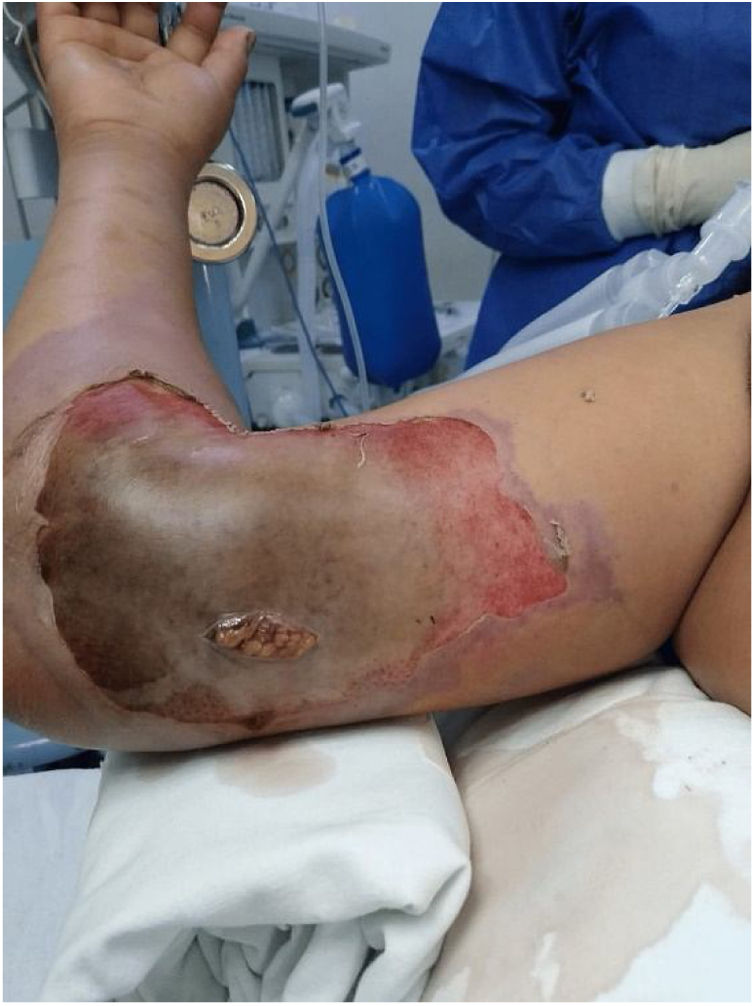
Case presentationA 53-year-old woman presented with pain, swelling, and discoloration of her right arm three days after a spider bite. Physical examination revealed a demarcated, erythematous to purple plaque with a dusky center and areas of ischemic skin (Fig. 1).

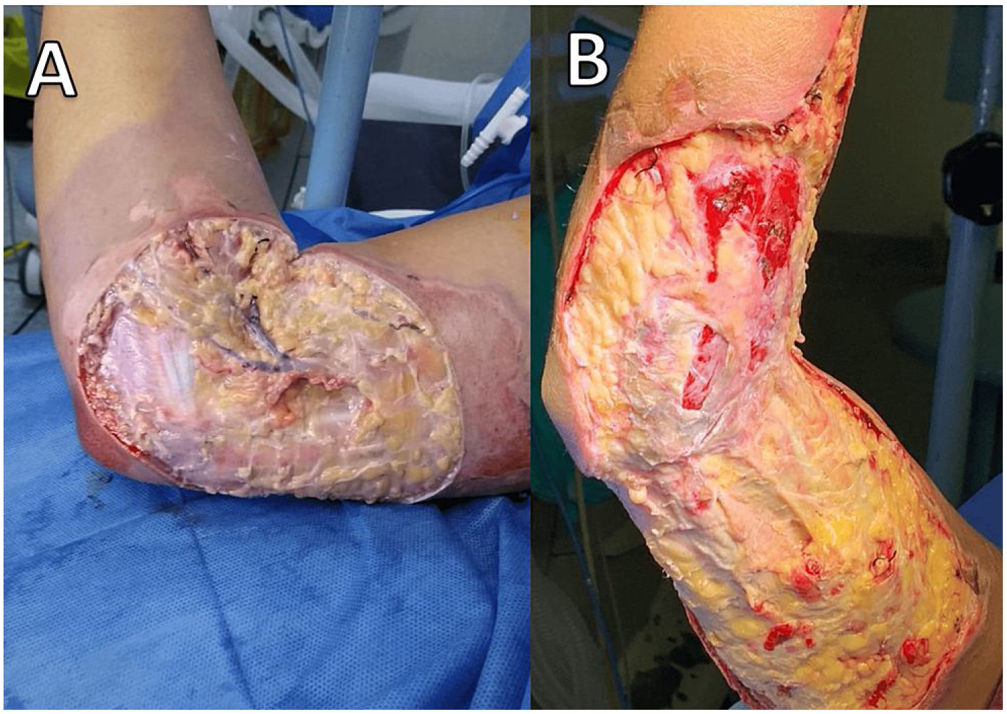
Laboratory analysis showed leukocytosis, anemia, hyperglycemia, hypercreatinemia, elevated lactate dehydrogenase, and bilirubin levels. Metabolic acidosis was observed. The patient developed progressive swelling, hypotension, and tachycardia despite fluid resuscitation, necessitating vasopressor support. After surgical intervention the patient received meropenem for seven days, resulting in nearly complete healing (Fig. 2).

Loxoscelism was considered in the differential diagnosis, and treatment included oral analgesics, antibiotics, general wound care, and surgical intervention.
DiscussionThe medical importance of the arachnid is due to the inoculation of venom that produces toxicity, triggering a proteolytic and necrotic action, produced by apocrine glands. The venom is composed of hyaluronidases, esterases, proteases, and DNases, with phospholipase D (sphingomyelinase D) being the main component responsible for the necrotic and hemolytic process. Loxoscelism is the term used to describe the clinical manifestations caused by the toxicity when it is injected through the bite into attacked individuals.3
Loxosceles spiders, such as violin spiders, have a wide geographical distribution (except in polar regions and high-altitude zones)4 and do not show a gender prevalence. Both men and women have an equal risk of exposure.4,5 In Campeche and Yucatan, it has been found and recorded the specie Loxosceles yucatana.6 The most commonly attacked areas by the arachnid, in decreasing order, are the thoracic limbs, face, neck, pelvic limbs, pelvis, and thorax. The patient in this case presents a bite mark on the thoracic limb, consistent with the aforementioned information. To the best of our knowledge in the state of Campeche, Mexico, this appears to be the first documented case of probable loxoscelism.
As previously mentioned, the venom of the violin spider causes cutaneous necrotic, hemolytic, vasculitic, and coagulant reactions.7 There are two forms of loxoscelism: the first and most common is cutaneous loxoscelism (84–97% of reported cases),7 which manifests 6–8h after the spider bite. It can be asymptomatic or develop symptoms such as fever, pain, itching, redness, vasoconstriction, erythema, ischemia, increased temperature, and edema, forming a necrotic lesion (lividoid plaque).7 The second form is cutaneous-visceral (systemic) loxoscelism, which is less common but more severe, as it carries a mortality rate of 15–25% that increases if not treated within the first 12–36h after the bite.8 It causes fever and general discomfort as characteristic symptoms. However, laboratory studies may reveal findings of hemolytic anemia, acute renal failure, disseminated intravascular coagulation, and multi-organ failure.8,9 Rarely, hemolysis is associated with acute kidney injury, as seen in this case.
The diagnosis of loxoscelism is clinical, and the presence of a cutaneous lesion along with a compatible epidemiological history is considered as “probable loxoscelism”. However, it is recommended to identify and examine the spider by a toxicology center or an expert when possible to properly give the classification as “documented loxoscelism”, on the contrary when neither the clinical signs and symptoms nor the epidemiological data support the diagnosis it should be labeled as “Assumption”, and as “Presumptive” if the spider is in the area, and the clinical aspect and evolution correspond to loxoscelism.10
For severe local lesions, dapsone is recommended, although its use remains controversial. Surgical debridement, skin grafting, hyperbaric oxygen therapy, and vacuum therapy may be necessary in severe cases of necrosis. Antivenom therapy is not very effective in treating dermal necrosis1.
The prognosis and severity of the clinical condition are proportional to the delay in medical attention. It is described that individuals who receive medical care within 36h have a better prognosis1. In this case, the patient delayed seeking medical attention for a week, which led to the development of metabolic acidosis, increased creatinine levels, and systemic involvement, requiring the use of vasopressors and surgical treatment.
For better success and reduced severity of clinical manifestations, antivenom should be administered within the first 36h. If administered after 36h, the antivenom will be ineffective.7
When there is systemic involvement, supportive therapy may be necessary, including transfusion and/or dialysis in severe cases, hydration, and systemic steroids. This type of systemic treatment was administered to the patient due to a poor outcome resulting from the delay in seeking medical attention and failure to administer antivenom in a timely manner.11
Patients’ consent was obtained, and the workplace protocols for patient information handling were followed.
ConclusionsThis case highlights the importance of raising awareness among the population about seeking early medical attention when presenting signs and symptoms compatible with, or suggestive of, loxoscelism, as it can cause significant morbidity that can be reduced with the early administration of antivenom, thereby avoiding systemic complications. Rapid recognition and proper management, including wound care, surgical intervention, and systemic therapy, can achieve successful symptom control and wound healing.
Conflict of interestNothing to declare for any of the authors.
To my colleagues at the Dermatological Institute of Jalisco, “Dr. José Barba Rubio”.
The present research has not received specific support from public sector agencies, commercial sector, or non-profit entities.

