
Diversos polimorfismos del gen de la resistina (RETN) se han asociado con alteraciones metabólicas. En este estudio se evaluó la asociación entre el polimorfismo 3’UTR +62G>A del gen RETN y elementos del síndrome metabólico.
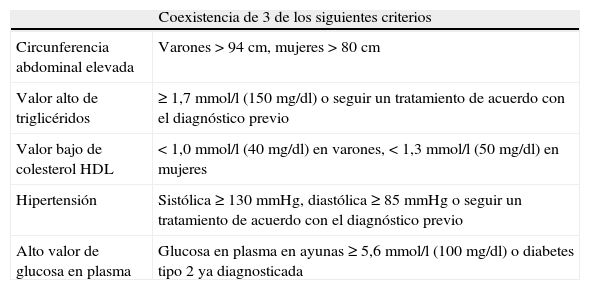
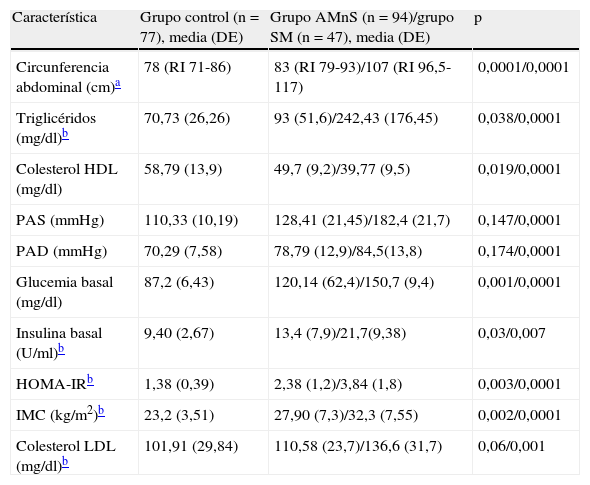
Sujetos y métodoLa población de estudio (n=218) fue distribuida en 3 grupos: control, sin alteraciones metabólicas (n=77); AMnS, con alteraciones metabólicas aisladas (n=94); y SM, con síndrome metabólico (n=47). El polimorfismo 3’UTR +62G>A se analizó por PCR-RFLP.
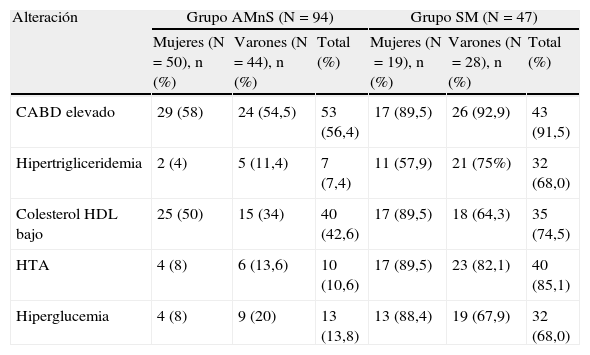
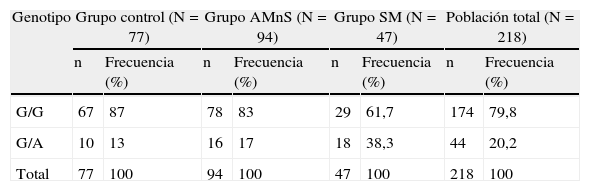
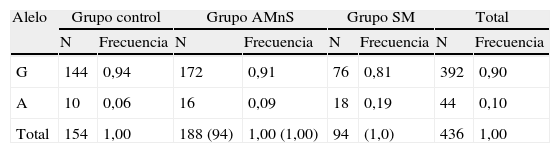
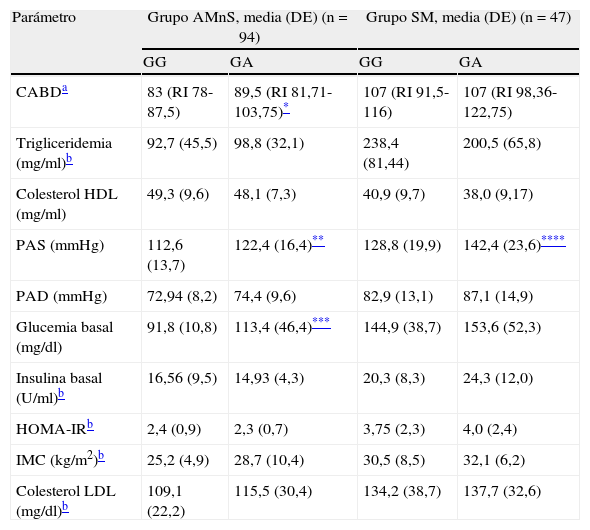
ResultadosLa obesidad central fue la alteración más frecuentemente descrita tanto en el grupo AMnS (56,4%) como en el SM (91,5%), seguida de bajos niveles de colesterol unido a lipoproteínas de alta densidad (colesterol HDL) (42,6%) en el grupo AMnS e hipertensión arterial (85%) en el grupo SM. La frecuencia del genotipo +62G/A para la población fue del 20,2%. El genotipo G/A fue más frecuente en los grupos SM (38,3%) y AMnS (17%) que en el grupo control (13%). La distribución alélica fue significativamente diferente entre grupos control (+62G=0,94, +62A=0,06) y SM (+62G=0,81, +62A=0,19) (p=0,0001). Se encontró asociación significativa entre el genotipo G/A y valores elevados de circunferencia abdominal (p=0,047), glucemia basal (p=0,02) y presión arterial sistólica (p=0,003).
ConclusiónLos resultados sugieren una asociación del genotipo RETN +62G/A con valores elevados de presión arterial sistólica, hiperglucemia y obesidad central. La asociación con estas alteraciones parece ser independiente de posibles efectos de agrupación en el contexto de síndrome metabólico.
The polymorphism of the resistin gene (RETN/RSTN) has been associated with metabolic alterations. In this study the association between the 3’UTR +62G>A polymorphism and metabolic syndrome components was evaluated.
Subjects and methodsThe population (n=218) was distributed in 3 groups: the control group with no metabolic alterations (n=77), nSMA group with isolated metabolic alterations (n=94) and MS group with metabolic syndrome (n=47). The 3’UTR +62G>A polymorphism was analyzed by PCR-RFLP.
ResultsCentral obesity was the most frequent alteration in both nSMA (56.4%) and MS (91.5%) groups followed by low c-HDL levels in the nSMA group (42.6%) and arterial hypertension in the MS group (85%). The frequency of the +62G/A genotype was 20.2% in the population. The G/A genotype was more frequently found in the MS (38.3%) and nSMA (17%) groups than in the control group (13%). The allelic distribution between the control group (+62G=0.94, +62A=0.06) and MS group (+62G=0.81, +62A=0.19) was significantly different (P=.0001). Significant associations between the G/A genotype and high values of abdominal circumference (P=.047), basal glycemia (P=.02) and systolic arterial pressure (P=.003) were found.
ConclusionThe findings suggest the association between the G/A genotype and high values of systolic arterial pressure, basal glycemia and abdominal circumference. This association was independent of the metabolic syndrome context.