
Información del artículo
Resumen
Texto completo
Bibliografía
Descargar PDF
Estadísticas
Tablas (5)
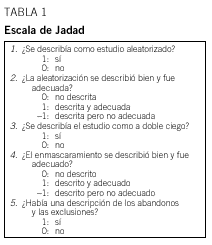
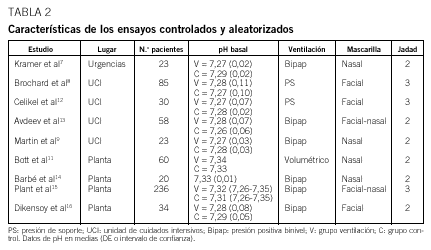
Fig. 1. Análisis de la mortalidad en planta y unidad de cuidados intensivos (UCI). VNI: ventilación no invasiva; OR: odds ratio; IC: intervalo de confianza; gl: grados de libertad; NNT: número necesario de pacientes a tratar para evitar una muerte.
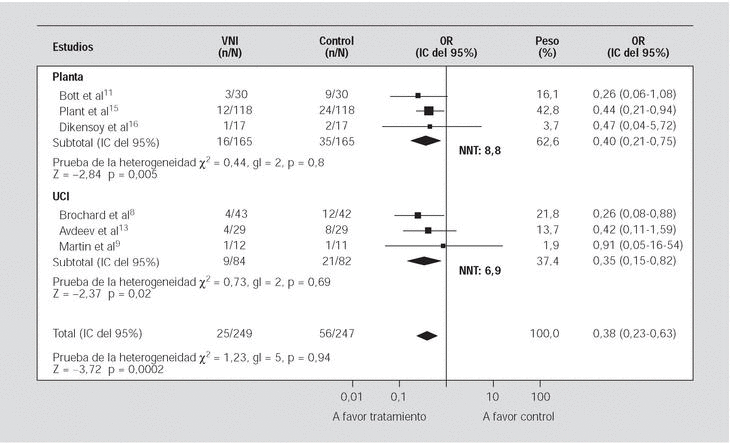
Fig. 2. Análisis de las intubaciones en planta y unidad de cuidados intensivos (UCI). VNI: ventilación no invasiva; OR: odds ratio; IC: intervalo de confianza; gl: grados de libertad; NNT: número necesario de pacientes a tratar para evitar una intubación.
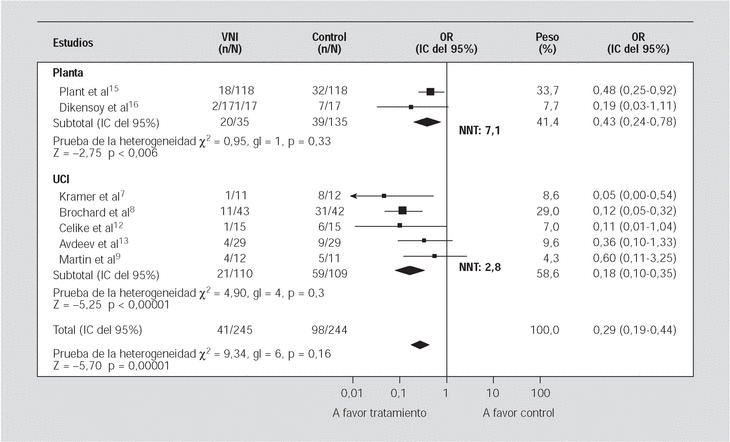
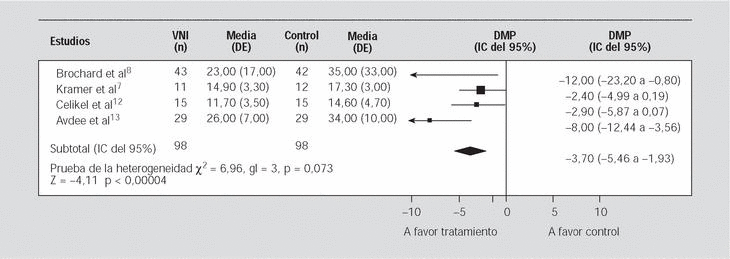
Fig. 3. Días de estancia media en los ensayos de unidad de cuidados intensivos (UCI). VNI: ventilación no invasiva; OR: odds ratio; IC: intervalo de confianza; gl: grados de libertad; DMP: diferencia media ponderada; DE: desviación estándar.
Mostrar másMostrar menos
Fundamento y objetivos: Valorar la eficacia de la ventilación no invasiva (VNI) en la enfermedad pulmonar obstructiva crónica (EPOC) en fracaso respiratorio agudo (FRA) y saber si hay diferencias en los resultados en función del lugar de aplicación. Material y método: Se realizó un metaanálisis de ensayos controlados aleatorizados (ECA) publicados en Medline, EMBASE, Registro de Ensayos Clínicos Controlados de la Colaboración Cochrane y Teseo hasta junio de 2002. Se efectuó una selección de los ECA en EPOC con FRA y pH sanguíneo < 7,35 y/o PaCO2 > 45 mmHg, con VNI frente a tratamiento estándar, y se analizaron mortalidad, tasa de intubación y días de estancia. La validez y calidad de los ECA fueron analizadas por dos investigadores con la escala de Jadad. Realizamos metaanálisis diferentes para los estudios de unidades de cuidados intensivos (UCI) y planta. Resultados: Se incluyeron 5 ECA de UCI y 4 de planta. Se encontró una reducción de la mortalidad (UCI, odds ratio [OR] = 0,35; intervalo de confianza [IC] del 95%, 0,15-0,82; n = 166; p = 0,02; planta, OR = 0,40; IC del 95%, 0,21-0,75; n = 330; p = 0,005) y del número de intubaciones (UCI, OR = 0,18; IC del 95%, 0,10-0,35; n = 219; p < 0,00001; planta, OR = 0,43; IC del 95%, 0,24-0,78; n = 270; p = 0,006). La estancia media fue menor en UCI (diferencia media ponderada de ¿3,7 días; IC del 95%, ¿5,46 a ¿1,93; n = 196; p = 0,00004). Sólo un ECA de planta demostró diferencias entre ambos grupos en la estancia media; los datos publicados no permitieron realizar metaanálisis acerca de la estancia. Conclusiones: La VNI reduce la mortalidad y la necesidad de intubación en pacientes con EPOC en FRA cuando se aplica tanto en UCI como en planta. En la UCI la VNI reduce también los días de hospitalización.
Palabras clave:
Enfermedad pulmonar obstructiva crónica
Ventilación no invasiva
Exacerbación aguda
Insuficiencia respiratoria aguda
Background and objectives: The purpose of this study was: 1) To determine the effect of non invasive ventilation (NIV) in chronic obstructive pulmonary disease (COPD) patients with acute respiratory failure, and 2) To find out whether there are differences in the results according to the site where ventilation in applied. Patients and method: Meta-analysis of randomized controlled trials (RCTs) published included studies in MEDLINE, EMBASE, Cochrane Controled Trials Register and Teseo. Study selection included RCTs in COPD patients with acute respiratory failure with PaCO2 > 45 mmHg or pH < 7.35, with underwent NIV versus standard therapy. Mortality, rate of tracheal intubation and length of stay were analized. Individual studies were rated as to their validity and quality by two investigators using the Jadad score. A different meta-analysis was made for intensive-care unit (ICU) RCTs and wards RCTs. Results: Five ICU RCTs and four ward RCTs were included. There was a reduction in hospital mortality (ICU, OR = 0.35; 95% confidence interval [CI], 0.15 to 0.83; n = 166; p = 0.02; ward, OR = 0.39; 95% CI, 0.20 to 0.76; n = 296; p = 0.005) and in the need for intubation (ICU, OR = 0.18; 95% CI, 0.10 to 0.35; n= 219; p < 0,00001; ward, OR = 0.43; IC 95%, 0.24-0.78; n = 270; p = 0.006). Length of stay was lower in the NIV group upon ICU trials (WMD, ¿3.7 days; 95% CI, ¿5.46 to ¿1.93 days). Only one ward RCT showed significant differences in the length of stay. Published data did not allow a meta-analysis for length of stay. Conclusions: NIV decreases mortality and the need for intubation in COPD patients with acute respiratory failure both in ICU and ward. In ICU non-invasive ventilation decreases the length of stay too.
Keywords:
Chronic obstructive pulmonary disease
Non invasive ventilation
Acute exacerbation
Acute respiratory failure
Artículo
Opciones para acceder a los textos completos de la publicación Medicina Clínica
Suscriptor
Suscribirse
Comprar
Contactar
Teléfono para suscripciones e incidencias
De lunes a viernes de 9h a 18h (GMT+1) excepto los meses de julio y agosto que será de 9 a 15h
Llamadas desde España
932 415 960
Llamadas desde fuera de España
+34 932 415 960
E-mail