








The interconnected phenomena of digital transformation and environmental innovation exert a major impact on sustainability. This research attempts to shed light on the sustainability implications of digital transformation and environmental innovation. Both digital transformation and environmental innovation offer multiple opportunities to address global challenges such as climate change, resource depletion, and social inequality. This study highlights the need to integrate digital technologies and innovation with environmental initiatives. By following this approach, the sustainability implications of digital transformation and environmental innovation can lead to a more resilient and sustainable society. Fuzzy-set qualitative comparative analysis (fsQCA) is used to determine the necessary or sufficient factors to increase sustainability. The study thus provides insights into what the environmental priorities should be. The results show how to reduce environmental impacts, improve quality of life, and support economic development. They can also be used to inform policies that support sustainability initiatives by encouraging the combinations of interventions that work best. By harnessing the potential of digital transformation and environmental innovation, it is possible to build a greener and more prosperous future for generations to come.
Building a sustainable economy needs both digital transformation and environmental innovation. These interlinked phenomena can solve global problems such as climate change, the depletion of natural resources, and the social inequalities facing humanity. Innovation is essential for navigating the digital world, exploiting new business opportunities, and encouraging the adoption of circular economy principles and models (Oluleye et al., 2023). Moreover, the widespread integration of artificial intelligence (AI), cloud computing, blockchain, and other recent technologies into traditional production helps firms optimize processes, reduce operating expenses, increase production efficiency, and create efficient and adaptable operational frameworks (Quttainah & Ayadi, 2024).
These technologies can have a positive impact if they are backed by suitable policies to ensure effective collaboration across sectors. Common obstacles in deploying digital technologies for environmental sustainability relate to the financial side, especially in developing countries. Policies that support research funding, partnerships, and initiatives aligned with the Sustainable Development Goals (SDGs) can accelerate progress toward sustainability. The call for inclusiveness and diversity in research collaborations highlights the need for policies that foster international cooperation and knowledge exchange between researchers from different regions and backgrounds (Raman et al., 2024).
A more sustainable future is possible if the synergy between digital transformation and environmental innovation is effectively harnessed. Innovation accelerates the integration of information technology (IT) and production linkages across firms, improving their production capacity (Edwards-Schachter, 2018; Kathuria et al., 2018). Harnessing this synergy is not an opportunity but an imperative for future generations. The protection of natural resources and sustainable economic development are crucial to achieve global sustainability goals. Policies that provide funding for international research projects, create platforms for knowledge exchange, and establish frameworks for collaborative research across disciplinary and geographic boundaries are needed (Raman et al., 2024).
The configurational model underpinning this study is built on theories from the fields of sustainability, the circular economy, digital transformation, innovation, and smart cities. Empirically, fuzzy-set qualitative comparative analysis (fsQCA) identifies the combinations of conditions that increase sustainability. Each condition in the model was chosen because of its contribution to sustainability, according to the literature.
For instance, the inclusion of ideas around the circular economy for business transformation is supported by Bassi and Guidolin (2021), who discuss resource efficiency and the implementation of circular economy practices in European small and medium-sized enterprises (SMEs), emphasizing the importance of green jobs and green skills. Developing smart cities as a model of urban sustainability is also considered a key factor to support sustainability. This idea is justified by research by Ibrahim et al. (2018) on the concept of sustainable smart cities, with those authors proposing a useful framework for assessing the readiness of cities to transition toward urban sustainability.
Likewise, innovation in precision agriculture for food security is another important condition for ensuring sustainability. The inclusion of this condition is justified by the study by Parra-López et al. (2024), who provide a comprehensive analysis of how digital technologies can support agriculture in the face of climate change. Their study examines the interactions between climate change and agriculture, reviews adaptation and mitigation strategies, explores the application of digital technologies in this context, and discusses future challenges and opportunities for sustainable and resilient agriculture.
Public-private partnerships (PPPs) are also included as a condition in the research model. PPPs are recognized as essential mechanisms for implementing sustainable projects. The importance of PPPs is supported by Marx (2019), who provides insight into how the design of PPPs can influence their effectiveness in achieving the SDGs. Hence, an appropriate institutional structure is crucial for the success of these initiatives.
The importance of innovation policies in stimulating sustainable development is justified by studies of the role of technological innovation encouraged by sustainability-oriented regulations. For instance, Vollenbroek (2002) argued that well-designed regulations can act as catalysts for technological and organizational innovations that are essential for achieving sustainability. According to this argument, an integrated policy approach is important to overcome barriers and promote systemic change. The condition of digital technology integration in sustainability strategies is supported by the research of Rosário and Dias (2022), who emphasize the importance of effectively managing the digital transition to achieve sustainability goals. They discuss alternative approaches that include innovation through experimentation and dynamic and sustainable benefits.
Despite major advances in digital transformation and environmental innovation, there is still a considerable gap in the literature on the impact of these factors on sustainability. As digital technologies continue to develop and influence industries and as environmental issues become more pressing, it is essential to understand how these two phenomena can be jointly harnessed to achieve sustainability goals. Previous research has explored digital transformation and environmental innovation separately. However, little research has examined the interactions between them or has explored how these processes directly influence long-term sustainability performance.
In addition, in the context of rapid global market changes and increasingly stringent environmental regulations, organizations face increased pressure to adopt innovative solutions that not only improve their economic performance but also help protect the environment. This research responds to the need to understand the interdependencies between digital transformation and environmental innovation and to explain their combined impact on sustainability. It thus provides an analytical framework that can guide organizations’ strategic decisions.
Literature reviewThe role of digital transformationThis research seeks to find the optimal solutions to support the transition to a greener and more resilient economy. Sustainability must become a global imperative as the environment increasingly suffers the effects of climate change. The use of digital technology enables businesses to obtain timely and relevant information on changes in the external environment, market demand, and technological frontiers, which can effectively reduce sunk costs and risks of innovation failure (Bharadwaj et al., 2013).
Digital transformation is a paradigm shift affecting industries and companies worldwide (Ferraris et al., 2019; Fitzgerald et al., 2014). It also has a positive influence on social development (Popkova et al., 2022). Digital transformation manifests itself in the adoption of advanced technologies to optimize economic and social processes. These technologies can help decrease resource consumption, reduce waste, and maximize operational efficiency.
Climate change, environmental degradation, and the depletion of natural resources can be combated through technological progress and recent innovations that offer opportunities to address these challenges. Technological innovation can contribute substantially to sustainable economic growth, while enhancing the efficiency of the targeted outcomes (Mohamed et al., 2022). By integrating digital technologies into sustainability strategies, resource consumption can be much more effectively monitored, waste can be reduced, and production processes can be optimized. However, digital transformation is a monumental task that requires substantial human and capital investments for technology adoption and infrastructure upgrades (Jones et al., 2021).
Digital transformation not only entails continuous optimization of innovation processes through data analytics but also provides shared digital research and development (R&D) platforms to accelerate low-carbon technological advancements (Lyu et al., 2024). Combining infrastructure with technology can lead to efficient and sustainable urban environments. Smart cities feature intelligent transportation systems, efficient street lighting, and effective waste management. Smart city development aims to improve quality of life through technology and therefore increase the efficiency of services while meeting the needs of citizens (Musa, 2018). Altogether, this approach reduces energy consumption and improves quality of life.
Innovation can also be observed in human resource management (HRM). For example, digital technologies are increasingly used in HRM (Mitrofanova et al., 2019). Digitalization and the adoption of new technologies by companies entail many changes, which require different managerial capabilities and the development of new HRM practices (Benson et al., 2002; Sousa & Rocha, 2019). Integrating digital technologies into HRM can help create more efficient and sustainable work environments. Employee performance monitoring and digitalization of organizational activities and processes reduce resource consumption and facilitate remote working. AI is increasingly being deployed in HRM to accelerate time-consuming information processes (Leicht-Deobald et al., 2022), thus saving time and resources.
Digital technologies such as AI, process automation, and data analytics can greatly improve the efficiency of recruitment, selection, and employee performance management. AI is particularly promising in HRM because it can consistently assess candidates using the same criteria (Metcalf et al., 2019), make more accurate and less biased decisions than those based on human intuition (Cowgill, 2019), and promote diversity (Daugherty et al., 2020). Technological innovations can accelerate and streamline human resource selection and HRM.
Environmental innovationKemp and Pearson (2007) define environmental innovation as a product, production process, service, or management or business method that is new to an organization and that ultimately reduces environmental risk, pollution, and other negative impacts of resource use (including energy use) with respect to the alternatives. Digital transformation can significantly influence the green innovation performance of companies (Martínez Falcó et al., 2024).
Mowery et al. (2010) discuss technological innovation and innovation policy in the context of climate change, inspired by innovation studies. The impact of environmental policy on environmental innovation has primarily been studied in the framework of the green economy. The topic of environmental innovation provides insights into the instruments that have the greatest dynamic efficiency or potential to stimulate innovation (Van den Bergh et al., 2011). The introduction of new technologies signals a beneficial change in economic systems. For example, equipment sensors can monitor and record carbon emissions, energy consumption, and waste management in real time, greatly increasing the efficiency and accuracy of data collection (Lyu et al., 2024). Through big data analytics, enterprises can process and analyze large amounts of environmental data to reveal valuable environmental insights (Dubey et al., 2019).
Zhao and Rasoulinezhad (2023) reported that natural resource use efficiency helps countries decrease waste and environmental pollution, which can help neutralize the challenge of climate change. To use natural resources efficiently and expand globally, the concept of the circular economy is important (Xu et al., 2023). Managing natural resources efficiently can reduce negative environmental impacts by decreasing resource intensity, waste, and pollution. Effective natural resource management is an important part of global climate change mitigation strategies, emphasizing the link between responsible resource use and neutralizing climate impacts.
Technological innovation can help achieve sustainability goals by creating new solutions or technologies that are more environmentally friendly, offer improved resource use efficiency, and promote sustainable economic progress (Zhang et al., 2019). Innovation and technological advances are essential to drive the transformation toward a circular economy (Srisathan & Naruetharadhol, 2022) while delivering economic benefits such as job creation, enhanced competitiveness, and secure resource availability (Wu et al., 2021). The circular economy can greatly contribute to social goals by fostering social equity and community resilience (Walker et al., 2021).
According to the theory of dynamic capabilities (Teece, 2007), digital transformation improves the efficiency of resource allocation and management’s ability to identify and capitalize on opportunities, enhancing organizational resilience. Digital transformation is a technology-driven strategic transformation with a direct impact on value creation and delivery (Dai et al., 2025; Vial, 2021; Wu et al., 2025). Building on this theory (Teece, 2007), digital transformation enhances the ability of organizations to detect, leverage, and reconfigure resources in response to changing environments (Warner & Wäger, 2019). In modern manufacturing firms, activities involving digital transformation significantly improve firm performance and market responsiveness (Savastano et al., 2022). An organization’s resilience is its ability to withstand disruptions and adapt to environmental changes (Williams et al., 2017). Wielgos et al. (2021) found that advanced digital business capabilities help firms survive market disruptions. Similarly, Cosa (2024) explained how digital technology has accelerated business model adaptation in the digital age. Digital transformation boosts organizational resilience through several mechanisms (Wang & Jia, 2025).
Sustainability policy and governanceLenferink et al. (2013) reported that PPPs can contribute to sustainable synergies. PPPs facilitate access to financial resources, advanced technologies, and expertise to develop green initiatives. Thus, promoting PPPs is important for the implementation of sustainable projects. Some projects such as solar parks and smart transportation networks that accelerate the transition to a green economy can take the form of joint investments. Smart city policies reduce energy consumption while maintaining output. In such cases, transportation and facilities may be the primary energy end users (Talan et al., 2023). Implementing smart transportation and smart logistics projects can effectively solve traffic congestion using real-time shared data to create an efficient operating platform, while reducing energy consumption in the process (Jiang et al., 2023).
Innovation policies condition the ability to create an enabling framework for sustainable development. Such policies, which include tax incentives for green companies and strict regulations on carbon emissions, can bring about major changes in the economy. Renewable energy subsidies have stimulated the global transition to cleaner energy sources. Public policy is a set of actions taken by public authorities to address social, economic, political, or environmental problems facing society or the state (Pollack Porter et al., 2018). Public policy aims to achieve certain sustainability goals and bring about positive changes in society as a whole (Anyebe, 2018).
The digital revolution can generate dynamic efficiencies and enable incremental and revolutionary innovation, improving various aspects of the economy (Hung & Nham, 2023). Governments should seize the opportunities provided by digital technology to establish a more effective regulatory framework and thus increase technological investment by businesses and public interest in caring for the environment (Hung & Nham, 2023).
Transformations toward sustainability refer to fundamental changes in the structural, functional, relational, and cognitive aspects of socio-technical-ecological systems, leading to new patterns of interactions and outcomes (De Haan & Rotmans, 2011; Feola, 2015; Hackmann & St. Clair, 2012; O’Brien, 2012). Such transformations emphasize the processes of change in human society involved in moving toward a more sustainable and equitable future, which can be addressed both normatively and analytically (Patterson et al., 2017). However, efforts to transform toward sustainability are likely to be deeply political and may well be contested, with different actors affected in different ways and standing to gain or lose from change (Meadowcroft, 2011; Van den Bergh et al., 2011).
Technological innovation encompasses the systematic advancement and application of concepts, information, and technology to create new solutions or improve existing ones (Hund et al., 2021). Digital technologies, innovation, the implementation of the circular economy, the development of smart cities, agricultural innovations, PPPs, innovation policies, and HRM are pillars of sustainable development. Together, they can help protect the environment, ensuring a resilient economy and a better quality of life for future generations.
Key factors in increasing the level of sustainabilityThe IT capabilities of smart cities can be used to gather important data from different scenarios of everyday life and then identify, determine, and monitor energy consumption using big data and cloud computing (Hittinger & Jaramillo, 2019). IT, big data, and cloud computing thus play a central role in the development of smart cities with a focus on energy efficiency. Transforming smart infrastructures with technologies such as AI can help smart cities combine important resources and information and improve interconnections, complementarity, and coordination between systems (Haarstad & Wathne, 2019). In short, AI can revolutionize urban infrastructures.
By analyzing complex data and providing predictive solutions, AI can optimize the functioning of urban systems such as transportation, energy, and waste management, creating a smarter and more efficient urban ecosystem. AI makes it possible to integrate data from diverse sources such as physical infrastructure, internet of things (IoT) sensors, and citizen-generated information. This capability is extremely useful in making real-time data-driven decisions and coordinating resources sustainably. Creating a smart city involves multiple systems that must work together effectively. By coordinating systems using certain algorithms, AI simultaneously analyzes multiple variables and provides optimal solutions. Transportation, energy, and emergency response systems can be coordinated using AI to minimize their impact.
Velenturf and Purnell (2021) explained that the circular economy is the most appropriate system to support natural resource use efficiency. The circular economy and sustainability are interconnected concepts that are necessary to build an economy that protects natural resources, minimizes environmental impacts, and supports sustainable development. The circular economy works toward a regenerative economic system in which resources are used efficiently, waste is minimized, and materials are recycled and reused on an ongoing basis.
PPPs have gained particular attention among project delivery methods because they are considered useful tools for large-scale project development worldwide (Grimsey & Lewis, 2007). They require complex legal and financial arrangements and have a major impact on the development of infrastructure and services worldwide. Despite being valuable instruments when properly managed, PPPs require a careful balance between public and private interests to ensure sustainable and beneficial outcomes for society. PPPs can encourage the implementation of sustainable solutions because private companies are often innovative and environmentally aware.
Researchers around the world have examined the relationship between technological innovation and economic growth because technological innovation benefits firms by creating new economic opportunities. Technological innovation boosts efficiency and productivity, giving firms the tools to develop new products, processes, and business models. Chaudhry et al. (2021) reported that innovation is an important driver of growth. The long-term relationship between innovation and economic growth reflects the idea that the benefits of innovation accrue and become more evident over the years. Technological advances have transformative effects that shape economies and societies for decades. As innovative technologies are integrated into the economy, they accelerate economic growth.
Adopting sustainable technologies is about not only protecting the environment but also creating a sustainable economic model. Sustainable technologies are an essential component of a green economic strategy, not only from an environmental protection perspective but also as drivers of long-term economic growth. Their implementation is necessary for global economies to meet environmental challenges and build a sustainable future. The promotion and development of sustainable technologies should be a central objective in government policies and global economic strategies to ensure an efficient and equitable transition to low-carbon economies and better managed resources.
The literature review reveals the following factors that increase sustainability:
- 1.
Integration of digital technologies into sustainability strategies (IDT);
- 2.
Integration of the circular economy for business transformation (ICE);
- 3.
Development of smart cities as a model for urban sustainability (DSC);
- 4.
Innovations in precision agriculture for food security (IPA);
- 5.
Public-private partnerships for sustainable projects (PPP);
- 6.
Innovation policies to stimulate sustainable development (IPS);
- 7.
Digital innovation and human resource management (DIH).
Based on these findings, the research proposition is formulated as follows:
Multiple causal configurations of antecedent conditions—integrating digital technologies into sustainability strategies (IDT), integrating the circular economy for business transformation (ICE), smart city development as a model for urban sustainability (DSC), innovations in precision agriculture for food security (IPA), PPPs for sustainable projects (PPP), innovation policies to stimulate sustainable development (IPS), digital innovation and HRM (DIH)—increase sustainability (IS).
Research methodologyData for the empirical analysis were collected from 233 respondents using a thematic questionnaire consisting of 36 questions. The questionnaire was distributed to specific groups of investors and entrepreneurs, the general public and local communities, representatives of non-governmental organizations (NGOs) and public institutions, company managers, and scholars in Romania. A diverse sample was sought to reflect the opinions and perspectives of different relevant groups for sustainability.
Data collection took place between January 18 and March 18, 2025. The data show that 55 % of investors and entrepreneurs were from large urban areas, 30 % were from medium-sized cities, and 15 % were from rural areas. Similarly, 25 % of the general public and local communities lived in rural areas, 40 % lived in small towns, and 35 % lived in large cities. Finally, 60 % of representatives of NGOs and public institutions were from large urban areas, with the rest spread between medium-sized and small towns. This distribution highlights the differences in priorities according to access to resources and opportunities. Specifically, there appeared to be more pronounced concerns for sustainability in rural areas, with innovation-oriented perspectives in urban environments.
The respondents were from the following age groups: 27 %, mainly young entrepreneurs, were aged 18 to 30 years; 33 % of respondents, mostly managers and company representatives, were aged 31 to 45 years; 30 % of respondents, mainly representatives of government institutions and NGOs, were aged 46 to 60 years; and 10 %, predominantly academic experts and independent consultants, were aged over 60 years. Younger people were observed to be more concerned with green technologies and innovative solutions, whereas older respondents focused on public policy and regulatory frameworks.
The participants were highly educated, suggesting a strong interest in and knowledge of sustainability. Specifically, 47 % had a bachelor’s degree, 34 % had a master’s or doctoral degree, and 19 % had secondary education. This distribution indicates a positive association between education level and interest in sustainable solutions and responsible practices.
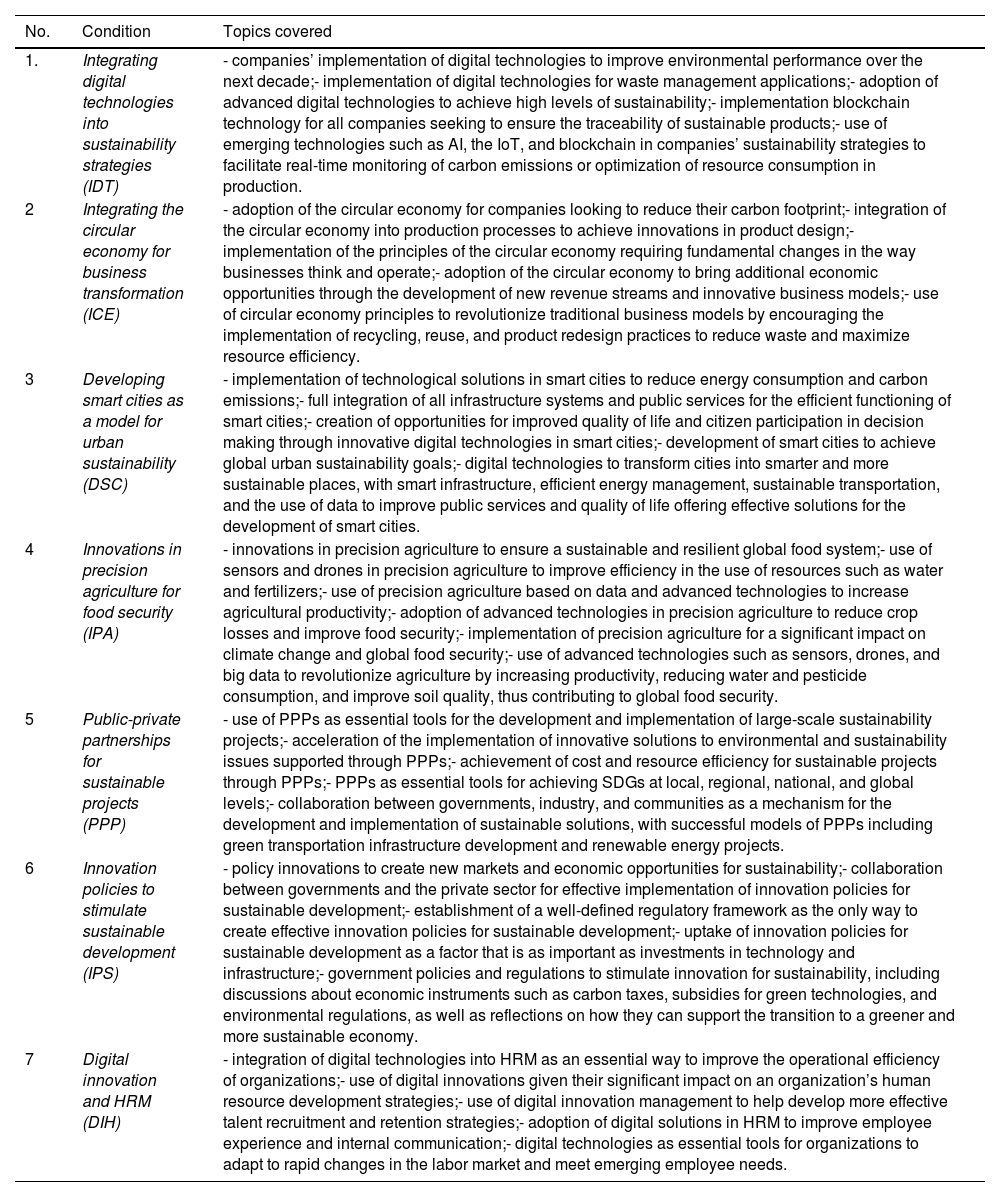
This research explores the sustainability implications of digital transformation and environmental innovation. Responses were processed using fsQCA software to identify the most effective solutions to increase sustainability. FsQCA focuses on the complex relationships between several conditions and an outcome of interest (in this case, increasing sustainability). This methodology is suitable for research aimed at identifying combinations of necessary and sufficient conditions that lead to an outcome of interest. Through fsQCA, combinations of factors that the literature identifies as being able to increase sustainability were identified. This analysis highlights the need for integrated approaches to maximize positive environmental impacts. Fig. 1 presents the underlying conceptual model, and Table 1 presents the topics covered in the operationalization of the causal conditions. As shown by the literature, all these conditions can increase sustainability.

Topics covered in the operationalization of the causal conditions.
Source: Authors.
The chosen research method was fsQCA. It was considered the most appropriate approach for this study because of the specific characteristics of the data and the research question. Although the sample size of 233 respondents was sufficient to apply traditional quantitative methods, fsQCA was preferred because of its ability to identify complex configurations of factors leading to a particular outcome, thereby addressing causal relationships in a more flexible way than traditional quantitative methods. Unlike quantitative methods, which often assume linear relationships between variables, fsQCA allows for nonlinear relationships and interdependencies, often giving a more realistic picture when analyzing complex social processes. Furthermore, fsQCA is useful in situations where multiple conditions can simultaneously contribute to an outcome. This method can highlight combinations of factors that, taken individually, would not explain the same outcomes. Therefore, fsQCA was chosen to provide a more detailed and nuanced understanding of the causal dynamics between the concepts under study.
FsQCA offers a unique combination of qualitative and quantitative approaches. It uses Boolean algebra (working with the values 0 and 1) to allow researchers to combine qualitative data, such as case studies or interviews, with quantitative data. In this way, researchers can capitalize on the strengths of qualitative and quantitative analyses. By uncovering complex causal configurations, fsQCA contributes to theory building and testing. Moreover, it enables researchers to refine and develop theories that capture the complexity of social phenomena and test them against empirical data. FsQCA allows researchers in the social sciences to identify complex configurations of conditions that lead to specific outcomes.
In the present study, fsQCA was appropriate because it enabled the integration of perspectives from technology, the environment, the economy, and society so that several dimensions of sustainability could be analyzed simultaneously. FsQCA facilitated the study of the interplay between digital transformation, environmental innovations, and sustainability, highlighting combinations of critical factors and supporting the development of sustainable policies, organizational strategies, and initiatives in a data-driven and context-specific way.
Calibration of fuzzy setsA crucial step in fsQCA-based research is calibration because fsQCA relies on fuzzy sets to represent the degree of membership of cases to certain sets. Calibration involves transforming the raw data, which in the present research were numbers, into a more usable form to reflect the level of membership of a case to a particular set. The calibration process determines how the raw data are transformed into fuzzy scores (from 0 to 1), which directly influences the validity and interpretability of the findings. Calibration defines thresholds for membership, where 1 indicates complete set membership, 0 indicates no set membership, and intermediate values such as 0.5 indicate uncertainty or a transition between these two states. Calibration helps comparability between cases by allowing identification of combinations of factors leading to success or failure. Thus, necessary conditions can only be identified if calibration is accurate. Calibration uses a uniform scale (from 0 to 1), which makes analysis easier and more accurate. Calibration makes it possible to identify necessary conditions and sufficient conditions.
Fuzzy-set representation captures the inherent complexity and ambiguity present in many real-world phenomena. Calibration was used to assign membership scores because fsQCA allows for cases to fall between the two binary categories of full membership and zero membership. In many real-life situations, cases may not fit perfectly in the presence or absence of a condition but instead may exhibit partial membership. Calibration therefore allows the analysis to take these intermediate cases into account. The data calibration process, performed using the fsQCA software, is reflected in Table 2.
Data calibration.
Source: Authors based on fsQCA software.
The causal conditions in this study, namely integrating digital technologies into sustainability strategies (IDT), integrating circular economy for business transformation (ICE), smart city development as a model for urban sustainability (DSC), innovations in precision agriculture for food security (IPA), PPPs for sustainable projects (PPP), innovation policies to stimulate sustainable development (IPS), digital innovation and HRM (DIH), were studied to see whether the outcome of increased sustainability is influenced by these factors. In fsQCA, conditions are analogous to independent variables in quantitative analysis. The membership scores in fsQCA range from 0 to 1, where 0 indicates that the case does not belong to the condition set and 1 indicates that the case fully belongs to the condition set. However, Pappas and Woodside (2021) recommend avoiding assigning the value 0 for any membership set, so 0.05 was used for this purpose instead.
The conditions and outcome were calibrated using a 5-point scale, based on the recommendations of Ragin (2014). This scale was adapted to the research context and interdisciplinary nature of the study. The calibration thresholds were chosen to give an accurate reflection of the degree to which each condition or outcome correctly reflected the condition or outcome, consistent with the variability in the data and the research objectives. A value of 5 represented the highest membership score for a condition, indicating that a case completely belonged to this condition set. A value of 3 indicated partial membership to the condition set. A value of 1 reflected very low membership to the condition set. Each antecedent condition was rated on a scale ranging from 1 (completely disagree) to 5 (completely agree), as shown in Table 3. The outcome was rated separately using another 5-point scale, ranging from 1 (fully adapted) to 5 (very poorly adapted), as shown in Table 4.
Calibration of antecedent conditions.
Source: Adapted from Ragin (2014).
Calibration of outcome.
Source: Adapted from Ragin (2014).
The threshold of 1 was assigned to cases that completely fulfilled a condition, reflecting full membership. Hence, they were representative of that condition. The threshold of 0.75 was chosen for cases with almost complete but not full implementation of a condition, differentiating them from those at an intermediate stage. If this threshold had been set at 0.80 or higher, there would have been a risk that too few cases would have been considered to have high implementation of a condition, which would have distorted the causal model.
The 0.50 threshold reflected a zone of uncertainty, indicating cases in a transitional stage. This midpoint was essential for identifying cases that belonged to neither extreme. The threshold of 0.25 was selected to designate cases with limited implementation of a condition, providing a minimum degree of membership. The threshold of 0.05 was chosen instead of absolute 0. This choice followed the recommendations of Pappas and Woodside (2021), who suggested avoiding a score of 0 to maintain flexibility of interpretation and to prevent bias in configurational analysis.
For the outcome, a similar scale was used. Being fully adapted meant being assigned a value of 1, reflecting a completely satisfied outcome. Being very poorly adapted meant being assigned a value of 0.05, indicating a case where the outcome was completely not satisfied. The choice of a threshold of 0.75 for being partially adapted was motivated by the fact that most cases cannot be categorized as fully adapted or very poorly adapted in a complex and dynamic context such as digital sustainability and innovation. The threshold of 0.75 provided a balance between these two extremes and reflected the true diversity of cases.
In this interdisciplinary research, calibration transformed the raw data into standardized scores that reflected how well a case or phenomenon met a specific condition. Without a well-defined calibration process, it is difficult to understand the complex relationships between variables and to draw valid conclusions. Thus, by calibrating data in a way that can be interpreted uniformly, researchers can more effectively explore the interactions between conditions and outcomes and thus ensure that their findings are relevant and applicable in diverse contexts. This aspect is particularly important for successful interdisciplinary research.
Distribution of fuzzy-set values and truth table analysisIn fsQCA, the distribution of fuzzy values is essential to understand how cases are categorized based on membership scores. These scores are assigned to each case in the calibration process, which transforms the raw (observable) data into fuzzy scores between 0 and 1. These scores indicate the degree to which a case belongs to a theoretical set. As mentioned in the previous section, the calibration process involved transforming raw data into fuzzy sets, with each case assigned a membership score between 0 and 1, indicating the degree of membership in a particular fuzzy set.
In fsQCA, each case is assigned a membership score indicating the extent to which it fulfills the criteria associated with the fuzzy set. A score of 0 indicates that a case does not fulfill the set’s conditions at all, whereas a score of 1 indicates complete fulfillment. Scores between 0 and 1 reflect partial membership, expressing varying degrees of fulfillment of the conditions defined by the fuzzy set.
This calibration process provides essential insights into the relationship between the cases and outcome under study. The distribution of fuzzy scores provides insight into all cases and how they relate to the outcome. It helps identify cases that are relevant to the outcome (with high scores ≥ 0.8). It also highlights cases that do not lead to the outcome (with low scores ≤ 0.2). These cases are important so that researchers can understand what does not work. Also, the distribution of fuzzy scores enables identification of ambiguous cases (cases with scores around the intersection point of 0.5), which are harder to classify. They may partially fulfill conditions but not enough to be considered definite solutions.
Cases that have membership scores close to the value 0.5 are ambiguous. Cases with scores close to 1 or 0 are referred to as extreme values, considered clear cases of fulfillment or nonfulfillment of the conditions that define the fuzzy set. These cases play a key role in modeling the outcome. To analyze and interpret the results of fsQCA, it is necessary to analyze the fuzzy-set distribution. The distribution of fuzzy-set values shows the relevant cases and ambiguous cases that are necessary to understand the causal configurations and their relation to the outcome of interest.
In fsQCA, the truth table is used to analyze how different combinations of conditions lead to a specific outcome. It is a matrix showing all possible combinations of conditions and their relationship to the outcome under study. By analyzing the truth table, the data entered into the software are examined to identify patterns and relationships between the conditions. This table contains all possible combinations of the input conditions (the variables from the conceptual model) and outcome. Each row in the table represents a specific combination of conditions and the corresponding outcome.
Each combination is evaluated to see whether it leads to the outcome, and, if it is consistent with the outcome, whether it meets a set threshold (≥ 0.8). Only combinations that meet these criteria are used to derive causal solutions. The combinations identified by the truth table analysis represent the causal configurations that explain the occurrence or absence of the outcome under study. These patterns provide important insights into the complex relationships between conditions, highlighting how different conditions combine to produce or prevent the outcome.
Table 5 shows the different case configurations from the data processing. Truth table analysis is important for identifying causally sufficient patterns and the combinations of conditions that are necessary for the outcome. Four configurations are identified.
Truth table for increasing the level of sustainability.
Source: Authors based on fsQCA software.
The first causal configuration has the following structure: cIDT = 1, cICE = 0, cDSC = 1, cIPA = 1, cPPP = 0, cIPS = 1, cDIH = 0. The number of cases is 2, raw consistency is 0.986642, PRI consistency is 0.759999, and SYM consistency is 0.760000. This configuration suggests that sustainability is increased by integrating digital technologies into sustainability strategies (IDT), developing smart cities as a model for urban sustainability (DSC), and developing innovation policies to stimulate sustainable development (cIPS). The absence of the integration of the circular economy for business transformation (ICE), PPPs for sustainable projects (PPP), and digital innovation and HRM (DIH) suggests that these conditions are not essential for a high level of sustainability in these particular cases. The configuration suggests that selective adoption of digital technologies and sustainable transformation strategies can increase sustainability, without the need for a full commitment to all conditions.
The second causal configuration is as follows: cIDT = 1, cICE = 1, cDSC = 1, cIPA = 1, cPPP = 1, cIPS = 1, cDIH = 1. The number of cases is 97, raw consistency is 0.994222, PRI consistency is 0.989095, and SYM consistency is 0.997289. This condition has the greatest frequency and consistency in the present research, indicating that all conditions are necessary to increase sustainability. These conditions include the integration of digital technologies in sustainability strategies (IDT), the use of the circular economy for business transformation (ICE), smart city development as a model for urban sustainability (DSC), innovations in precision agriculture for food security (IPA), PPPs for sustainable projects (PPP), innovation policies to stimulate sustainable development (IPS), and digital innovation and HRM (DIH). This configuration suggests that a fully integrated and well-coordinated sustainability model involving all policy areas has the greatest impact on increasing sustainability. It offers an example of a sufficient configuration, where each condition contributes to increasing sustainability.
The third configuration is as follows: cIDT = 0, cICE = 0, cDSC = 0, cIPA = 0, cPPP = 0, cIPS = 0, cDIH = 1. The number of cases is 3, raw consistency is 0.975058, PRI consistency is 0.588234, and SYM consistency is 0.588235. This configuration indicates that, in a small number of cases, the presence of only digital innovation and HRM (DIH) can achieve sustainability through effective HRM and innovation management. Interestingly, conditions related to digital technologies and the circular economy are missing from this configuration, suggesting that, in some contexts, organizational and strategic factors may compensate for a lack of broader external conditions. This configuration signals the value of an approach focused on optimizing internal resources rather than adopting technological or external solutions.
For the last configuration, cIDT = 0, cICE = 0, cDSC = 0, cIPA = 0, cPPP = 0, cIPS = 0, cDIH = 0, the number of cases is 8, raw consistency is 0.926319, PRI consistency is 0.235294, and SYM consistency is 0.235294. This configuration refers to cases where none of the studied conditions are present. The low consistency suggests that this configuration is not sufficient to achieve sustainability. However, it may reflect isolated cases where sustainability does not depend on the selected conditions but instead depends on other external or internal factors not captured by the present model. This type of configuration suggests that certain unexplored factors may also influence sustainability. Examples include cultural, political, or economic factors.
In fsQCA, consistency assesses the reliability and quality of data. Consistency is used to assess the degree to which the data in the truth table contribute to the research proposition. Raw consistency refers to the overall consistency of the truth table and indicates the extent to which the empirical data support the identified causal configurations. The raw consistency values are 0.986642, 0.994222, 0.975058, and 0.926319, indicating that the predicted model results largely correspond to the observed results. A higher raw consistency value suggests a higher degree of agreement between cases with the same combination of conditions.
PRI consistency assesses the consistency of the model in terms of the relationship between observed and predicted outcomes based on the causal configurations derived from the data set. The consistency ratio, also known as the PRI, is a measure of how well the predicted model results match the actual observed results. The PRI consistency values are 0.759999, 0.989095, 0.588234, and 0.235294, showing a relatively high level of alignment of the predicted model results with the observed results, accounting for the distribution of the data.
SYM consistency indicates when the outcome variable is symmetric, with both high and low values being relevant. Symmetry in fsQCA means that the solutions for the outcome of interest are reflected in two complementary sets of conditions. High symmetric consistency suggests that the truth table demonstrates a balanced representation of the different causal paths leading to the outcome. SYM consistency assesses the symmetry between predicted outcomes and observed outcomes. The SYM consistency values are 0.76000000, 0.997289, 0.588235, and 0.235294, indicating a high level of symmetry between the predicted model results and the observed results.
For the present research, the high values of raw consistency, PRI consistency, and SYM consistency suggest a strong model fit and a strong capacity to explain the observed results. The truth table analysis identifies complex causal configurations and leads to conclusions regarding the relationships between the examined conditions and the outcome of interest.
XoY plotsXoY plots show whether a particular condition is necessary to achieve the outcome of interest, while specifying the level of consistency of that condition. The consistency score reflects the degree to which a causal combination leads to an outcome. The coverage score indicates the number of cases leading to an outcome that are reflected by a specific causal condition. The consistency score indicates that a combination of the seven antecedent conditions is sufficient to increase sustainability. The more cases are in the Y plane, the more important X turns out to be for Y. In the case of increasing sustainability, most cases lie in the Y plane. Of the 233 cases, 223 cases lie in the Y plane, and 10 cases lie diagonally (Fig. 2). Also, most cases have a membership of >0.8. Thus, the seven antecedent conditions seem to exert a strong influence on increasing the level of sustainability.

The XoY plane is often used to show the relationship between a condition or combination of conditions and the outcome of interest. The X-axis typically represents the cases (i.e., the respondents’ answers), and the Y-axis typically represents the membership scores, ranging from 0 to 1. Each case is represented by a point on the diagram, and its position on the Y-axis indicates its membership in the fuzzy set. The values of a condition or a consistency index for a combination of conditions are placed on the X-axis, and the values of the outcome are placed on the Y-axis.
The XoY plane, also known as the calibration diagram, is a graphical tool used in fsQCA to visualize the degree of membership of cases in a fuzzy set. Cases that are relevant to the outcome of interest have higher membership scores because they indicate a stronger association with the conditions that define the fuzzy set. Cases that are less relevant have lower scores. Cases that fall close to the fuzzy-set boundary have membership scores that are close to 0.5. These cases are considered ambiguous because they do not belong to the fuzzy set.
Existing research on the sustainability implications of digital transformation and environmental innovation contains some important gaps that the present study addresses. Studies have examined sustainability, but most have focused on the negative consequences of not adopting sustainable measures. Also, in most cases, the methodology is based on traditional methods that fail to capture the complexity of the relationships between sustainability and the promotion of sustainability. In contrast, the present study takes an innovative approach by using fsQCA. This method enables a more nuanced and complex analysis of the questionnaire data. Using fsQCA provides a new perspective on how different combinations of factors contribute to the success of sustainability measures.
This study is unique and valuable in that it addresses the sustainability implications of digital transformation and environmental innovation. Unlike most research, which has examined sustainability and the consequences of failing to adopt sustainable principles under a general framework, this paper explores how specific features influence the effectiveness and impact of digital strategies on sustainability. This research contributes to a deeper understanding of how sustainability can be promoted through digital transformation and innovation. Therefore, this study fills research gaps in the literature by providing a detailed and specific analysis of sustainability adoption. It also uses an advanced methodology that has not been fully exploited in previous research and contributes to the literature by providing new insights and solutions regarding how local features shape the effectiveness and impact of digital strategies in promoting sustainability.
ResultsThis study addressed the following research question: What are the sustainability implications of digital transformation and green innovation? FsQCA was used to answer this question by identifying the combinations of factors that contribute to sustainability. FsQCA is suitable for studies involving multiple interrelated factors that are difficult to quantify directly such as the increase in sustainability due to digital transformation and green innovation. This method reveals nuanced relationships between antecedents and outcomes, providing a deeper understanding of how different factors interact to influence sustainability.
In fsQCA, the Quine-McCluskey algorithm logically simplifies the truth table. This algorithm reduces complex logical formulae and Boolean expressions resulting from the combinations of conditions that lead to the outcome. It reduces these combinations to their simplest form, thereby minimizing the logical terms. It is commonly used to analyze data in the form of truth tables, especially in cases with multiple conditions and outcomes. The Quine-McCluskey algorithm produces a parsimonious solution (i.e., the simplest one available), which is a logical expression that reflects the relationships between the causal conditions and the outcome in the truth table. The Quine-McCluskey algorithm also produces a complex solution, which reflects valuable information about the combinations of antecedent conditions that influence the outcome. The combinations of antecedent conditions shown in Table 6 represent effective solutions for increasing sustainability.
Complex solutions identified by the Quine-McCluskey algorithm for increasing sustainability.
Source: Authors based on fsQCA software.
The first solution, cIDT*cICE*cDSC*cIPA*cPPP*cIPS*cDIH, has a coverage of 0.78 and a consistency of 0.99, indicating that this combination of factors is present in most cases and is particularly conducive to increasing sustainability. The results thus suggest that when digital transformation is combined with sustainable strategies in urban planning, agriculture, and public policy, the impact on sustainability is maximized. These initiatives are boosted by PPPs that mobilize resources and innovation, as well as innovation policies that create an enabling framework for sustainable development. At the same time, digital innovation and HRM play an important role in ensuring that organizations adapt to new sustainable realities.
The second solution, cIDT*cDSC*cIPA*cIPS, has a lower coverage (0.33) and high consistency (0.98), indicating that this combination is less widespread than the first but is still effective in predicting increased sustainability. This solution suggests that digital transformation (IDT), smart city development (SCD), and innovations in precision agriculture (IPA) supported by innovation policies (IPS) can increase sustainability, even in the absence of other factors. This finding confirms that digitalization and environmental innovation can have a significant impact even in specific contexts.
FsQCA software shows researchers the conditions that are necessary for a given outcome to occur (Table 7). At the sample level, four causal combinations that differed from those resulting from the Quine-McCluskey algorithm were tested. Table 7 helps answer the research question by precisely identifying the combinations of factors that explain the impact of digital transformation and environmental innovation on sustainability. These results are valuable for policymakers and practitioners, revealing the direction that should be followed when implementing sustainability strategies based on technology and environmental innovation.
The first tested combination, cIDT+cICE+cDSC+cIPA, has a consistency of 0.986406 and represents the sum of integration of digital technologies in sustainability strategies, integration of the circular economy for business transformation, development of smart cities as a model for urban sustainability, and innovations in precision agriculture for food security. These conditions support each other, contributing to more efficient resource management, reducing environmental impacts, and promoting a sustainable economy.
The second combination, cIDT+cDSC+cPPP+cIPS, has a consistency of 0.968696 and represents the sum of integration of digital technologies in sustainability strategies, development of smart cities as a model of urban sustainability, PPPs for sustainable projects, and innovation policies to stimulate sustainable development. These conditions contribute to the creation of a sustainable ecosystem, where digital technologies optimize resources, smart cities promote efficiency and reduce environmental impacts, and PPPs and innovation policies support the implementation and scaling of sustainable solutions.
The third combination, cPPP+cDSC+cDIH+cICE, has a consistency of 0.991457 and represents the sum of PPPs for sustainable projects, smart city development as a model for urban sustainability, digital innovation and HRM, and the adoption of the circular economy for business transformation. These conditions reinforce each other. PPPs facilitate the implementation of sustainable solutions on a large scale, smart cities promote efficient management of urban resources, and the circular economy transforms business by reducing waste and using resources more responsibly.
The fourth combination, cPPP+cIPS+cDIH+cIDT, has a consistency score of 0.982851 and represents the sum of PPPs for sustainable projects, innovation policies to foster sustainable development, digital innovation and HRM, and the integration of digital technologies in sustainability strategies. Together, these interrelated conditions form a powerful framework for promoting a sustainable future. PPPs facilitate the implementation of large-scale sustainable projects, innovation policies stimulate the uptake of sustainable solutions, and digital innovation and HRM ensure that organizations adapt to new technologies.
All tested combinations of conditions have a high consistency of >0.96, suggesting that they are strongly related to achieving high levels of sustainability. The results confirm that the involvement of digital transformation and green innovation in sustainability strategies is essential. In line with the objectives of the configurational research model, these combinations show that the adoption of digital technologies, the integration of the circular economy, and the development of sustainable policies are necessary for increasing sustainability.
The results show that digitalization, the circular economy, PPPs, and innovation public policy are necessary conditions for improving sustainability. These findings confirm the research objective of identifying combinations of factors that positively influence sustainability and provide directions for future strategies.
DiscussionThis study provides useful insights into key aspects of sustainability, highlighting the value of embracing digital technologies and innovations in various areas. The results suggest that digital technologies have the potential to optimize resource use and reduce the environmental impact of business. However, their effectiveness depends on the degree of take-up and compatibility with existing infrastructures. Organizations that adopt a strategic approach and include these technologies judiciously in their sustainability plans can achieve tangible benefits such as reduced costs and increased supply chain transparency.
The findings of the present study support the theory of sustainable innovation presented by Boons et al. (2013) in their extensive research. They argue that technological and environmental innovations contribute significantly to increasing sustainability. The results of the present study suggest that effective integration of digitalization is necessary for sustainability. The present study is aligned with recent research on the sustainability of the sharing economy. Examples of such research include the study by Geissinger et al. (2019), who analyzed the sustainability implications of the sharing economy. The implementation of circular economy models contributes substantially to waste reduction and resource efficiency. The results indicate that businesses that adopt circular principles such as reusing materials and designing for recycling can better adapt to modern market demands. However, the transition to these models entails challenges related to upfront costs and the restructuring of operational processes.
This study is also aligned with the theories and methodology presented in research on sustainable innovation and sustainability assessment in the context of smart cities. In particular, the concept of smartainability, proposed by Girardi and Temporelli (2017), resonates with the present study. In their paper, Girardi and Temporelli (2017) develop a methodological framework for assessing the sustainability of smart cities, reflecting the present study’s integrated approach to sustainability by considering the technological as well as the social and economic dimensions of urban development.
The results of the present study reflect the importance of using precision technologies to promote sustainable agricultural production, in line with the analysis by Getahun et al. (2024). The present study explores the impact of modern technologies such as sensors and data for efficient monitoring of agricultural resources on optimizing production and reducing environmental impacts. Precision agriculture is proving to be an important driver of sustainability in the agricultural sector, contributing to the optimal use of water, fertilizers, and other resources. The integration of digital technologies, such as drones and sensors, enables real-time monitoring of crops, improving productivity and reducing losses. Despite their many benefits, these technologies still face the challenge of low accessibility among smallholder farmers.
The study is also in line with the research of Caloffi et al. (2017), who developed an ecological transition model emphasizing the potential of PPPs for innovation and sustainable development. Caloffi et al. (2017) explored how PPPs can contribute to achieving the SDGs by creating innovative solutions involving both the public and private sectors.
The present study is similarly aligned with the research of Ashford and Hall (2011), who emphasize the importance of regulation in stimulating innovation for sustainable development. The present study explores how regulation and public policy can influence the adoption of green technologies and innovative solutions in industry. Innovation-oriented public policies such as tax incentives for renewable energy and strict emission regulations can accelerate the transition toward sustainability. However, the implementation of these policies must seek a balance between economic development and environmental protection to avoid economic barriers for companies. Thus, although regulation is often perceived as a constraint, it can in fact stimulate technological innovation and support the transition toward a more sustainable economic model.
Research implicationsThe adoption of digital technologies is central to improving energy efficiency and reducing environmental impacts. Carbon-intensive industries should benefit from digital solutions to optimize resource consumption. Thus, tax incentives should be provided to companies that invest in sustainable digital technologies such as resource management systems and AI applications to optimize energy consumption. Governments can likewise introduce tax deductions for investments in green digital technologies.
In pursuit of the aims of reducing industrial waste, creating more sustainable supply chains, and increasing collaboration between the private sector and authorities, smart cities can help optimize resource consumption, reduce pollution, and improve quality of life. Public funds are needed for smart urban infrastructure, including solutions for lighting, traffic, water, and energy management. Government subsidies should be available to cities that adopt green solutions, and PPPs should be encouraged to develop sustainable infrastructure. Such measures are expected to reduce operating costs for local governments, decrease pollution, increase energy efficiency, and improve the quality of urban life.
To stimulate innovation in precision farming and ensure food security, precision technologies can help reduce water and pesticide consumption, thereby promoting more sustainable agriculture. Launching a national grant program for farmers investing in precision farming solutions would be an attractive solution. National and European funds should be allocated to acquiring intelligent agricultural equipment. Likewise, training centers should be created for farmers to learn how to use advanced technologies. Such measures are expected to reduce natural resource waste, increase agricultural yields with minimal environmental impact, and make farmers more competitive in the market. PPPs for sustainable projects can accelerate the uptake of sustainable solutions. However, they require a well-defined regulatory framework.
A production system that relies on cleaner and more sustainable mechanisms can reduce operating costs and the environmental impact of business, thereby improving profitability and worker safety (El Haggar, 2010; Zhang et al., 2017). Smart and sustainable production, which deals with green production, energy conservation, sustainable production, and renewable energy consumption, is attracting increasing attention in the literature (Ren, 2019). Sustainable production can enable producers to reduce resource use, degradation, and pollution so that they can achieve the SDGs (Roy et al., 2017). Smart cities focus on improving citizens’ lives, sustainability, and labor efficiency by using the latest digital technologies such as the IoT (Malik et al., 2018). Smart cities use digital technologies to control available resources in sustainable ways, thereby improving social welfare (Bibri & Krogstie, 2017).
Another important implication of this study is the analysis of the impact of precision technologies in sustainable agriculture. These technologies, which include sensors and drones, allow for the efficient monitoring of agricultural resources, thereby reducing the consumption of water, fertilizers, and other resources. The implications for the agricultural sector are profound. The adoption of these technologies can help farmers manage resources more efficiently and increase production in a sustainable way. However, their low accessibility among smallholder farmers remains a challenge. To maximize their impact, there is a need for investment in solutions that make these technologies accessible to all farmers, including those with limited financial resources.
In conclusion, the implications of this study suggest that integrating digital technologies and sustainable innovations is a key direction for developing a more sustainable economy and society. To maximize the benefits of this process, organizations and governments must invest in research, adopt enabling regulations, and promote PPPs to support the transition to a greener and more resource-efficient future.
ConclusionsThe depletion of natural resources has destroyed ecosystems, while accelerating biodiversity loss, deforestation, and environmental pollution. Hussain et al. (2020) discussed the depletion of the Earth’s natural resources as a growing dilemma in recent decades. Sustainability is a global imperative to fight climate change, environmental degradation, and natural resource depletion. The opportunities offered by technological progress must be seized to address these challenges effectively. The main objective of digital transformation is to enable improvements and promote transformative adjustments that bring value to stakeholders (Barrutia & Echebarria, 2021).
Building a sustainable future can be achieved by combining solutions such as the integration of digital technologies, the circular economy, the development of smart cities, and agricultural innovations. Public policy has a key role to play in promoting wider accessibility to technological advances, particularly in rural regions and less developed communities (Korinek et al., 2021). PPPs, innovation policies, and digital innovation and HRM are also relevant in shaping a sustainable future. Public policy consists of a set of actions by public authorities to address social, economic, political, and environmental problems (Pollack Porter et al., 2018). Combining these solutions effectively can support the transition to a greener and more resilient economy. Sustainable development success depends on a systemic and interconnected approach. Innovation is not only an optimization tool but also a catalyst for other key areas such as the circular economy and precision agriculture. Using digital technologies can improve resource management, facilitating the reuse of materials and reducing waste in circular supply chains. The key to success lies in the ability to combine technological, human, and economic resources to create a future that meets the needs of today and those of future generations. Digital technologies facilitate data-driven decision making, optimizing the use of resources and reducing risks. Digital technologies also enable large-scale implementation of the circular economy by monitoring material flows, identifying critical points of waste, and leveraging resources.
Smart cities exemplify how technology can transform the urban environment into a model of sustainability. Connected infrastructure not only improves energy efficiency and reduces emissions but also generates valuable data that can be used for more targeted policies. The industrial structure optimization due to the smart city model mainly refers to the transformation of industrial structures from high-pollution and high-emission industries to green and clean industries with low energy consumption and pollution (Caragliu & Del Bo, 2018). This approach can increase the quality of life of residents while reducing environmental impacts.
Precision agriculture, supported by technological innovations, strikes a delicate balance between productivity and natural resource protection. It addresses the challenge of global food security by reducing water consumption and pesticide use. Connecting farmers to data networks and support through innovative agricultural policies also encourages the rapid adoption of these technologies. Digital technologies support sustainable behaviors, with adoption influenced by factors such as accessibility and usability (Casalo et al., 2019). Digital platforms can help reduce waste (Liao et al., 2019). Smartphone apps can likewise help users track energy consumption, find green products, and connect with like-minded people (Paneru & Tarigan, 2023).
PPPs facilitate the financing and implementation of sustainable initiatives. By combining financial, technological and organizational resources, PPPs can create scalable and resilient projects. They also enable direct community involvement, ensuring positive social impact and long-term support. Innovation policies play a key role in stimulating investment and encouraging innovation. Through clear regulations and financial incentives, authorities create an enabling environment for change, encouraging companies to adopt green practices. HRM and digital innovation also help create an organizational culture that values sustainability. Educated and well-informed employees can become ambassadors of change, while digital processes optimize operations, reducing environmental impacts.
The interconnection between these solutions creates a cumulative effect, where each solution supports and amplifies the effectiveness of the others. Innovation policy stimulates the uptake of digital technologies, which in turn supports the circular economy and smart cities. In this way, success increases as all elements converge to create a system that is sustainable, adaptable, and ready to meet the challenges of the future. Through this integration, a global economy can be built that not only meets the needs of today but also protects the resources needed for future generations.
Research limitationsThis study contributes substantially to understanding the sustainability implications of digital transformation and environmental innovation. However, it has some limitations that are important to note when interpreting its findings. Data were collected in a limited time frame. This temporal delimitation may influence the results, with external factors such as economic, political, or social changes potentially altering respondents’ perceptions and behaviors. To capture a full picture of the dynamics of the phenomena under study, further research could consider longitudinal analyses or comparisons between different periods. Also, collecting data based on respondents’ answers to a questionnaire may introduce subjectivity. Factors such as the emotional state of the participants and their degree of engagement when completing the questionnaire may influence the accuracy of the results. The use of complementary methods such as qualitative interviews and secondary data analysis could reduce these possible biases. In conclusion, although this study provides valuable insights, recognizing these limitations is important to interpret the findings correctly. Extending this research through alternative approaches and in diverse contexts could contribute to a more complex understanding of the relationship between digital transformation, environmental innovation, and sustainability.
Future research directionsThis study provides a solid basis for investigating the relationship between digital transformation, environmental innovation, and sustainability. However, multiple new research directions could broaden the understanding of this complex phenomenon. A first aspect worth exploring in future research is how digital transformation and environmental innovation are combined across different industries or social environments. Investigating these phenomena in different contexts may shed light on the specific factors such as market characteristics, local policies, and level of technological development that influence the implementation and success of these initiatives. Second, future research could investigate the long-term impact of digital transformation and environmental innovation on sustainability. Longitudinal studies could enable analysis of how sustainability indicators evolve over time and how technological and environmental innovations contribute to sustainable outcomes. Third, it would also be of interest to examine the interplay between the technological, economic, and social factors influencing sustainability. Delving further into the human factor perspective, such as how employees and consumers perceive and adopt digital and green initiatives, could provide valuable insights. Qualitative studies, interviews, or focus groups could help give a deeper understanding of the barriers and motivations behind behavioral changes. Finally, future research could explore how public policy and regulation influence the implementation of digital transformation and environmental innovation. Analysis of the regulatory framework, combined with empirical studies, could identify the most effective practices to boost sustainability at the national and global levels. In conclusion, extending this research in the suggested directions could offer a more complete understanding of the impact of digital transformation and environmental innovation, while providing pragmatic solutions for sustainable development.
CRediT authorship contribution statementOana Pricopoaia: Writing – original draft, Software, Methodology, Conceptualization. Nicoleta Cristache: Resources, Investigation. Adrian Lupașc: Writing – review & editing, Formal analysis. Dorin Iancu: Writing – review & editing, Investigation, Formal analysis.
