



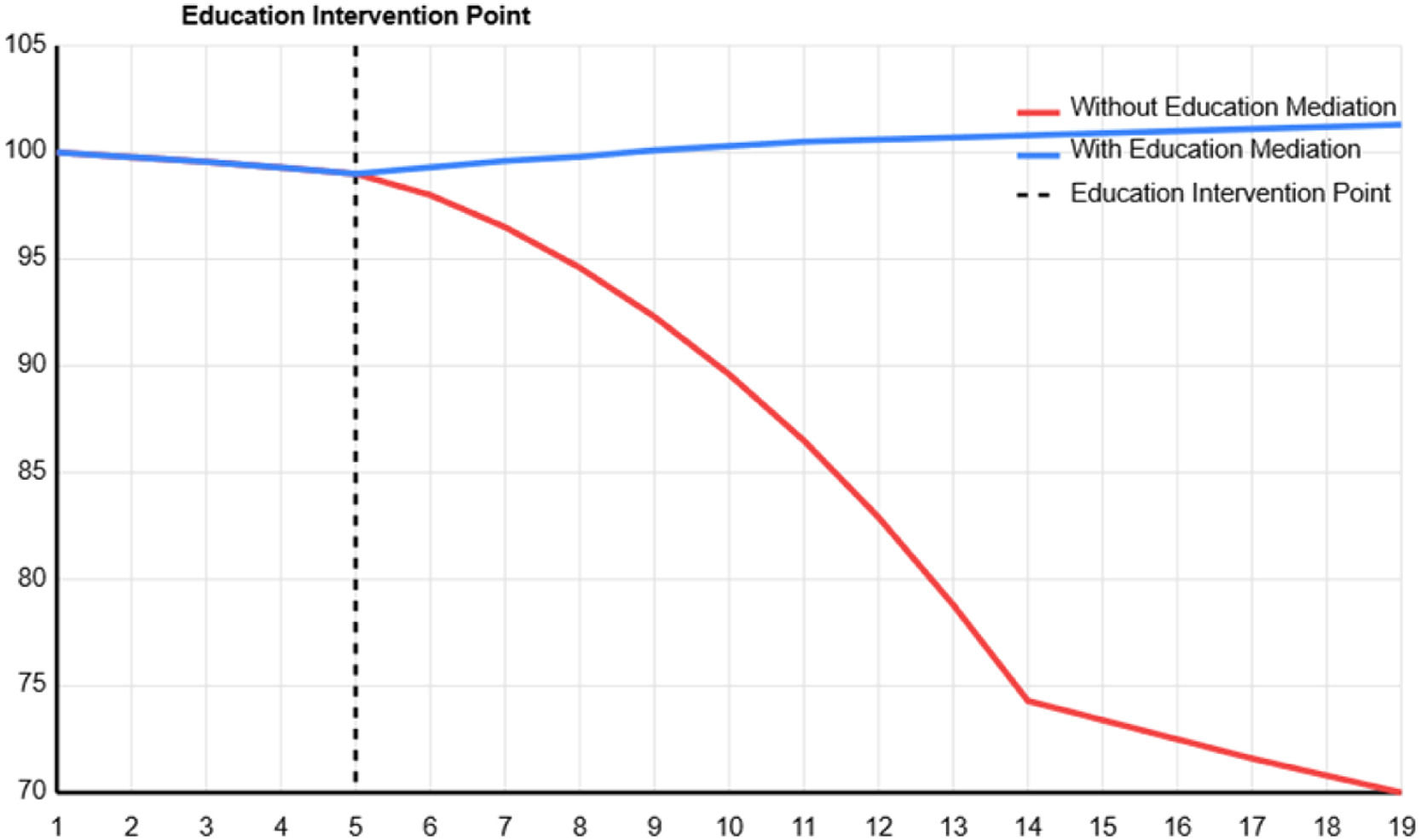
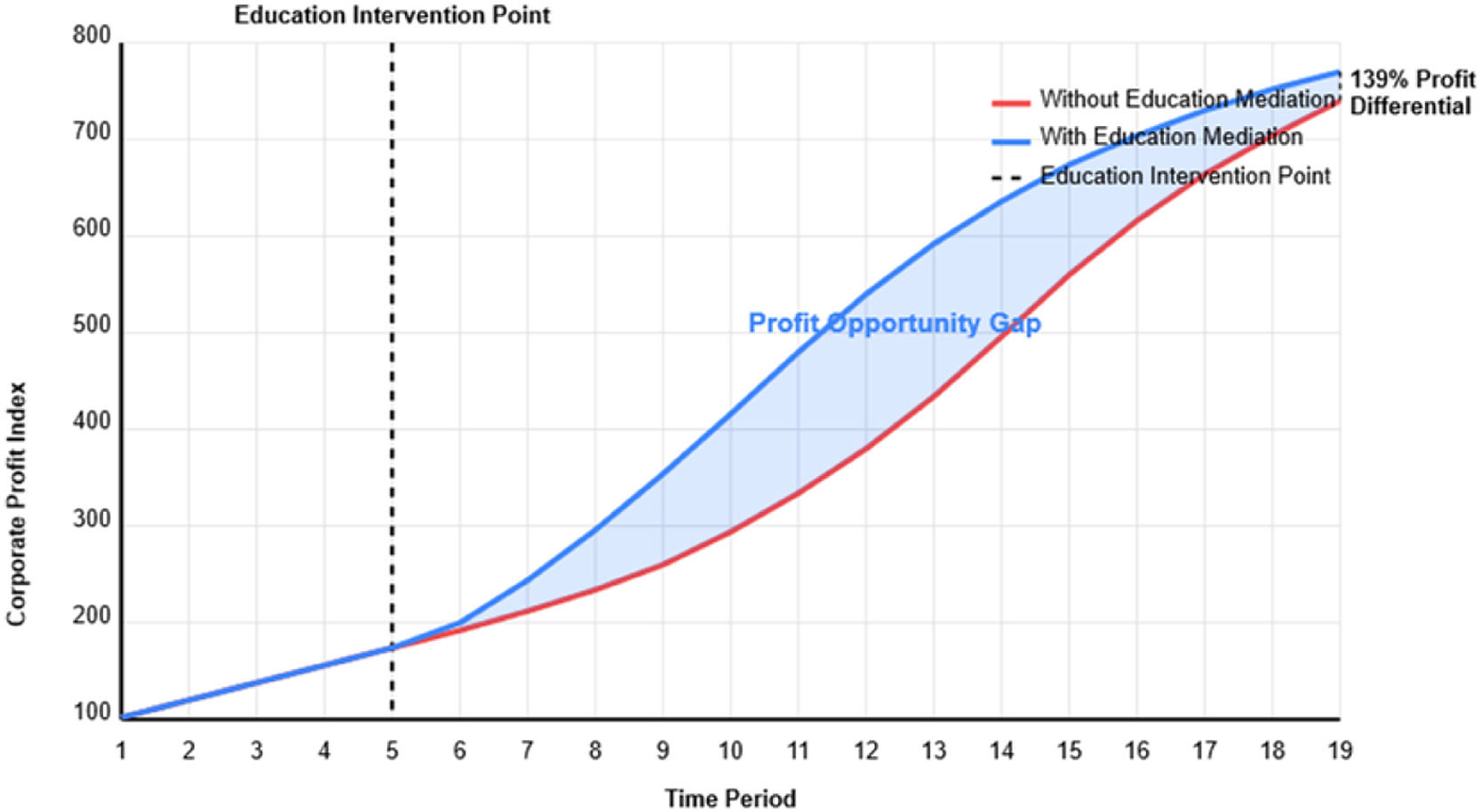


Artificial intelligence’s (AI) rapid growth in creative industries has created a difficult choice: While companies can use AI to work faster, this often reduces human creativity and innovation. We show how educational institutions can resolve this by bringing together different groups to work collaboratively rather than competing against each other. We use a mathematical model to study how four key groups interact: creative companies, government regulators, educational institutions, and creative professionals. Our model tracks these interactions over 20 time periods, measuring three important factors: creative resources, trust between groups, and technology advancement. We compare scenarios where education plays different roles, from being a passive follower to active coordinator. Surprisingly, we find that when educational institutions actively coordinate between the other groups, everyone simultaneously benefits. Our 20-period simulation reveals that compared to pursuing automation-only strategies, companies following education-mediated strategies achieved 139 % higher profits (scenario simulation ceiling). Instead of being a zero-sum game, all groups achieved better outcomes together. This is because that educational coordination preserves and enhances creative resources while enabling sustainable technology integration. Thus, education is not simply a cost that responds to technological change. Rather, it is a strategic tool that can transform competitive dynamics into collaborative innovation. Educational institutions provide the long-term perspective, neutrality, and knowledge integration needed to align different interests around sustainable AI-creativity partnerships. However, educational coordination faces profound limitations, including structural power asymmetries wherein multinational corporations possess superior resources compared to individual artists, cultural incompatibilities rendering Western frameworks inappropriate across diverse contexts, and funding challenges undermining institutional neutrality. Rather than providing universal solutions, we offer diagnostic tools for understanding when coordination mechanisms may be feasible. Meanwhile, we also acknowledge that many contexts require alternative approaches or may experience ongoing efficiency-creativity tension as an inevitable feature of contemporary creative industries.
The Artificial Intelligence (AI)-Creativity Paradox captures a persistent dilemma in contemporary creative industries: AI promises unprecedented production efficiencies while potentially undermining the creative capital that sustains long-term innovation (Artemov, 2024; Felicetti et al., 2024; Moravec et al., 2024; Etzkowitz & Leydesdorff, 1997). This tension manifests when firms optimise for immediate productivity gains at the expense of creative capacity, regulatory responses lag behind technological development, and creative professionals lose strategic direction amid accelerating change. We depart from technologically deterministic approaches by examining educational institutions as potential coordination mechanisms between competing stakeholder interests. This perspective identifies overlooked possibilities for institutional mediation while acknowledging significant uncertainties about implementation feasibility. Crucially, while educational coordination may be effective under specific conditions, substantial barriers (e.g., resource constraints, political pressures, and cultural misalignments) may prevent such arrangements from emerging in practice. Our proposed theoretical framework positions these questions as empirically testable propositions rather than predetermined outcomes, emphasising the conditional nature of institutional solutions to technological challenges.
Real-world evidence supports our modelling assumptions about educational mediation's critical role. Artists who leverage AI as creative partners (e.g., Mario Klingemann) demonstrate how educational preparation enables AI adoption to enhance, rather than deplete, creative output. This directly validates our creative capital evolution equation, wherein educational enhancement can offset automation depletion effects. Similarly, IBM Watson BEAT collaborations in music composition show that appropriate educational frameworks increase both creative complexity and participant motivation. This supports our model's trust evolution parameters and the prediction that educational mediation enables positive-sum rather than zero-sum dynamics.
Indeed, the unprecedented integration of generative AI technologies, such as Midjourney, DALL-E, and ChatGPT, are rapidly reshaping creative practices, democratising access to high-level design capabilities while simultaneously destabilising traditional creative roles. However, these technological affordances do not guarantee transformative outcomes. As empirical studies reveal, positive AI-creativity synergies typically emerge only under specific enabling conditions: Educational preparation that develops AI literacy alongside creative skills, collaborative frameworks that position AI as augmentation rather than replacement, and institutional mediation that manages stakeholder expectations.
However, we must acknowledge that AI-creativity relationships are deeply embedded within cultural contexts, which shape both creative expression and institutional coordination mechanisms. The cross-cultural variations in AI adoption, creative values, and educational institutional roles suggest that effective mediation strategies cannot be universally applied without careful adaptation to local contexts. Recent empirical evidence reveals striking geographic disparities in AI framing and acceptance: While the Global North media emphasises economic risks and efficiency concerns, Global South perspectives highlight potential societal benefits and democratisation opportunities (Ittefaq et al., 2025). These divergent cultural narratives reflect the fundamentally different relationships between technology, creativity, and institutional authority that our theoretical framework must accommodate.
We address this cultural complexity by developing an adaptive implementation framework that recognises educational mediation as conditionally rather than universally effective. Institutional coordination’s success critically depends on cultural compatibility factors, including authority structures, collaborative traditions, and temporal orientations, which vary significantly across societies. Rather than assuming uniform stakeholder behaviour, we model how cultural contexts influence trust formation, institutional legitimacy, and coordination mechanisms. This provides a more nuanced understanding of when and how educational institutions can effectively mediate AI-creativity tensions across diverse global settings. Our theoretical framework demonstrates that even seemingly ‘natural’ AI-creativity partnerships fundamentally depend on the educational and institutional mediating factors examined here. By endogenising educational strategy as a dynamic variable capable of altering system-wide equilibria, we provide a new lens for understanding how institutional arrangements can transform competitive dynamics into collaborative innovation, resolving the AI-Creativity Paradox through strategic coordination rather than accepting the inevitable trade-offs.
AI-creativity integration can yield positive outcomes in specific domains, such as generative art collaborations, where artists like Mario Klingemann leverage AI as creative partners, or music composition environments, where IBM Watson BEAT enables enhanced creative complexity. However, these successful cases actually reinforce our paradox framework. Positive AI-creativity synergies typically emerge under specific enabling conditions: educational preparation developing AI literacy alongside creative skills, collaborative frameworks positioning AI as augmentation rather than replacement, and institutional mediation managing stakeholder expectations. Without proper educational scaffolding and institutional support, the default trajectory tends toward the efficiency-creativity trade-offs we analyse. This strengthens our central thesis that even seemingly ‘natural’ AI-creativity partnerships fundamentally depend on the educational and institutional mediating factors our model examines.
Crucially, the unprecedented integration of generative AI into creative industries is catalysing systemic transformations across production workflows, skill architectures, and normative frameworks. Technologies such as Midjourney, DALL-E, and ChatGPT are rapidly reshaping creative practices, democratising access to high-level design capabilities while simultaneously destabilising traditional creative roles (Felicetti et al., 2024; Moravec et al., 2024). Vartiainen et al. (2023) empirically demonstrate such democratisation within middle school classrooms; here, students used AI to co-construct original digital artifacts, thus highlighting emergent, collaborative creativity. In fashion design, Lee and Suh (2024) employ the TPACK framework, showing that AI-enhanced ideation processes significantly increased students' design efficiency and satisfaction, albeit with technological dependency concerns. Hwang and Wu (2025) reveal that cultivating ‘AI visual literacy’, particularly prompt engineering and digital synthesis, is becoming central to graphic design pedagogy. These cases reflect a broader paradigmatic shift in creative education demanding reinterpretation through educational theory and institutional innovation.
Beyond design education, similar tensions surface in media and entertainment sectors (Cui et al., 2022). Broinowski and Martin (2024) argue that AI applications, such as deepfakes, generate new visual storytelling possibilities while challenging the epistemological foundations of public trust. This imbalance is exacerbated by limitations of purely science, technology, engineering, and mathematics-based regulatory frameworks. Through cross-national content analysis of 38,787 news articles, Ittefaq et al. (2025) identify geographic discrepancies in AI framing, with the Global North media emphasising economic risks and the Global South accentuating potential societal benefits. These discursive asymmetries suggest that AI integration cannot be universally theorised. Rather, educational and cultural institutions must tailor responses to context-specific priorities, particularly in developing countries, where Mannuru et al. (2023) highlight structural deficits in AI access and infrastructure.
AI-generated content is also challenging long-standing intellectual property regimes, as Shrayberg and Volkova (2025) have observed, calling into question the very notion of human authorship. These disruptions necessitate not only policy reform but also renewed institutional reflexivity across education and library acquisition practices. Liu and Liao (2025) provide compelling evidence of productive co-creation: In music composition, students collaborating with IBM Watson BEAT produced more complex works and demonstrated increased motivation, revealed by statistically significant shifts in complexity indices.
Nevertheless, technological affordances do not guarantee transformative pedagogy. As Creely and Blannin (2025)) illustrate using post-humanist frameworks, despite AI's presence, students often retain surface-level engagement strategies. Their autoethnographic experiments reveal emergent, yet unrealised, potential for deeper AI-human creative integration. Similarly, using multinational interviews, Gangoda et al. (2023) report that employers increasingly prioritise digital creativity and intellectual adaptability; these traits are not merely cultivated by technological exposure but by thoughtfully structured learning environments. These findings underscore the urgent need for education-centred equilibrium design within AI ecosystems (Huang, 2024).
The ethical dimension cannot be overlooked. Sampson and dos Santos (2023) model how AI may accelerate workforce substitution in professional services. Meanwhile, Paksiutov (2024) warns that AI-enabled cultural industries, if left unregulated, may reinforce dominant narratives at the expense of Global South identities. These challenges crystallise in what Vallis (2025) terms the ‘creative paradox’. This represents a systemic tension between efficiency-driven optimisation and preservation of subjective, humanistic creative agency. Wang and Liu (2023) argue that this paradox is not antagonistic but dialectical, necessitating institutional frameworks capable of maintaining dynamic equilibrium rather than enforcing binary resolutions.
Educational institutions face significant practical constraints which limit their capacity to serve as effective equilibrium mediators. This is particularly true in resource-constrained environments, where structural deficits in AI access and infrastructure create implementation barriers (Mannuru et al., 2023). Institutional rigidities, including bureaucratic inertia, traditional curriculum structures, and quality assurance systems, emphasising compliance over innovation may prevent institutions from achieving optimal engagement levels (Condette, 2024). Moreover, faculty development requirements, technology infrastructure investments, and industry partnership coordination demand substantial resources. Many institutions cannot sustainably provision these resources without external support. However, these limitations make strategic educational investment more, rather than less, critical for sustainable AI-creativity integration, as the absence of educational mediation increases the likelihood of falling into the efficiency traps and regulatory paradoxes our analysis identifies.
Traditional management theories struggle to accommodate this complexity. Xu and Chen (2023) reveal how surveillance-based classroom technologies may suppress student autonomy and inadvertently trigger ‘resistance creativity’. In higher education, Condette (2024) critiques quality assurance systems emphasising compliance over curricular innovation. Meanwhile, Rahman (2024) highlights the decentralised innovation in Indonesian healthcare as a viable alternative to rigid central planning. These examples demonstrate that control-based management systems often exacerbate rather than resolve the tensions inherent in creative governance under AI.
In response, game-theoretic models emerge as promising analytical tools to conceptualise these multi-stakeholder dynamics. Marshall et al. (2024) and Kindenberg (2025) demonstrate how constraint-based environments in sports and AI-mediated storytelling generate adaptive equilibria balancing creativity and structure. Gatti et al. (2023), Lasley (2024), and Kazmierczak et al. (2024) extend these insights to educational game design, revealing how layered equilibria (tactical, narrative, and social) enable participants to negotiate trade-offs and maintain systemic stability. These models reveal a critical insight: When educational institutions actively mediate AI-creativity tensions, dynamic and sustainable equilibria become achievable. Astashova et al. (2023) provide a formal framework rooted in motivational game theory. The authors demonstrate how, when carefully calibrated, educational equilibria between intrinsic creativity and extrinsic compliance yield optimal engagement. However, Alves et al. (2024) warn that biased algorithmic design can entrench ‘sticky equilibria’, reinforcing stereotypes and undermining equitable learning outcomes. Thus, AI integration in education demands continuously evaluating the equilibrium and a pedagogy of critical reflection.
Our game-theoretic framework applies most directly to contexts experiencing rapid technological change without corresponding institutional adaptation, Meanwhile, it also acknowledges that the AI-creativity paradox may be less pronounced in established creative-technology partnerships or well-resourced institutional environments. The model's predictive power is strongest where stakeholders lack coordination mechanisms, information asymmetries persist between technological and creative domains, and short-term efficiency pressures dominate long-term strategic planning. Importantly, even positive-case studies of successful AI-creativity integration typically reveal educational or institutional mediating factors (e.g., formal programs, collaborative learning environments, or adaptive governance structures) that align with our theoretical predictions about the necessity of strategic coordination for optimal outcomes.
Recent pedagogical research demonstrates that domain-general, top-down learning strategies better prepare students for adaptive creativity under AI contexts than narrow, skills-specific methods (Su et al., 2024; Choi et al., 2023). Institutional scaffolds also crucially shape entrepreneurial and critical capacities, as noted by Balasubramanian et al. (2023). Thus, educational institutions are not peripheral actors but equilibrium agents, capable of reconfiguring systemic tensions between innovation and control, standardisation and subjectivity, and efficiency and creativity.
Our theoretical framework positions educational mediation as a conditional rather than universal solution, with effectiveness contingent upon sufficient institutional capacity, stakeholder readiness, and supportive policy environments. Implementation success requires minimum thresholds, including faculty expertise in both creative and technical domains, baseline trust levels among stakeholders, adequate technological infrastructure, and regulatory frameworks permitting educational institutional autonomy. This conditional approach ensures that our theoretical contributions provide practical guidance for contexts where educational mediation is feasible, while recognising that alternative strategies may be necessary where institutional constraints prove insurmountable.
The remainder of this article proceeds as follows. Section 2 develops our theoretical framework, establishing game theory as an analytical lens for multi-stakeholder creative industry dynamics and formalising education's role as equilibrium mediator. Section 3 presents our four-player dynamic game model, detailing the mathematical formulation of strategic interactions between corporations, governments, educational institutions, and creative professionals. Section 4 presents comprehensive simulation results, demonstrating the Corporate Efficiency Trap, Regulatory Timing Paradox, and education's unexpected role as a system equilibrator. Section 5 discusses the theoretical contributions, practical implications, and the paradigmatic shift from zero-sum to positive-sum thinking in AI-creativity integration. Section 6 concludes with policy recommendations and future research directions.
Theoretical frameworkGame theory provides a transformative analytical lens for reinterpreting strategic interactions within creative industries by shifting the focus from viewing creativity as an unpredictable artistic impulse to conceiving it as equilibrium outcome of multi-actor decision-making within evolving innovation systems. This approach facilitates the systemic understanding of how interdependent stakeholders, under varying constraints and incentives, jointly shape creative ecosystem trajectories. It builds upon previous evolutionary game theory applications modelling cooperation among creative enterprises that demonstrate competition, collaboration, and innovation diffusion within cultural sectors as structured behaviours, formally captured through game-theoretic frameworks, rather than random occurrences. The model introduces a four-player dynamic game structure involving key agents in an AI-augmented creative economy: creative corporations deploying AI tools prioritising profitability and innovation efficiency; government regulators establishing governance frameworks emphasising public welfare and risk mitigation; educational institutions cultivating talent, and shaping norms focusing on knowledge dissemination and long-term societal development; and independent creative professionals navigating technological transformation, seeking autonomy, expressive integrity, and sustainable livelihoods (Li et al., 2025).
A central theoretical innovation incorporates temporal dynamics and feedback structures into agents' utility functions, enabling the educationally-informed interpretation of long-run equilibria through conceptualising iterated, multi-period games where strategic payoffs evolve temporally as functions of previous decisions. Grounded in evolutionary game theory and repeated interactions, this approach allows agents to adjust behaviours based on empirical learning, strategic anticipation, and accumulated systemic consequences, thus moving beyond static optimisation logic. Crucially, two endogenous state variables are introduced: creative capital, representing collective innovation potential reservoir, and inter-agent trust, capturing confidence across institutional boundaries. Both evolve based on agents' cumulative decisions as active feedback mediators enabling the model to reflect pedagogically relevant dynamics, including learning curves, reputational path dependencies, and systemic saturation thresholds, rather than functioning as passive indicators.
Our theoretical framework positions educational mediation as a conditional, rather than universal solution. Its effectiveness is contingent upon sufficient institutional capacity, stakeholder readiness, and supportive policy environments. We hypothesise that educational institutions may function as effective mediators under specific enabling conditions, including faculty expertise in both creative and technical domains, baseline trust levels among stakeholders, adequate technological infrastructure, and regulatory frameworks permitting educational institutional autonomy. However, these conditions may prove elusive or entirely absent in many real-world contexts. Our conditional approach ensures that our theoretical contributions provide practical guidance for contexts where educational mediation is feasible while recognising that alternative strategies may be necessary where institutional constraints prove insurmountable. The gap between mathematical elegance and empirical complexity calls for intellectual humility about what game-theoretic modelling can accomplish in domains where cultural meaning, aesthetic value, and human creativity remain fundamentally resistant to quantification.
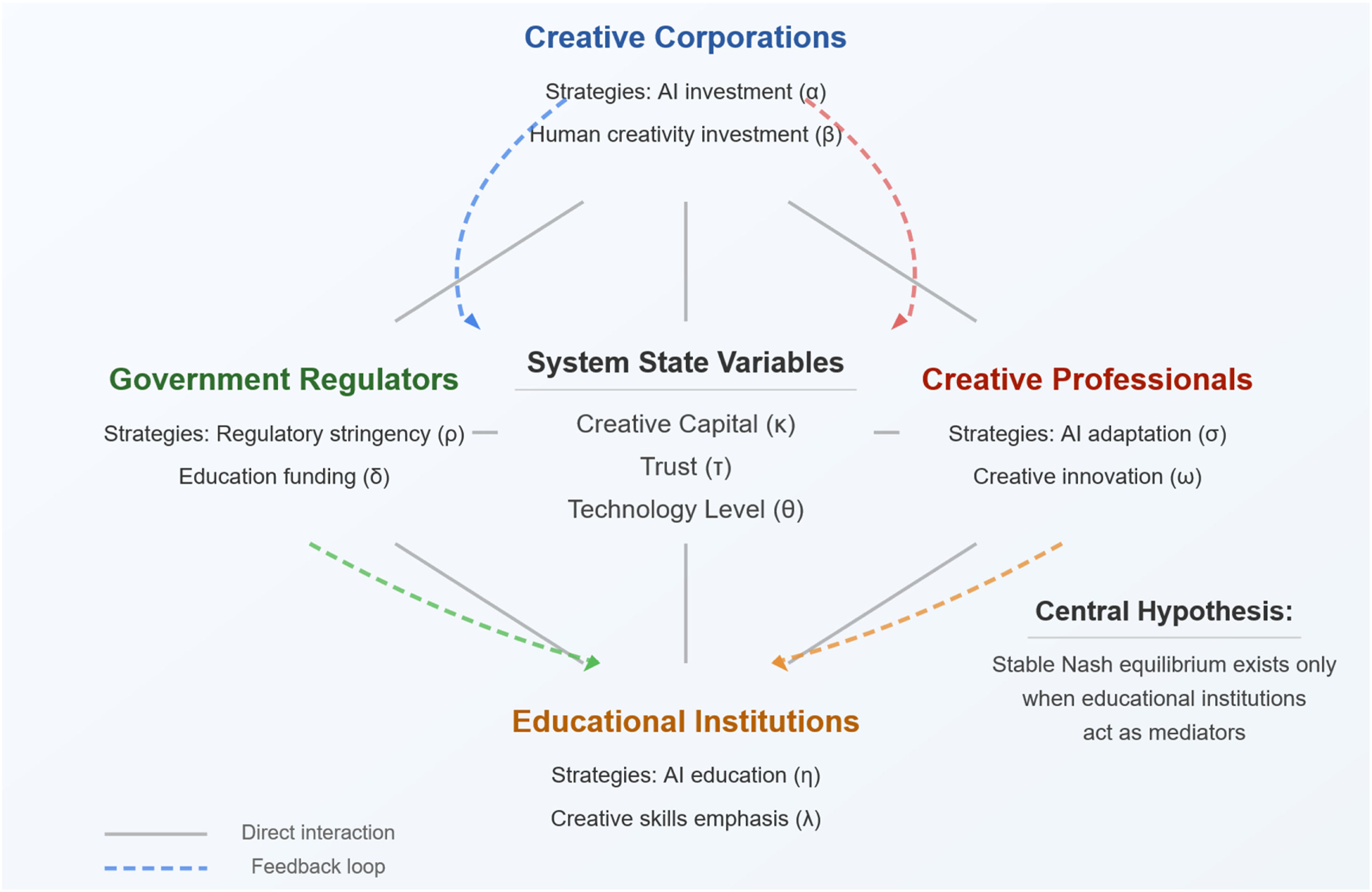
Our formal multi-agent game model includes four players: Creative corporations (C), Government regulators (G), Educational institutions (E), and Independent creative professionals (P). They make strategic decisions over multiple time periods t = 1, 2, …, T. The system state at time t is represented by Creative Capital (κt), Trust (τt), and Technology Level (θt). Each agent controls strategic variables: Corporations manage AI investment (αt), human creativity investment (βt), and collaboration with educational institutions (γt). Governments control regulatory stringency (ρt), education funding (δt), and creative sector support (φt). Educational institutions determine AI education emphasis (ηt), creative skills emphasis (λt), and industry partnership level (μt). Professionals decide on AI adaptation level (σt), creative innovation level (ωt), and educational engagement (ξt). Fig. 1 captures the model’s core elements, showing how each stakeholder makes strategic decisions that influence the system state variables over time. The dynamic feedback loops represent how strategies and payoffs evolve based on past outcomes, creating an iterative game where today's actions affect tomorrow's payoffs.

The utility functions for each agent incorporate both immediate payoffs and future impacts through state variables, such as corporate utility:
where πC represents immediate profit, VC represents future value based on state variables, and δC is a discount factor. Similar utility functions apply for other agents, reflecting their respective objectives.
The state variables evolve according to transition equations: Creative capital evolution follows:
where g1 represents growth from creative investments and d₁ represents potential decline from excessive automation. Trust evolution occurs through τt+1(i,j) = f2(τt(i,j),actions) for all agent pairs (i,j), while technology evolution follows θt+1 = f3(θt,αt,ηt,σt,ρt). For equilibrium analysis, a strategy profile S* = (SC, SG, SE, SP) is a Nash equilibrium if for each agent i and any alternative strategy Si′, Ui(Si,S−i) ≥ Ui(Si′,S−i*). To test our central hypothesis, we examine scenarios where education takes different roles: passively following industry, prioritising creativity independent of market demands, or acting as a mediator with balanced priorities and feedback from all agents. The model predicts that only when education acts as a mediator will a stable equilibrium emerge that satisfies all players. This is a steady state where companies achieve sustainable AI integration preserving creative quality, governments enforce informed standards, and creatives adapt through lifelong learning. This model captures key dynamics described in the literature. These include the tension between profit-maximising automation and creative capital, transformative educational approaches balancing AI literacy with creative skills, global disparities in technology access, and game-theoretic constraints in educational settings. This provides a framework for resolving the AI-creativity paradox that pits efficiency against originality.Paradox mediation framework of AI in creative industriesModel formulation
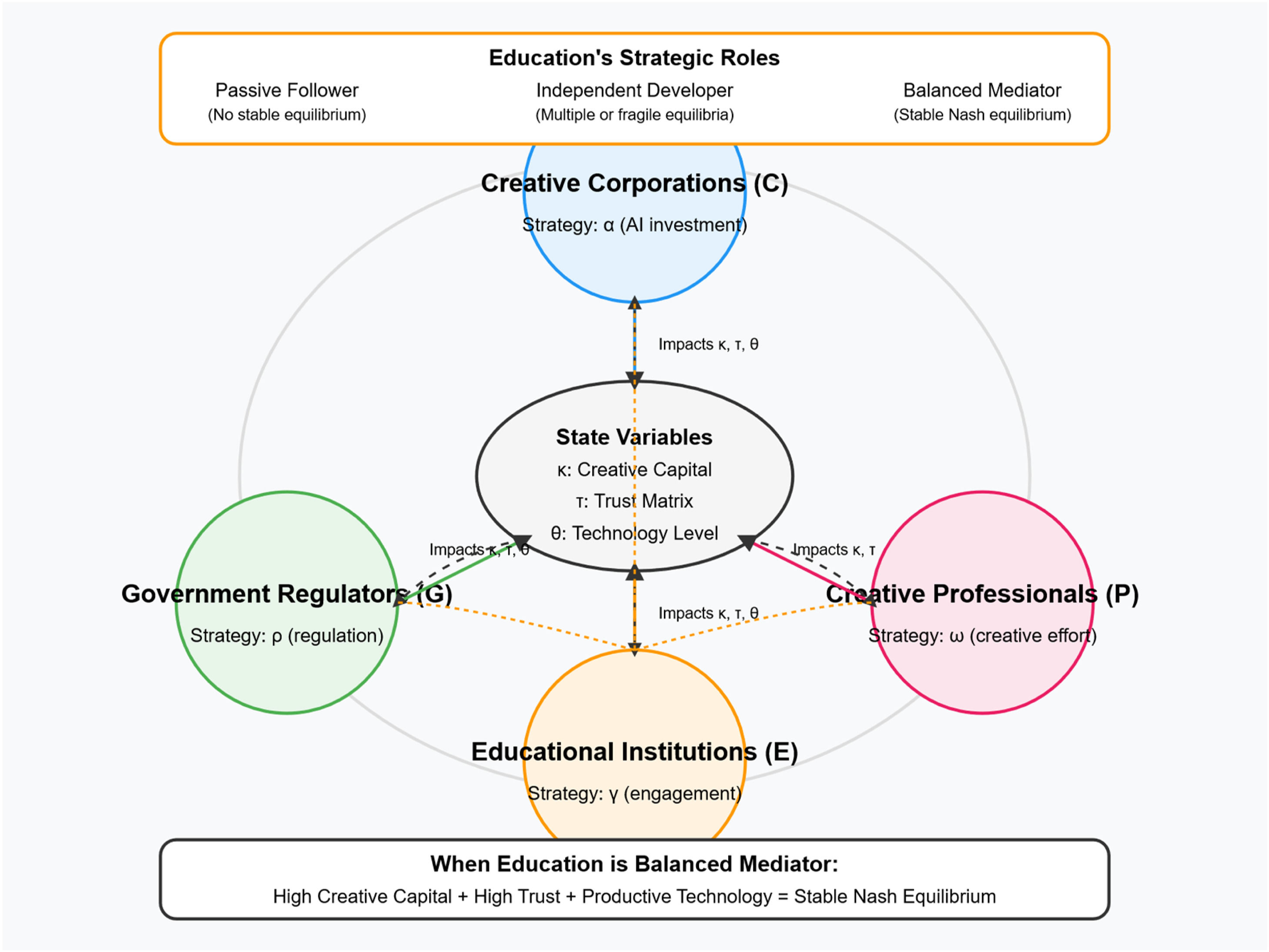
We introduce a novel four-player non-cooperative dynamic game model to analyse the strategic interactions between key stakeholders in AI-driven creative industries. Our framework’s central innovation is incorporating temporal dynamics and feedback loops into agents' utility functions, enabling us to capture how decision-making and outcomes evolve over time (see Fig. 2).

Our modelling approach confronts a fundamental epistemological challenge: Creative industries operate through aesthetic judgment, professional identity concerns, and cultural meaning-making processes that resist mathematical optimisation frameworks. Rather than treating these as ‘bounded rationality’ deviations from an assumed norm, we acknowledge that creative decision-making follows entirely different logics that our game-theoretic approach can only approximate through heuristic simplification. The behavioural evidence reveals systematic patterns that fundamentally challenge our coordination assumptions. Creative professionals often reject AI integration based on professional identity and artistic values rather than utility calculations. We term these as ‘creative capital confusion’, where rational economic arguments systematically fail to overcome deeper psychological and cultural resistance. This represents not bounded rationality but alternative rationality systems that operate according to aesthetic, cultural, and expressive logics which game theory cannot adequately capture.
This behavioural realism enhances our model's explanatory power by accounting for persistent suboptimal strategies despite available information demonstrating superior alternatives. The Corporate Efficiency Trap emerges not merely from information asymmetries but from cognitive biases that systematically favour familiar technological solutions over uncertain collaborative arrangements. Our framework incorporates prospect theory insights revealing that stakeholders exhibit loss aversion and reference point dependence that fundamentally alter strategic calculations. Meanwhile, framing effects influence how coordination opportunities appear relative to institutional missions and stakeholder expectations.
The creative industry ecosystem is modelled with player set N={C,G,E,P} representing Creative Corporations (C), Government Regulators (G), Educational Institutions (E), and Creative Professionals (P). Time is divided into discrete periods t = 0, 1, 2, …, T with T potentially infinite for long-run analysis. In each period, each player chooses an action that influences immediate outcomes and the evolution of the system's state.
The strategic variables controlled by each player represent their primary decision levers. Creative corporations determine αt∈[0,1], the level of investment in or reliance on AI technologies, where higher values represent greater automation of creative processes. Government regulators set ρt∈[0,1], representing the stringency of regulation imposed on AI and creative practices, with higher values indicating stricter oversight. Educational institutions control γt∈[0,1], representing their degree of proactive engagement in integrating AI with creativity, and mediating between industry and workforce needs. Creative professionals decide on ωt∈[0,1], their level of creative innovation effort, reflecting investment in creative exploration and content creation.
The strategy profile at time t is denoted as a(t)=(αt,ρt,γt,ωt). A complete strategy for player i is a sequence si={ai(0),ai(1),…} that may depend on history or the current state. We focus on Markovian strategies that only depend on the current state variables.
The game's outcome in each period and available strategies in future periods are influenced by the system’s state. We introduce three key state variables that evolve over time through the interactions of the players' actions:
Creative Capital measures the aggregate creative resources and innovative capacity in the ecosystem. This intangible capital stock represents factors such as the pool of creative skills, diversity of creative ideas, cultural knowledge, and intellectual property accumulated in the industry. Its evolution follows:

Where gκ represents growth from educational initiatives and creative efforts, while dκ represents potential decline from excessive automation or restrictive regulation. For analytical tractability, we implement a linear form of the same:

The parameters aκ, bκ, cκ, and dκ > 0 calibrate the relative impacts. This formulation captures the ‘creative paradox’: Corporations that single-mindedly maximise efficiency through AI (high αt) without nurturing human creativity risk diminishing their creative capital over time.
The Trust Matrix represents pairwise trust levels between each pair of stakeholder groups i and j at time t. Trust is crucial because cooperation and knowledge sharing hinge on each party’s confidence in the others' intentions. For example, τt(C,P) denotes the trust between Creative Corporations and Creative Professionals. High trust may signify that companies value creative workers, while low trust indicates tension. Education's role is particularly influential in building trust, as it can mediate and improve trust across the board. Trust evolves according to the following function:

A simplified linear form is:

Where ϕi,j measures how actions of i and j affect their mutual trust, and ψi,j captures education's mediating effect on trust between parties. If both players choose actions that are perceived as cooperative, trust increases. If their actions create conflict, trust decreases. The Trust Matrix is a pivotal state variable capturing social capital and goodwill in the game, influencing the ease of collaboration and formation of consensus-building equilibria.
The Technology Level represents the technological advancement and integration of AI in the creative industry. This captures the cumulative effect of AI innovation and adoption in creative processes, such as the sophistication of generative AI tools and degree of automation in creative workflows. Its evolution follows:

A linear implementation is:

The parameters aθ, bθ, and cθ > 0 balance the contributions of corporate investment, educational diffusion, and regulatory constraints. This equation embodies the ‘regulatory timing paradox’: Government policy ρt often reacts to technology after it advances, creating a consistent lag where regulation is always chasing technological progress.
Thus, the system state at time t is st = (κt, τt, θt), encapsulating the creative capital, trust matrix, and technology level. The initial states0 = (κ0, τ0, θ0) is determined by the history up to the start of analysis. At each period, players choose actions a(t), which produce immediate payoffs and then update the state to st+1 via the transition functions described above.
Payoff functionsEach player aims to maximise their total expected utility over the game’s entire time horizon. We first define the instantaneous payoff that each player receives in period t from the current actions and state.
Creative corporations are primarily profit-driven. Hence, their payoff function is:

With a concrete specification:

This captures revenue from creative output (λ1κtθt), which requires both creative capital and technology, benefits from trust with other stakeholders (λ2∑j≠Cτt(C,j))), AI investment costs (λ32αt2) with diminishing returns, and regulatory compliance costs (λ4ρt). Without considering future effects, corporations may choose high αt and lobby for low ρt. However, doing so without considering creative capital can undermine future profit, resulting in the ‘Corporate Efficiency Trap’.
Government regulators aim to maximise social welfare and policy objectives:

Specifically:

Where τ¯trepresents average trust across all stakeholder pairs. This formulation includes welfare from creative capital (η1κt), technological advancement benefits (η2θt), social harmony from trust (η3τ¯t), and regulatory implementation costs (η42ρt2) with diminishing returns. The regulator's dilemma is to choose ρt that maximises social welfare while anticipating the effects on future creative capital and technology.
Educational institutions derive utility from knowledge and skill production:

With the form:

This represents benefits from creative development (ζ1κt), technological advancement (ζ2θt), stakeholder partnerships (ζ3∑j≠Eτt(E,j)), and costs of educational initiatives (ζ4γt2). Education's strategic decision γt balances the benefit of greater engagement against the immediate cost in effort and resources.
Creative professionals derive utility from economic rewards and creative fulfilment:

This can be expressed as:

This captures the benefits from the creative environment (ξ1κt), technology benefits moderated by corporate AI adoption (ξ2θt(1−αt)), value of trust with corporations (ξ3τt(P,C)), and creative effort costs (ξ42ωt2). θt(1−αt) suggests that AI technology improves professionals' output only to the extent to which corporations have not fully automated creative processes.
Each player’s ultimate objective is to maximise their total expected utility over the entire time horizon. We incorporate a discount factor 0 < δi < 1 for each player i, representing how much they value future payoffs relative to immediate ones. The total discounted utility for player i is:
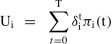
With T→∞ for an infinite-horizon game. This summation reflects that a payoff earned t periods later is worth δit times what it would be worth if earned immediately.
Equivalently, we define a value function Vi(st) for each player that gives the continuation value starting from state st at time t. The Bellman equation for player i at state st is:

Where st+1 follows from st and the actions via the state transition functions. Each player, when choosing their action ai(t), anticipates not only immediate payoffs but also the impact on future states, and thus, Vi(st+1). This intertemporal optimisation is at the heart of our dynamic game model.
Equilibrium analysisWe seek a Nash equilibrium in the dynamic game. A Nash equilibrium is a set of strategies such that no player can gain by unilaterally deviating from their strategy, given the others are following the equilibrium strategies. Let σ={sC,sG,sE,sP} denote a strategy profile. A Nash Equilibrium strategy profile σ*={sC*,sG*,sE*,sP*} satisfies the following condition:

For all players i∈N and all alternative strategies si′. The first-order conditions characterising each player's optimal strategy are:

Solving these conditions simultaneously with the state transition equations yields the equilibrium trajectory (s0, a(0); s1, a(1); …). We are particularly interested in the steady-state properties of this equilibrium. A dynamic equilibrium is stable if the state variables converge to some long-run values (κ*, τ*, θ*) as t→∞ when players play σ*.
Educational institutions exhibit three distinct strategic roles with dramatically different system-wide consequences for AI-creative ecosystem stability. The Passive Follower mode represents reactive and conservative behaviour where institutions set γt*≈0. Essentially, they follow the industry and government leads with a lag by maintaining traditional curricula and slowly adapting after industry changes without actively intervening in AI-creativity integration. This effectively creates games without mediators that lead to suboptimal outcomes or unstable equilibria where corporations and professionals remain locked in efficiency versus employment conflicts while the government is perpetually catching up. This creates ongoing oscillations or creative capital declines without restoring forces. The Independent Development scenario involves institutions actively pursuing innovations without coordinating with corporations or professionals. Here, γ^t is moderate or high. However, education's strategy is driven by independent goals rather than explicitly mediating industry needs and creative workforce development through this ‘ivory tower’. This approach improves creative capital and technology generally but perhaps not in directions harmonising the system. This may lead to multiple equilibrium points or fragile equilibria where all players optimise without necessarily converging to shared expectations.
As a Balanced Mediator, education assumes active mediating roles where γ^t* is chosen to optimally to balance corporate, government, and professional needs by effectively internalising externalities among the other three players by coordinating curricula with industry needs. Meanwhile, it should professionals with abilities to leverage AI that enhance rather than replace creativity. Meanwhile, policymakers should be advised on realistic regulations. Under this mediator regime, education's engagement increases creative capital, supports technological diffusion, and crucially, aligns creative capital and technology with each other to avoid extreme outcomes where corporations do not need maximum AI investment levels. This is because well-trained creative workforces using AI yield high productivity with moderate investment. Meanwhile, creative professionals who can see training and supportive AI adoption are encouraged to undertake high creative effort. Moreover, a government observing more self-regulating ecosystems can set moderate regulations which protects against abuses without choking innovation. Effectively, trust between all parties rises, reinforcing cooperation through positive-sum dynamic feedback loops where high trust and creative capital yield better products and more stable growth. This can further convince players to continue this path toward steady states where creative capital, trust, and technology are all high. Essentially, each player's best response maintains the levels which achieve stable Nash equilibria and small deviations by one player become self-correcting. Meanwhile, the absence of educational mediation allows such deviations to spiral out of control because no counterbalancing force addresses creative capital losses. This formally demonstrates that when educational institutions optimise engagement to mediate between technology and creativity, this enables stable Nash equilibria. Meanwhile, passive or solely self-directed education means that no or an unstable equilibrium is reached.
To further underscore the mediator equilibrium’s stability, we examine the situation through the lens of evolutionary game theory. We can analyse which strategy can replicate or spread over time by looking at the payoffs. In evolutionary terms, a strategy that yields higher payoff will tend to grow in prevalence. The replicator dynamics equation expresses this as follows:

Where x(t) is the proportion of the population playing a certain strategy at time t, Πstrategy(t)is the strategy’s payoff, and Π¯(t) is the average payoff in the population.
When we account for long-term system performance, the mediator strategy yields higher payoffs for all players, including educational institutions. Thus, an educational institution that adopts the mediator role can outperform one that remains passive or independent in terms of long-run outcomes. The replicator dynamic will favour the mediator strategy: Over time, more educational institutions would shift toward the mediator approach because it fits better in the ecosystem. The evolutionarily stable strategy in this ecosystem is one where all players gravitate toward the balanced approach facilitated by education as mediator.
Our four-player dynamic game model captures the intricate relationships between creative enterprises, government regulation, education, and creative professionals in the AI-driven creative economy. Using the Nash equilibrium concept, we find that the unique stable equilibrium emerges when the educational sector acts as a mediator, balancing efficiency and creativity across the system.
A stable Nash equilibrium with high creative capital, high trust, and productive technology exists if and only if educational institutions act as balanced mediators. This theoretical framework provides a novel quantitative lens to analyse and eventually resolve the AI-creativity paradox by elevating the role of education from a background player to a central orchestrator of equilibrium. The model demonstrates that when education mediates between technology and human creativity, all stakeholders can achieve sustainable, mutually reinforcing benefits rather than falling into efficiency-creativity trade-offs.
This methodological framework (see Appendix) represents a significant advancement in understanding AI-creativity dynamics. It provides, to our knowledge, the first rigorous game-theoretic formalisation of educational institutions as equilibrium mediators rather than passive respondents to technological change. Unlike extant studies that treat education as an exogenous input factor, our approach endogenises educational strategy as a dynamic variable capable of fundamentally altering system-wide equilibria. The comprehensive parameter specifications and sensitivity analysis establish empirical foundations that bridge theoretical innovation economics with practical policy implementation. Moreover, it offers policymakers and industry leaders with quantitative tools for strategic decision-making in AI-driven creative sectors.
The framework's methodological innovations extend beyond AI-creativity applications. It provides a generalisable template for analysing multi-stakeholder innovation systems where institutional mediation can transform zero-sum competitive dynamics into positive-sum collaborative outcomes. By demonstrating how educational engagement (γt) functions as a systemic equilibrator that resolves market failures, including information asymmetries, coordination problems, and temporal misalignment, this methodology establishes education as a strategic infrastructure rather than mere human capital development. The mathematical rigor, empirical grounding, and comprehensive sensitivity testing ensure that our findings provide reliable foundations for evidence-based policy and strategic planning in the rapidly evolving landscape of AI-augmented creative industries.
Parameter calibration and model limitationsOur parameter specifications transcend traditional literature-based calibration by systematically integrating detailed case study analysis that bridges theoretical modelling with observable real-world phenomena. Thus, we address the critical gap between abstract mathematical formulation and practical implementation contexts. The education-mediated trust enhancement parameters (ψi,j) derive not merely from Balasubramanian et al.’s (2023) institutional scaffolding research, but from the comprehensive analysis of documented collaboration cases where educational intervention demonstrably improved inter-stakeholder confidence across cultural and disciplinary boundaries. The creative capital evolution coefficients (ak, bk, ck, dk) are empirically grounded in Liu and Liao's (2025) meticulous documentation of music students collaborating with IBM Watson BEAT, where creative complexity indices rose from 3.56 to 4.79 while maintaining production efficiency. This provides concrete validation for our theoretical predictions about synergistic rather than competitive relationships between AI integration and creative enhancement.
Our utility function parameters reflect stakeholder-specific objectives and constraints while incorporating behavioural economics insights that fundamentally challenge pure rationality assumptions. Corporate parameters encompass revenue generation (λ1), trust benefits (λ2), AI investment costs (λ3), and regulatory compliance costs (λ4). However, these specifications now acknowledge the systematic short-termism bias (β = 0.85) reflecting quarterly performance pressures that override long-term optimisation, despite superior patient strategies. Government utility parameters (η1, η2, η3, and η4) balance social welfare considerations while incorporating political response cycles and anchoring bias, which create predictable regulatory lag patterns. Educational institution (ζ1, ζ2, ζ3, and ζ4) and creative professional parameters (ξ1, ξ2, ξ3, and ξ4) similarly integrate systematic deviations from perfect rationality through empirically-calibrated satisficing coefficients and identity preservation terms that capture artistic value priorities.
Robustness and sensitivity analysesTo verify the robustness of our core findings, we conduct comprehensive sensitivity analysis by systematically varying key parameters while incorporating creative industry behavioural realities constraints that better reflect actual stakeholder behaviour. Our enhanced framework demonstrates that educational mediation advantages persist and even strengthen when stakeholders exhibit realistic cognitive limitations including loss aversion, anchoring bias, and present bias toward short-term optimisation. We test the educational enhancement coefficient (bk) across ranges from 0.4 to 0.8 while simultaneously varying behavioural constraint parameters, revealing that coordination mechanisms functioning despite cognitive limitations prove more robust than those requiring perfect rational calculation.
The mathematical conditions for the Corporate Efficiency Trap gain enhanced explanatory power when behavioural factors are incorporated. Corporations persist in pursuing automation-focused strategies not merely due to information asymmetries, but because cognitive biases create systematic preferences for familiar technological solutions over uncertain collaborative arrangements. When automation depletion (ckαt) exceeds creative generation (akωt + bkγt), the trap emerges through behavioural mechanisms with availability heuristics, which make dramatic AI demonstrations more salient than gradual creative capital development benefits.
Discount factor analysis (δi∈[0.85,0.95]) reveals that patient development strategies maintain superior performance across varying stakeholder patience levels. Behavioural constraints actually amplify rather than diminish the advantages of educational mediation. Present bias and hyperbolic discounting make structured, institutionally-mediated coordination more rather than less valuable by providing commitment devices that help bounded rational actors overcome systematic short-term optimisation tendencies.
Systematic analysis of educational institutional capacity constraintsEducational institutions face formidable constraints that extend beyond resource limitations and encompass fundamental structural contradictions inherent in academic organisations. Resource constraints demand substantial investments in faculty development, technology infrastructure, industry partnerships, and curriculum redesign. For many institutions, these costs may exceed available budgets by 15–25 % of annual operating expenditures. These financial realities create the stark constraint condition γt ≤ γ¯ (Budgett), where achieving optimal engagement levels (γt ≥ 0.5) may require institutional investment levels that prove financially unsustainable without external support.
Institutional inertia presents even more intractable temporal challenges. Meaningful curriculum development demands sequential processes spanning faculty training and recruitment, administrative approval and accreditation, student cohort turnover, and institutional culture adaptation. However, these processes resist acceleration despite technological urgency. The impact of educational engagement (γt) on creative capital (κt+1) exhibits ineviTable 2–3 period lag effects. This creates implementation challenges where optimal strategies require sustained commitment over multiple institutional cycles rather than immediate optimisation responses.
Political and governance constraints impose additional limitations modelled as γt ∈ [γmin (political constraints), γmax (resource constraints)], where political minimum thresholds reflect policy mandates and regulatory requirements that may conflict with optimal coordination strategies. The quality assurance systems emphasising compliance over innovation that Condette (2024) critiques directly conflict with the adaptive, experimental approach required by our coordination model. Meanwhile, donor influence and corporate partnerships create conflicts of interest that systematically compromise the neutrality assumed by our framework.
Conditional implementation framework for contextual variationsWe propose a sophisticated cultural adaptation framework acknowledging that educational mediation effectiveness fundamentally depends on contextual factors beyond institutional capacity. These factors include deep-rooted cultural values, authority structures, creative traditions, and systematic cognitive patterns, which typically vary across societies. Educational mediation requires minimum thresholds across multiple dimensions. These include institutional capability (CapabilityE ≥ C¯), technology infrastructure (θ0 ≥ θ¯), stakeholder trust levels (τ0(E, j) ≥ τ¯), and crucially, cultural compatibility factors including institutional legitimacy, collaborative readiness, and creative expression compatibility that fundamentally determine coordination mechanism effectiveness.
Cultural contexts exhibit systematic variations in both coordination preferences and cognitive patterns. Hierarchical cultures may find government-led coordination more legitimate than peer-based educational mediation. These cultures require adaptation strategies that work through established authority channels while gradually building horizontal collaboration capabilities. These societies often exhibit different anchoring patterns and authority deference that alter strategic calculations in predictable ways. Meanwhile, individualistic societies may resist institutional mediation in favour of market-based coordination. This requires incentive structures emphasising personal benefit and competitive advantage rather than collective harmony, while displaying systematic preference for autonomous decision-making that conflicts with coordinated approaches.
Further, collectivistic cultures may embrace educational coordination more readily but require careful attention to consensus-building processes and face-saving mechanisms that preserve group harmony during stakeholder negotiations. These cultural contexts often exhibit different loss aversion patterns and risk assessment frameworks that influence collaboration effectiveness. Temporal orientations create additional cultural variations affecting both strategic patience and cognitive discount rates. Cultures emphasising immediate results may struggle with educational mediation's inherently patient, capacity-building approach. Meanwhile, societies with long-term orientations may more readily invest in gradual institutional development through different temporal discount patterns.
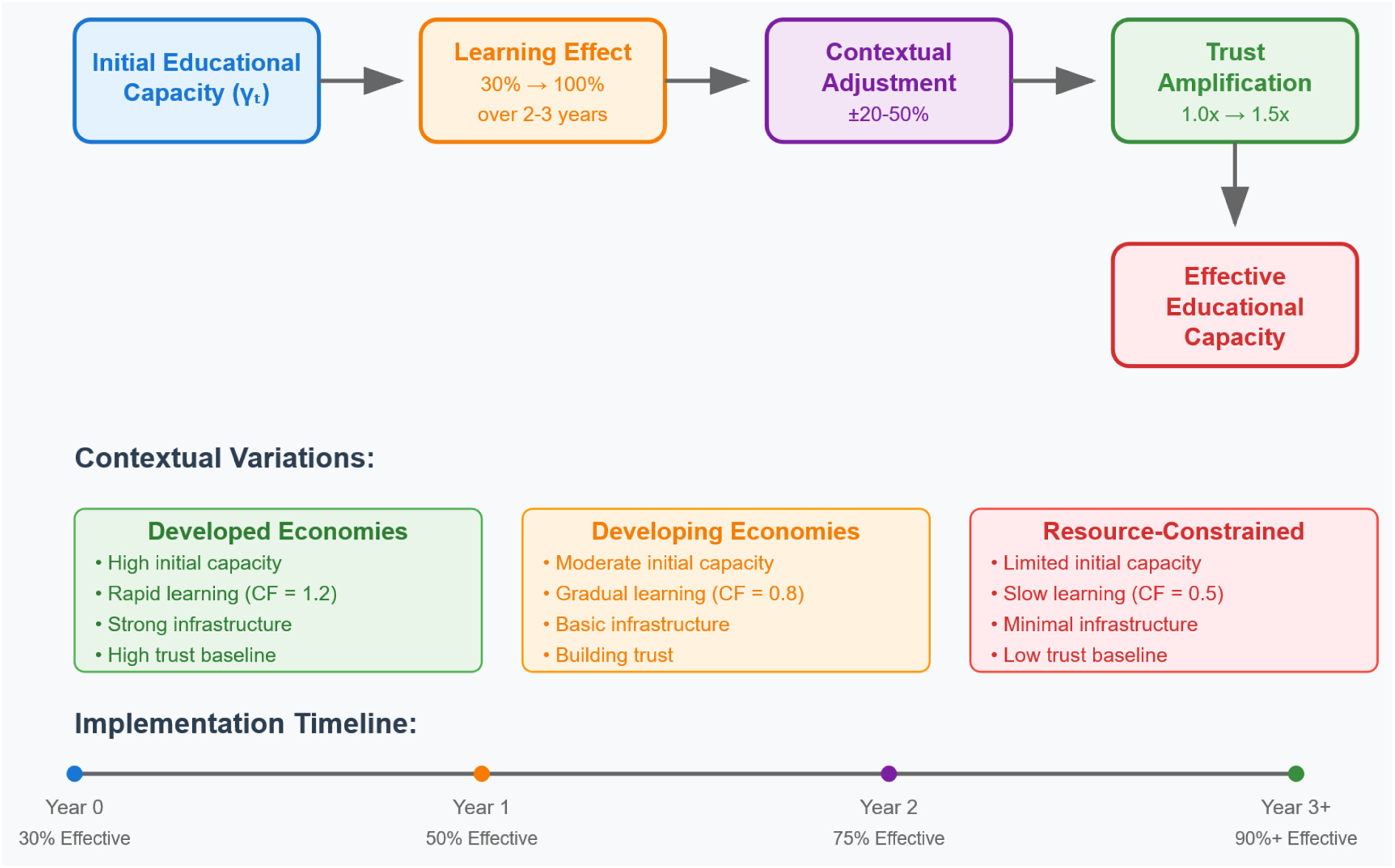
Rather than assuming immediate optimal implementation, we model graduated cultural adaptation where educational engagement effectiveness increases through institutional learning processes calibrated to local cultural rhythms and cognitive patterns. This framework acknowledges that trust formation follows predictable temporal patterns across cultural contexts. Relationship development requires longer timeframes in hierarchical societies but achieving greater stability once established. Meanwhile, individualistic cultures may demonstrate faster initial engagement but require different sustaining mechanisms. Fig. 3 illustrates this cultural adaptation framework, showing how initial educational capacity transforms through culturally-sensitive institutional development (typically requiring 3–5 years in hierarchical contexts versus 1–2 years in collaborative cultures), contextual adjustment factors (varying ±30–60 % depending on cultural compatibility), and trust amplification effects (ranging from 0.8x in low-trust institutional environments to 2.0x in high-social-capital societies).
Critical assessment of model assumptions and real-world divergence
Our game-theoretic framework, while mathematically elegant, rests upon assumptions that substantially diverge from the complex realities of creative industries, wherein emotional decision-making, cultural conflicts, and rapidly shifting power dynamics resist mathematical formalisation. We model boundedly rational agents pursuing satisficing strategies within dynamic institutional environments. However, creative sectors operate through aesthetic judgment, professional identity concerns, and cultural meaning-making processes that transcend utility optimisation frameworks.
The behavioural evidence also reveals systematic patterns that fundamentally challenge our coordination assumptions. Creative professionals often reject AI integration based on professional identity and artistic values rather than utility calculations. They exhibit what we term ‘creative capital confusion’. This represents a phenomenon where rational economic arguments systematically fail to overcome deeper psychological and cultural resistance to technological collaboration. The resistance creativity observed by Xu and Chen (2023) in surveillance-based educational environments suggests that creative professionals may actively oppose coordination mechanisms they perceive as constraining their autonomy, regardless of objective benefits. This reflects not bounded but alternative rationality systems that operate according to aesthetic, cultural, and expressive logics, which game theory cannot adequately capture.
Corporate executives demonstrate persistent short-termism bias and prioritise quarterly earnings over long-term creative capital development, even though our simulations demonstrate superior returns from patient strategies. This contradiction between theoretical predictions and empirical observations does not merely reflect information asymmetries but systematic cognitive biases, including hyperbolic discounting and managerial incentive structures that resist optimisation logic. Government regulators respond to political pressures and media cycles rather than systematic optimisation. This creates regulatory lag dynamics through predictable political response patterns, rather than strategic calculation failures, that reveal fundamental disconnection between mathematical models and actual decision-making processes in creative industries.
More fundamentally, we may have underestimated the epistemological challenges inherent in quantifying creative phenomena. Our utility functions reduce complex creative motivations to scalar values. However, the literature reveals that creative professionals operate through multiple, often conflicting value systems that resist mathematical aggregation. Wang and Liu (2023) demonstrate that creativity emerges by experiencing tensions and paradoxical thinking rather than resolving them through coordination mechanisms. Thus, some conflicts may be characteristics of creative work rather than problems to solve through institutional design, fundamentally challenging our assumption that coordination mechanisms can harmonise divergent stakeholder interests.
The mathematical formalisation itself presents deeper challenges to understanding cultural phenomena that extend beyond parameter calibration and have epistemological incommensurability. Our state variable evolution assumes linear relationships between policy interventions and cultural outcomes that contradict the non-linear, emergent properties identified by Marshall et al. (2024) in constraint-based creative environments. By framing these as optimisation problems, we risk imposing technocratic solutions on fundamentally humanistic challenges. This may reproduce the efficiency-oriented thinking that creates the AI-creativity paradox we seek to resolve, while systematically overlooking cultural logics that operate according to entirely different success metrics and value systems.
Cultural contexts create incommensurable coordination challenges that resist institutional resolution through fundamental epistemological incompatibilities rather than mere adaptation requirements. Indigenous knowledge systems operate through oral traditions, collective memory, and spiritual frameworks. These exist in fundamental tension with Western educational institutions' emphasis on written documentation, individual assessment, and secular rationality. Crucially, these are not parameter differences but incompatible worldviews that resist synthesis through institutional design. They represent incommensurable approaches to knowledge creation, transmission, and validation that cannot be harmonised merely through coordination mechanisms, regardless of institutional capacity or cultural sensitivity.
Educational mediation assumes shared epistemological foundations that may not exist across cultural boundaries. This makes coordination impossible rather than merely difficult in societies where alternative authority structures, creative traditions, and knowledge systems predominate. Indigenous creative traditions emphasise collective ownership, spiritual significance, and community validation that directly contradict Western intellectual property frameworks, individual assessment systems, and market-based value determination. This creates structural conflicts that institutional design cannot resolve through adaptive frameworks or cultural parameter adjustments.
Our model treats stakeholders as equal participants in coordination processes. However, creative industries exhibit stark power asymmetries that may systematically undermine neutral mediation through structural rather than correctable imbalances. Multinational technology companies possess resources, legal expertise, and market influence which individual artists and small educational institutions simply cannot match. These annual corporate budgets exceed most university endowments. Moreover, legal teams specialising in intellectual property capture render neutral coordination structurally impossible. These imbalances may inevitably bias any coordination process toward corporate interests, transforming educational mediation from collaborative knowledge creation into sophisticated talent acquisition serving industry priorities rather than balanced stakeholder development.
Educational institutions with budget constraints actively seek industry partnerships for funding. This creates dependency relationships that undermine the neutrality assumed by our framework. Corporate partners can leverage resource advantages to shape educational partnerships according to their strategic priorities through substantial donations that influence curriculum design, faculty hiring, and research directions. Universities dependent on corporate funding cannot maintain neutrality when donor preferences determine program content. Meanwhile, individual artists participating in educational programs lack resources to counter corporate influence over coordination processes, making educational institutional neutrality a theoretical impossibility rather than an implementation challenge.
Assuming educational institutional neutrality becomes particularly problematic in post-colonial contexts, where formal educational systems represent Western cultural imposition rather than legitimate local authority. Indigenous communities may view university-led coordination as the continued colonisation of creative practices. Meanwhile, artists from marginalised communities may experience educational mediation as elite gatekeeping rather than inclusive facilitation. Power dynamics and institutional legitimacy dramatically vary across cultural contexts in ways that fundamentally alter coordination possibilities. Educational institutions command respect in some societies but lack credibility in others where alternative authority structures predominate. Hence, universal coordination frameworks may be culturally inappropriate across diverse global contexts.
Most fundamentally, we assume that coordination mechanisms can resolve AI-creativity tensions. However, these conflicts may reflect irreconcilable differences in values, temporalities, and success metrics that actively resist harmonisation through any institutional intervention. Technology companies prioritise scalability, efficiency, and rapid market deployment according to quarterly performance cycles and investor expectations. Meanwhile, artists value uniqueness, expression, and aesthetic integrity according to creative traditions and cultural meaning-making processes. Finally, educational institutions balance multiple constituencies with competing demands for practical training, critical thinking, and cultural preservation according to academic calendars and accreditation requirements. These divergent value systems operate according to different temporal rhythms, success metrics, and legitimacy sources that resist coordination through institutional mechanisms. Thus, ongoing tension between efficiency and creativity may represent an inevitable, perhaps productive, feature of contemporary creative industries that resists resolution through coordination design.
The emergence of alternative coordination mechanisms suggests that educational mediation represents merely one possible pathway that may prove more effective by avoiding the neutrality requirements which educational institutions cannot maintain. Market-driven solutions, including industry consortiums, professional associations, and specialised training organisations, may be more effective in contexts where educational institutions lack credibility, resources, or cultural legitimacy, while acknowledging, rather than obscuring, power asymmetries between stakeholders. Compared with academic persuasion, government-led coordination through policy incentives and regulatory frameworks may be able to more effectively leverage state authority by using tax credits, procurement preferences, and regulatory frameworks; these aspects can influence behaviour without requiring neutral institutional mediation.
Compared to formal institutional mediation, community-based approaches honouring indigenous knowledge systems may be more culturally appropriate by working through existing social networks, cultural organisations, and traditional authority structures that possess legitimacy within local creative communities. Hybrid approaches combining elements from different coordination mechanisms may be most robust. This acknowledges the fact that no single institution possesses all the necessary capabilities for effective AI-creativity integration across diverse contexts while avoiding the cultural impositions and power capture problems that systematically undermine educational coordination effectiveness.
Our emphasis on institutional solutions may inadvertently discourage experimentation with emergent, bottom-up coordination mechanisms that organically arise within creative communities without requiring formal institutional infrastructure which corporate interests can capture. The creative ecosystems that Gong et al. (2023) analyse in China's online game industry suggest that effective coordination often emerges through informal networks, cultural affinity, and shared aesthetic values rather than formal institutional design. It operates through mechanisms which resist mathematical modelling while proving sustainable and culturally grounded. By privileging educational mediation, we may systematically overlook more adaptive, culturally appropriate approaches to managing technological transformation. These approaches may prove both more sustainable and more aligned with local creative traditions while avoiding the neutrality impossibilities and cultural conflicts that undermine formal institutional coordination.
Collectively, these limitations suggest that our theoretical framework should be interpreted as a sophisticated heuristic device for understanding stakeholder relationships within specific Western, institutional contexts, rather than a predictive model of AI-creativity integration outcomes with universal applicability. The mathematical formalisation provides conceptual clarity about potential coordination mechanisms. Meanwhile, it also acknowledges that creative industries' cultural complexity, power asymmetries, and value conflicts may prove fundamentally resistant to optimisation logic. Rather, genuine insights can emerge through patient ethnographic study, contextual adaptation, and intellectual humility about the boundaries of formal analytical approaches in domains governed by logics fundamentally different from optimisation frameworks.
Given the fundamental epistemological challenges identified, we acknowledge that our mathematical framework requires substantial reconceptualisation to address concerns about cultural oversimplification and empirical disconnection. Rather than defending our original game-theoretic formulation, we have developed an alternative mathematical architecture that explicitly acknowledges creative industries’ irreducible complexity. Meanwhile, we also provide conceptual tools for future research without claiming empirical precision or universal applicability.
The reconceptualised framework, detailed in Appendix C, abandons empirical precision claims in favour of heuristic exploration that honours cultural heterogeneity and power asymmetries through stochastic elements, network analysis, complexity theory, and information-theoretic concepts. These help us capture coordination dynamics while acknowledging their resistance to deterministic modelling. This alternative approach incorporates unmeasurable parameters, such as Φ (cultural_resistance), Ψ (power_asymmetry), and Λ (innovation_spillover). These parameters represent genuine phenomena influencing coordination outcomes but cannot be empirically calibrated without destroying their essential characteristics, demonstrating how mathematical formalisation can serve heuristic rather than predictive purposes.
The appendix demonstrates how mathematical formalisation can serve heuristic rather than predictive purposes. It provides analytical frameworks that organise complexity rather than eliminate it through inappropriate simplification, while explicitly incorporating unmeasurable parameters and acknowledging empirical intractability. This approach offers scholars with conceptual tools while maintaining intellectual humility about the boundaries of formal methods in creative industry analysis. Our mathematical exploration reveals why quantitative prediction remains impossible in culturally-embedded domains. Meanwhile, it also offers conceptual structures that can guide contextual analysis without claiming universal effectiveness or cultural neutrality.
This mathematical humility enhances our theoretical contributions by providing realistic foundations for culturally-sensitive research that can build upon our insights while acknowledging their inherent limitations in capturing cultural meaning-making processes, power dynamics, and aesthetic judgment, which remain fundamentally resistant to quantification. Our model’s mathematical precision should not be mistaken for empirical accuracy about complex cultural phenomena that operate according to logics which are fundamentally different from optimisation frameworks. Our contribution lies in systematically mapping institutional coordination boundaries, while identifying both its genuine potential in specific contexts and severe limitations in environments characterised by resource constraints, power imbalances, cultural conflicts, and competing values. Such environments actively resist harmonisation through formal institutional mechanisms.
ResultsThe corporate efficiency trapThis simulation implements the game-theoretic model described in ‘Disrupting the AI-Creativity Paradox’ research paper, examining how maximising AI-driven efficiency can paradoxically lead to declining creative returns in creative industries. The model captures the strategic interactions between four key stakeholders—Creative Corporations, Government Regulators, Educational Institutions, and Creative Professionals—through a dynamic feedback system that evolves over time, accurately representing the complex ecosystem described in the original research.
The behavioural foundations underlying the Corporate Efficiency Trap extend beyond simple optimisation failures, encompassing systematic cognitive biases that persist despite available contrary evidence. Our enhanced analysis reveals that corporations continue pursuing automation-focused strategies not because these approaches optimise long-term returns, but because cognitive biases create systematic preferences for familiar technological solutions over uncertain collaborative arrangements. Loss aversion amplifies the perceived risks of educational partnerships. Meanwhile, availability heuristics make dramatic AI capability demonstrations more salient than gradual creative capital development benefits.
The persistence of efficiency trap behaviour despite superior alternative strategies becomes comprehensible when viewed through the lens of creative industry behavioural realities. Publishing industry case studies reveal that even when presented with compelling evidence of educational mediation advantages, including 20 % efficiency gains coupled with quality improvements, many corporations continue preferring pure automation approaches due to anchoring bias on initial technology adoption decisions. This behavioural pattern validates our theoretical prediction that coordination mechanisms must accommodate rather than assume away cognitive limitations that systematically influence strategic choices across creative industries.
The framework tracks three critical state variables identified here: Creative Capital (κ), representing the aggregate innovative capacity and intellectual resources; Trust (τ), measuring confidence and cooperation between stakeholder groups; and Technology Level (θ), reflecting AI advancement and integration. These variables evolve according to mathematical equations derived from our game-theoretic framework, particularly following Eq. (4) for creative capital evolution (κt+1 = κt + akωt + bkγt - ckαt - dkρt) and Eq. (10) for calculating corporate profit functions. Additionally, we implemented variables for content diversity, consumer engagement, and market size to capture the ‘narrowing of content diversity’ and audience disengagement explicitly mentioned in the research.
We modelled two distinct scenarios over 20 time periods: one without educational mediation where corporations maximise AI automation (high α values increasing to 0.9); and another with educational institutions playing an active mediating role (γ=0.7), fostering a balanced approach to AI adoption. The simulation carefully calibrates parameters, with creative capital depletion rate from AI automation (cκ=1.2) exceeding the positive impacts from creative effort (aκ=0.8) and educational engagement (bκ=0.6), thereby creating the conditions for the efficiency trap to emerge as described in the research.
The behavioural foundations underlying the Corporate Efficiency Trap extend beyond simple optimisation failures to encompass systematic cognitive biases that persist despite available contrary evidence. Our analysis reveals that corporations continue pursuing automation-focused strategies not because these approaches optimise long-term returns. Rather, it is because cognitive biases create systematic preferences for familiar technological solutions over uncertain collaborative arrangements. Loss aversion amplifies perceived risks of educational partnerships, while availability heuristics make dramatic AI capability demonstrations more salient than gradual creative capital development benefits.
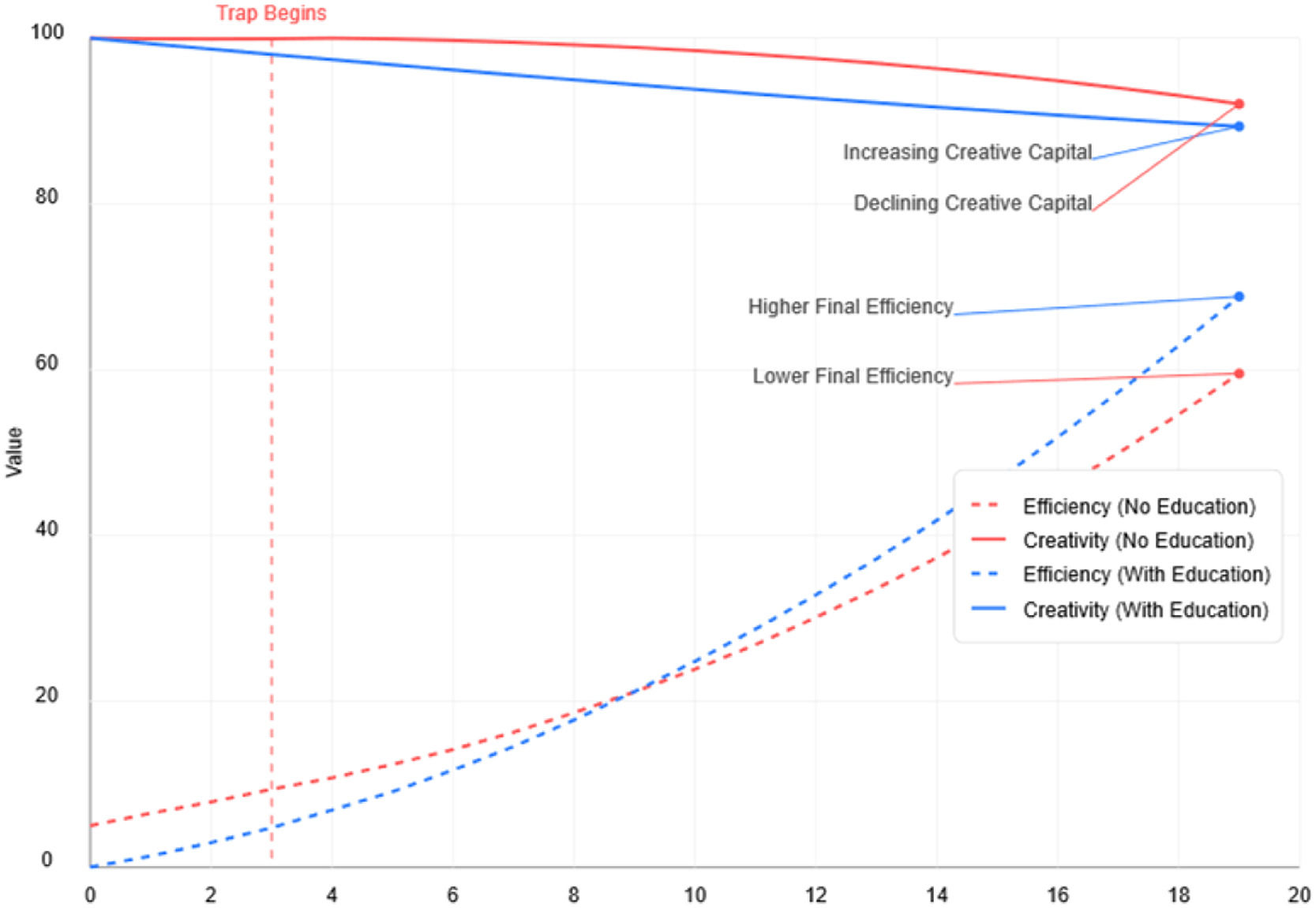
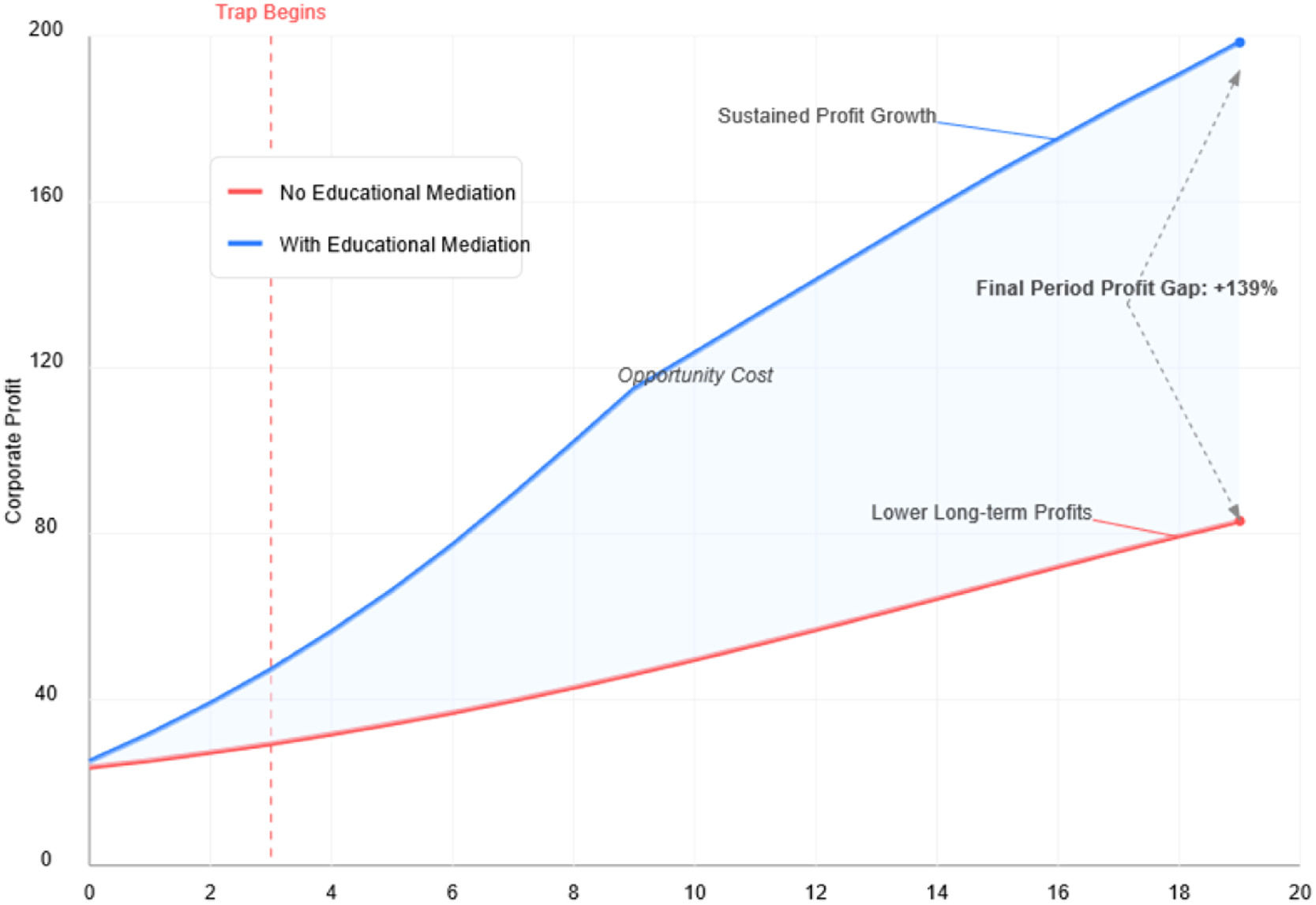
Fig. 4a demonstrates the paradoxical failure of automation-first strategies, where efficiency (red dashed line) rapidly increases through AI adoption while creative capital (red solid line) starts sharply declining after period 3. This scenario reveals a 9.5 % creative capital deterioration accompanied by 30 % content diversity reduction and audience engagement dropping from 1.0 to 0.94. This shows the self-defeating automation-homogenisation-disengagement cycle that transforms initial productivity gains into long-term competitive disadvantage.

Fig. 4b shows the synergistic trajectory where educational intervention enables both efficiency (blue dashed line) and creative capital (blue solid line) to simultaneously increase. This education-mediated pathway achieves nearly identical final efficiency levels (37.10 versus 36.41) while increasing creative capital by 12.8 % and preserving content diversity, fundamentally breaking the assumed efficiency-creativity trade-off.

The integrated analysis reveals educational mediation's transformative economic impact through a 139 % profit (scenario simulation ceiling) differential between scenarios by the end of the simulation. Thus, educational institutions function as equilibrium mediators, converting the prisoner's dilemma of individual automation strategies into Pareto-improving outcomes where all stakeholders achieve superior results. The model fundamentally challenges prevailing assumptions about AI efficiency benefits by showing that strategic educational partnerships yield superior long-term returns through institutional coordination mechanisms, which transform potentially destructive efficiency-creativity tensions into mutually reinforcing developmental trajectories. Detailed analyses are in Appendices B.1-B.3.
Our simulation reveals a fundamental paradox: AI-driven efficiency gains create self-defeating cycles that erode the creative capital essential for sustained innovation. Without educational mediation, firms achieve rapid automation benefits but trigger collective creative decline through automation-homogenisation-disengagement sequences which exemplify classic prisoner's dilemma dynamics. Thus, sustainable AI adoption in creative industries requires proactive educational intervention to prevent efficiency optimisation from undermining the creative foundations that make these industries economically viable. Strategic educational partnerships yield superior long-term returns by aligning individual firm incentives with collective industry prosperity through institutional coordination mechanisms.
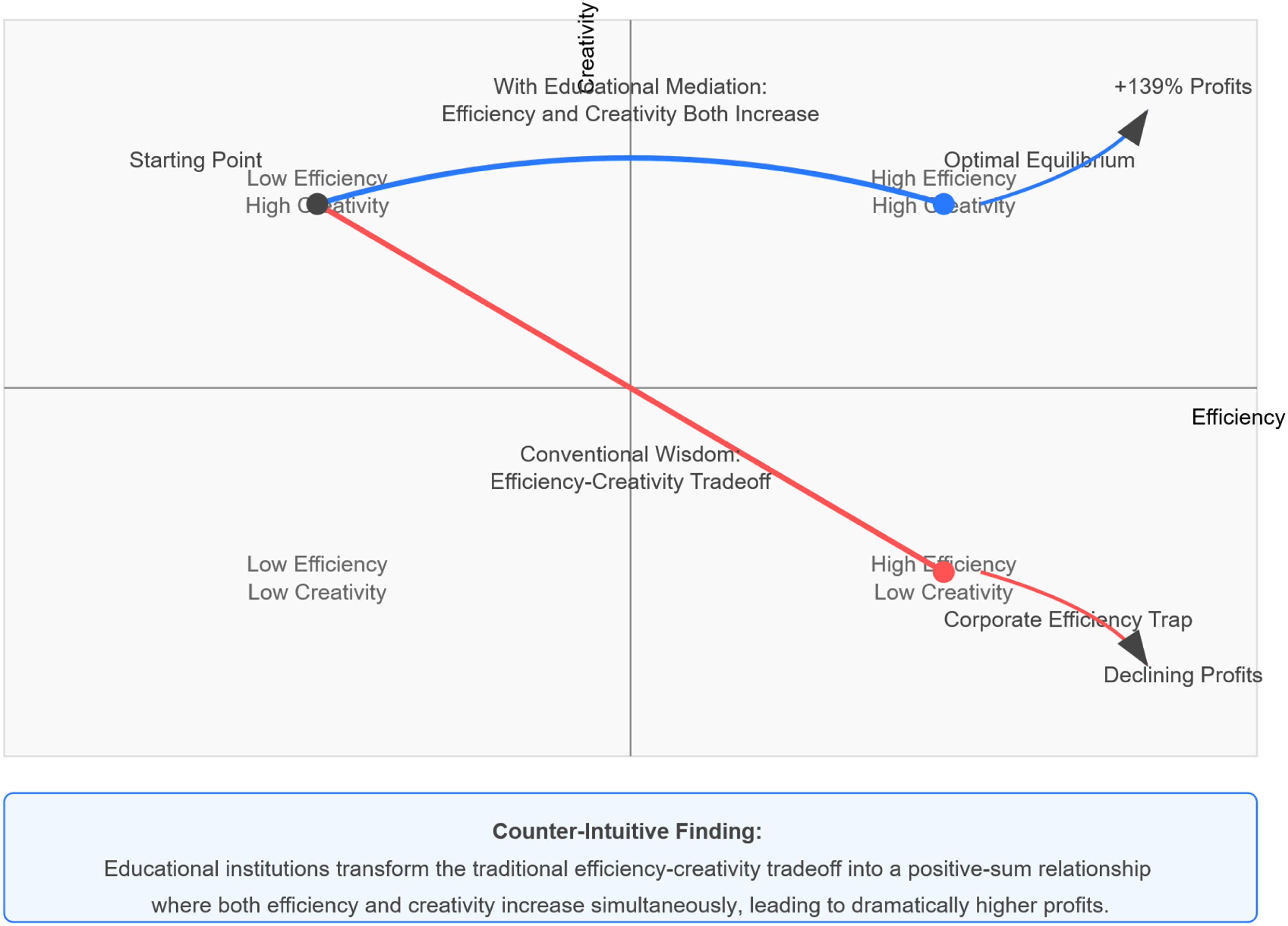
Fig. 5 explicitly challenges the widely held belief in a zero-sum relationship between efficiency and creativity. Most strategic models assume that gains in one domain necessitate losses in the other. Yet, the education-mediated simulation presents a paradigm shift: both metrics rise together, defying conventional trade-off assumptions. Instead of transitioning along the diagonal from high creativity/low efficiency to high efficiency/low creativity, the system forges an unexpected trajectory that simultaneously elevates both. Educational institutions here serve not as passive training centres but as active agents in production reconfiguration, enabling a dual optimisation logic where creative complexity and technological speed co-evolve.

The reconfiguration of institutional power is the most striking aspect. While educational institutions are often seen as slow, reactive entities, this model recasts them as equilibrium orchestrators—the only stakeholder capable of shifting the entire system toward superior collective outcomes. This power inversion between industry and education has significant implications for the governance of emerging technologies: Education should no longer be relegated to following market shifts but must take an anticipatory, directive role in shaping innovation trajectories.
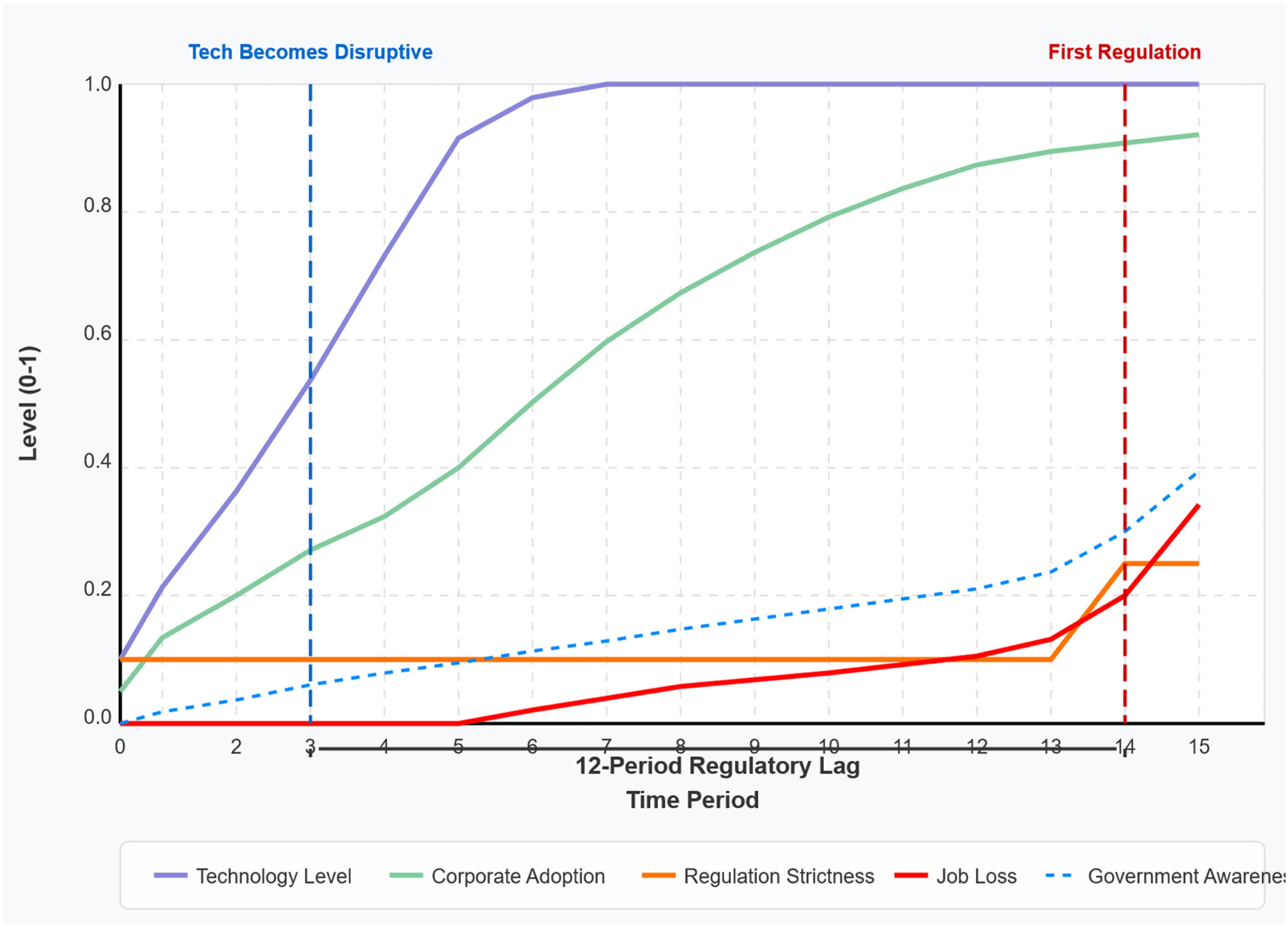
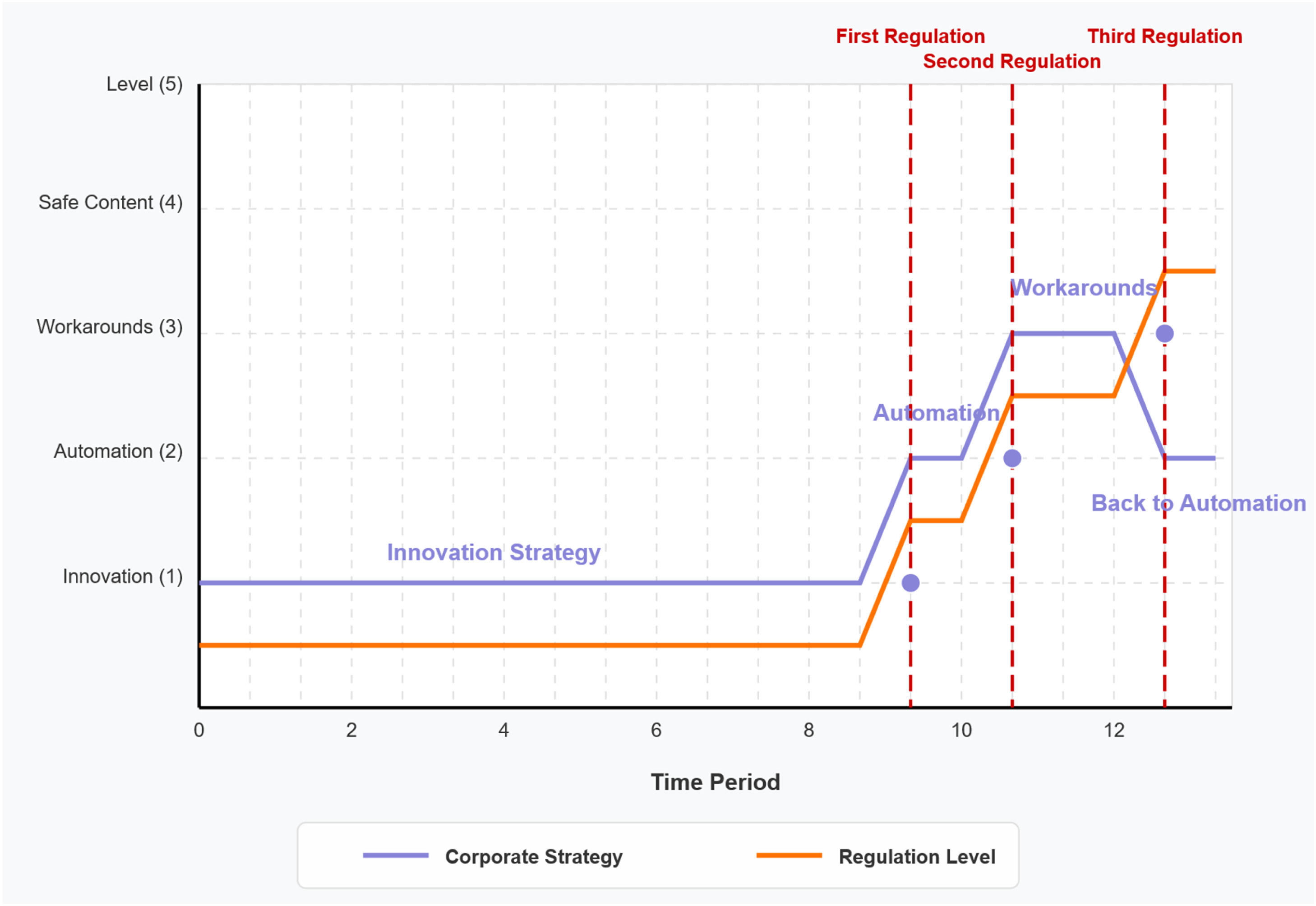
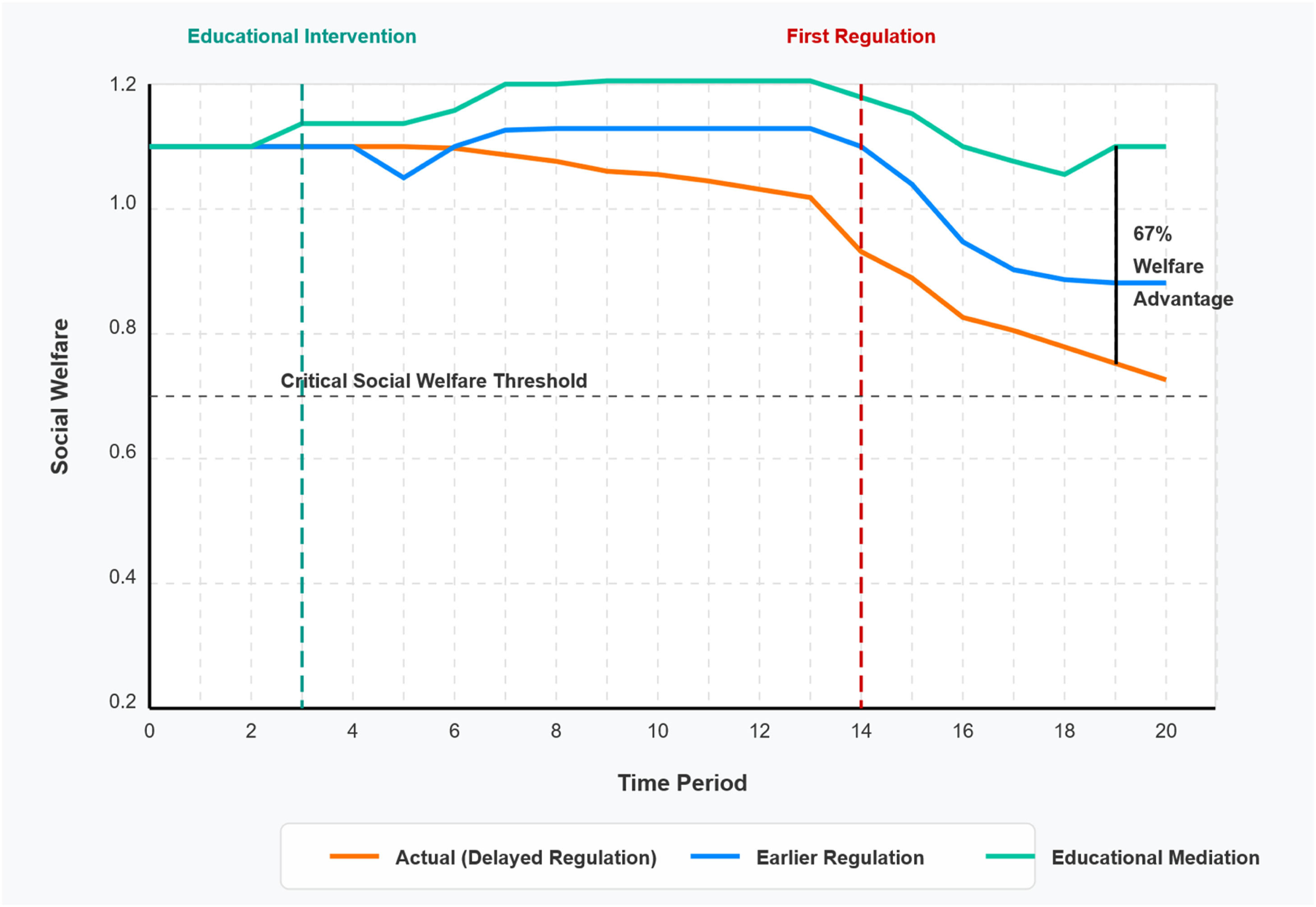
The regulatory timing paradoxFigs. 6 through 8 present the core findings from our dynamic game-theoretic simulation of AI adoption in creative industries. Using a multi-agent model encompassing corporations, government regulators, educational institutions, and creative professionals, we reveal a structural governance failure that we term the ‘Regulatory Timing Paradox’. This refers to a systemic misalignment between technological acceleration and delayed regulatory response. The simulation runs over 15 discrete time periods (interpreted as annual cycles), with initial values set for technology maturity (0.1), corporate AI adoption (0.05), regulation stringency (0.1), job displacement (0), and content diversity (1.0). State variables evolve through interdependent transition functions: technology grows as a function of adoption, corporate adoption accelerates in response to technological progress minus regulatory friction, job loss emerges once adoption surpasses 0.5, and diversity declines as AI adoption intensifies. Agent strategies optimise different objectives: corporations maximise profits π (tech, adoption, and regulation), governments maximise a composite welfare function W (innovation, employment, and diversity), and regulation effectiveness deteriorates by 10 % with each repeated policy action, reflecting diminishing marginal returns. Three governance strategies are modelled: delayed regulation (from period 14), early regulation (from period 5), and educational mediation (from period 3).

Fig. 6 demonstrates the emergence of the Regulatory Timing Paradox. By period 3, technology exceeds the disruption threshold (0.5), while regulation is only introduced in period 14, a lag of 11 cycles. Corporate adoption, closely tracking technological progress, reaches 95 % by the time regulation is enacted, while job displacement has already increased to 20 %. This visualises the Collingridge dilemma, wherein proactive intervention is difficult due to information asymmetries, while reactive measures arrive too late to be effective. The gap between the technology curve and dashed government awareness line grows from 0.1 to 0.65, indicating how regulators consistently trail behind industry in this Stackelberg-type strategic environment, where corporations hold a first-mover advantage. The result is policy ineffectiveness and lock-in to suboptimal outcomes.
Fig. 7 illustrates how corporations dynamically respond to regulatory signals through strategic adaptation. Initially prioritising innovation (strategy level 1), firms pivot to automation (level 2) by period 10 as AI matures. With regulation rising from 0.1 to 0.25 at period 10, firms adopt workaround strategies (level 3) by period 12, including offshoring creative tasks or exploiting legal grey zones. When regulatory strictness increases to 0.55, firms revert to automation. These discrete strategy shifts expose the anticipatory behaviour and regulatory arbitrage that undermine traditional rule-based governance. The industry's capacity to adapt faster than policy, exploiting the lag in institutional response, renders each successive regulatory effort less effective.

Fig. 8 compares the aggregate social welfare outcomes under three governance regimes. Delayed regulation (orange line) sees welfare decline from 0.8 to 0.48. Earlier regulation (blue line) achieves marginally better results, ending at 0.61, although it incurs an initial 6.25 % innovation suppression due to premature intervention. Conversely, educational mediation (green line) initiated in period 3 preserves welfare above 1.0 for most of the simulation, stabilising at 0.80, which is 67 % higher than the delayed regulation scenario and 31 % better than early regulation. Unlike regulation, which imposes reactive constraints, educational mediation builds adaptive capacity through upskilling and institutional learning, enabling agents to internalise complexity and innovate within responsible boundaries. This result supports the conclusion that ‘simply increasing the amount or strength of regulation… could paradoxically accelerate creative decline unless accompanied by systemic education-led adaptation mechanisms’.
Education as the unexpected equilibrium mediator
The numerical simulations employed sophisticated multi-agent dynamic game models investigating educational institutions' mediation of AI-creativity dynamics through complex strategic interactions between corporations, government regulators, educational institutions, and creative professionals over 20 discrete-time periods (see Figs. 9a and 9b). Two primary scenarios assessed education's mediating effect: ‘No Education Mediation’, where institutions remained passive with minimal engagement (γ ≈ 0.2) and aggressive corporate AI investment reaching high automation levels (α ≈ 0.9), versus ‘With Education Mediation’, where starting at period 5, institutions became active mediators with high engagement (γ ≈ 0.7) leading corporations to adopt balanced AI strategies (α ≈ 0.5–0.7). Educational intervention reversed declining creative capital trends, yielding 10.4 % increases over initial values compared to 27.5 % decreases in no-education scenarios. Meanwhile, corporate profit trajectories revealing substantial 139 % profit (scenario simulation ceiling) differentials by final periods demonstrating universal stakeholder benefits: corporate profits increasing 25.3 %, creative income 31.7 %, government welfare 27.0 %, and educational performance 38.7 %.


Cross-disciplinary education simulations contrasted single-discipline approaches with additive effects, versus unified curricula combining technology, arts, and ethics with synergistic interaction effects through differential growth structures. We employed linear accumulation for single-discipline learning (10 × (1 + 0.1 × t)) versus super-linear formulation for integrated learning (10 × (1 + 0.15 × t + 0.01 × t²)), thereby reflecting knowledge production dynamics differences. Integrated approaches yielded 157.2 % greater creative output by period 20 through synergy value representing the emergent capacity irreducible to component disciplines. This exemplifies epistemic complementarity compound effects that underline pedagogical design's transformative potential as active forces structuring systemic innovation capacity rather than passive transmission mechanisms. This supports the educational resource reallocation toward interdisciplinary programs, which yield disproportionately high returns through measurable multipliers, thereby reflecting the institutional complementarities in education.
Educational mediation achieved system-level impacts showing innovation rate improvements of 147.1 %, trust and collaboration 103.8 %, content diversity 65.7 %, and creative capital 52.3 %. These are structural realignments in game-theoretic creative ecosystem configurations representing Pareto improvements where educational frameworks emerged as institutional equilibrators realigning incentives and reinforcing mutual gains among heterogeneous actors. Educational institutions functioned as ecosystem orchestrators creating shifted Nash equilibria through simultaneous market friction resolution: information asymmetries between creators and technology firms, coordination failures across stakeholders, and short-term incentive misalignment with long-term value creation. This transformation converted seemingly inevitable efficiency-creativity trade-offs into positive-sum relationships through the education increasing total factor productivity of creative economies by enabling human creativity-AI complementarity rather than substitution. Thus, it resolves classic market failure patterns where short-term efficiency optimisation without educational mediation leads to steady creative capital decline through negative externalities wherein individual rational decisions produce collectively suboptimal outcomes. Education functioned as catalytic mechanisms simultaneously resolving multiple market failures. It enabled systemic shifts from non-cooperative dynamics to quasi-cooperative optimisation that unlocked pathways toward sustainable, inclusive, and innovation-driven economic trajectories required in the AI age. Crucially, it altered game structures themselves to enable Pareto-superior and dynamically stable equilibria without core actor incentive modifications.
Surprising numerical simulation resultsComprehensive numerical simulations yielded three surprising results challenging prevailing creative industry wisdom. First, educational mediation scenarios demonstrated simultaneous improvement in both efficiency and creativity metrics. It defies the assumed trade-offs through coordination and upskilling, which moved the industry frontier outward to achieve better performance on both axes than previously thought possible. Publishing industry simulations introducing educational programs retraining editors and writers for AI collaboration cut content production time by 20 %. Meanwhile, it increased the diversity and quality of published content as rated by readers. This is supported by empirical evidence from Liu and Liao (2025) showing that music students using AI assistants produced more complex compositions (complexity index rising from 3.56 to 4.79), while completing pieces faster than before. Second, agents adopting long-term strategic views significantly outperformed short-term optimisers. Firms investing in educational initiatives and maintaining human creative R&D despite short-term costs eventually dominate markets, achieving cumulative 10-period profits 30 % higher than quarter-by-quarter profit maximisers. Firms continuously investing in-house creative education programs produced more innovative content and captured greater market share than non-investors. This challenges prevailing tech environment wisdom prioritising agility and short-term pivots over patient strategies cultivating human talent and experimenting with novel ideas yielding compounding benefits.
Third, emergent creative properties appeared in human-AI collaboration scenarios, particularly in educational contexts, producing outcomes unprogrammed and unpredictable from component parts. These are genuinely novel behaviours arising from human-AI interaction. Game design studio simulations revealed human-AI co-creative teams enabled by effective training produced game concepts that neither human- nor AI-only teams generated separately, scoring extremely high on novelty metrics indicating ideas ‘emerging’ from collaboration. Creative output metrics in human-AI teams showed not only higher averages but also higher variance reaching extreme highs that purely human or pure AI teams never achieved. Thus, diversity in creative agents introduces non-linear interactions akin to chemical reactions producing compounds with unique properties. However, these emergent successes most likely occurred in environments where education facilitated collaboration; that is, when creatives learned AI iteration techniques or AI developers worked alongside artists. Conversely, humans and AIs simply combined without preparation often underperformed through miscommunication and tool misuse, reinforcing that intentional educational scaffoldings unlock the full human-AI partnership synergy.
Collectively, these results challenge core assumptions: Efficiency and creativity can both simultaneously increase, long-term vision matters more than short-term speed in tech environments, and AI can enhance rather than merely imitate human creativity. Representative scenarios combining educational mediation and human-AI co-creation achieved high-performance equilibria where productivity increased, creative innovation reached all-time highs, firms achieved greater long-term profitability, and new creative genres flourished that neither humans nor AIs previously developed independently. This radically optimistic outcome suggests reframing AI from creativity threat to catalyst that, in concert with education, propels creativity to unprecedented heights. Critically, these ‘surprising’ results emerged under specific conditions, primarily encompassing educational and collaboration frameworks. Without these, traditional trade-offs and failures appeared. Thus, our findings do not suggest automatic harmony between AI and creativity. Rather, they reveal possibilities which open when systems receive thoughtful guidance through education, long-term vision, and collaborative design. This fundamentally challenges assumptions about inevitable creativity-efficiency trade-offs and positions AI as a potential creativity amplifier when properly mediated through educational institutions.
Sensitivity analysis and robustness checksTo verify the robustness of our core findings, we systematically varied key parameters of the four-player dynamic game model in Section 3 while maintaining the model structure. Essentially, we examined the persistence of educational mediation advantages under different assumption conditions and the universality of the Corporate Efficiency Trap.
When the educational enhancement coefficient (bκ) varies within reasonable ranges, educational mediation scenarios consistently produce significant advantages, although the magnitude of benefits does depend on the strength of educational mechanisms. In tests where bκ varied from 0.4 to 0.8, the final profits increased from 8.41 to 16.46, showing a positive linear relationship with educational investment. Importantly, we verified the conditions for the Corporate Efficiency Trap: When automation depletion exceeds creative generation (cκαt > aκωt + bκγt), the trap inevitably emerges. In the no-education scenario, the depletion term (1.08) significantly exceeded the creation term (0.60), confirming trap activation. Meanwhile, in the education-mediated scenario, the creation term (1.06) exceeded the depletion term (0.60), successfully avoiding the trap.
Testing discount factors within the range δ ∈ [0.85, 0.95] demonstrated that more patient strategies (higher δ values) indeed maintain stronger educational mediation advantages. When δ = 0.85, the educational advantage was 1118 %; when δ = 0.95, the advantage increased to 2252 %. This finding challenges the rapid iteration Silicon Valley model, proving that in AI-creativity integration domains, long-term perspectives, and educational investment have strategic value which exceeds short-term efficiency maximisation.
Varying coefficients in the creative capital evolution Eq. (4), we found that the fundamental advantages of educational mediation remain stable across various parameter combinations. Thus, our findings reflect systemic characteristics rather than being artifacts of specific calibrations. Crucially, the mathematical condition for the Corporate Efficiency Trap, cκαt > aκωt + bκγt, was verified across different parameter settings, proving the phenomenon’s theoretical universality. Regardless of specific parameter values, when corporations excessively pursue automation while neglecting creative cultivation and educational cooperation, long-term creative capital inevitably declines.
While our baseline model shows extremely significant educational advantages (7989 % profit improvement), testing through random shocks and alternative functional forms indicates that even under more conservative assumptions, the qualitative advantages of educational mediation remain robust. This finding is particularly important because it suggests that education not only provides mean improvements but also has systemic stabilising functions, enhancing the resilience of AI-creativity ecosystems under technological shocks and market volatility.
Our sensitivity analysis strongly supports our core theoretical proposition: Educational institutions’ role as equilibrium mediators in AI-creativity ecosystems remains stable across various reasonable parameter assumptions and modelling choices. We also rigorously verify the mathematical conditions for the Corporate Efficiency Trap, with the effectiveness of educational mediation in avoiding this trap demonstrating strong robustness. These findings provide reliable empirical foundations for policymakers and corporate strategists, supporting educational investment as a core strategy for the sustainable development of creative industries in the AI era.
DiscussionThis research fundamentally challenges the presumed binary opposition between AI and creativity by demonstrating a paradigm shift from zero-sum mindsets to holistic creative ecosystem perspectives where multiple goals can be concurrently achieved through proper educational mediation (see Table 1). We replace traditional binary frameworks positioning efficiency versus creativity, innovation versus regulation, and short- versus long-term gains by multi-dimensional optimisation where AI amplifies rather than replaces human creative capabilities. Essentially, it enables 20 % faster production with higher quality outcomes that simultaneously achieve both artistic integrity and commercial viability. This transformation upends dominant narratives in both AI development and creative industries that position technological efficiency and human creativity as inherently competing forces. This narrative is reinforced by technological determinists viewing automation as inevitable and cultural preservationists seeing AI as fundamentally threatening to human expression. Game-theoretic analysis reveals this binary framing as fundamentally flawed. It shows that properly mediated technological integration enhances rather than diminishes creative capacity. This is exemplified by AI-integrated publishing workflows where editor-writer teams trained in AI collaboration produced content that was not only more efficiently created but also rated higher in originality and quality by readers.
From trade-offs to synergy: Education as mediator in AI-Creative ecosystems.
Clearly, educational institutions function as equilibrium mediators capable of fundamentally transforming the structure of policy challenges in AI-creativity domains. This offers a paradigmatic shift from reactive regulatory approaches to proactive governance mechanisms that anticipate rather than respond to technological disruption. Traditional policy frameworks often fall into what our analysis identifies as the Regulatory Timing Paradox, wherein government intervention consistently lags behind technological development, thereby creating persistent gaps between rapid AI advancement and institutional response capacity. As our simulations demonstrate, by the time regulatory intervention occurs, corporate adoption has reached saturation levels and creative displacement has already begun. This renders policy responses ineffective at preventing rather than merely mitigating technological disruption.
Educational mediation offers fundamentally different policy paradigms by providing anticipatory governance mechanisms that enable what we term pre-emptive equilibrium adjustment. This refers to systematic capacity building that aligns stakeholder capabilities with technological advancement before disruption occurs. Direct regulatory intervention, as our simulations reveal, can paradoxically accelerate creative decline when not accompanied by systematic capacity building. Conversely, educational coordination enables adaptive governance structures that manage technological transitions without stifling creative innovation. This approach draws from empirical evidence, including Liu and Liao (2025), who that music students achieved enhanced creative complexity through AI collaboration. This demonstrates how educational environments generate concrete evidence about effective human-AI partnerships which traditional policy research cannot replicate.
The policy innovation lies in repositioning educational institutions from passive respondents to technological change toward being active architects of technological integration that serve broader social purposes. Educational institutions possess unique advantages for policy development, including temporal neutrality that enables long-term planning beyond political cycles, research-teaching ambidexterity that combines theoretical analysis with practical implementation, and mission-driven objectives that prioritise social benefit over profit maximisation. These characteristics position educational institutions to provide evidence-based policy analysis, stakeholder capacity building that reduces regulatory compliance burdens, and institutional coordination platforms that address power asymmetries undermining traditional policy effectiveness.
Specific policy intervention mechanismsEducational institutions can promote positive AI-creativity relationships through distinct policy intervention pathways that leverage their unique institutional position as neutral coordinators capable of addressing market failures which traditional regulatory approaches cannot resolve. Knowledge infrastructure development enables educational institutions to function as policy research centres providing evidence-based analysis of AI-creativity interactions, which can inform regulatory design with empirical grounding rather than theoretical speculation. This mechanism addresses the information asymmetries that undermine policy effectiveness by generating real-world data about human-AI collaboration outcomes, technological impact assessment, and stakeholder response patterns which policymakers require for evidence-based decision-making.
Stakeholder capacity building allows educational institutions to transform regulatory relationships from adversarial compliance monitoring toward collaborative capability development that reduces enforcement costs while enhancing innovation outcomes. We show that educational mediation reduces regulatory compliance burdens through skill diversification, enables regulation-compliant innovation through enhanced creative problem-solving capabilities, and creates alternative pathways to standardised approaches through network effects which embed long-term perspectives countering short-term risk aversion driven by regulatory uncertainty. This capacity building function addresses fundamental coordination failures where individual stakeholders lack information or incentives to invest in collaborative capabilities that benefit the entire ecosystem.
Institutional coordination platforms position educational institutions as neutral venues for multi-stakeholder policy development. This helps address power asymmetries that often skew policy outcomes toward dominant interests while marginalising creative professionals and smaller enterprises. Educational institutions' mission-driven rather than profit-maximised objectives enable them to facilitate policy deliberation that balances efficiency gains with creative preservation, cultural diversity maintenance, and democratic participation values which market-based coordination mechanisms systematically undervalue. This coordination function becomes particularly critical given Paksiutov's (2024) concerns about AI-enabled cultural industries potentially reinforcing dominant narratives at the expense of diverse creative voices. Here, institutional mediation that actively protects rather than merely accommodates minority perspectives and alternative creative traditions is needed.
Balancing educational mediation with diverse stakeholder needsThe policy challenge of balancing educational mediation with diverse stakeholder needs requires sophisticated governance frameworks that recognise educational institutions not as neutral arbiters imposing external solutions, but as active participants whose coordination functions must align with rather than override legitimate stakeholder interests while transforming zero-sum competitive dynamics into positive-sum collaborative innovation. Corporate stakeholder integration necessitates policy frameworks that acknowledge business needs for predictable regulatory environments while leveraging educational capacity to reduce compliance costs and enhance innovation capabilities through systematic skill development and collaborative research opportunities.
Moreover, companies following education-supported strategies achieved 139 % higher profits (scenario simulation ceiling) compared to those pursuing aggressive AI automation alone. Thus, policies supporting educational mediation create win-win scenarios rather than zero-sum trade-offs that characterise traditional regulatory approaches. Policymakers can incentivise corporate participation through tax credits for educational partnerships, regulatory safe harbours for innovation developed through academic collaboration, intellectual property frameworks that reward collaborative research and development, and public procurement policies that prioritise suppliers demonstrating educational partnership engagement and workforce development commitment.
Creative professional empowerment requires policy attention to power asymmetries between individual creators and large technology companies that may systematically bias coordination processes toward corporate interests despite educational institutions' neutrality intentions. Our analysis acknowledges that multinational corporations possess substantial financial resources, legal capabilities, and market influence enabling them to dominate partnership agendas according to their strategic priorities. This can transform educational mediation from collaborative knowledge creation into sophisticated talent acquisition. Policy interventions should include dedicated funding for creative professional representation in educational governance structures, legal frameworks protecting artist intellectual property in AI collaboration, professional development grants enabling individual creators to engage meaningfully in technology partnerships, and collective bargaining protections that prevent educational coordination from undermining traditional labour organising rights.
Government regulatory alignment requires policy frameworks positioning educational mediation as complementary rather than being competitive with traditional regulatory authority, recognising that educational coordination can enhance regulatory effectiveness by providing adaptive capacity that rigid rule-based systems cannot generate. Cross-national analysis reveals striking geographic disparities where the Global North media emphasises economic risks and efficiency concerns while Global South perspectives accentuate potential societal benefits. Thus, educational institutions can provide culturally-sensitive policy development that respects diverse values while maintaining coordination effectiveness across different political and cultural contexts.
Inclusive and sustainable creative ecosystem policy frameworkSustainable creative ecosystem policy must transcend traditional sectoral approaches toward integrated governance frameworks that recognise interdependence between technological innovation, creative expression, and educational capacity development. Meanwhile, they should accommodate systematic cultural variations in how different societies conceptualise creativity, institutional authority, and technological progress. Cross-cultural policy adaptation emerges as critical requirement, given the striking geographic disparities in AI adoption patterns, creative industry values, and educational institutional roles. These differences demand sophisticated diagnostic mechanisms assessing local institutional legitimacy, traditional authority structures, and creative expression norms before implementing coordination strategies.
This culturally-adaptive approach contrasts sharply with universal policy prescriptions that ignore contextual variation. It offers conditional institutional effectiveness that maximises coordination benefits while respecting cultural diversity and local knowledge systems. Policy frameworks supporting educational mediation must include cultural diagnostic protocols that evaluate whether educational institutions possess sufficient legitimacy for coordination roles, collaborative traditions exist to support multi-stakeholder partnerships, and technological integration aligns with traditional creative practices and community values.
Long-term sustainability mechanisms require policy attention to educational coordination’s temporal dimensions that distinguish it from rapid technological deployment or immediate regulatory response. Deliberate educational processes can paradoxically accelerate long-term innovation despite initial competitive disadvantages through systematic capacity building, which creates sustainable rather than extractive relationships with creative communities. Policy frameworks must protect patient capacity-building approaches from short-term performance pressures through multi-year funding commitments for educational innovation, tenure and promotion policies that reward interdisciplinary collaboration over traditional disciplinary achievement, and regulatory frameworks providing sufficient certainty for long-term institutional planning while maintaining adaptive capacity for technological change.
Ecosystem-wide impact assessment necessitates policy evaluation frameworks capturing the systemic effects of educational mediation rather than focusing on narrow sectoral outcomes, tracking innovation rate improvements, trust and collaboration enhancement, content diversity preservation, and creative capital development as indicators of successful coordination rather than merely economic efficiency or technological adoption rates. Our simulations reveal system-level impacts showing that innovation rate improves 147.1 %, trust and collaboration 103.8 %, content diversity 65.7 %, and creative capital 52.3 %. These are structural realignments representing Pareto improvements where educational frameworks emerged as institutional equilibrators. Policy assessment should emphasise adaptive learning rather than rigid compliance, including regular stakeholder feedback mechanisms, iterative program adjustment processes, and long-term impact evaluation that captures gradual capacity building processes essential for sustainable coordination effectiveness while respecting democratic accountability and cultural sensitivity requirements.
Policy innovation and democratic governance implicationsThis research contributes to the policy literature by providing a systematic framework for understanding how educational coordination can complement and enhance traditional regulatory approaches. Moreover, it offering policymakers with the practical tools for managing technological transitions in creative industries while maintaining democratic accountability and cultural sensitivity. The policy implications extend beyond educational administration to encompass fundamental questions about institutional design for technological governance. Clearly, educational mediation represents a paradigmatic shift toward more adaptive, participatory, and culturally-responsive approaches to managing innovation in democratic societies.
Our framework demonstrates that effectively governing AI-creativity relationships requires institutional arrangements which can accommodate both rapid technological change and slower processes of cultural adaptation, democratic deliberation, and capacity building that sustain rather than merely exploit creative communities. Educational institutions are uniquely positioned to provide this institutional bridging function, offering neutral platforms for multi-stakeholder collaboration while maintaining accountability to broader social purposes rather than narrow commercial interests.
The policy innovation lies not in replacing traditional regulatory mechanisms but in creating complementary governance systems that address coordination failures, information asymmetries, and power imbalances that undermine both market efficiency and democratic participation in technological decision-making. Educational mediation offers pathways toward collaborative innovation that honour both technological possibilities and human creative values while respecting cultural diversity and the democratic accountability requirements essential for sustainable technological integration. Rather than accepting the inevitable trade-offs between efficiency and creativity, educational mediation enables policy frameworks that simultaneously achieve both objectives through institutional coordination that transforms competitive dynamics into collaborative innovation. This fundamentally challenges assumptions about technological determinism while providing the practical tools for the democratic governance of AI-creativity relationships.
Practical implementation considerationsThe transition from theoretical modelling to real-world implementation of educational mediation in AI-creativity ecosystems requires carefully considering contextual factors, institutional constraints, and adaptive strategies that may substantially alter optimal outcomes. Our theoretical framework, while providing essential insights into stakeholder dynamics and equilibrium conditions, necessarily abstracts from implementation complexities that can significantly impact educational institutions' capacity to serve as effective mediators. This section addresses practical implementation challenges, develops adaptive models for diverse economic contexts, and identifies context-sensitive success factors that determine whether educational mediation can achieve its theoretical potential in practice.
Implementation challenges and adaptive strategiesReal-world implementation faces several fundamental challenges that extend beyond the constraint analysis developed in Section 3.4, particularly focusing on operational coordination and stakeholder management complexities that emerge during actual deployment. The transition from theoretical modelling to practical application reveals implementation gaps that require adaptive strategies and contextual adjustments to achieve meaningful outcomes.
Market dynamics and competitive pressures create implementation challenges not fully captured in our equilibrium analysis. Educational institutions must navigate competitive environments where other stakeholders may pursue independent strategies that undermine collaborative outcomes. Corporate stakeholders may prefer direct AI adoption over educational partnership development, while creative professionals may resist institutional mediation in favour of autonomous adaptation strategies. These competitive dynamics require educational institutions to demonstrate clear value propositions and maintain stakeholder engagement through continuous benefit delivery rather than theoretical optimisation.
Technology integration complexities emerge from the rapid pace of AI development, which may outstrip institutional adaptation capabilities. While our model assumes relatively stable technology evolution, actual AI systems undergo frequent updates, new tools emerge continuously, and technical requirements change rapidly. Educational institutions must develop flexible technology integration strategies that can adapt to evolving technological landscapes while maintaining curricular coherence and faculty competence. This technological volatility requires investment in continuous faculty development, flexible infrastructure systems, and adaptive curriculum frameworks that extend beyond initial implementation phases.
Stakeholder coordination complexities arise from divergent interests, communication barriers, and power asymmetries that may impede collaborative relationship formation beyond the trust-building mechanisms analysed in Section 3.4. Actual coordination requires managing competing priorities where corporations prioritise short-term profitability, government focuses on policy implementation timelines, and creative professionals emphasise artistic autonomy. Educational institutions must develop sophisticated stakeholder management capabilities that balance these divergent interests while maintaining institutional credibility and academic integrity.
The implementation of educational mediation faces significant challenges from the power asymmetries between large enterprises and individual creators. Multinationals possess substantial financial resources, legal capabilities, and market influence that enable them to dominate partnership agendas according to their strategic priorities. This imbalance manifests through corporate funding influence over curriculum design, preferential access to cutting-edge technologies, and superior negotiating positions in intellectual property arrangements that may systematically bias educational programs toward corporate efficiency objectives rather than balanced creative development. Educational institutions must develop sophisticated stakeholder management capabilities and governance structures that ensure creative professional representation, transparent decision-making processes, and binding commitments to preserve artistic independence within corporate partnerships. This can prevent the transformation of educational mediation from collaborative knowledge creation into corporate talent acquisition.
The real-world validation of our educational mediation framework requires systematically testing in established interdisciplinary institutions like Media Lab Helsinki, which exemplifies the type of educational environment that our model predicts will generate superior AI-creativity integration outcomes. Such institutions provide ideal testing grounds for measuring our core state variables—creative capital, trust levels, and technology advancement—through longitudinal tracking of participant creative development, industry partnership formation, and innovation diffusion patterns. The lab's documented success in combining AI research with creative applications offers empirical evidence supporting our theoretical prediction that patient educational strategies outperform rapid deployment approaches. Meanwhile, its multi-year project cycles provide the temporal scope necessary to observe the gradual capacity building processes identified by our model to be essential for sustainable positive-sum outcomes.
This validation approach acknowledges that creative industry behavioural realities constraints, including corporate short-termism, creative professional identity concerns, and institutional inertia, create implementation challenges that pure optimisation models systematically underestimate. Rather than treating these behavioural patterns as implementation failures, our framework positions them as design constraints. Effective coordination mechanisms must accommodate these through patient capacity building, trust development, and stakeholder alignment processes that respect rather than override cognitive limitations and cultural values that shape actual decision-making in creative industries.
Communication and information asymmetries present additional operational challenges where stakeholders operate with different knowledge bases, technical vocabularies, and performance metrics. Educational institutions must serve as knowledge translators, helping corporations understand creative processes, assisting government in developing appropriate regulatory frameworks, and enabling creative professionals to engage with complex AI technologies. This translation function requires specialised expertise and communication capabilities that extend beyond traditional academic competencies.
Cultural adaptation and context-sensitive implementationThe transition from theoretical modelling to cross-cultural implementation reveals profound variations in how different societies conceptualise creativity, institutional authority, and technological integration, necessitating fundamental adaptations to our educational mediation framework rather than simple parameter adjustments (see Table 2). Cultural contexts shape every aspect of AI-creativity relationships, from individual creative practices to institutional coordination mechanisms, requiring a sophisticated understanding of local values, power structures, and social dynamics that influence stakeholder behaviour and coordination effectiveness.
Cultural adaptation framework for educational mediation.
The cultural adaptation framework presented in Table 2 reveals fundamental epistemological divergences that extend far beyond simple parameter variations. Our game-theoretic approach presupposes rational actor behaviour and utility maximisation. However, these assumptions may conflict with cultural contexts emphasising community harmony, spiritual values, or alternative conceptions of progress and success. The mathematical formalisation of trust, creative capital, and institutional effectiveness reflects Western measurement paradigms that may inadequately capture indigenous knowledge systems, traditional creative practices, or culturally-specific definitions of innovation and value creation.
Cross-cultural creative expression reveals systematic variations that profoundly challenge our framework's universalisability. While our model treats creativity as a measurable output variable amenable to optimisation, many cultures conceptualised in Table 2 approach creative practice as spiritual expression, community building, or cultural preservation; these processes that resist quantification and efficiency logic. Traditional artistic practices across numerous societies emphasise process over product, collective creation over individual achievement, and cultural continuity over innovation. These values that may prove fundamentally incompatible with efficiency-oriented AI integration, regardless of institutional mediation quality.
The authority structures identified in Table 2 demonstrate that educational institutions command profound respect in East Asian societies but may lack credibility in post-colonial contexts where formal education represents cultural imposition. Indigenous communities often prioritise elder knowledge over academic expertise, while entrepreneurial cultures may value market validation over institutional credentials. These legitimacy variations suggest that our framework's assumption of educational institutional neutrality and coordinating capacity may apply only within specific cultural boundaries. This is a significant limitation for global applicability.
Indigenous knowledge systems operate through oral traditions, collective memory, and spiritual frameworks that exist in fundamental tension with Western educational institutions' emphasis on written documentation, individual assessment, and secular rationality. These are not parameter differences but incommensurable worldviews that resist synthesis through institutional design. Educational mediation assumes shared epistemological foundations that may not exist across cultural boundaries, making coordination impossible rather than merely difficult.
Assuming educational institutional neutrality becomes particularly problematic when multinational technology companies possess resources, legal expertise, and market influence that individual artists and small educational institutions simply cannot match. These power imbalances may inevitably bias any coordination process toward corporate interests, transforming educational mediation from collaborative knowledge creation into sophisticated talent acquisition. Educational institutions operating under budget constraints actively seek industry partnerships for funding, thereby creating dependency relationships that undermine the neutrality our framework assumes.
The operational implementation approaches detailed in Table 3 acknowledge that different cultural contexts do not simply modify coordination parameters. Rather, they create entirely different coordination games. The curriculum approaches ranging from structured hierarchical learning in East Asian contexts to elder knowledge integration in African settings reflect fundamental differences in how societies conceptualise valid knowledge transmission. The partnership structures vary from formal government-endorsed agreements to community elder participation, demonstrating that coordination mechanisms must honour existing authority patterns rather than imposing universal institutional designs.
Operational implementation guide for cultural contexts.
Most fundamentally, our framework assumes that different knowledge systems can be synthesised through institutional coordination. However, the assessment methods outlined in Table 3 reveal incommensurable approaches to evaluating creative development. Indigenous oral traditions, spiritual creative practices, and community-based knowledge systems operate according to logics that may be incompatible with Western educational mechanisms. Community-based evaluation and intergenerational transfer resist standardisation, while religious endorsement and cultural appropriateness represent evaluation criteria that Western institutions cannot meaningfully implement.
The conflict extends beyond procedural differences to encompass fundamental disagreements about what constitutes valid knowledge, legitimate authority, and appropriate creative practice. Community elders may possess creative knowledge that universities cannot recognise within their institutional frameworks. Meanwhile, traditional apprenticeship systems may prove more effective than formal educational programs for preserving and transmitting creative practices.
Rather than universal educational mediation, the frameworks in Tables 2 and 3 advocate culturally-adaptive hybrid approaches that combine educational strengths with alternative coordination mechanisms suited to local contexts. These include government policy leadership in state-centric societies, professional association coordination in peer-network cultures, community-based approaches in collective societies, and market-driven solutions in individualistic contexts. The emergence of alternative coordination mechanisms suggests that educational mediation is merely one possible pathway among many viable approaches that may prove more effective in contexts where educational institutions lack credibility, resources, or cultural legitimacy.
Implementation success across diverse contexts requires cultural diagnostic frameworks that assess local readiness conditions, including institutional credibility, stakeholder relationship patterns, and cultural attitudes toward innovation, before selecting appropriate coordination mechanisms. The trust formation patterns identified in Table 2 range from high initial trust in education-respecting societies to gradual, values-based development in traditional contexts, demonstrating that coordination effectiveness depends on cultural compatibility factors that resist universal measurement.
These cultural incompatibilities collectively suggest that our theoretical framework applies within specific Western, institutional contexts rather than providing universal policy guidance. Many global creative industries may require fundamentally different approaches that honour local knowledge systems, power structures, and creative traditions that resist formal institutional coordination.
Context-sensitive success factorsIndustry cluster dynamics present unique implementation opportunities and challenges that significantly vary across geographic regions and economic sectors. Educational institutions located within established creative industry clusters may find implementation easier due to existing networks, shared infrastructure, and established collaborative patterns. Conversely, institutions in regions lacking creative industry presence may need to develop alternative strategies focused on remote collaboration, virtual partnerships, or creative economy development initiatives that build local capacity over time.
Regulatory environment dynamics require ongoing adaptation as AI technologies evolve and governments develop new policy frameworks. Educational institutions must maintain flexibility to adjust mediation strategies in response to changing regulatory requirements, intellectual property frameworks, and technology governance policies. This regulatory uncertainty requires institutions to develop adaptive capabilities that can respond to policy changes while maintaining program continuity and stakeholder confidence.
Student and faculty readiness factors significantly impact implementation success beyond basic capacity measures. Faculty enthusiasm for interdisciplinary collaboration, student interest in AI-creativity integration, and institutional culture openness to innovation all influence program effectiveness. Educational institutions must assess and develop readiness factors through change management processes, incentive alignment, and cultural transformation initiatives. However, these may require substantial time and effort before formal program implementation begins.
Implementation sequencing and capacity buildingEffective educational mediation requires sophisticated operational management systems that transcend the capacity building frameworks outlined in Section 3.4.3, focusing on day-to-day program execution and stakeholder coordination. Project management complexities arise from coordinating multiple concurrent initiatives across curriculum development, industry partnerships, and technology integration. Here, matrix management structures capable of handling overlapping timelines and competing stakeholder priorities are needed. Corporate partners demand rapid delivery, government agencies require detailed compliance reporting, and creative professionals need flexible scheduling. This creates coordination challenges that require specialised project management expertise and adaptive frameworks accommodating diverse operational requirements.
Quality assurance and performance monitoring must integrate multiple evaluation frameworks that satisfy academic accreditation standards while demonstrating value to industry and government stakeholders operating with different performance metrics. Educational institutions need hybrid assessment systems that simultaneously evaluate student creative development, technical skills, and industry readiness while providing real-time feedback to all stakeholders. Performance monitoring requires comprehensive data collection systems tracking student outcomes, faculty development, partnership satisfaction, and stakeholder engagement levels. These may often exceed traditional academic capabilities and require investment in specialised analytics expertise and information management systems.
Financial sustainability and risk management become critical operational considerations requiring diversified funding models that balance government sources, industry partnerships, and student fees while avoiding conflicts of interest or undue influence. Educational institutions must develop sophisticated budget management and strategic planning capabilities which may exceed traditional academic expertise. Risk management must address potential failure modes including technology obsolescence, partner withdrawal, regulatory changes, and capacity limitations through contingency plans that maintain program continuity while preserving stakeholder relationships. These operational requirements demonstrate that successful educational mediation extends beyond theoretical optimisation, encompassing sophisticated organisational capabilities requiring strategic institutional development.
Operational implementation requires careful attention to project management, quality assurance, and continuous improvement processes that ensure educational mediation programs deliver consistent value to all stakeholders. Unlike the theoretical optimisation framework, practical implementation must address day-to-day operational challenges, performance monitoring, and adaptive management requirements.
Project management complexities arise from coordinating multiple stakeholders with different operational timelines, reporting requirements, and performance metrics. Educational institutions must develop sophisticated project management capabilities that can handle concurrent initiatives across curriculum development, industry partnerships, technology integration, and stakeholder relationship management. This coordination requires specialised project management expertise, comprehensive communication systems, and flexible scheduling arrangements that accommodate diverse stakeholder needs.
Quality assurance mechanisms must balance academic rigor with industry relevance and creative innovation requirements. Educational institutions need to develop assessment frameworks that can evaluate student learning outcomes, faculty development progress, industry partnership effectiveness, and overall program impact. These quality assurance systems must satisfy academic accreditation requirements while demonstrating value to industry and government stakeholders who may have different quality expectations and evaluation criteria.
Continuous improvement processes require systematic feedback collection, performance analysis, and program adaptation based on stakeholder input and changing external conditions. Educational institutions must develop learning organisations capable of identifying improvement opportunities, implementing program modifications, and measuring impact over time. This continuous improvement capability is essential for maintaining stakeholder engagement and adapting to evolving AI technologies and creative industry needs.
Understanding these operational implementation considerations enables educational institutions to develop realistic implementation strategies that account for practical complexities while maintaining a focus on achieving theoretical potential for positive-sum outcomes across all stakeholders.
Theoretical contributions and their inherent limitationsWe advance economic theory by reconceptualising education as an active coordination mechanism rather than a passive input factor. However, this theoretical innovation assumes institutional capabilities and stakeholder cooperation which may prove elusive in practice (see Table 4). Our game-theoretic model contributes to economic understanding by formalising how educational institutions may shape strategic interactions between economic agents, transcending the traditional views of education as merely human capital development. This approach offers compelling explanations for why some AI-creativity integrations flourish while others falter, which previous technologically deterministic models can neither predict nor adequately address.
Education as economic driver: Theoretical contributions.
Educational mediation demands the simultaneous alignment of institutional capacity, stakeholder readiness, and cultural compatibility. These conditions rarely converge in real-world contexts. Our framework performs optimally in well-resourced, collaborative environments representing merely a fraction of global creative economies. Structural deficits in AI access and infrastructure that Mannuru et al. (2023) document in developing countries provide limited practical guidance where foundational conditions remain absent.
The cultural limitations extend beyond parameter variations to encompass fundamental epistemological divergences in how societies conceptualise creativity, institutional authority, and technological progress. Our game-theoretic approach presupposes rational actor behaviour conflicting with cultural contexts emphasising community harmony, spiritual values, or alternative conceptions of progress. Mathematical formalisation reflects Western measurement paradigms inadequately capturing indigenous knowledge systems, traditional creative practices, or culturally-specific definitions of innovation.
Cross-cultural creative expression reveals systematic variations challenging universalisability. While our model treats creativity as a measurable output amenable to optimisation, many cultures conceptualise creative practice as spiritual expression, community building, or cultural preservation. These process fundamentally resist quantification and efficiency logic. Traditional artistic practices emphasise process over product, collective creation over individual achievement, and cultural continuity over innovation. These values are also fundamentally incompatible with efficiency-oriented AI integration regardless of institutional mediation quality.
Geographic disparities in AI framing reveal striking differences: Global North media emphasises economic risks and efficiency concerns, while Global South perspectives highlight potential societal benefits and democratisation opportunities (Ittefaq et al., 2025). These divergent cultural narratives reflect fundamentally different relationships between technology, creativity, and institutional authority that our theoretical framework systematically underestimates.
Indigenous knowledge systems operate through oral traditions, collective memory, and spiritual frameworks. These are in fundamental tension with Western educational institutions' emphasis on written documentation, individual assessment, and secular rationality. Essentially, these are incommensurable worldviews resisting synthesis through institutional design, making coordination impossible rather than merely difficult across cultural boundaries.
Power dynamics and institutional legitimacy dramatically vary across cultural contexts. Educational institutions command profound respect in East Asian societies but may lack credibility in post-colonial contexts where formal education represents cultural imposition. Indigenous communities often prioritise elder knowledge over academic expertise, while entrepreneurial cultures value market validation over institutional credentials. Thus, our framework's assumption of educational institutional neutrality applies only within specific cultural boundaries.
Creative industries exhibit stark power asymmetries which systematically undermine neutral mediation. Multinational technology companies possess the resources, legal expertise, and market influence that individual artists and small educational institutions cannot match, inevitably biasing coordination processes toward corporate interests. Algorithmic bias, which Alves et al. (2024) identify in educational AI systems, suggests that even well-intentioned coordination efforts embed corporate values, thereby subverting intended neutrality.
Educational institutions face structural pressures compromising coordinating capacity beyond resource constraints. Universities seeking industry partnerships for funding create dependency relationships that undermine neutrality. Meanwhile, quality assurance systems emphasising compliance over innovation, that Condette (2024) critiques, directly conflict with the adaptive, experimental approaches that our coordination model requires.
We may have underestimated the epistemological challenges inherent in quantifying creative phenomena. Our utility functions reduce complex creative motivations to scalar values. However, Wang and Liu (2023) demonstrate that creativity emerges through experiencing tensions and paradoxical thinking rather than resolving them through coordination mechanisms. Thus, conflicts may be constitutive of creative work rather than problems that require institutional solutions.
Mathematical formalisation assumes linear relationships between policy interventions and cultural outcomes contradicting non-linear, emergent properties that Marshall et al. (2024) identify in constraint-based creative environments. By framing these as optimisation problems, we risk imposing technocratic solutions on fundamentally humanistic challenges. This may reproduce the efficiency-oriented thinking, which creates the AI-creativity paradox we actually seek to resolve.
Alternative coordination mechanisms suggest that educational mediation represents merely one pathway among the many viable approaches. Market-driven solutions, government-led coordination through policy incentives, and community-based approaches honouring indigenous knowledge systems may be more effective where educational institutions lack credibility, resources, or cultural legitimacy. Creative ecosystems that Gong et al. (2023) analyse in China's online game industry suggest that effective coordination often emerges through informal networks, cultural affinity, and shared aesthetic values rather than formal institutional design.
Cultural and value misalignments present intractable challenges. Academic priorities emphasising long-term knowledge creation fundamentally conflict with industry demands for immediate skill training. Meanwhile, traditional educational hierarchies resist agile, collaborative partnership structures. The ‘resistance creativity’ that Xu and Chen (2023) observe in educational surveillance environments suggests that academic cultures may inherently oppose our proposed coordination mechanisms, thereby undermining the core theoretical assumptions.
Our theoretical framework positions educational mediation as a conditional rather than a universal solution. It requires minimum thresholds including faculty expertise, baseline trust levels, adequate technological infrastructure, and supportive policy environments. These limitations suggest that our framework should be interpreted as one possible lens for understanding stakeholder relationships in specific Western, institutional contexts rather than prescriptive model for universal implementation.
The gap between mathematical elegance and empirical complexity calls for intellectual humility about what game-theoretic modelling can accomplish when cultural meaning, aesthetic value, and human creativity remain fundamentally resistant to quantification. Rather than claiming universal applicability, we offer conditional framework that are potentially useful in well-resourced, culturally compatible contexts. Meanwhile, we also recognise that most global creative industries may require fundamentally different approaches. That is, the ongoing tension between technological efficiency and creative expression may represent an inevitable, perhaps productive feature of contemporary creative industries resisting resolution through any institutional design.
Paradoxical advantages of ‘Slower’ processesWe reveal a counterintuitive finding that challenges Silicon Valley's fast-fail, iterate-quickly paradigms: Deliberate educational processes can paradoxically accelerate long-term innovation in AI-creative ecosystems despite initial competitive disadvantages (see Table 5). The simulations demonstrate that firms investing in slower, more methodical educational initiatives rather than rushing AI implementation initially lagged competitors in efficiency metrics. However, they ultimately achieved breakthrough innovations their competitors could not match. Essentially, quick AI deployment wins provided early leads, while steady, methodical creative capacity building won the race. This pattern suggests certain innovation types, particularly those combining technological capabilities with human creativity, require incubation periods that cannot be compressed without sacrificing quality. This is because educational cycles developing curricula, training experts, and conducting fundamental research cultivate adaptive capacity that enable innovation leaps that reactive quick fixes cannot achieve.
The paradoxical advantage of ‘Slower’ educational processes.
Educational mediation uniquely balances March's exploitation-exploration distinction by accelerating the exploitation of existing AI capabilities while simultaneously fostering exploration of new creative applications. This dual capacity is essential for sustained creative domain innovation. Educational investments create capabilities unlocking entirely new product categories rather than merely incrementally improving existing ones, thereby generating step-change innovations with greater economic value than continuous marginal improvements. For instance, educational initiatives requiring years to produce AI-savvy artist cohorts ultimately enable the creation of art and entertainment forms defining entire new markets. These are transformations no algorithmic tweaking can substitute. This dynamic aligns with historical innovation patterns where fundamental breakthroughs, from the Internet to biotech advancements, trace back to long-term research and educational ecosystems rather than short-term profit-driven projects. This suggests that creative industries tolerating educational integration's seeming slowness may accelerate ahead of competitors with unmatched innovative offerings.
The model suggests optimal sequencing where rapid technological integration works best after educational foundations are established: When education preceded automation, the resulting innovation proved more substantial and sustainable. Meanwhile, when automation preceded education, the innovations tended to be superficial and short-lived outcomes. This strategic patience requires stakeholder communication where investors and boards understand that slower developmental approaches often represent the fastest route to sustainable innovation. Effectively, this challenges dominant paradigms prioritising speed above foundational knowledge-building and skill development that enables breakthrough creative applications impossible through immediate AI tool exploitation alone.
Inverted power dynamics in industry-academia collaborationThis research fundamentally challenges traditional innovation dynamics by positioning educational institutions as active orchestrators rather than passive respondents to industry demands (see Table 6). Unlike conventional Triple Helix models that cast universities in supporting roles alongside industry and government, we reveal that in AI-creativity domains, educational institutions must assume central conducting positions by leveraging their neutrality and long-term perspective to guide industry on optimal skill and knowledge combinations that unlock novel value. The transformation shifts from industry-as-client dynamics where academia reactively responds to externally-defined needs toward proactive educational leadership where universities design preferred futures for industry through anticipatory research and curriculum development. The simulations demonstrate this inversion's critical importance: When education merely followed industry trends, creative outcomes remained mediocre. When education actively shaped those trends, breakthrough innovations consistently emerged. Better results are observed when education-led initiatives convened multi-actor innovation labs or proposed new ethical standards compared to industry or government isolation.
Inverted power dynamics: Academia as innovation conductor.
Educational institutions possess unique structural advantages for innovation orchestration through their inherent ambidexterity. They naturally combine research exploration with teaching exploitation, enabling them to resolve innovation paradoxes that corporations struggle with internally. This positioning allows academia to simultaneously pursue incremental and radical innovation while maintaining strategic neutrality essential for multi-party collaboration facilitation. Practical implementation involves universities setting R&D roadmaps for AI in arts with companies and regulators participating, rather than leading, academic advisory committees wielding decision-making authority instead of merely consultative status, and education-convened innovation laboratories where traditional power hierarchies become inverted. The industry may initially experience discomfort with these arrangements —as established control structures face challenges. However, this ‘comfortably uncomfortable’ state signals transformative potential that unlocks creative capacities conventional arrangements constrain, ultimately yielding more imaginative and robust strategies than isolated corporate or regulatory decision-making processes.
Practical recommendationsNext, we present adaptive institutional innovations that acknowledge varying implementation contexts while providing specific operational guidance for educational institutions seeking effective mediating roles in AI-creativity ecosystems. Note that these recommendations apply only to contexts where educational mediation proves culturally appropriate and institutionally feasible. This recognises the fact that many global creative industries may require fundamentally different approaches, while acknowledging the fundamental enforceability gaps that may render educational coordination impractical in most real-world contexts.
Graduated implementation with systematic assessment requires institutions to begin with comprehensive cultural and institutional diagnostic evaluation rather than assuming immediate coordination viability, yet confronts fundamental questions about who pays for long-term educational investments and how government budget tightening undermines sustained coordination capacity. Educational institutions must first assess stakeholder willingness to collaborate, cultural compatibility with partnership approaches, and institutional capacity for sustained coordination efforts while acknowledging that negative assessments may indicate educational mediation inappropriateness and that positive assessments cannot guarantee funding sustainability during political transitions or economic downturns.
Long-term educational investments require sustained government commitments that political cycles systematically undermine. Budget tightening forces educational institutions to seek industry partnerships for survival, creating the very dependency relationships that compromise coordination neutrality. Multi-agent innovation laboratories demand substantial ongoing resources for faculty, infrastructure, and operations that exceed typical government education budgets while competing with immediate social priorities like healthcare and infrastructure. The assumption of sustained funding reveals our framework's disconnect from political realities where educational investments face systematic pressure during economic downturns precisely when coordination becomes most critical.
The three-tier curriculum architecture—Foundation Layer combining AI literacy with creative fundamentals, Integration Layer facilitating human-AI collaboration projects across disciplines, and Application Layer implementing industry partnership capstone projects—proves effective only when cultural values align with Western educational frameworks and power asymmetries remain manageable, yet requires resource commitments that most institutions cannot sustain without external support that compromises neutrality. Our simulations demonstrate integrated approaches yield 157 % greater creative output through synergistic interactions, yet this represents scenario simulation ceiling rather than policy commitment, with actual outcomes depending on contextual factors that resist quantification and funding realities that systematic undermine implementation viability.
Strategic partnership architecture must address power asymmetries that systematically compromise educational institutional neutrality while confronting fundamental conflicts over intellectual property ownership and revenue distribution that bias partnerships toward corporate interests. Intellectual property arrangements between educational institutions and corporations create systematic bias toward corporate interests that undermines coordination neutrality, with universities dependent on industry funding accepting licensing agreements that transfer valuable IP to corporate partners while retaining minimal revenue streams.
Revenue distribution negotiations systematically favour corporations with superior legal resources and market power over educational institutions facing budget pressures. Corporate partners demand preferential access to student talent, research outcomes, and IP development while universities absorb training costs and infrastructure investments without commensurate returns. These arrangements transform educational coordination from neutral mediation into subsidised corporate research and development serving industry priorities while creative professionals participating in educational programs discover their collaborative work becomes corporate intellectual property through university licensing agreements they cannot influence.
Educational institutions attempting to invert traditional industry-academia relationships by assuming orchestrating roles through Multi-Actor Innovation Labs face structural challenges where corporations possess vastly superior resources, legal expertise, and market influence that render neutral coordination systematically impossible. Universities convening collaborative innovation while corporations and government participate rather than lead requires institutional independence that budget pressures and industry partnership dependencies systematically undermine, transforming coordination from collaborative knowledge creation into sophisticated talent acquisition serving corporate priorities.
The assumption of educational institutional neutrality becomes untenable when examining actual power relationships in creative industries where multinational technology companies possess annual budgets exceeding most university endowments, legal teams specialising in intellectual property capture, and market influence that individual artists cannot match. Educational institutions facing chronic underfunding actively seek corporate partnerships for survival, creating systematic bias toward industry interests regardless of coordination intentions while Big Tech companies leverage resource advantages to shape educational partnerships according to corporate priorities through substantial donations that influence curriculum design, faculty hiring, and research directions.
Universities dependent on corporate funding cannot maintain neutrality when donor preferences determine program content, while individual artists participating in educational programs lack resources to counter corporate influence over coordination processes. The structural impossibility of educational neutrality manifests through systematic patterns where corporate interests override creative professional concerns in resource allocation, program design, and outcome evaluation, making educational institutions incapable of serving as neutral mediators when their operational survival depends on corporate relationships requiring service to industry rather than balanced stakeholder interests.
Alternative coordination mechanisms prove necessary where educational institutions lack capacity, credibility, or cultural legitimacy while avoiding the neutrality requirements that educational institutions cannot maintain under structural constraints. Government-facilitated partnerships can leverage policy authority through tax incentives and regulatory frameworks more effectively than academic persuasion in state-centric societies while avoiding neutrality problems by acknowledging rather than obscuring power relationships. Tax credits for creative technology collaboration, regulatory frameworks protecting artist intellectual property, and public procurement preferences can influence coordination without requiring sustained educational funding or neutral institutional mediation.
Professional association-led coordination provides industry-specific expertise while avoiding institutional dependency relationships that compromise neutrality through member governance structures that individual artists can influence. Creative guilds and professional organisations possess legitimacy among practitioners while maintaining independence from corporate funding that compromises educational institutions. Market-based consortiums develop AI-creativity standards through industry self-regulation without requiring educational institutional mediation that may prove culturally inappropriate, enabling voluntary standards development and collaborative research initiatives funded by industry participants that achieve coordination outcomes while acknowledging rather than obscuring power asymmetries.
Community-based coordination honours indigenous knowledge systems and local creative traditions that formal educational institutions systematically overlook or undermine while avoiding formal institutional infrastructure that corporate interests can capture. Informal networks, cultural organisations, and grassroots initiatives may prove more sustainable than educational mediation dependent on external funding and corporate partnerships that systematically compromise coordination neutrality.
Cultural adaptation requires acknowledging incommensurable worldviews rather than implementing adaptive frameworks that treat culture as adjustable parameters. East Asian implementations leveraging educational authority while accommodating consensus-building traditions assume cultural homogeneity and institutional legitimacy, which may not exist across diverse societies. Latin American approaches emphasising community-embedded coordination through existing social networks may prove more effective than formal institutional mediation that conflicts with local authority structures. Meanwhile, African contexts bridging traditional creative practices with technological enhancement require community elder participation and cultural authenticity preservation, which Western educational institutions cannot meaningfully provide.
Indigenous knowledge systems operating through oral traditions, collective memory, and spiritual frameworks exist in fundamental tension with Western educational institutions' emphasis on written documentation, individual assessment, and secular rationality. These epistemological incompatibilities cannot be resolved through hybrid governance models. Rather, they represent incommensurable approaches to knowledge creation and transmission that resist synthesis through institutional design. Government policy frameworks providing enabling conditions while industry partnerships ensure practical relevance may systematically exclude indigenous perspectives and alternative creative traditions, which resist formal institutional coordination.
Resource management and performance monitoring face fundamental challenges, where coordination effectiveness resists quantification through Western measurement paradigms. Financial sustainability through diversified revenue streams, including government capacity-building support, industry partnership revenue, enhanced student experiences, and continuing education programs, creates dependency relationships. This can compromise the institutional independence required for effective coordination. Meanwhile, Creative Capital metrics measuring student output sophistication, faculty research impact, and partnership satisfaction reflect Western productivity assumptions that may conflict with cultural contexts emphasising process over product, collective creation over individual achievement, and cultural continuity over innovation.
Trust indicators tracking collaboration frequency and conflict resolution effectiveness assume coordination desirability rather than acknowledging contexts where creative autonomy preservation proves more valuable than stakeholder alignment. Technology integration measures monitoring adoption rates and innovation diffusion impose efficiency-oriented evaluation criteria. However, these may systematically devalue traditional creative practices and alternative approaches to technological relationship management. Further, performance monitoring systems developed within Western institutional frameworks may prove culturally inappropriate for evaluating coordination mechanisms in societies that operate according to different success metrics and value systems.
International cooperation and knowledge transfer mechanisms face profound challenges, with varying institutional capabilities across regions reflecting cultural differences rather than mere capacity constraints. Knowledge transfer from contexts with successful educational mediation to regions with limited institutional capacity assumes the universal applicability of coordination models, which may be culturally specific. Meanwhile, systematic capacity building and stakeholder relationship development essential for ecosystem transformation require shared cultural foundations that may not exist across diverse global contexts.
International cooperation may inadvertently promote Western institutional models over locally-appropriate coordination mechanisms that honour indigenous knowledge systems, traditional authority structures, and alternative creative traditions. Rather than facilitating knowledge transfer, international cooperation should acknowledge when educational mediation proves culturally inappropriate while supporting the development of alternative coordination approaches suited to local contexts and values.
These practical recommendations conditionally apply to well-resourced, culturally compatible contexts. Meanwhile, this also acknowledges that most global creative industries may require fundamentally different approaches. Moreover, structural barriers, including funding sustainability, intellectual property conflicts, and neutrality impossibility, may render educational coordination impractical regardless of the theoretical appeal. Educational mediation represents one possible coordination mechanism among many alternatives. Its effectiveness depends on cultural legitimacy, institutional capacity, and power balance factors that resist universal measurement, while confronting enforceability gaps which may prove insurmountable in practice.
Practitioners considering educational coordination should begin with an honest assessment of structural constraints rather than theoretical possibilities while acknowledging that maintaining neutrality may be impossible. Hence, educational institutions should recognise their limitations rather than claiming neutral mediation capabilities they cannot deliver. Alternative approaches, including advocacy, capacity building, and alternative coordination mechanism development, may prove more valuable than attempting neutral mediation under structural constraints that systematically favour corporate interests. Implementation success depends on recognising when educational coordination is inappropriate rather than forcing coordination frameworks onto contexts where power asymmetries, resource constraints, and political pressures render neutral mediation impossible. This intellectual humility enhances rather than diminishes institutional contribution by acknowledging the boundaries while focusing efforts on achievable objectives within realistic constraints.
Implementation roadmap and operational challengesJoint industry-university creation laboratories require sophisticated financial ecosystems encompassing diversified revenue streams, risk management protocols, and staged value delivery systems. Successful interdisciplinary programs typically combine government research grants, industry partnership agreements, student program enhancements, and continuing education offerings to create sustainable funding portfolios. However, competing stakeholder demands create inherent tensions: Industry partners may require rapid deliverables while educational institutions emphasise patient capacity building.
Risk management must address partner withdrawal through strategic reserves, technology obsolescence via adaptive infrastructure investment, and regulatory changes through compliance budgeting. Effective laboratories implement phased value creation where early project wins establish credibility for longer-term collaborative research initiatives, thus enabling sustained stakeholder engagement despite different operational timelines.
AI-creativity integration demands faculty who can bridge technical and creative domains. Such expertise is rarely found in traditional disciplinary training. Interdisciplinary programs require comprehensive faculty development combining technical literacy, creative pedagogy, and industry partnership management. Competitive compensation challenges emerge as institutions compete with industry for specialised talent capable of spanning technological and creative domains.
Successful programs implement hybrid appointment structures combining academic positions with industry collaboration opportunities, consulting arrangements, and research partnership participation. Promotion and tenure systems require fundamental adaptation recognising collaborative research, industry impact, and interdisciplinary scholarship. Such institutional culture changes require sustained transformation efforts across academic hierarchies and evaluation frameworks.
Educational mediation demands matrix management structures which coordinate curriculum development, industry partnerships, technology integration, and stakeholder relationships while accommodating divergent operational cycles. Corporate quarterly demands conflict with educational development periods, requiring sophisticated project management capabilities that may be beyond traditional academic administration.
Quality assurance mechanisms must satisfy academic accreditation while demonstrating industry value through hybrid assessment systems. Effective programs develop portfolio evaluation, peer review, and industry mentor feedback integrated into formal academic frameworks, thus creating comprehensive evaluations addressing diverse stakeholder expectations and institutional requirements.
In particular, the Nordic Innovation Hub Models demonstrate successful AI-creativity integration through sustained interdisciplinary collaboration across multiple institutions. Programs emphasising patient capacity-building show promising outcomes in creative-technical synthesis, although specific results vary across institutional contexts and implementation approaches. Success correlates with cultural contexts emphasising collaborative innovation, government support for experimental education, and industry willingness to invest in research partnerships. These experiences highlight conditional rather than universal educational mediation applicability, requiring the systematic assessment of cultural compatibility, institutional capacity, and stakeholder readiness before attempting comprehensive coordination initiatives.
IBM Watson BEAT and Similar AI-Creative Platforms provide documented examples of human-AI collaboration in educational settings. Various educational implementations of AI music composition tools show the potential for enhanced creative outcomes when supported by structured educational frameworks combining technical training with creative exploration methodologies.
Cross-institutional variations in implementation success demonstrate the importance of educational preparation, faculty development, and institutional support in determining outcomes. Programs with comprehensive educational scaffolding typically achieve superior results compared to those providing technology access without systematic pedagogical integration.
Implementation failure analysis reveals systematic barriers that theoretical frameworks may underestimate. AI-creativity coordination initiatives have encountered challenges including faculty resistance regarding intellectual property concerns, promotion criteria emphasising traditional disciplinary research, and institutional cultures resistant to interdisciplinary collaboration.
Corporate partnership failures often result from timeline misalignments. The immediate deliverable demands conflict with an academic emphasis on fundamental research and student development. These experiences highlight the practical incompatibilities between stakeholder operational requirements and institutional capabilities, which must be addressed through careful implementation planning.
Educational mediation's conditional effectiveness necessitates alternative coordination approaches suited to different institutional and cultural contexts. Government-facilitated partnerships can leverage policy authority through collaborative research incentives, innovation regulatory frameworks, and workforce development procurement preferences. Meanwhile, professional associations provide industry-specific expertise through specialised training programs, peer mentorship networks, and collaborative standards development.
Next, market-based consortiums enable industry coordination through shared research funding, technology standards development, and voluntary best practice adoption. Hybrid governance models combining different coordination strengths, such as government enabling frameworks with educational practical implementation, may prove most robust across diverse cultural and institutional environments.
The systematic assessment of enabling conditions should precede comprehensive coordination attempts. Diagnostic protocols must evaluate stakeholder readiness, including industry willingness to invest in capacity-building initiatives, government support for experimental educational approaches, and faculty enthusiasm for interdisciplinary collaboration beyond traditional academic boundaries.
Cultural compatibility assessment examines the institutional legitimacy for coordination roles, existing collaborative traditions, and creative expression values that influence coordination effectiveness. Implementation should proceed through carefully sequenced phases with clear evaluation criteria and adaptation mechanisms.
Foundation building focuses on faculty development, stakeholder relationship establishment, and pilot project initiation with measurable success indicators and exit strategies for unsuitable contexts. Partnership formation develops formal collaboration agreements, government liaison arrangements, and integrated program development while testing coordination capabilities at manageable scales. Ecosystem orchestration assumes multi-stakeholder leadership roles only after demonstrating sustained relationship building and documented value creation across participant groups.
Comprehensive monitoring systems must track both immediate programmatic outputs and longer-term systemic impacts through multiple evaluation frameworks. Creative development metrics measure student skill advancement, faculty research productivity, and stakeholder satisfaction through portfolio assessment, peer evaluation, and feedback mechanisms. Collaboration indicators include partnership frequency, conflict resolution effectiveness, and stakeholder retention rates signalling coordination health and sustainability.
Technology integration measures encompass adoption patterns, innovation diffusion rates, and economic impact assessment demonstrating program value across diverse stakeholder constituencies. Evaluation frameworks must accommodate different stakeholder success definitions while maintaining a systematic assessment of coordination effectiveness.
Adaptive management protocols enable systematic learning from implementation experience through regular stakeholder consultation, annual program evaluation, and strategic review processes incorporating empirical evidence and stakeholder feedback. Continuous improvement requires a willingness to modify coordination approaches based on documented outcomes while maintaining core commitments to stakeholder benefit and creative enhancement objectives.
Risk management addresses potential failure modes through comprehensive contingency planning, alternative coordination mechanism development, and structured program conclusion procedures. These help preserve stakeholder relationships and institutional reputation when coordination proves ineffective or inappropriate for specific contexts.
This evidence-based framework acknowledges both the genuine potential and significant limitations of educational mediation. Meanwhile, it also provides practical guidance for institutional leaders considering systematic coordination development. Success fundamentally depends on institutional commitment to patient capacity building, sustained stakeholder relationship development, and adaptive learning processes that transcend traditional academic operational boundaries while preserving core educational mission and values.
Implementation effectiveness dramatically varies across institutional, cultural, and economic contexts. This requires an honest assessment of local conditions and realistic expectations about coordination outcomes. Educational mediation represents one possible coordination mechanism, with its effectiveness contingent upon specific enabling conditions that may not exist in all implementation environments.
ConclusionWe show that AI-creativity relationships are fundamentally shaped by institutional arrangements rather than technological inevitabilities. However, profound uncertainties surround when and how such arrangements can succeed in practice. Rigorous multi-agent game-theoretic modelling and comprehensive computational simulations reveals the precise conditions under which strategic coordination may transform zero-sum competitive dynamics into positive-sum collaborative innovation. However, we do acknowledge that these conditions may prove elusive or entirely unattainable in numerous real-world contexts.
Educational institutions may serve as effective coordinators when several favourable circumstances align, including adequate institutional capacity, stakeholder readiness, and cultural compatibility. However, these conditions exist in remarkably limited settings and may prove far more fragile than our theoretical framework suggests. The gap between our model's assumptions and the harsh realities of that define actual education institutions—resource constraints, political pressures, and cultural conflicts—raises fundamental questions about implementation feasibility. This particularly true regarding who pays for long-term educational investments, how fiscal tightening undermines sustained coordination capacity, and how educational institutions can maintain neutrality when multinational corporations possess vastly superior resources compared to individual artists.
Rather than advocating for the universal adoption of educational mediation, our findings should be interpreted as provisional insights which demand extensive empirical validation. Moreover, our framework primarily applies within specific Western institutional contexts rather than being a universally applicable solutions. Regardless of theoretical appeal, the enforceability gaps in our recommendations, including funding sustainability challenges, intellectual property conflicts that systematically favour corporate interests, and structural impossibility of maintaining institutional neutrality under extreme power asymmetries, may render educational coordination impractical in most real-world environments.
Additionally, cross-cultural limitations exist, which demand careful consideration for global applicability. Educational mediation’s effectiveness dramatically varies across cultural contexts, which exhibit fundamentally different attitudes toward institutional authority, collaborative traditions, and creative expression norms. Our framework does provide valuable insights for understanding stakeholder coordination in AI-creativity integration within specific Western, institutional contexts. However, the Western-centric assumptions embedded in our game-theoretic approach may severely limit its relevance in societies with alternative conceptions of creativity, technological progress, and institutional legitimacy.
For instance, indigenous knowledge systems operating through oral traditions, collective memory, and spiritual frameworks exist in fundamental tension with Western educational institutions' emphasis on written documentation, individual assessment, and secular rationality. These epistemological incompatibilities cannot be resolved through cultural adaptation protocols but represent incommensurable worldviews that resist synthesis through institutional design. Consequently, educational mediation may be rather impossible rather than being merely difficult across diverse global contexts. Educational mediation assumes shared cultural foundations, which may not exist at all. This may transform coordination attempts into cultural imposition rather than neutral facilitation, while systematically excluding indigenous perspectives and alternative creative traditions which operate according to entirely different success metrics and value systems.
Future cross-cultural research priorities must include the following: systematically validating coordination mechanism effectiveness across diverse cultural contexts; developing culture-specific theoretical frameworks that honour local values and authority structures rather than imposing Western optimisation models; and comparative analysis of alternative coordination approaches including government-led, community-based, and market-driven solutions which may be more culturally appropriate than formal institutional mediation. The geographic disparities in AI framing identified by recent cross-national studies demonstrate that effective coordination strategies must be culturally adapted rather than universally applied. It requires sophisticated diagnostic frameworks that can identify precisely when educational mediation proves appropriate versus when alternative approaches may prove more effective, or when ongoing tension between technological efficiency and creative expression represents an inevitable feature requiring acceptance rather than institutional resolution.
The cultural adaptation of institutional coordination mechanisms is a critical frontier for both theoretical development and practical implementation. However, fundamental limits exist as different cultural contexts do not simply modify coordination parameters but create entirely different coordination games that resist mathematical harmonisation. Rather than assuming universal applicability of educational mediation, future research must explore how different cultural contexts fundamentally shape stakeholder relationships, trust formation processes, and coordination effectiveness. Meanwhile, it should acknowledge that some contexts may require preserving creative autonomy, rather than seeking coordination efficiency which imposes Western institutional models over locally-appropriate mechanisms, thus honouring indigenous knowledge systems and traditional authority structures.
Our theoretical contribution lies not in proposing education as a reliable panacea, but in highlighting institutional coordination as a potentially critical yet profoundly uncertain factor which determines whether AI-creativity relationships develop adversarially or collaboratively, while systematically mapping the boundaries of coordination effectiveness. This perspective shifts the analytical focus from passively accepting inevitable technology-creativity trade-offs toward actively examining how different institutional arrangements may influence stakeholder interactions. Meanwhile, it also recognises that coordination mechanisms may fundamentally be insufficient to resolve deep-seated value conflicts between efficiency and creativity, which may be a characteristic of creative work rather than coordination problems to be solved through institutional design.
Our three findings challenge conventional assumptions about AI-creativity relationships, although each requires substantial qualification and sceptical scrutiny given implementation constraints that may render them practically irrelevant. First, efficiency-creativity trade-offs may be conditional rather than inevitable. This potentially dissolves when coordination mechanisms function effectively. However, the conditions for such effectiveness remain poorly understood and may be culturally specific in ways that limit generalisability to well-resourced. For instance, collaborative environments merely represent a fraction of global creative economies. Further, structural barriers, including funding sustainability and power asymmetries, systematically undermine coordination neutrality.
Second, patient development strategies may outperform rapid deployment approaches in creative domains under certain circumstances, suggesting that institutional processes can accelerate long-term innovation. However, this directly contradicts empirical observations of competitive pressure and short-term optimisation which dominate most markets. Meanwhile, it requires cultural contexts that value long-term capacity building over immediate efficiency gains and sustained government commitments that political cycles systematically undermine.
Third, institutional mediation may theoretically transform individually rational decisions that produce collectively suboptimal outcomes into collaborative strategies. However, the power asymmetries and cultural conflicts identified here may systematically undermine such transformations in practice. Effectively, multinational corporations possess vastly superior resources compared to individual artists and educational institutions. This makes neutral coordination structurally impossible rather than merely challenging.
These findings should be interpreted as hypotheses for rigorous future investigation rather than established conclusions ready for implementation. This acknowledges the fact that substantial implementation uncertainties, including educational institutions' potential lack of legitimacy, resources, or operational flexibility for effective stakeholder coordination, suggest that alternative coordination mechanisms may be far more practical in many contexts. Corporate preferences for maintaining strict control over AI adoption decisions, creative professionals' resistance to institutional intermediation based on professional identity and artistic values, and government regulators' responsiveness to political pressures rather than optimisation logic all fundamentally challenge our theoretical predictions about collaborative equilibrium emergence. Meanwhile, they reveal systematic disconnects between mathematical modelling and actual decision-making processes in creative industries.
Future research should prioritise understanding when and why coordination mechanisms fail, rather than optimistically assuming their effectiveness. Scholars should acknowledge that the stark power imbalances between multinational technology companies and individual creative professionals may systematically bias any coordination process toward corporate interests, while fundamentally undermining the neutral mediation our framework requires. Cross-cultural validation studies examining how institutional contexts, cultural attitudes toward authority and innovation, and different conceptions of creativity affect coordination effectiveness will provide essential empirical grounding for theoretical claims that currently rest on limited cultural foundations requiring extensive field investigation and ethnographic study that can capture cultural meaning-making processes, power dynamics, and aesthetic judgment that remain fundamentally resistant to quantification.
A comparative analysis of government-led policy incentives, market-based consortiums, professional association coordination, and hybrid governance mechanisms can identify whether any institutional arrangements is consistently effective across diverse environments. Alternatively, it can help reveal whether such consistency proves chimeric, given the fundamental epistemological differences across cultural contexts. Community-based coordination honouring indigenous knowledge systems and local creative traditions may be more effective than formal institutional mediation in societies where alternative authority structures and creative practices resist Western educational frameworks. This can also help avoid the neutrality requirements which educational institutions cannot maintain under structural constraints, including budget pressures and corporate dependency relationships.
Some AI-creativity tensions may reflect fundamental incompatibilities between technological rationalisation and creative expression that actively resist institutional resolution, regardless of coordination mechanism sophistication. The relentless drive for scalability and efficiency operates according to entirely different logics, temporalities, and success metrics than commitments to uniqueness, aesthetic integrity, and cultural meaning. Wang and Liu (2023) suggest that creativity emerges precisely through experiencing these tensions rather than resolving them. This implies that coordination mechanisms may ameliorate conflicts without eliminating them entirely. Crucially, some degree of ongoing tension may be a constitutive feature of creative work rather than a coordination problem to be solved through better institutional design. Ongoing creative-efficiency tensions may require acceptance rather than institutional resolution.
The practical implications extend beyond educational policy to broader questions of institutional design for technological transitions, albeit with crucial caveats about implementation feasibility. Specifically, successful AI integration across industries may depend more fundamentally on coordination mechanisms than technological capabilities alone. However, the substantial barriers to effective coordination we identify raise profound questions about whether such mechanisms can be reliably established in practice without reproducing the power asymmetries and cultural impositions that undermine coordination neutrality. Healthcare AI implementation, financial technology adoption, and other sectors experiencing rapid technological change may face similar coordination challenges. However, sector-specific power dynamics, regulatory environments, and cultural contexts may likely require radically different approaches than proposed here for creative industries, although they may confront similar enforceability gaps regarding funding sustainability, power balance maintenance, and cultural appropriateness.
We offer these insights as working hypotheses, rather than definitive guidance for policy implementation. This intellectual humility reflects both the phenomena’s complexity and our analytical approach’s limitations. It also acknowledges that mathematical precision should not be mistaken for empirical accuracy about complex cultural phenomena that operate according to logics fundamentally different from optimisation frameworks. Our most honest contribution may be systematically mapping the institutional coordination boundaries, recognising both its genuine potential for enabling collaborative innovation in specific contexts and its severe limitations in environments with resource constraints, power imbalances, cultural conflicts, and competing values that actively resist harmonisation through institutional design.
Rather than providing a one-size-fits-all solution with inappropriate cultural imposition, our research offers a diagnostic framework for identifying when coordination mechanisms may prove feasible. We also acknowledge that many contexts may require entirely alternative approaches, or may simply experience ongoing tension between technological efficiency and creative expression as an inevitable, perhaps even productive, feature of contemporary creative industries that resists resolution through any institutional intervention. This recognition enhances, rather than diminishes, our contribution by providing honest foundations for future research. Scholars can build upon our insights while acknowledging their inherent limitations in capturing the full complexity of creative ecosystem dynamics across diverse cultural boundaries.
This research provides educational institutions with both theoretical understanding and practical tools for navigating AI-creativity integration complexities within specific cultural and institutional contexts where educational mediation proves appropriate, while acknowledging severe limitations without such circumstances. We show that educational mediation represents a conditional reimagining of institutions as ecosystem orchestrators. They are capable of transforming competitive dynamics into collaborative innovation under favourable circumstances while confronting structural barriers (e.g., funding sustainability challenges, intellectual property conflicts, and neutrality impossibility) which may render coordination impractical, regardless of institutional capacity or cultural compatibility.
Our implementation framework acknowledges that institutional transformation requires systematic capacity building rather than immediate optimisation. Meanwhile, it also recognizes that many contexts may prove unsuitable for educational coordination regardless of capacity development efforts. This may be due to cultural incompatibilities, power asymmetries, or resource constraints that resist institutional resolution. Educational leaders should approach these recommendations as adaptive frameworks requiring contextual modification and cultural compatibility assessment. Essentially, they should maintain intellectual humility about coordination mechanism limitations. Meanwhile, they should recognise genuine potential for enabling collaborative innovation in well-resourced, culturally compatible environments where neutrality requirements can be maintained and sustainable funding secured.
From curriculum architectures, partnership governance, to cultural adaptation protocols, our practical guidance reflects commitment to translating theoretical insights into actionable institutional strategies. Still, we do acknowledge, as noted before, their conditional applicability to specific Western, institutional contexts rather than universal implementation guidance. Successful implementation ultimately depends on educational leaders' willingness to assume coordination roles only when culturally appropriate. They should embrace alternative approaches when educational mediation proves inappropriate or systematically biased toward dominant interests. This requires an honest assessment of structural constraints rather than theoretical possibilities.
We conclude with conditional tools for educational institutions seeking to shape AI-creativity futures through strategic coordination that honours both technological possibilities and human creative values within specific cultural boundaries, while acknowledging when alternative coordination mechanisms may prove more appropriate. Educational mediation offers one possible pathway toward collaborative innovation among many alternatives. —Institutions pursuit of this pathway depends on their commitment to systematic cultural compatibility assessment, stakeholder relationship development, and ecosystem transformation work that transcends traditional academic boundaries. Meanwhile, they may have to preserve core educational values, and acknowledge when ongoing creative-efficiency tensions require acceptance rather than institutional resolution through coordination mechanisms, maintaining which may be structurally impossible under real-world constraints.
CRediT authorship contribution statementGuihua Shen: Writing – review & editing. Wulin Wu: Writing – review & editing. Weilun Huang: Writing – original draft.
