








The construction industry faces risks across various domains, including cost, safety, schedule, quality, and supply chain management. Recent artificial intelligence (AI) advancements offer promising solutions to enhance risk management. This systematic literature review (SLR) explores the integration of AI in construction risk management, focusing on AI applications, risk categories, and key algorithms. A total of 84 peer-reviewed articles published between 2014 and 2024 were analysed. The SLR method involved rigorous identification, selection, and critical appraisal of studies, followed by bibliometric analysis to uncover research trends, influential authors, and thematic clusters. The bibliometric analysis, including keyword co-occurrence and author collaboration networks, provided insights into the structure of the research landscape. Findings revealed that AI methods such as machine learning (ML), natural language processing (NLP), knowledge-based reasoning (KBR), optimisation algorithm (OA), and computer vision (CV) play crucial roles in predicting and managing risks. ML is employed for predictive modelling, NLP for document and compliance risk management, KBR for decision support, OA for optimising resources and schedules, and CV for real-time safety monitoring. Despite advancements, challenges related to data quality, model interpretability, and workforce skills hinder full AI integration. Future research should explore AI’s intersection with emerging technologies such as blockchain and adaptive risk models for responsible adoption. This paper contributes to the growing knowledge of AI’s transformative impact on construction risk management.
The construction industry, one of the oldest and most expansive sectors globally, spans various disciplines including project management, urban planning, engineering, and materials science. Renowned for its high-risk environment, the construction sector is characterised by hazardous working conditions, intricate project management demands, and significant financial uncertainties (Zhao, 2024).
Testorelli et al. (2024) defined construction risks as the likelihood of events that occur during project execution, leading to unforeseen outcomes, impacting decision-making and project planning. Such risks encompass a spectrum of potential issues that may negatively influence project deliverables. These include, but are not limited to, schedule, cost, documentation, safety, environmental, supply chain, operational, quality, and planning risks (Jackson & Priya, 2024; Zhao, 2024). These risk categories represent both potential hazards and opportunities, each capable of yielding beneficial or adverse effects. Rahman and Adnan (2020) argue that construction risks should be viewed as dual-faceted, presenting threats and opportunities that could enhance or degrade project outcomes, contingent upon their management.
Adopting comprehensive risk management strategies is advocated to bolster project success by mitigating potential threats while maximising opportunities (Murray-Webster & Dalcher, 2019). Effective risk management in construction facilitates a proactive approach to identifying, assessing, and addressing risks, ensures more predictable and favourable project outcomes. By integrating thorough risk management practices, the construction industry can navigate its inherent complexities and uncertainties, thus fostering more resilient and successful project executions (Murray-Webster & Dalcher, 2019).
Risk management in construction is a systematic process that aids in the proactive management of individual and collective project risks (Bahamid & Doh, 2017). Armetti and Panciera (2023) highlight that this process comprises critical stages essential for successful project execution: risk identification, risk assessment, risk response formulation, and periodic risk review. Each stage is crucial in identifying potential risks early, evaluating their potential impact and likelihood, developing appropriate mitigation strategies and continually revising these strategies to adapt to new challenges throughout the project lifecycle (Cakmak & Tezel, 2018). This structured approach strengthens the project's resilience against uncertainties and supports adaptive management practices aimed at achieving the desired outcomes within dynamic operational environments (Xia et al., 2018).
The utilisation of AI has seen exponential growth, propelled by significant advancements in computing technology (Welser et al., 2018). This surge in computing capabilities has facilitated the implementation of complex AI algorithms, enhancing applications across various sectors, including construction, healthcare, finance, and autonomous systems (Gill et al., 2022). Regona et al. (2023) suggest that AI has the potential to rejuvenate the construction industry, which has historically experienced modest growth. In 2023, the construction market experienced slow growth potentially impacting labour demand, capital investment, and economic stability (World Bank, 2024).
Historically, the integration of AI in construction began in the early 1970s and has evolved from abstract academic exploration to practical and impactful applications (Pan & Zhang, 2021; Pena et al., 2021). With advancements in technology, AI now simulates human-like cognitive functions and is integral to various construction processes including project planning, design optimisation, risk management, and resource allocation (Regona et al., 2023). Today, AI algorithms can extract and analyse vast amounts of data, identify patterns, and make informed decisions based on historical insights (D. Li et al., 2022). These sophisticated AI applications not only predict potential project risks but also enhance decision-making, schedule optimisation, defect identification, and overall project efficiency, marking a significant leap in productivity and accuracy within the industry (An et al., 2024; Forcael et al., 2020; C. Liu et al., 2024; Son & Tri, 2024).
Background of AI in construction risk managementSeveral technologies are classified under AI. Backgrounds and descriptions of these are provided as follows.
Machine learningMachine learning (ML) technology, a subset of AI, refers to the development of algorithms that learn from and make predictions or decisions based on data. Whereas traditional algorithms are explicitly programmed for specific tasks, ML models identify patterns and correlations within datasets, improving their performance over time through iterative training. This technology encompasses various techniques, including supervised, unsupervised, and reinforcement learning, each tailored to different types of predictive and analytical tasks (Janiesch et al., 2021; Pugliese et al., 2021). In the context of construction risk management, ML technology significantly enhances processes by offering predictive insights, optimising resource allocation, improving safety, and ensuring quality control. The integration of ML into construction practices not only mitigates risks but also contributes to more efficient and cost-effective project execution (Azar & Kamat, 2017; Nath et al., 2020).
Data mining (DM) technology refers to the process of discovering patterns, correlations, and anomalies within large datasets through the use of statistical, ML, and computational techniques. The goal of DM is to extract meaningful information from raw data to inform decision-making and enhance predictive capabilities (Sarker, 2021). Supervised ML and unsupervised ML are two sub-categories under the DM domain. DM encompasses several methods, including classification, clustering, regression, association rule learning, and anomaly detection. In the construction industry, DM has become an essential tool for risk management by enabling the analysis of complex datasets to identify potential risks and improve project outcomes (Aghimien et al., 2019). The application of DM significantly enhances construction risk management across multiple dimensions, including safety management, quality management, fraud detection, and risk prediction (Aghimien et al., 2019; Gurmu & Ongkowijoyo, 2019; Qing et al., 2021).
Deep learning (DL) technology, a branch of ML, involves the use of artificial neural networks (ANNs) with multiple layers (hence "deep") to model complex patterns in data. This approach is particularly practical for high-dimensional data such as images, audio, and text. DL models, including convolutional neural networks (CNNs), recurrent neural networks (RNNs), and transformers, are designed to automatically learn representations from raw data by stacking multiple layers of artificial neurons that progressively extract higher-level features (LeCun et al., 2015). In the construction industry, DL has been increasingly applied to enhance risk management across various domains including safety management, quality control, equipment management, and resource allocation. DL technology provides advanced predictive analytics, real-time monitoring, and decision support, thereby improving overall project efficiency and reducing risks (Akinosho et al., 2020; Nath et al., 2020; M. Zhang et al., 2020).
Natural language processingNatural language processing (NLP) technology, a branch of AI, focuses on the interaction between computers and human language. It involves the development of algorithms and models that enable machines to understand, interpret, and generate human language in a meaningful and useful manner. NLP encompasses a range of techniques derived from linguistics, computer science, and ML to process and analyse large volumes of natural language data. Key tasks in NLP include language modelling, sentiment analysis, named entity recognition (NER), machine translation, and text summarisation (Khurana et al., 2023; Sawicki et al., 2024). In the construction industry, the integration of NLP significantly enhances risk management across multiple layers. These enhancements include improved decision support, more efficient documentation management, comprehensive contract defect analysis, accurate risk identification, and effective information prediction and generation (Abioye et al., 2021; Arnarsson et al., 2021; Mir et al., 2021).
Text mining methods, a sub-category under NLP, were employed to identify construction risks through the analysis of extensive volumes of textual data sourced from reputable outlets. The text representation technique, term frequency-inverse document frequency (TF-IDF), facilitated the quantitative analysis of text data, enabling the identification of critical risks based on their frequency and significance (Baker et al., 2020; Erfani et al., 2021; Khalef & El-Adaway, 2021; Z. Wu & Ma, 2024). Word embeddings (WEs), particularly Word2Vec, were utilised to capture the contextual distinctions of risk-related terms, thereby providing a more profound understanding of the associated risks (Erfani et al., 2021; Hong et al., 2021; F. Zhang, 2022; Zou et al., 2017).
Knowledge-based reasoningKnowledge-based reasoning (KBR) is a branch of AI that employs expert systems and rule-based logic to replicate human reasoning processes (Okudan et al., 2021). Within the construction industry, KBR systems utilise extensive repositories of domain-specific knowledge to make informed decisions, solve complex problems, and enhance project management processes (Hoseini et al., 2017). Le et al. (2019) employed KBR algorithms to evaluate the relationship between environmental factors and site layout, aiming for a comprehensive review of the current project situation to minimise site layout costs. By analysing historical data and applying domain knowledge, KBR systems can identify potential risks and propose mitigation strategies. These methods are particularly useful in the processes of cost estimation and schedule planning, as highlighted by Lesniak and Zima (2018), Xiao et al. (2023), and Xie et al. (2023). KBR methods, when integrated with building information modelling (BIM) software or internet of things (IoT) tools, can assist in the planning process of construction and help organise resources to minimise risks associated with human activities (Le et al., 2019). This proactive approach significantly improves the overall risk management framework of construction projects (Nguyen et al., 2016).
Case-based reasoning (CBR), Bayesian networks (BNs), fuzzy logic (FL), and Ontology-based KBR are the tools most discussed on the Web of Science and Scopus, which are sub-categories under the KBR system. BNs are used in this scenario to formalise project management experts' knowledge, extract insights from a database of past projects, and consider potential interactions and dependencies between various predictors. (Ashtari et al., 2022; Khodakarami & Abdi, 2014; Nguyen et al., 2016; Sanchez et al., 2020).
Optimisation algorithmsOptimisation algorithms (OAs) are advanced computational techniques designed to identify the best possible solutions to complex problems, considering a set of constraints and objectives (Tavakolan & Nikoukar, 2022). These algorithms are increasingly being utilised in the construction industry to enhance efficiency, reduce costs, improve quality, and manage risks throughout various stages of construction projects (Alekseytsev & Nadirov, 2022). OAs have been extensively applied within the construction industry to address various challenges, including the estimation of construction waste, planning construction site layouts, and enhancing decision-making processes (Jalilzadehazhari et al., 2019; D. Lee et al., 2016; Xu et al., 2020). In the domain of construction risk management, Song (2022) utilised OAs to explore solution spaces comprehensively and identify optimal strategies for minimising risks while adhering to budgetary constraints. Furthermore, OAs have been employed in construction site layout planning to achieve a balance between safety and efficiency in on-site resource allocation (Oral et al., 2018). By simulating different scenarios and outcomes, these algorithms can effectively identify, quantify, and mitigate risks, thereby aiding in the development of robust risk management plans capable of addressing uncertainties and unexpected changes (Shoar & Nazari, 2019). OA approach was employed to enhance the response to safety accidents on construction sites, offering a scientific and dynamic method to improve safety management. This approach provides a valuable reference for project participants, aiding in the development of more effective safety strategies (W. Li et al., 2024). Metaheuristic algorithms including ant colony optimisation (ACO), genetic algorithms (GA), and particle swarm optimisation (PSO) are the most used under OAs.
Computer visionComputer vision (CV) is a field of AI that enables computers and systems to extract meaningful information from digital images, videos, and other visual inputs, subsequently taking actions or making recommendations based on this information. It aims to automate tasks that the human visual system can perform by utilising techniques from ML, DL, and image processing. CV technology encompasses various tasks, including image classification, object detection, image segmentation, and activity recognition (Szeliski, 2022). In the construction industry, CV methods are utilised for automated inspections of construction projects to detect defects or deviations from the required specification (Cha et al., 2017; Koch et al., 2014). CV technology allows for frequent inspection of the site, providing real-time data to monitor the construction progress (Gharib & Moselhi, 2023; Reja et al., 2022). CV technology has been increasingly adopted to enhance risk management across multiple dimensions. These enhancements include site monitoring to improve safety management, material detection to optimise resource allocation, and image analysis to track construction progress (Assadzadeh et al., 2023; Q. Fang et al., 2018; Kopsida et al., 2015).
You Only Look Once (YOLO) is a state-of-the-art, real-time object detection system widely used in CV due to its speed and accuracy and is the most cited algorithms on the Web of Science (W. Fang et al., 2020; Nath et al., 2020). YOLO plays a crucial role in enhancing risk management on construction sites by providing a real-time, accurate, and reliable means of detecting unsafe behaviours and hazardous conditions (W. Fang et al., 2020; Nath et al., 2020).
Existing knowledge gaps and the need for further inquiryThe significant expansion of AI applications in construction risk management has resulted in numerous reviews on the subject. However, these reviews typically concentrate on specific subfields such as ML, NLP, KBR, OA, and CV, which provides a limited rather than a comprehensive perspective on AI implementation in construction risk management. For example, Yan et al. (2020) specifically examined DM within the construction sector, while Shishehgarkhaneh et al. (2024a) focused on NLP applications in construction. DM and NLP are subsets of AI designed to automatically process data and generate valuable insights. Rabbi and Jeelani (2024) concentrated on safety risks in construction, and Shishehgarkhaneh et al. (2024a) explored supply chain risks. However, safety and supply chain risks only represent partial aspects of the extensive range of risks encountered throughout the construction project lifecycle. Other critical risks also adversely affect construction projects. However, this review aims to address critical gaps in the existing literature.
- 1.
Focus on narrow subfields: Many existing reviews focus on specific subfields of AI, such as DM and NLP, respectively. While these technologies are integral to AI, this narrow focus limits the scope and understanding of AI’s holistic impact on construction risk management.
- 2.
Fragmented risk categories: Previous studies concentrate on specific risk categories, such as safety risks and supply chain risks. While these areas are important, they represent only partial aspects of the extensive range of risks encountered throughout the construction project lifecycle. Other critical risks, such as cost, schedule, and quality risks, remain underexplored.
- 3.
Absence of project management viewpoint: No prior review has comprehensively examined AI applications in construction risk management specifically from a project management viewpoint. This gap in the literature overlooks key project management considerations, including the effectiveness of risk management strategies, allocation of management resources, and other critical decision-making processes essential for mitigating construction-related risks.
This review aims to provide a systematic and comprehensive examination of AI applications in construction risk management practice by addressing these gaps. It seeks to integrate findings across multiple technologies and risk categories, offering a unified perspective that bridges the fragmented insights of previous studies.
The research aims and questionsGiven the existing knowledge gaps and need for further inquiry as identified in section 1.2, this research aimed to address the following research questions.
- RQ1.
What are the prevailing research trends in the application of AI in construction risk management practices?
- RQ2.
How do AI methodologies contribute to construction risk management practices across different risk categories?
The core value of this systematic research lies in investigating the role and impact of AI on construction risk management practices. Studies focusing on the integration of AI in construction risk management were identified and extracted. This process helped in understanding how AI technologies are employed to mitigate risks in construction projects. The subsequent analysis explored the relationship between AI utilisation and its effectiveness in addressing various risk management tasks. This included assessing the types of AI methods employed and the specific risk management activities they support. This research examined how AI is integrated across different construction risk management tasks, taking into consideration modern technologies such as ML, NLP, KBR, OA, and CV.
A bibliometric analysis was conducted on the selected studies to enhance the rigor and depth of this research to gain a structured and comprehensive view of the research landscape. This analysis utilised VOSviewer for visualising the relationships between key topics, authors, and journals. The co-occurrence analysis of keywords identified clusters of frequently occurring terms, revealing the central themes and research areas within AI in construction risk management practices (Bornmann et al., 2018). The application of Bradford’s Law and Lotka’s Law further facilitated understanding the distribution of research output across journals and authors, highlighting the core contributors and the concentration of knowledge in specific areas (Cardillo & Basso, 2025).
Insights gained from existing literature, combined with the bibliometric analysis, reveal that AI holds significant potential for tackling the challenges inherent in construction risk management. AI’s capacity to automate complex processes, analyse large datasets, and predict risk outcome positions as a transformative tool in the construction industry, offers solutions to improve safety, quality, cost efficiency, and project timelines. Through both quantitative bibliometric analysis and qualitative thematic analysis methods, this research aims to contribute to a deeper understanding of how AI methods can be leveraged to enhance risk management practices, focusing on their contributions, applications, and the evolving landscape of AI technologies within the construction sector.
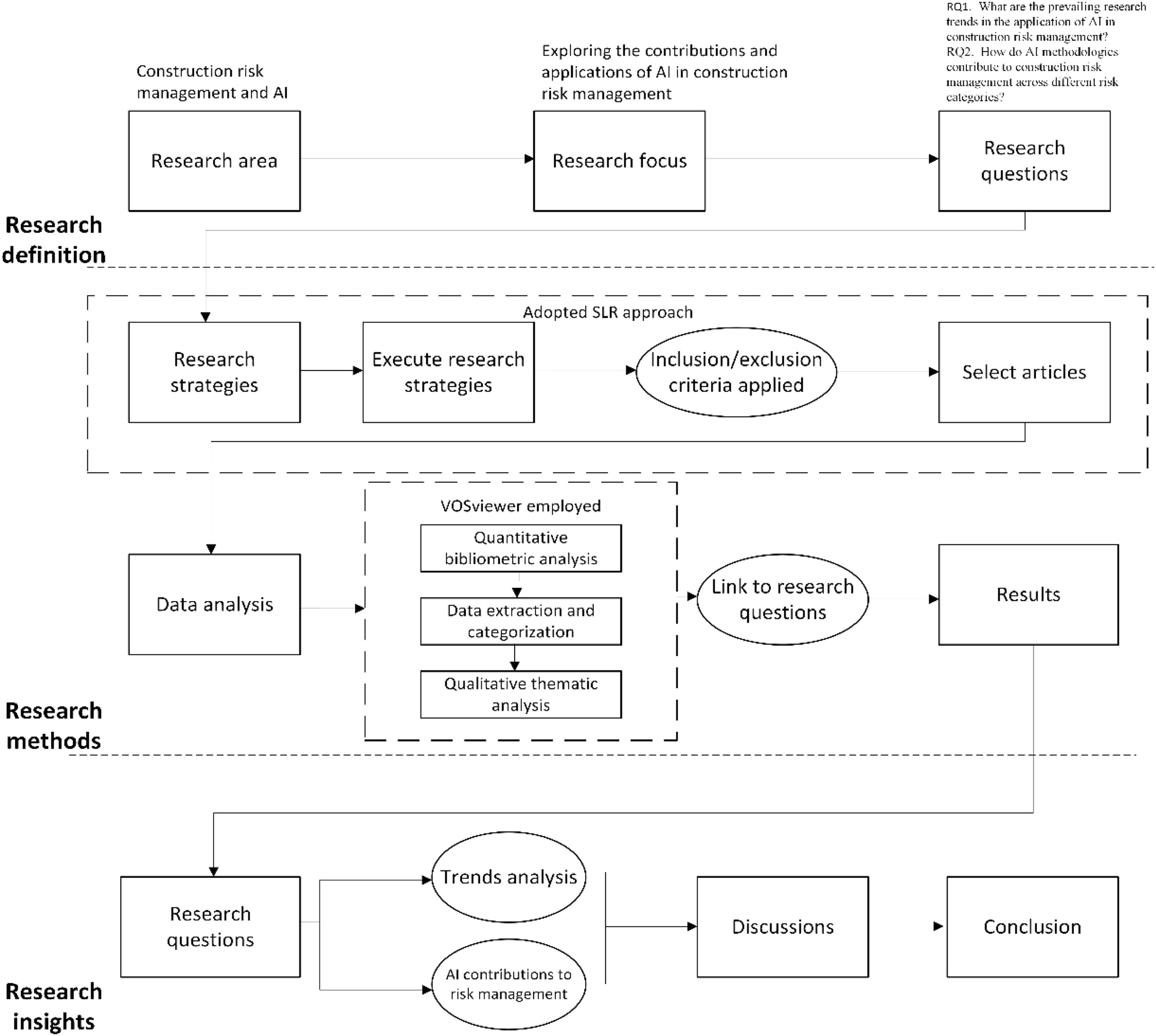
MethodologyThe method for this study adopts a hybrid approach that integrates a systematic literature review (SLR) with bibliometric analysis and thematic analysis to ensure a comprehensive and multi-dimensional exploration of AI applications in construction risk management practices. This hybrid approach was chosen to provide both qualitative insights and quantitative mapping of research trends, enabling a rigorous evaluation of the existing literature and identifying critical gaps and future research directions.
Research methodology overviewTo enhance both qualitative and quantitative synthesis, bibliometric analysis was performed using VOSviewer to identify prevailing research trends, and significant contributions within the domain. This process facilitated keyword extraction and thematic categorisation, supporting the development of a thematic classification framework that systematically organises AI techniques and risk categories.
The framework was iteratively refined using insights from bibliometric analysis, ensuring robustness and relevance in linking findings to the research questions. The integrated SLR approach effectively addresses the complexity of AI research in construction risk management while providing actionable insights for future scholarly and practical advancements.
Fig. 1 visually encapsulates the integrated research method, illustrating how all phases align cohesively to achieve the study’s aims.
Systematic literature review approach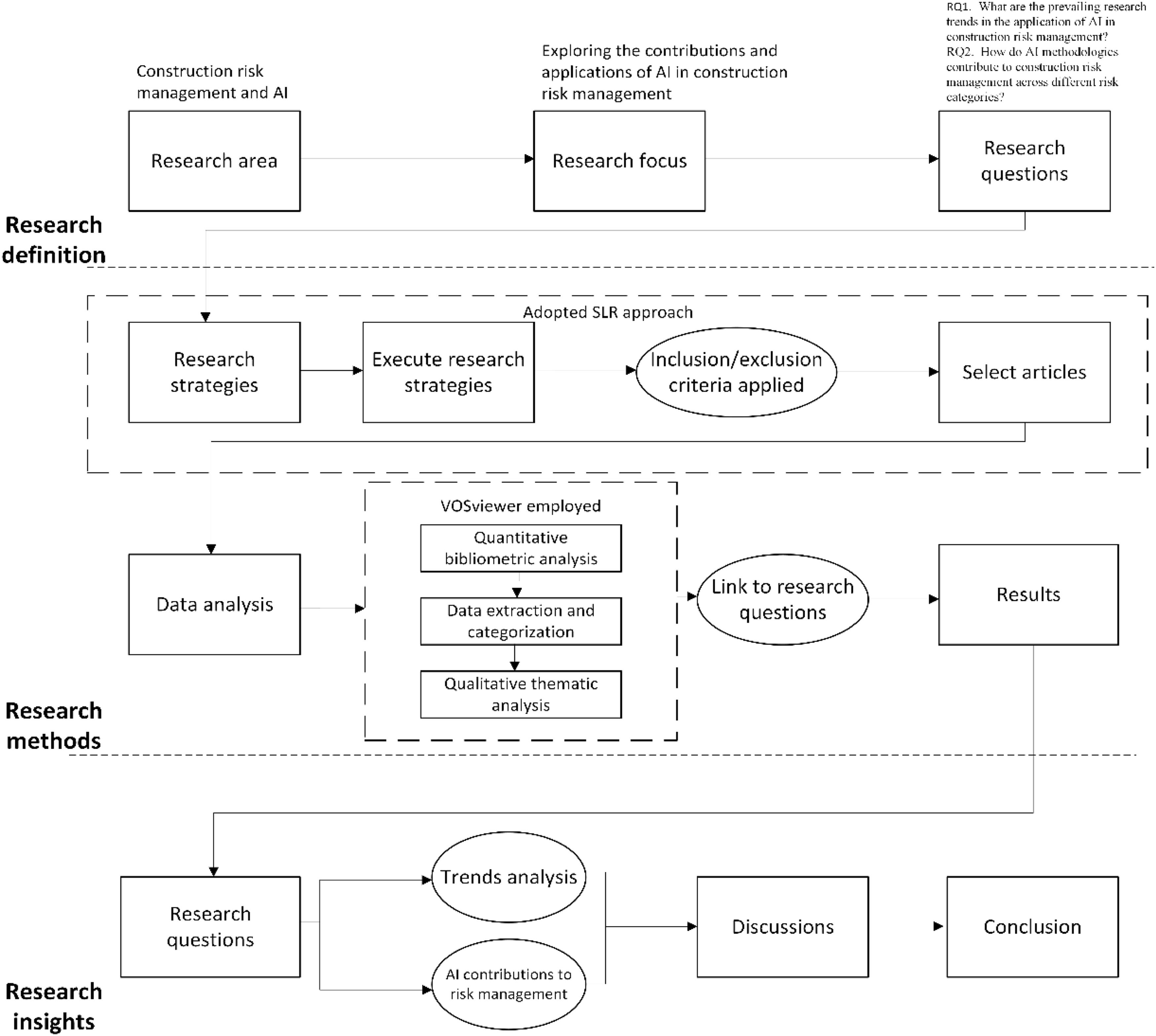
Following best practices in SLR, the study was conducted in accordance with structured protocols designed to enhance reproducibility and rigor (Khizar et al., 2023; Shishehgarkhaneh et al., 2024a). Systematic reviews should be transparent, unbiased, and replicable, ensuring a critical and methodical evaluation of relevant literature (Ammirato et al., 2023). To maintain methodological robustness, the review process incorporated the principles outlined by Khizar et al. (2023) and Ali et al. (2023), applying best practices at different stages to ensure consistency and validity (Rabbi & Jeelani, 2024).
This study adopted a hybrid SLR approach to provide a comprehensive and multi-dimensional assessment (Bramer et al., 2017; Paul & Benito, 2018). The SLR enabled a structured qualitative synthesis, while bibliometric analysis facilitated the identification of publication trends, influential contributors, core journals, and conceptual relationships through keyword co-occurrence analysis. This integration ensures that findings are both critically appraised and contextualised within the broader research landscape.
The bibliometric analysis was conducted after the study selection process, serving as a quantitative foundation to inform the systematic review. It identified key research patterns and thematic clusters, providing a data-driven framework for classifying AI applications in construction risk management. This iterative linkage between bibliometric insights and SLR design enhances thematic categorisation and research synthesis, ensuring a structured and methodologically sound analysis.
By integrating bibliometric analysis with a systematic review, this approach overcomes limitations inherent in either method when applied independently. Bibliometric analysis reveals broader research patterns, while the SLR ensures qualitative depth and critical engagement with the literature (Paul & Benito, 2018). Systematic reviews play a crucial role in identifying knowledge gaps and shaping future research directions, while bibliometric analysis enhances understanding by quantitatively examining publication dynamics, co-authorship networks, and thematic clusters (Ali et al., 2023; Cardillo & Basso, 2025; Khizar et al., 2023). By combining these methodologies, this study adheres to best practice in research synthesis, ensuring a rigorous, contextually rich, and actionable evaluation of AI applications in construction risk management.
Search strategy and selection processA rigorous and transparent search strategy was employed to gather and synthesise existing knowledge, ensuring objectivity and minimise bias (Pollock & Berge, 2017). The research strategy and selection process encompass a multi-phase approach, including an exploratory phase to identify relevant literature, a keyword refinement phase to ensure precision in search terms, the use of Boolean operators for combining and refining queries and the systematic application of inclusion and exclusion criteria to filter relevant studies (Siddaway et al., 2019). The review systematically explored the application of AI in construction risk management, adhering to established guidelines for systematic reviews (Ali et al., 2023; Shamshiri et al., 2024).
Exploratory phase: The research aims to investigate the contributions and applications of AI within the context of construction risk management practices. A comprehensive literature review was conducted to examine the intersection of AI and construction risk management practices.
Keyword refinement phase: The initial search, guided by keywords such as "construction risk management" and "artificial intelligence," generated a substantial number of results. The literature analysis revealed several key areas of interest, including machine learning, deep learning, data mining, natural language processing, knowledge-based reasoning, optimisation algorithms, computer vision, and construction risk management. These themes were identified as central to understanding the integration of AI technologies in enhancing risk management practices within the construction industry.
Boolean operators: Search for the keyword employed by Boolean operators on selected key databases. Key databases such as Scopus, Web of Science, EBSCOhost, ProQuest, and Google Scholar were systematically searched to retrieve pertinent studies. Scopus and Web of Science were chosen for their extensive coverage of relevant topics and robust search functionalities, including citation connections that facilitate access to influential research and assessment of scholarly impact. Web of Science and Scopus are more related to this research field and highly recommended by previous research (Ali et al., 2023; Khizar et al., 2023; Shamshiri et al., 2024).
Inclusion/Exclusion criteria: Rigorous inclusion and exclusion criteria were employed to ensure a comprehensive and unbiased selection of relevant literature on AI applications in construction risk management practices. The inclusion criteria focused on peer-reviewed articles published in English between 2014 and 2024, explicitly addressing construction risks. Articles that were duplicates, inaccessible, literature reviews, from low-quality journals or deemed irrelevant were excluded from consideration.
The emphasis on high-quality peer-reviewed articles was based on their rigorous review processes, ensuring methodological soundness and reliability of findings (Rabbi & Jeelani, 2024; Shishehgarkhaneh et al., 2024a). The selected publication timeframe (2014–2024) aimed to capture recent advancements, emerging trends, and current gaps in research, thereby providing insights into the evolving landscape of AI in construction risk management. This approach facilitated a comprehensive synthesis of contemporary knowledge and informed discussions on the state-of-the-art AI technologies applied to mitigate construction risks.
Table 1 presents the inclusion and exclusion criteria of this study.
Review selection criteria.
This study followed the adapted PRISMA diagram methodology, which involves four sequential stages: identification, screening, eligibility, and inclusion, as detailed by O’Dea et al. (2021). A search strategy incorporating Boolean operators (AND/OR) was employed during the identification stage with specific keywords outlined in Table 2. The systematic review focused exclusively on English-language articles published between 2014 and 2024, aiming to capture the latest developments in AI applications for construction risk management.
Initial review search results.
To ensure rigorous evaluation of the selected articles, quality assessment criteria were employed, informed by established methodologies from prior studies (Rostami et al., 2015; Z. Zhou et al., 2015). Following the application of the inclusion and exclusion criteria as outlined by Pollock and Berge (2017) and Tennant (2018), the selected articles were evaluated based on specific content relevance to address the research questions. The checklist used for quality assessment was derived from insights gleaned from previous scholarly research (Rostami et al., 2015; Z. Zhou et al., 2015).
- 1.
Validity and reliability in assessing risk management measures are foundational in systematic reviews. They ensure accuracy, credibility, comparability, reproducibility, and objectivity, thereby enhancing the trustworthiness of conclusions for informing practice and policy.
- 2.
Transparency in reporting AI algorithms and methodologies is critical for reproducibility, enabling comparisons, mitigating biases, assessing study quality, fostering innovation, building trust, and meeting regulatory standards.
- 3.
Citations play a crucial role in quality assessment by indicating impact, relevance, and study quality. They aid in identifying key literature, providing context, minimising bias, enriching the evidence base, and facilitating comprehensive literature reviews.
This rigorous filtering process ensures that only relevant high-quality studies are included in the review, thereby bolstering the reliability and validity of research findings. By methodically applying the inclusion and exclusion criteria, the review aims to offer a thorough and precise analysis of AI integration in construction risk management, focusing on studies that offer valuable insights into this domain.
Data analysis methodsData analysis for this research applied quantitative bibliometric analysis and qualitative thematic analysis, which involved coding and visualising keywords using VOSviewer.
Quantitative bibliometric analysisBibliometric analysis is a quantitative research methodology designed to systematically investigate the academic literature landscape by analysing publication patterns and citation data (Han et al., 2020; Q. Wang & Su, 2020). This approach is particularly effective for identifying influential authors, key studies, and prevailing trends within a research field. Its structured, data-driven nature has contributed to its growing popularity as a method for enhancing the understanding of scholarly communication (Cardillo & Basso, 2025; Obreja et al., 2024).
Within this context, foundational bibliometric laws such as Bradford's Law and Lotka's Law, provide further insights into the structure and dynamics of academic literature. Bradford's Law identifies the core journals responsible for publishing the majority of impactful articles. This aligns with Garfield's concept of citation networks which highlights areas where research output is most concentrated (Aria & Cuccurullo, 2017). Lotka's Law focuses on author productivity which reveals that a small proportion of authors contribute to the majority of publications. This aligns with Price’s distribution of scientific productivity observations (Cardillo & Basso, 2025). Bradford's Law can be employed to identify core journals and knowledge hubs within a given dataset. The process of applying Bradford’s Law is outlined as follows:
1. Total articles: Begin by determining the total number of articles in the dataset.
2. Articles per zone: Divide the total number of articles by three to calculate the number of articles in each zone:
3. Zone division: Assign journals to the first zone until the cumulative number of articles reaches one-third of the total. This process is repeated for the subsequent zones, creating a division that identifies the core journals.

By utilising Bradford's Law in combination with bibliographic coupling, researchers can gain a more structured understanding of the research landscape. Bibliographic coupling, which assesses the strength of connections between journals based on shared references, can be visualised using network mapping tools. In such maps, journals are represented as nodes, and their interconnections are depicted as lines, with stronger links indicating a higher number of shared citations. This technique enables a more refined and interdisciplinary view of the academic field, helping researchers to identify clusters of journals that focus on similar research areas (Cardillo & Basso, 2025). The integration of these methodologies facilitates the exploration of the scholarly landscape in a systematic and detailed manner (Venable et al., 2016).
The application of Lotka's Law in bibliometric analysis follows a systematic approach aimed at understanding author productivity within a specific research domain. The process begins with the collection of a comprehensive dataset of publications in the fields of AI and construction risk management. Once the dataset is established, the authors of these publications are identified, and their respective contributions are quantified by the number of publications. The distribution of these contributions is then analysed to assess whether it conforms to the inverse square law as described by Lotka, which posits that the number of authors publishing a given number of articles decreases in proportion to the square of that number (Qiu et al., 2017).
Incorporating Lotka's Law with bibliographic coupling analysis offers a deeper and more distinct understanding of the research landscape in AI and construction risk management (Cardillo & Basso, 2025). Bibliographic coupling, which evaluates the strength of connections between articles based on shared references, was conducted using VOSviewer. This method generates a visual representation of the interrelationships between articles, helping to identify research clusters and the centrality of specific works within the broader academic network (Obreja et al., 2024). The integration of Lotka's Law and bibliographic coupling thus provides a comprehensive view of both author productivity and the structural interconnections within the field (Cardillo & Basso, 2025).
In addition to coupling analysis, co-occurrence analysis is frequently employed in bibliometric research. Keyword-based co-occurrence mapping visualises the relationships between concepts and identifies major themes within a research field. These visual representations of interconnections among concepts are invaluable for understanding the intellectual structure of a discipline and guiding future research endeavours (Cardillo & Basso, 2025; Obreja et al., 2024). To visualise the co-occurrence patterns of keywords, bibliometric data was processed using VOSviewer, a tool that facilitates the creation of network maps. These maps provide a clear and structured view of the research landscape, focusing on the relationships between co-occurring keywords. By analysing the clusters formed by frequently occurring keywords, the visualisation highlights thematic areas, and key research focuses within the field (Bornmann et al., 2018). These clusters reveal the underlying topics that dominate the research discourse, offering insights into emerging trends and the evolution of specific themes. The co-occurrence of keywords thus serves as a valuable method for identifying the central themes and directions in the research field, supporting a deeper understanding of its structure and guiding future investigations (Obreja et al., 2024).
The findings from the bibliometric analysis were integrated with the systematic review. This integration allowed for a comprehensive synthesis of research trends within the field. The combined approach also enabled the identification of critical gaps and informed recommendations for future research directions (Obreja et al., 2024).
Data extraction and categorisationA structured data extraction and categorisation process was employed to systematically analyse the selected studies. In contrast to traditional manual coding methods, this study leveraged bibliometric analysis to identify relevant themes, categories, and research trends, ensuring an objective and data-driven categorisation process. This process involved keyword extraction and thematic categorisation to ensure a comprehensive assessment of AI applications in construction risk management.
The initial stage of data extraction focused on conducting a bibliometric analysis to identify key research clusters within the selected studies. This analysis was performed using VOSviewer software, which enabled the visualisation of co-occurrence keywords, facilitating the identification of recurring concepts and emerging research areas.
Following the classification of extracted keywords, a structured categorisation thematic framework was developed. Predefined categories based on AI methodologies and risk classifications were applied to align findings with the research questions and provide a structured perspective on how AI techniques are distributed across different risk categories. This categorisation process enabled a detailed exploration of research gaps and emerging trends in the field.
Qualitative thematic analysisBuilding on the extracted keywords and bibliometric insights, a qualitative thematic analysis was conducted to classify and synthesise AI contributions to construction risk management. VOSviewer-generated keyword clusters were analysed to detect recurring themes and relationships between AI methodologies and risk categories.
To enhance the robustness and applicability of the thematic classification framework, an iterative refinement process was undertaken to ensure the framework aligned comprehensively with research findings derived from the selected studies. The initial keyword-based themes were further refined through full-text analysis, ensuring consistency with the research objectives. The final classification provided a structured synthesis of AI contributions, offering a comprehensive perspective on research trends in AI-driven construction risk management.
Once the thematic classification framework was established, the selected articles were systematically allocated to their respective categories. This critical step ensured that the findings were directly linked to the research questions, reinforcing the systematic review's validity and methodological rigor (Ali et al., 2023; Paul et al., 2021). A systematic review is only successful when it effectively answers the specific research questions (Ali et al., 2023; Paul et al., 2021), and this study ensured that its thematic classification framework provided meaningful insights into AI applications for construction risk mitigation.
This data-driven thematic analysis, derived from VOSviewer keyword extraction, offers a systematic classification of AI contributions, ensuring that research findings are aligned with empirical bibliometric trends and real-world AI applications in construction risk management.
ResultsFollowing a thorough review of the articles extracted using the databases, results revealed significant insights related to the research questions concerning emerging research trends, classifications of AI technologies, phases of construction risk management addressed, and specific AI methodologies employed. The findings are presented as follows.
Study selection resultsTable 2 provides an overview of the initial search outcomes, and the specific keywords utilised in the study.
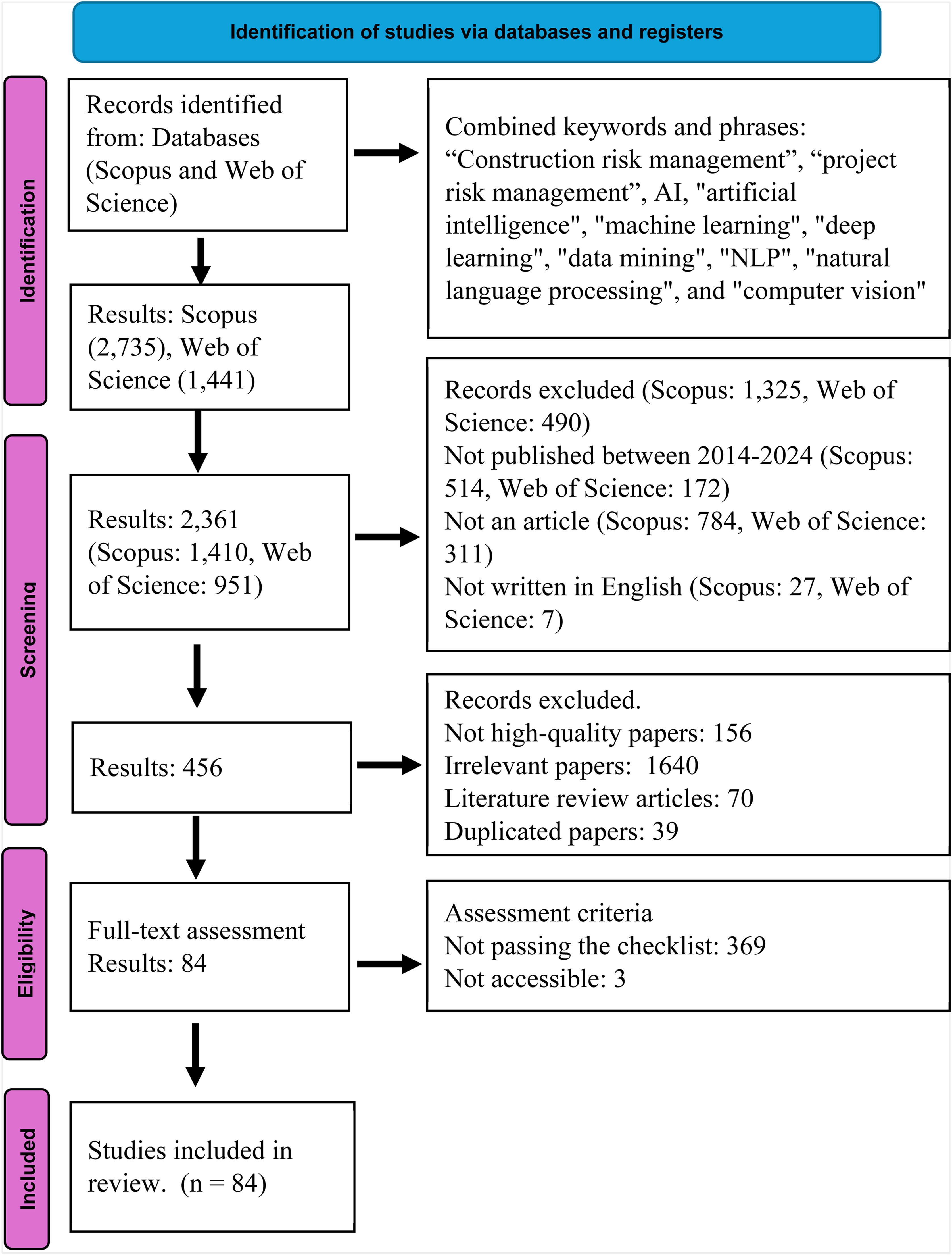
A total of 2361 articles were identified during the identification stage. During the screening stage, a thorough assessment was conducted based on predefined exclusion criteria which lead to the exclusion of 1905 articles. This screening process resulted in 456 articles remaining for further eligibility screening.
The next step involved a thorough reading of the full texts and quality assessment, with researchers focusing on specific criteria such as the alignment of objectives, research questions, data description, applied methodology, data analysis techniques, and the presentation of results. Following this in-depth review, 372 articles were deemed irrelevant and excluded from the study, resulting in 84 articles remaining for this study.
Fig. 2 summarises the comprehensive process of article selection using the adapted PRISMA framework for the reviews (O’Dea et al., 2021).

Adapted PRISMA diagram for the systematic review (Author’s design; insights from O’Dea et al., 2021).
Bibliometric analysis insights were identified through an analysis of data extracted from both the Web of Science and Scopus. Publication growth trends were visualised using the comprehensive data from these two databases, while the bibliometric analysis including Broadford’s law and Lotka’s law focused on the data derived from the selected articles.
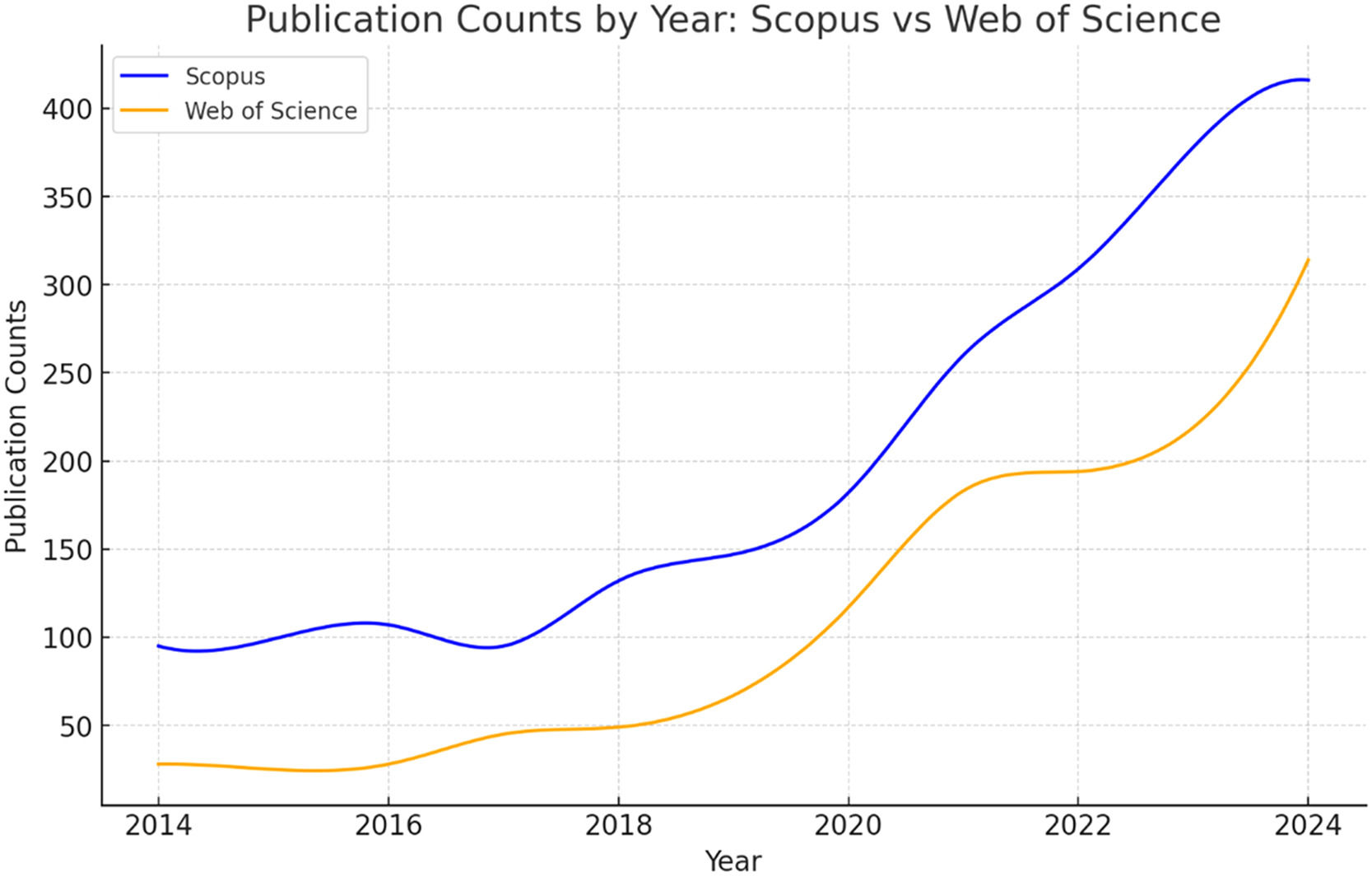
Publication growth over timeThe analysis of articles published per year provides insights into the adoption and evolution of AI technology in construction risk management. Cumulative publication counts retrieved from Web of Science and Scopus were plotted in Fig. 3. Results demonstrated the lowest publication counts were recorded in 2014 with 95 publications recorded in Scopus, while Web of Science indicated 25 publications in 2015. Conversely, the highest number of publications were recorded in 2024, with Scopus reporting 416 publications and Web of Science reporting 314.

The annual publication trend, as presented in Fig. 3, revealed two distinct phases of growth. There were relatively few publications from 2014 to 2018, reflecting the nascent stage of AI application in this field (Q. Liu et al., 2024). Subsequently, from 2019 onwards, there was a marked exponential increase in publications, indicating a significant uptake and ongoing growth of AI integration. A similar pattern is observed in the data from Scopus, where the number of publications also surged notably from 2018 onwards. This period coincides with advancements in AI capabilities, particularly in ML, NLP, and other algorithms, often referred to as the AI 2.0 generation (Cheng & Yu, 2019). The trend has consistently exhibited a sustained upward trajectory, reflecting the growing relevance and enduring interest in AI technologies for construction risk management within the global research community.
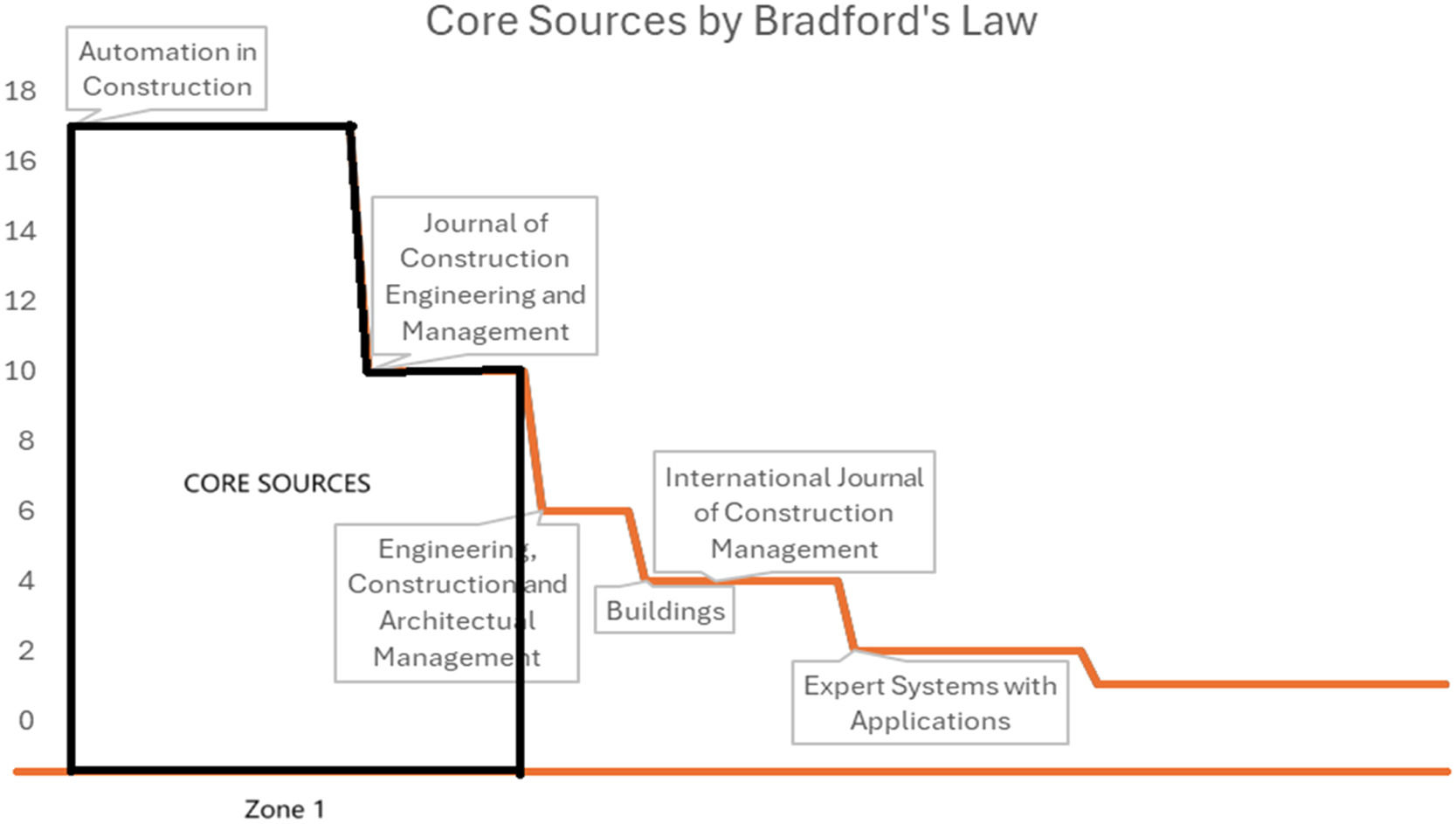
Bradford’s law and bibliographic coupling analysisFig. 4 provides a visual summary of the application of Bradford's Law, highlighting the concentration of core journals within the domain of AI and construction risk management research. The corresponding zone distribution is detailed in Table 3. Zone 1 comprises two core journals contributing twenty-eight publications, representing the most concentrated sources of high-impact research. Zones 2 and 3 include eight and twenty-four journals, respectively, with a progressively lower frequency of publications, reflecting a broader and less concentrated distribution of research output.

Table 3 presents the zone distribution as determined by Bradford's Law.
The core zone comprises two journals: Automation in Construction, contributing 17 articles, and the Journal of Construction Engineering and Management, contributing 11 articles. The prominence of these high-citation core journals highlights the hierarchical structure of knowledge production in the field. The findings emphasise that cutting-edge research, foundational theories, and innovative methodologies predominantly emerge from and gain validation within this elite group of journals (Zupic & Čater, 2015).
Table 4 provides a detailed breakdown of the annual scientific production and citation metrics for each source, offering a comprehensive analysis of the most influential journals in AI and construction risk management research.
The high citation counts of these journals demonstrate their significant influence and impact within the field of research. Table 5 provides further insights into the distribution of citations, highlighting the most impactful contributions to the domain.
Citation distribution highlighting high-impact documents in the field.
| Source | Title | Author and year | Citations |
|---|---|---|---|
| Automation in Construction | Detecting non-hardhat-use by a deep learning method from far-field surveillance videos | Q. Fang et al., 2018 | 558 |
| Automation in Construction | Ontology-based semantic modelling of construction safety knowledge: Towards automated safety planning for job hazard analysis (JHA) | S. Zhang et al., 2015 | 488 |
| Automation in Construction | Deep learning for site safety: Real-time detection of personal protective equipment | Nath et al., 2020 | 410 |
| Journal of Construction Engineering and management | Machine Learning Algorithms for Construction Projects Delay Risk Prediction | Gondia et al., 2020 | 292 |
| Automation in Construction | Computer vision applications in construction safety assurance | W. Fang et al., 2020 | 237 |
The observation that the most-cited articles predominantly originate from core source journals, as defined by Bradford's Law, offers valuable insights into the dynamics of scholarly communication and the structure of knowledge dissemination within a research domain. This pattern suggests that concentrating on core journals can enhance the efficiency of literature searches and provide a robust foundation for understanding key studies, methodologies, and emerging trends in the field. Core journals serve as reliable repositories for high-impact research and foundational contributions (Aria & Cuccurullo, 2017).
Top cited studies in core journals:
- 1.
Q. Fang et al. (2020; Automation in Construction; 558 citations): This study utilises DL to detect non-hardhat use in far-field surveillance videos, demonstrating the integration of AI into construction safety management. A high citation count underscores the growing interest in leveraging AI for real-time safety monitoring.
- 2.
S. Zhang et al. (2015; Automation in Construction; 488 citations): This paper introduces ontology-based semantic modelling to formalise safety knowledge for job hazard analysis (JHA). This article emphasised an ontology that aligns with the industry's push towards structured knowledge management for safety planning.
- 3.
Nath et al. (2020; Automation in Construction; 410 citations): By focusing on DL for real-time detection of personal protective equipment (PPE), this study highlights the importance of advanced AI techniques in improving on-site safety compliance.
- 4.
Gondia et al. (2020; Journal of Construction Engineering and Management; 292 citations): This paper explores ML algorithms for predicting construction project delays, addressing a critical challenge in construction project management and resource planning.
- 5.
W. Fang et al. (2020; Automation in Construction; 237 citations): This article discusses CV applications for construction safety assurance, showcasing how visual data can be used to enhance safety protocols and reduce accidents.
The top five cited studies provide critical insights into the application of AI in construction risk management, with implications in the following areas:
- 1.
CV and safety risk management: The predominant focus on AI, particularly CV, reflects a clear trend towards automation and technology-driven solutions for addressing safety challenges in construction.
- 2.
KBR AI for risk management: The ontology-based semantic modelling study underscores the importance of organising and formalising construction safety knowledge, signalling a shift towards structured information systems for enhanced safety planning.
- 3.
ML for risk prediction and management: The application of DL algorithms highlights the relevance of predictive modelling in mitigating construction risks and ensuring project efficiency, particularly concerning schedule adherence and resource planning.
These insights underscore the significant impact of the research in construction risk management and highlight key areas of focus. The application of ML, CV, and KBR methods in construction risk management practices, particularly in safety risk management, represents a cutting-edge approach to addressing industry challenges. These areas have become essential in mitigating construction risks and enhancing safety protocols. The studies in this domain not only exert considerable influence but also establish foundational frameworks and methodologies that serve as benchmarks for ongoing research, guiding the direction of future advancements in the field.
The overlap between the core journals identified by Bradford’s Law and the journals publishing the most-cited documents reinforces their dual role as leaders in both research volume and impact (Gupta & Singh, 2022). These journals not only publish a substantial number of articles but also house studies with significant academic and practical relevance as demonstrated by their citation metrics. This dual distinction positions core journals as pivotal platforms for advancing the field of AI in construction risk management.
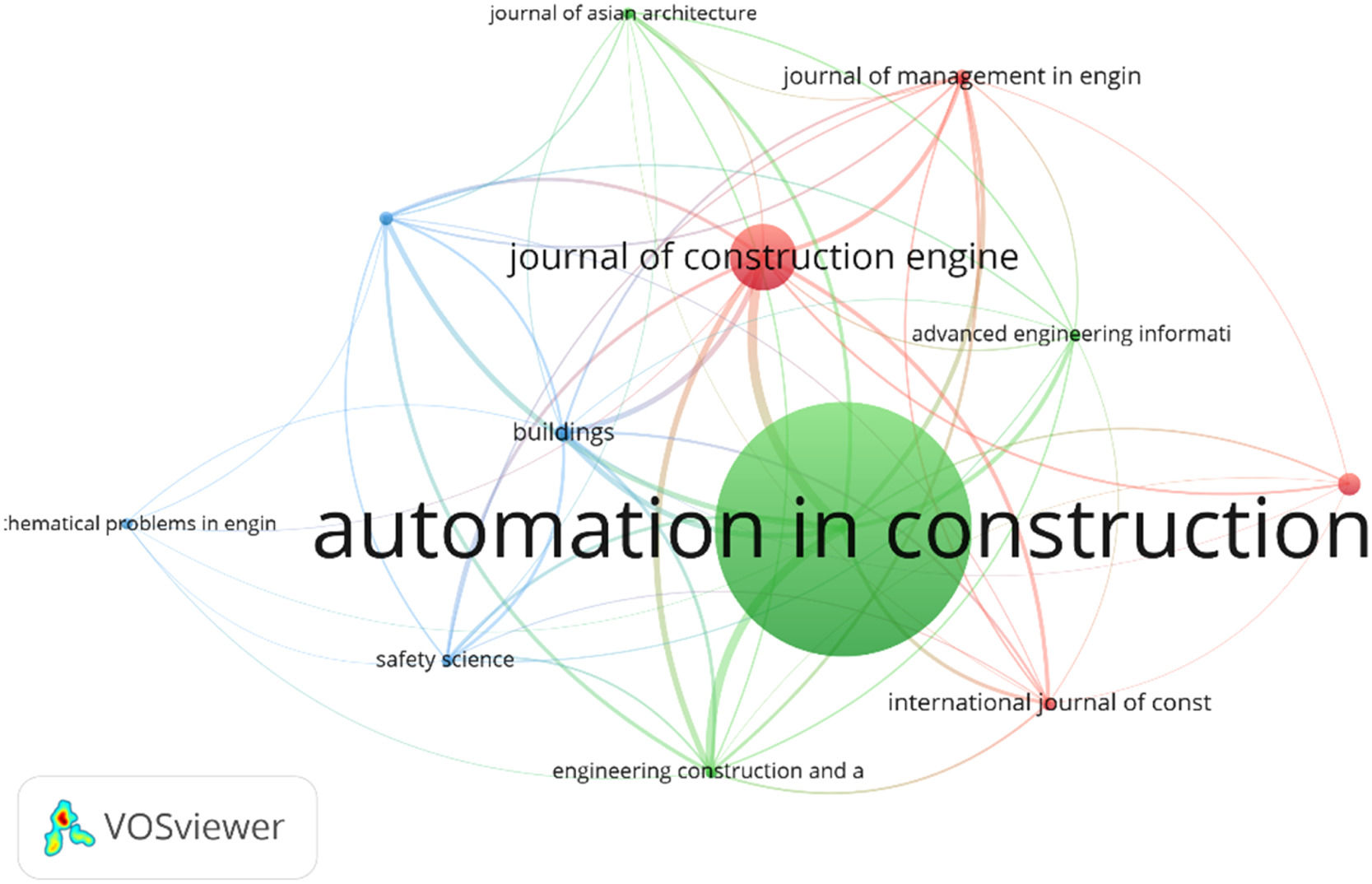
Fig. 5, generated using VOSviewer, illustrates the co-citation network of journals within the domain of construction risk management and AI. This analysis highlights the key journals contributing to the research field, with nodes representing individual journals and the links between them signifying co-citation relationships. The size of each node reflects the number of co-citations received, serving as an indicator of the journal's influence within the network. Additionally, the thickness and density of the links denote the strength of co-citation relationships, offering insights into thematic clustering and collaborative patterns across the research landscape.

The green cluster within Fig. 5 encompasses journals such as Automation in Construction (JCR Q1) and Engineering, Construction and Architectural Management (JCR Q2), which focus on the application of AI algorithms in addressing various risks across different aspects of construction. A significant number of studies in this cluster concentrate on developing and implementing real-time monitoring algorithms aimed at immediately detecting safety risks during the construction phase. For instance, research has explored the integration of YOLO and CNNs to enhance the accuracy and efficiency of these safety risk detection models (Nath et al., 2020). Kifokeris and Xenidis (2019) utilised ML algorithms and OAs to analyse data for optimising supply chain planning, highlighting the broader applications of AI in risk management within the construction industry. These studies collectively demonstrate the diverse and transformative role of AI in enhancing construction risk management practices. These studies primarily focus on the application of AI technologies in practical methods for construction risk management, with an emphasis on-site management and operational efficiency.
The red cluster links journals such as the Journal of Management in Engineering (JCR Q1) and Advanced Engineering Informatics (JCR Q1), which focus on managerial and technological aspects of risk management. For instance, Elbashbishy et al. (2022) and Mohamed et al. (2023) employed AI methods for the automated detection of cost and schedule risks, assisting project managers in reducing the likelihood of adverse conditions arising. Khalef and El-Adaway (2021) utilised AI techniques to predict documentary risks, enabling the management team to proactively plan for potential documentation-related challenges. These studies explore how AI methods are used to predict and automate the detection of various risks, such as cost, schedule, and documentary risks, with the goal of assisting project managers and management teams.
The blue cluster involves journals such as Safety Science (JCR Q1) and Buildings (JCR Q2). Alkaissy et al. (2023) utilised a pre-trained AI model to develop indicators that reveal risk relationships, thereby enhancing the accuracy of estimation predictions. Ashtari et al. (2022) integrated various AI methods to optimise risk allocations, supporting the decision-making process. These studies focus on the application of AI to evaluate and analyse historical data, thereby enhancing risk management in construction projects.
This co-citation network provides valuable insights into the intellectual structure of the field. It identifies core journals that serve as knowledge hubs and illustrates how different research themes are interconnected. By analysing the clusters and connections, researchers can identify emerging trends, influential works, and potential gaps in the literature. The findings reaffirm the centrality of Automation in Construction as a key resource for scholars exploring AI applications in construction risk management and suggest areas for further interdisciplinary collaboration.
Frequent publication in prestigious journals is a strong indicator of a research area's quality, impact, and significance within the scientific community (Zong et al., 2024). Such publications validate the credibility and reliability of research findings and enhance the field’s visibility, attract funding and institutional support, shape research agendas, and elevate scholarly recognition and prestige. High-quality publications in esteemed journals can influence policy decisions and inform public discourse, further amplifying their societal and academic relevance (Long et al., 2024).
Lotka's law and bibliographic coupling analysisTable 6 applies Lotka's Law by analysing author productivity, demonstrating the relationship between the number of authors and publications in AI and construction risk management research field. It illustrates a typical distribution pattern of authorship in academic literature, where a few authors are highly prolific, while the majority contribute only occasionally.
The bibliometric analysis of author productivity reveals a distribution that aligns with Lotka's Law, which suggests that a small proportion of authors contribute significantly to the field, while the majority publish only a single paper. In this dataset, 243 authors, accounting for 92.04 % of the total, have written only one document each, indicating a large pool of infrequent contributors. A smaller group of 17 authors, representing 6.44 %, have authored two documents each, demonstrating moderate productivity. Additionally, two authors each contributed three papers, while another two authors produced four papers, reflecting the high productivity of the "core" group of authors who make the most substantial contributions to the literature, as predicted by Lotka's Law. These findings emphasise the central role of core contributors in advancing research on AI applications in construction risk management. Furthermore, the notable proportion of single-publication authors highlights the field's openness and its capacity to attract diverse academic participation. These insights provide a deeper understanding of the academic structure of the field, offering valuable guidance for future research directions and resource allocation strategies. Table 7 outlines the documents within the "core" group, showcasing the most influential contributions to the research domain.
Documents categorised in the core group.
| Authors | Organisation | Documents | Theme | Citations |
|---|---|---|---|---|
| Moon, S | Seoul National University, South Korea | Automated Construction Specification Review with Named Entity Recognition Using Natural Language Processing | Focuses on using NLP for efficient review of construction specifications through entity recognition. | 53 |
| Chi, S | Reference section identification of construction specifications by a deep structured semantic model. | Leverages semantic modelling to identify reference sections in construction specifications | 2 | |
| Lee, G* | Semantic text-pairing for relevant provision identification in construction specification reviews. | Applies semantic text-pairing to identify relevant provisions in construction documents for review | 27 | |
| Automated detection of contractual risk clauses from construction specifications using bidirectional encoder representations from transformers (BERT) | Utilises Bidirectional Encoder Representations from Transformers (BERT) to identify risk clauses in contractual documents | 48 | ||
| Li, H | The Hong Kong Polytechnic University, Hong Kong SAR | Computer vision applications in construction safety assurance | Explores the use of computer vision for improving safety protocols in construction | 237 |
| Detecting non-hardhat-use by a deep learning method from far-field surveillance videos | Focuses on using deep learning to monitor compliance with safety protocols through far-field video analysis | 558 | ||
| Excavator 3D pose estimation using deep learning and hybrid datasets. | Develops methods for excavator pose estimation to enhance safety and operational efficiency | 31 |
The authors with notable contributions in the core group highlight the following key trends in the application of AI to construction risk management:
- 1.
NLP for contractual risk management: Significant focus on using advanced NLP models such as bidirectional encoder representations from transformers (BERT) for reviewing and managing construction specifications and risk clauses.
- 2.
CV for construction safety: Applications of DL and CV to enhance safety monitoring and equipment operation.
The contributions of high-productivity authors, as highlighted by Lotka's Law, emphasise their pivotal role in advancing the application of AI in construction risk management. Through the integration of AI techniques such as NLP and CV, these core authors are driving innovation and offering practical solutions for mitigating risks, improving cost efficiency, and ensuring safety compliance within the construction industry. Their research, particularly in utilising ML for safety monitoring and BERT for the analysis of construction contracts, enhances real-time decision-making, reduces human error, and establishes foundational benchmarks for future research. These seminal studies not only guide the development of AI applications in construction but also provide valuable tools for industry practitioners to more effectively manage risks, enhance safety protocols, and maintain project schedules and budgets.
While the authors’ role highlights individual expertise and leadership, the institutional affiliations of these researchers offer complementary insights into the broader academic and scientific infrastructure supporting this emerging field. The affiliation analysis reveals that top-ranking institutions are not only fostering innovative research but also providing the resources and collaboration networks necessary to sustain these advancements. This alignment between leading authors and globally renowned institutions demonstrates a synergistic relationship where academic reputation and research output mutually reinforce progress in AI-driven solutions for construction risk management. By bridging individual and institutional contributions, this analysis underscores the importance of collective efforts in shaping the future of AI applications in the construction industry. Table 8 presents institutional rankings, research outputs, and citation metrics within the field of AI and construction risk management research.
Institutional rankings, research contributions and citations in the field.
The results also provided valuable insights into AI-focused research dynamics across the academic and global scientific landscapes (W. Li et al., 2024). These trends illuminate regional strengths, specialisations, and the scientific influence wielded by high-reputation institutions in specific research fields (Hosseini et al., 2018). Of keen interest is the revelation of the intersection of AI technology with construction risk management, which has successfully attracted top talents and is recognised as a pivotal and emerging area within the construction industry (Cheng & Yu, 2019; Y. Li et al., 2022).
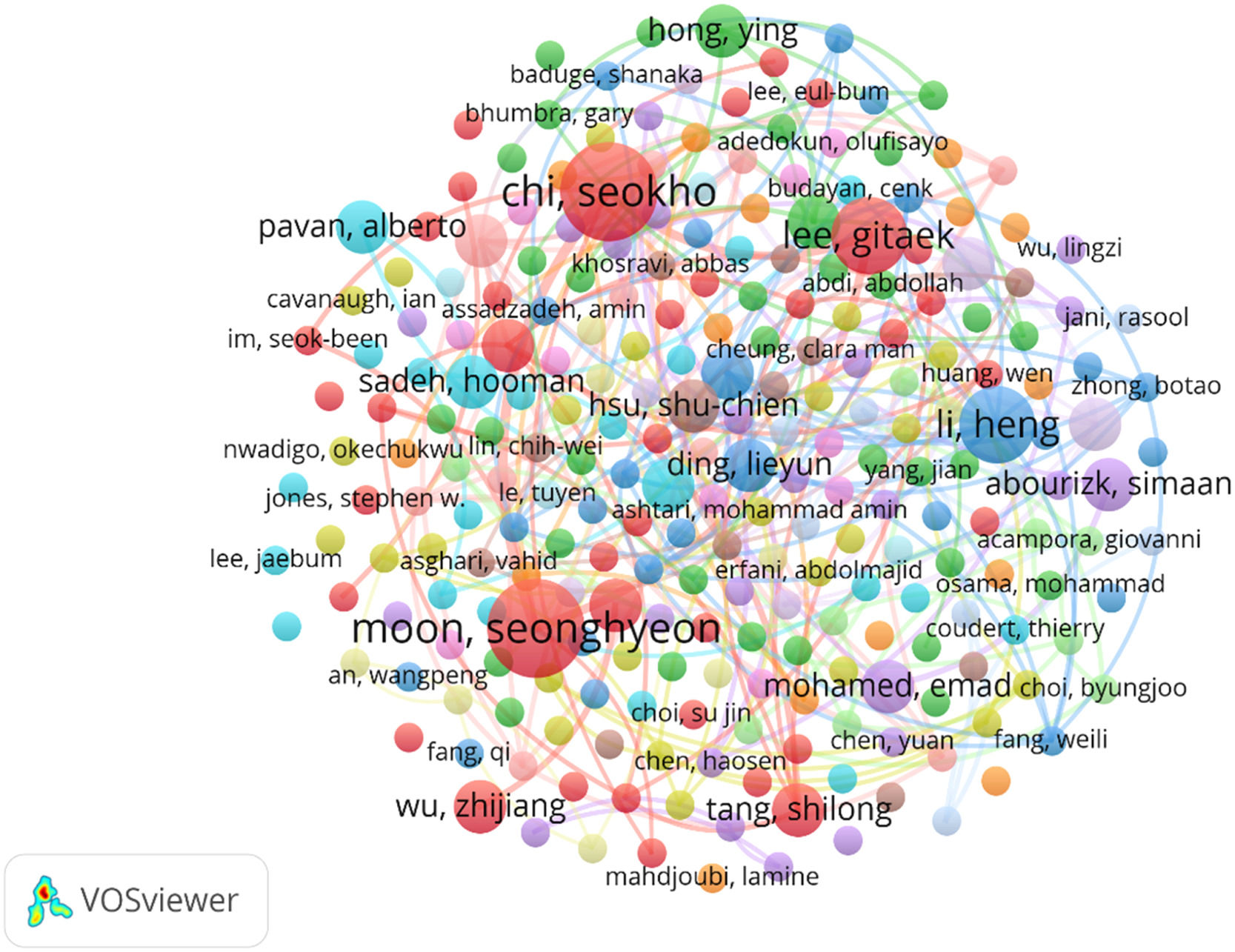
The VOSviewer software facilitates the development of maps derived from bibliographic data. In this study, bibliographic coupling analysis was conducted based on shared references among articles. Fig. 6 illustrates the bibliographic coupling map, revealing key clusters and the intellectual structure of the field as determined by the interconnectedness of shared references.

The visualisation highlights several central authors with larger nodes, such as Moon, Chi, Li, and Lee. These authors demonstrate significant contributions to the field and appear to be pivotal figures in their respective collaborative networks.
The red cluster may represent a group of authors working on specific topics, such as risk management strategies or AI applications in construction. H. Zhou et al. (2023a) employed BERT and semantic modelling to efficiently identify risk clauses and relevant provisions in construction contracts, utilising entity recognition and semantic text-pairing techniques. H. Zhou et al. (2023b) integrated KBR approaches with DL to generate risk response measures for subway construction projects, enhancing the ability to predict and address potential risks. Both studies highlight the use of AI to improve the accuracy and efficiency of risk management in construction through automated document analysis and decision support systems.
The green cluster appears to represent a focus on OAs and predictive modelling within construction processes. Hong et al. (2021) conducted a comparison of various AI methods for clustering construction schedules, demonstrating the potential of AI techniques in improving the organisation and analysis of scheduling data. J. Yang and Yin (2024) emphasised key strategies for addressing risks across construction projects, underscoring the importance of AI-driven approaches in mitigating challenges and enhancing project outcomes. These studies highlight the application of AI to improve risk analysis and management in construction. Specifically, they focus on areas such as schedule optimisation and proactive risk mitigation.
The blue cluster is indicative of research addressing ML and DL applications in safety and operational risk assessments. These studies investigate the use of CV, specifically DL, to improve safety protocols in construction by monitoring safety compliance through far-field video analysis (W. Fang et al., 2020). It also develops methods for excavator pose estimation to enhance both safety and operational efficiency on construction sites (Q. Fang et al., 2018). Both of these studies focus on the use of AI in enhancing safety and operational efficiency
The co-authorship network analysis provides insights into the collaborative dynamics within the field of AI applications in construction risk management. By identifying influential authors and their research communities, the analysis sheds light on the intellectual structure of the domain and highlights opportunities for interdisciplinary collaboration. The findings are particularly useful for researchers seeking to identify key contributors, establish connections with established networks or understand the collaborative landscape of the field.
Co-occurrence of keyword analysisKeyword analysis using VOSviewer is a valuable bibliometric approach that identifies key research themes and trends by examining the co-occurrence of keywords within academic publications. By constructing co-occurrence networks, VOSviewer visually maps how frequently specific keywords appear together in the same documents and reveals clusters of related concepts. This helps researchers identify core topics, emerging trends, and potential research gaps within a field. Additionally, the strength of the connections between keywords offers insights into the relationships between different research areas, guiding future research directions and supporting interdisciplinary exploration. VOSviewer is widely used in systematic reviews and research planning due to its ability to quantify and visualise the intellectual structure of a domain effectively.
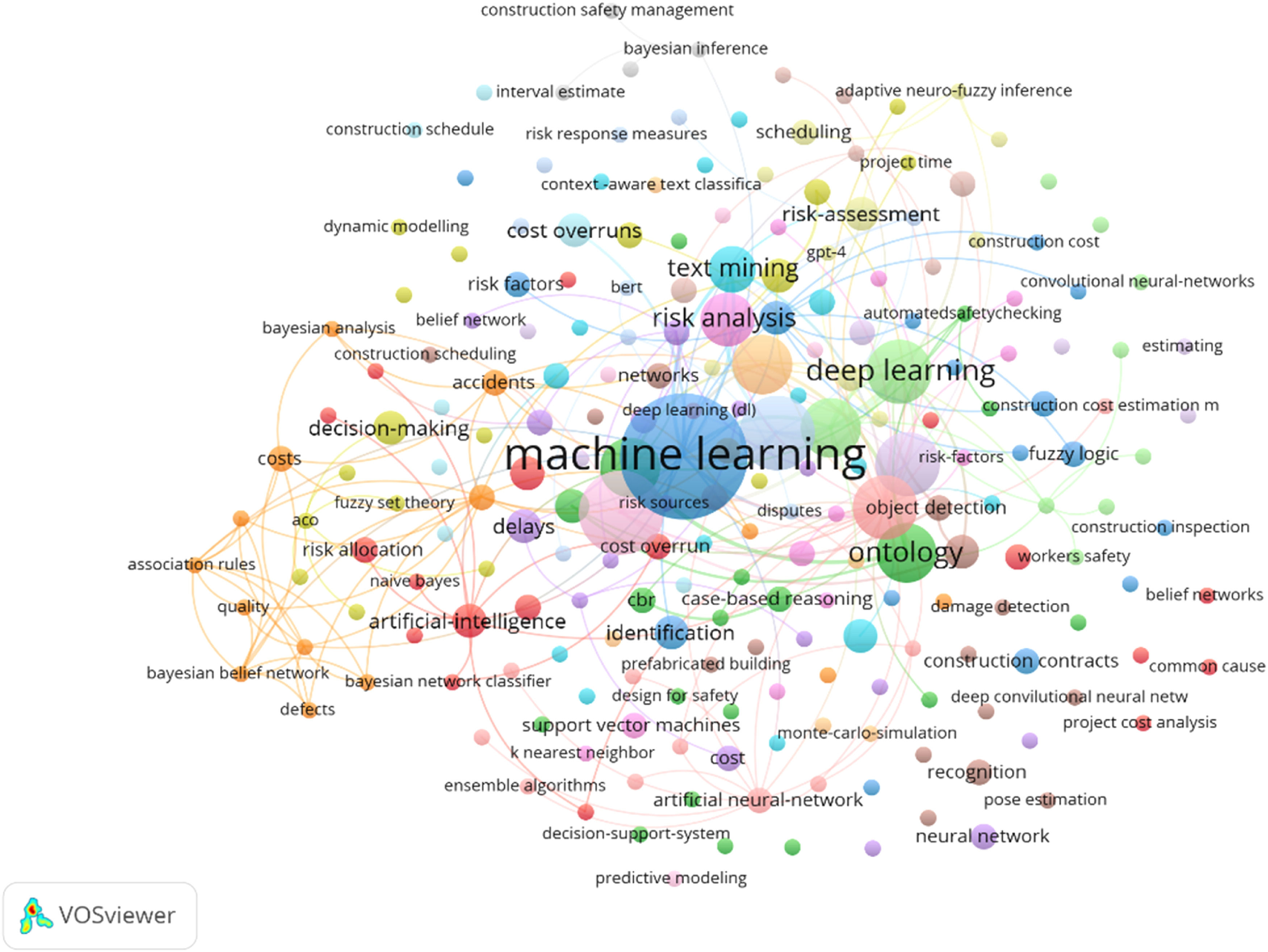
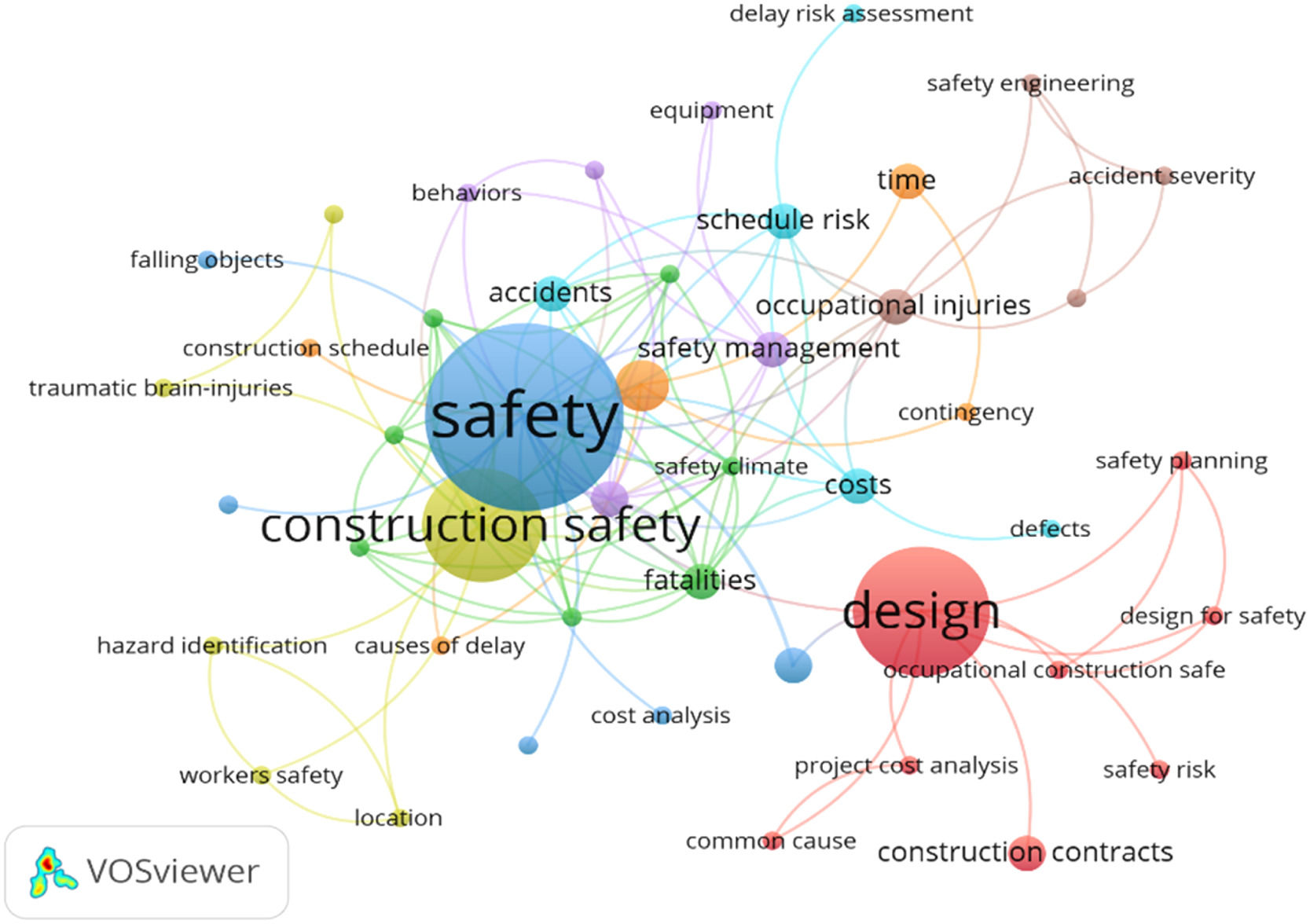
Fig. 7 presents a VOSviewer-generated keyword co-occurrence map depicting the major themes and conceptual linkages within the literature. Table 9 illustrates the grouping of these words into relevant clusters.

Table 9 presents the co-occurrence keywords extracted from the selected articles, as generated by VOSviewer.
ML is the most dominant node, indicating its pivotal role in AI applications for construction risk management. The size of the node reflects its frequent appearance in the literature, making it the central theme around which related topics are structured.
Keywords such as DL and risk analysis, closely linked to the ML cluster, form major sub-clusters. These keywords represent the critical methodologies and tools utilised in advancing the field.
Blue cluster: This group focuses on ML-related methodologies, including DL, DM, and risk assessment. These keywords illustrate the connection between ML methods and risk analysis, specifically focusing on the use of ML-driven prediction models to address construction-specific risks. These models are employed to identify and evaluate risk factors, enabling more accurate and efficient management of potential risks in construction projects. For example, P. Wang et al. (2023) employed ML technologies to categorise the outcomes of time-cost trade-off implementations as either successful or unsuccessful, based on a set of critical managerial factors identified in their study. It emphasises the computational techniques employed in analysing and predicting construction risks (Hassan et al., 2023; Shrestha et al., 2023).
Green cluster: Keywords such as ontology, FL, and construction inspection highlight the application of knowledge representation and reasoning in risk identification and management. These keywords reveal that the KBR system contributes to decision-making during the construction risk management process. For example, Osama et al. (2023) employed the CBR method to retrieve past solutions in order to identify more effective strategies for addressing current cost and schedule risks in construction projects. This highlights the importance of KBR systems for risk identification, risk management, and decision-making within the construction risk management process (Feng et al., 2022; P. Zhang et al., 2024).
Red cluster: This cluster revolves around risk mitigation, featuring terms such as risk allocation and AI, indicating a focus on OAs in construction risk management. OA systems analyse characteristics from data to optimise project scenarios and select optimal solutions (Lachhab et al., 2018; Shoar & Nazari, 2019). Chattapadhyay et al. (2021) employed an integrated OA model to determine the most cost-effective allocation of resources, aiming to minimise wastage and cost overruns. This emphasises AI within OA systems significantly enhances construction risk management by optimising project scenarios and identifying solutions.
Yellow cluster: Highlighting cost-related risks, this cluster includes terms such as cost overrun, cost estimation, and delays, reflecting economic considerations within construction risk management. These keywords reflect the importance of cost and time-related risks in construction. Cost and schedule risk factors are primarily linked to different AI methods, including ML, KBR, and OA (Adedokun et al., 2024; Sohrabi & Noorzai, 2024; R. Wang et al., 2022). These studies emphasised the priority focus on the applications of AI in construction cost and schedule risk management, which helps achieve the goals of construction projects.
The links between nodes illustrate the relationships and co-occurrences of keywords within the literature. Strong links between ML and risk analysis, for example, suggest a concentrated research effort in utilising ML techniques for analysing construction risks. The integration of ontology from KBR with risk factors underscores the role of semantic knowledge models in the identification and categorisation of risks. Additionally, emerging technologies such as GPT-4 from NLP, neural networks from ML, and object detection from CV are being explored for their potential applications in construction risk management, offering innovative approaches to enhance decision-making and risk mitigation strategies within the industry.
Thematic classification of AI in construction risk managementThe thematic classification framework provides a structured overview of how AI technologies are integrated into construction risk management. To further dissect these applications, this section explores the specific AI techniques employed, the risk categories they address, and a synthesis of their contributions in mitigating construction-related risks.
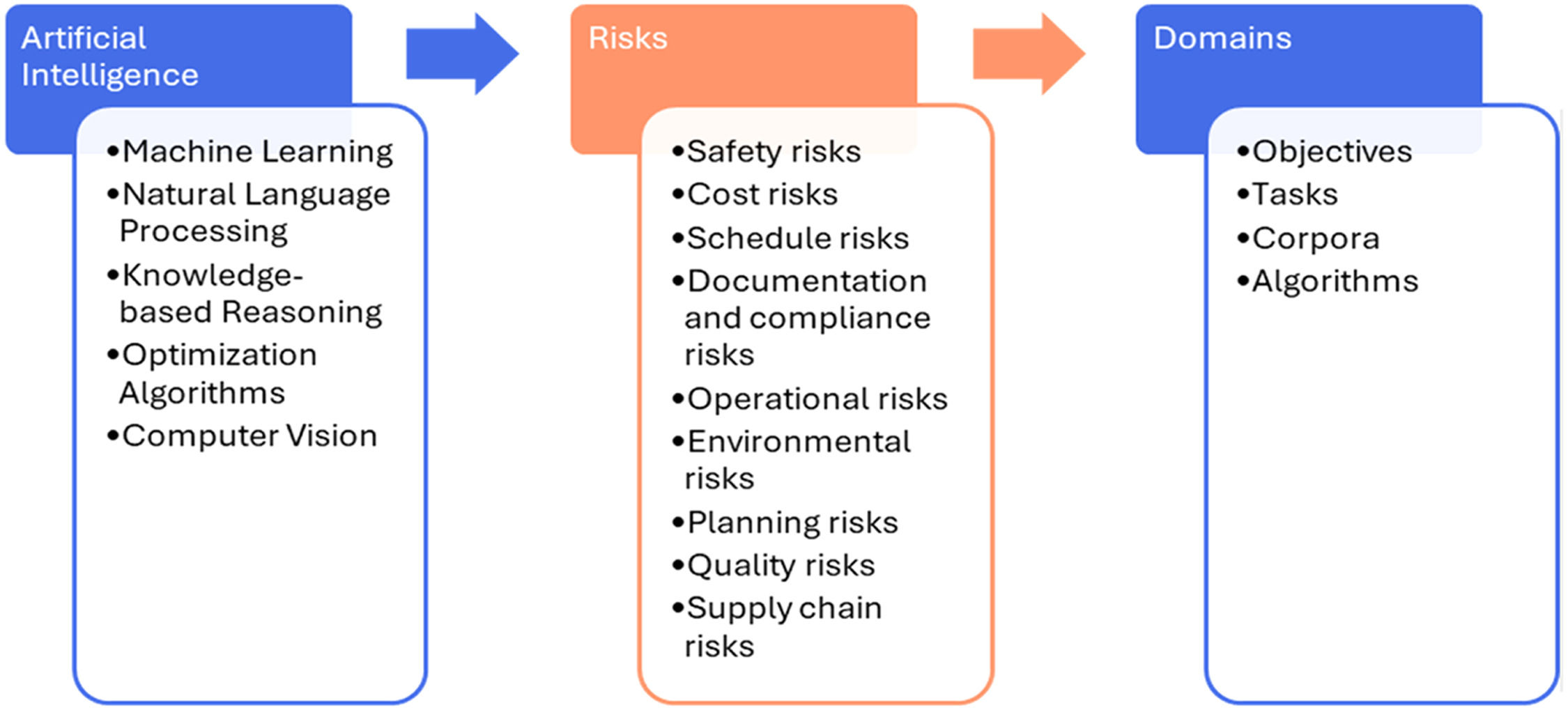
AI techniques used in construction risk managementA deeper understanding of AI’s role in construction risk management requires an examination of the specific AI methodologies applied across different risk domains. The following section categorises key AI techniques utilised in construction risk analysis extracted via VOSviewer, highlighting their functionalities and impact.
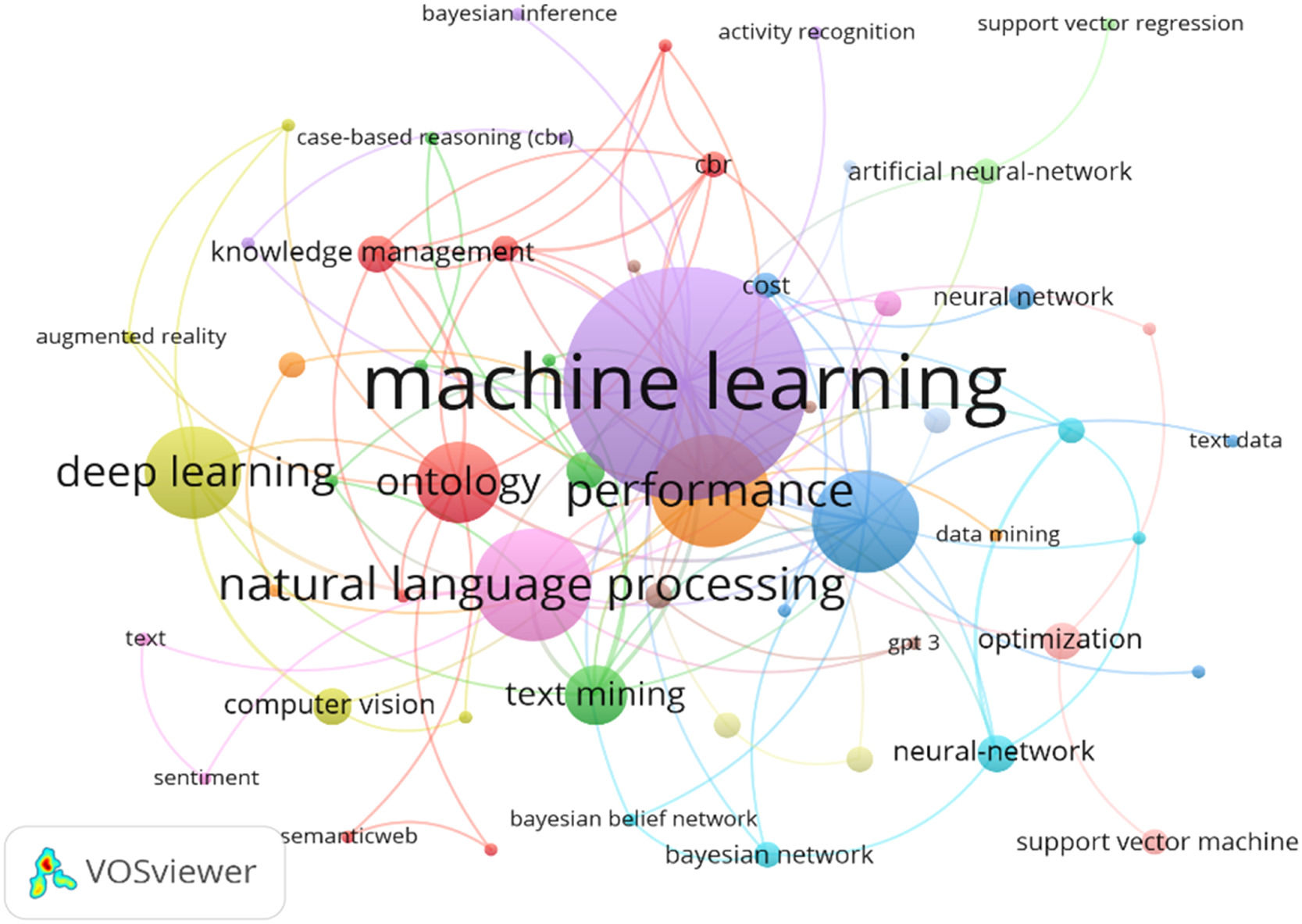
Fig. 8 illustrates the mapping of AI techniques derived from the selected literature through VOSviewer analysis.

The largest category identified is ML, with DM and DL emerging as prominent sub-categories within ML. NLP, including text mining, BERT, and ChatGPT, constitutes the second largest category. KBR encompasses methodologies such as CBR and ontological approaches. OAs and CV techniques are significant AI methods identified through the VOSviewer analysis. In this research, AI methodologies can be systematically classified into ML, NLP, KBR, OA, and CV, along with their respective sub-categories, including DL, CBR, ACO, and image detection algorithms.
Risk categories addressed by AIWith various AI techniques being implemented in construction risk management, it is crucial to analyse the types of risks these technologies address. By mapping AI applications to specific risk categories, this section outlines their effectiveness in improving safety, cost estimation, scheduling, compliance, and other critical risk domains.
Fig. 9 presents the visualisation of risk category keywords extracted from the selected studies generated using VOSviewer. This depiction highlights the frequency and relationships of key terms, offering insights into the primary focus areas of research within the field.
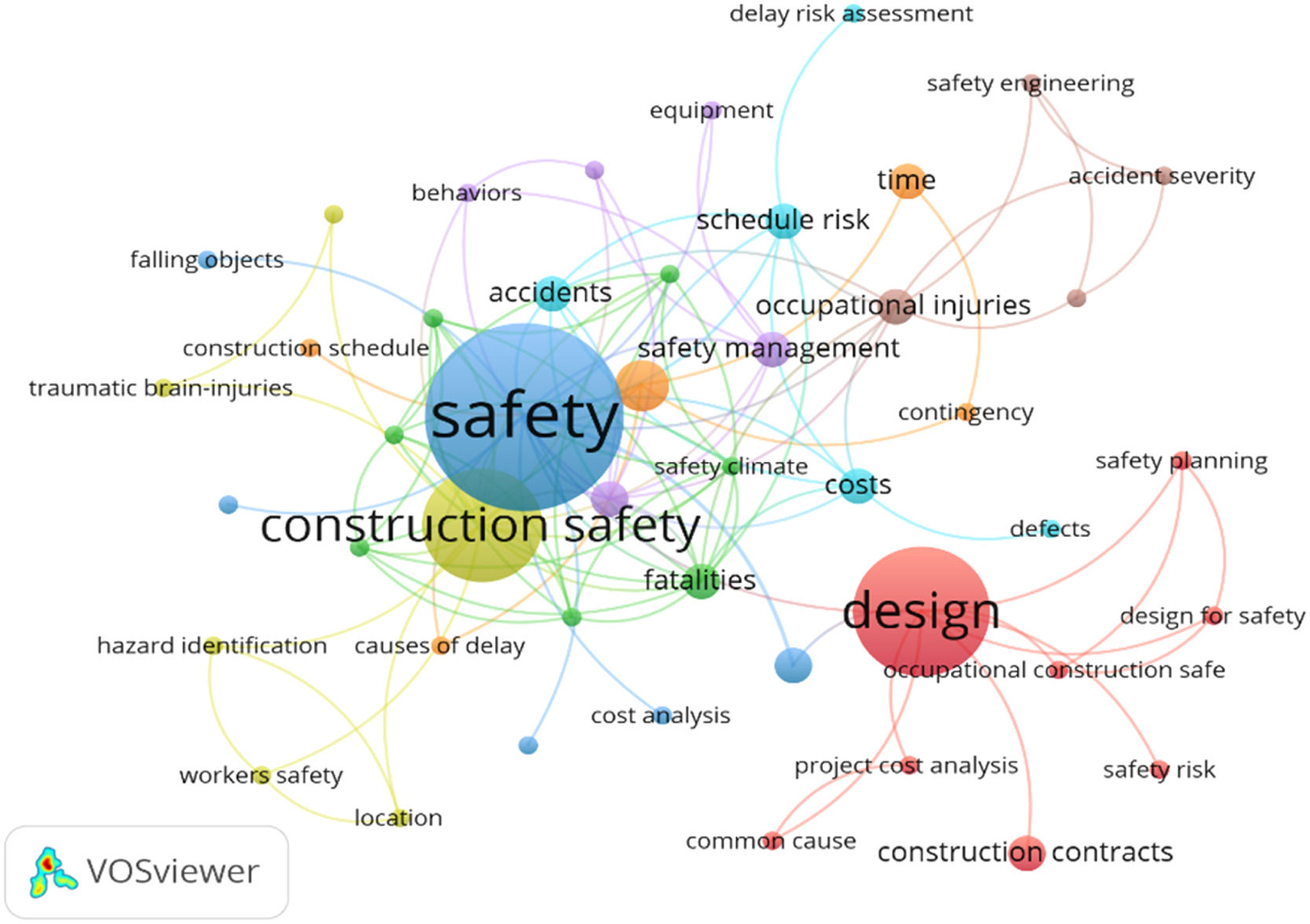
Safety risks represent the most prominent category, encompassing issues such as falls, accidents, and injuries. Factors related to cost and schedule are also identified as critical areas of concern. Contract risks are highlighted as a significant issue. Other identified risks include those associated with planning and design, climate and site impact, construction defects and supply chain challenges, which can be classified under planning risks, environmental risks, quality risks, and supply chain risks, respectively. Consequently, the overarching risk categories can be systematically grouped into safety risks, cost risks, schedule risks, documentation and compliance risks, planning risks, environmental risks, quality risks, and supply chain risks.
Thematic synthesis of AI contributionsThe final synthesis integrates AI techniques and risk categories to consolidate these insights, providing a comprehensive qualitative perspective on AI’s overall contributions to construction risk management.
The primary aim of this research is to explore the contributions of AI to construction risk management. For instance, CV algorithms can identify unsafe behaviours by analysing camera footage, enabling immediate reporting and rectification of safety hazards. ML algorithms leverage historical data to predict risks related to time and cost. Understanding how these algorithms operate within the context of construction risk management is crucial to elucidate their role and impact.
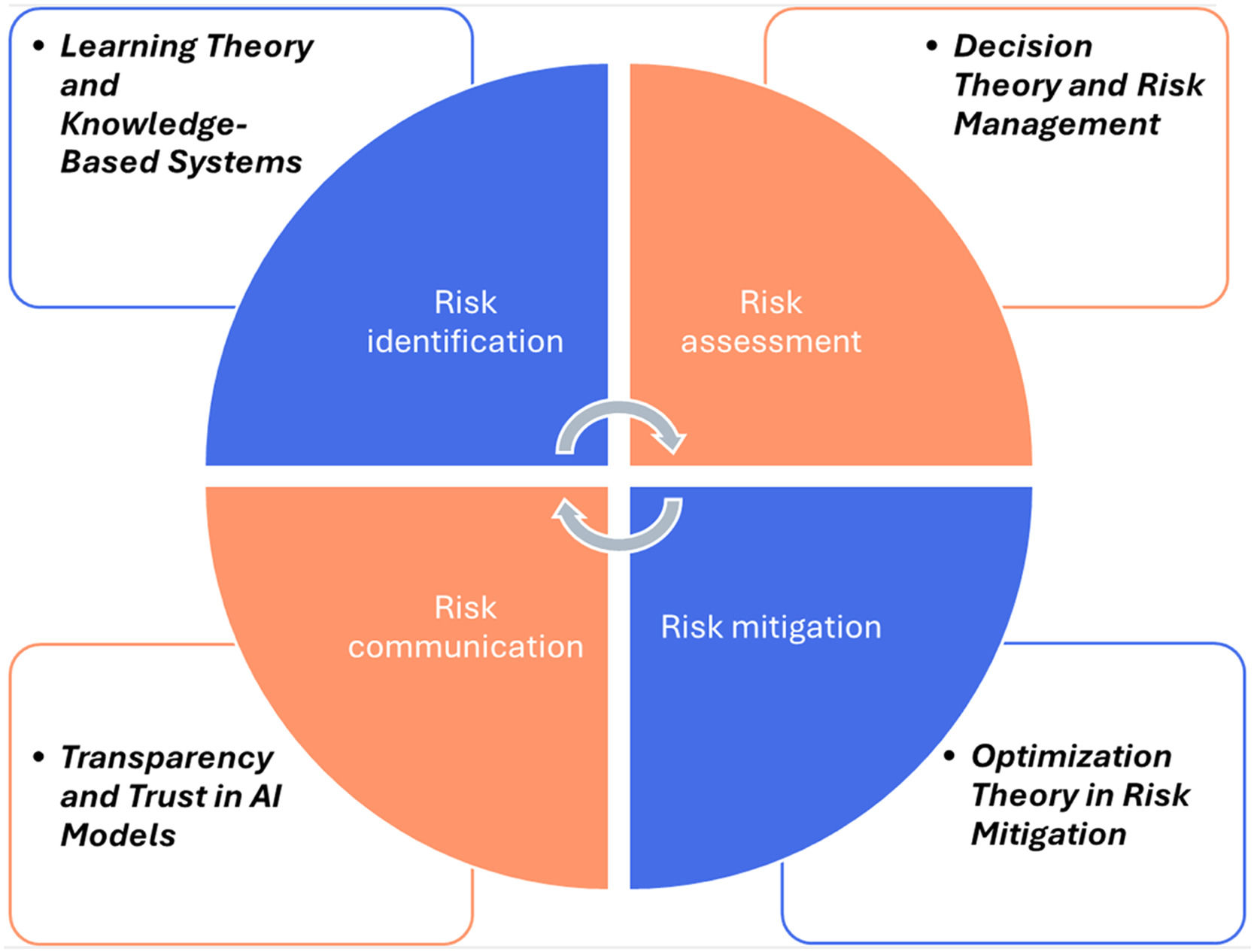
These studies seek to examine the objectives of AI applications, such as predictive and detection models, and to critically discuss the methodologies employed to achieve these objectives. A thematic classification framework has been developed and updated to refine the analytical approach based on keywords reflecting AI applications in the construction risk management domain. This framework is systematically divided into four distinct domains: the tasks performed by AI in risk management, the requirements for effective AI implementation, the application of algorithms within the risk management context and the role of AI across various stages of the risk management process. Each domain is further categorised into specific components, grouping various factors derived from the systematic review of selected studies. This structured framework provides a robust foundation for analysing and understanding AI's contributions to construction risk management.
Fig. 10 provides a visual representation of the thematic classification framework constructed in this study.

Thematic classification framework (Author’s design; insights from Ali et al., 2023; Shamshiri et al., 2024).
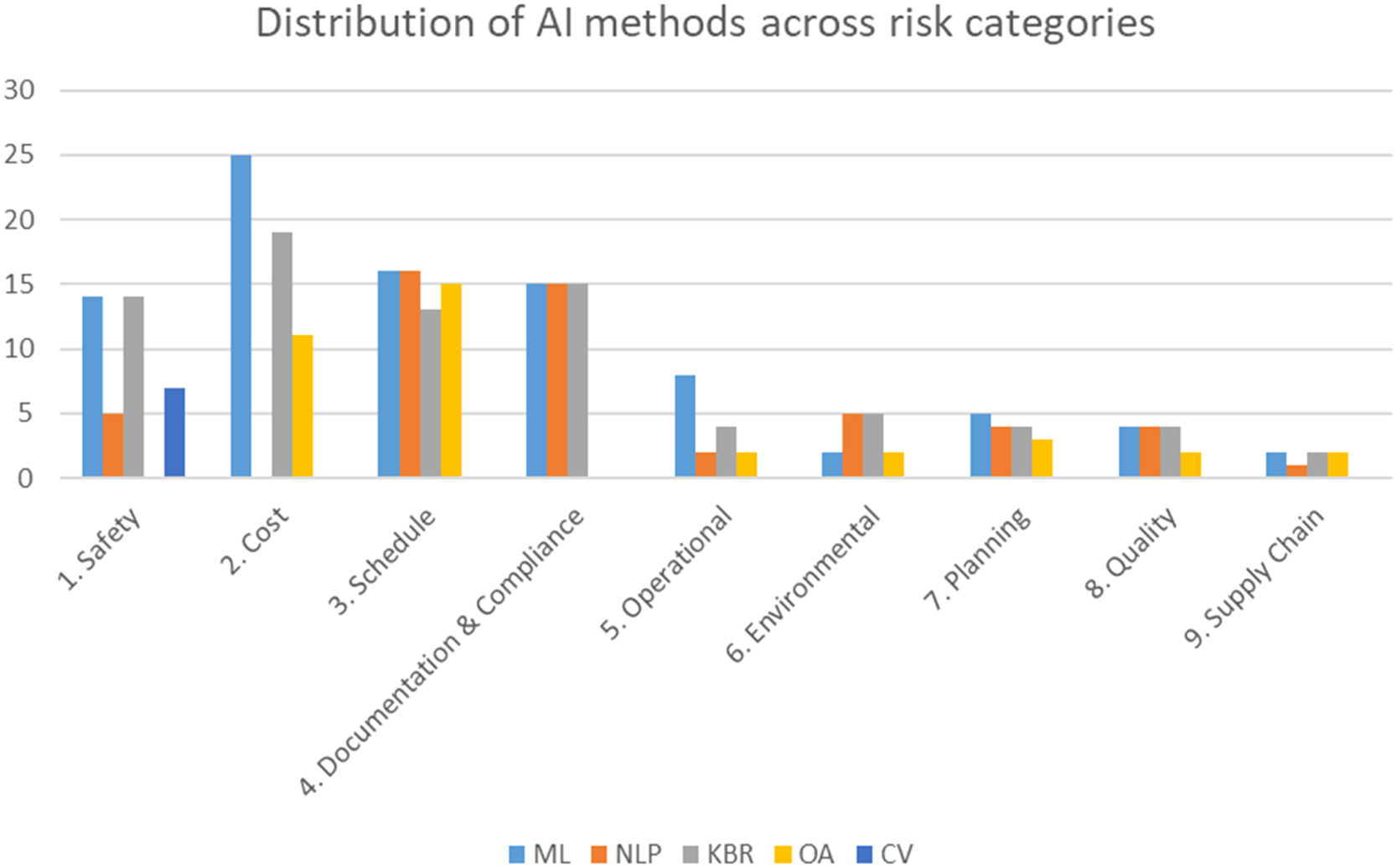
Following the development of the thematic classification framework, the selected studies were systematically mapped onto the framework to ensure a structured representation of AI applications in construction risk management. Fig. 11 illustrates the distribution of AI applications across different risk categories in construction.

Safety, cost, schedule, and documentation and compliance risks dominate AI applications, reflecting the industry's primary concerns. Environmental, planning, quality, and supply chain risks have relatively fewer AI applications, suggesting potential areas in construction risk management. ML is the most frequently applied method across most categories following the NLP, and KBR. OA and CV methods are less frequently used but show growing applications.
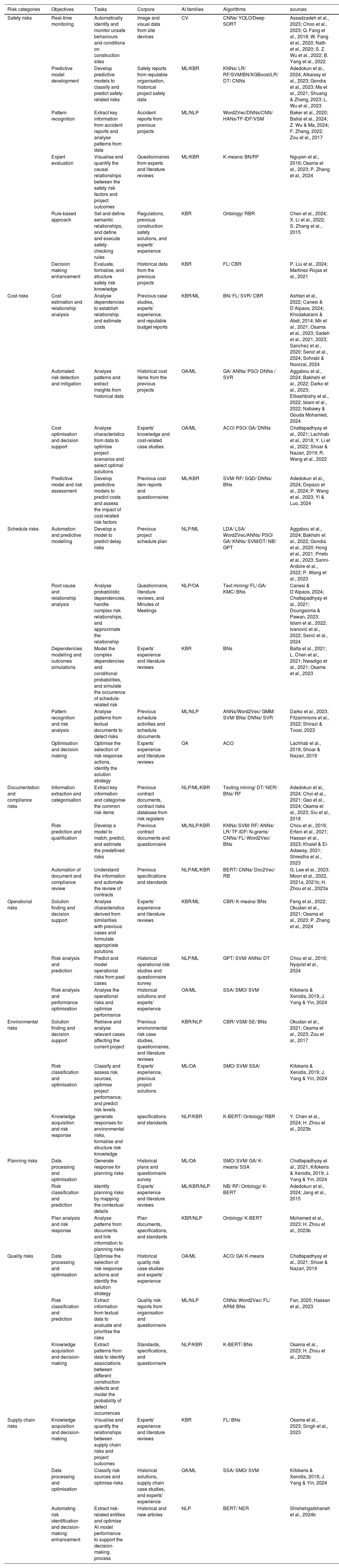
Table 10 presents a synthesis of the findings, derived from an in-depth review of construction risk management archetypes and their relationship with AI-driven solutions. This classification highlights the alignment between AI methodologies and specific risk categories, demonstrating how various AI techniques contribute to mitigating identified risks in construction projects.
Risk-based thematic classification framework for AI application in construction risk management (See “Abbreviations” for definitions).
| Risk categories | Objectives | Tasks | Corpora | AI families | Algorithms | sources |
|---|---|---|---|---|---|---|
| Safety risks | Real-time monitoring | Automatically identify and monitor unsafe behaviours and conditions on construction sites | Image and visual data from site devices | CV | CNNs/ YOLO/Deep SORT | Assadzadeh et al., 2023; Choo et al., 2023; Q. Fang et al., 2018; W. Fang et al., 2020; Nath et al., 2020; S. Z. Wu et al., 2022; B. Yang et al., 2022 |
| Predictive model development | Develop predictive models to classify and predict safety-related risks | Safety reports from reputable organisation, historical project safety data | ML/KBR | KNNs/ LR/ RF/SVM/BN/XGBoost/LR/ DT/ CNNs | Adedokun et al., 2024; Alkaissy et al., 2023; Gondia et al., 2023; Ma et al., 2021; Shuang & Zhang, 2023; L. Wu et al., 2023 | |
| Pattern recognition | Extract key information from accident reports and analyse patterns from data | Accident reports from previous projects | ML/NLP | Word2Vec/DNNs/CNN/ HANs/TF-IDF/VSM | Baker et al., 2020; Ballal et al., 2024; Z. Wu & Ma, 2024; F. Zhang, 2022; Zou et al., 2017 | |
| Expert evaluation | Visualise and quantify the causal relationships between the safety risk factors and project outcomes | Questionnaires from experts and literature reviews | ML/KBR | K-means/ BN/RF | Nguyen et al., 2016; Osama et al., 2023; P. Zhang et al., 2024 | |
| Rule-based approach | Set and define semantic relationships, and define and execute safety-checking rules | Regulations, previous construction safety solutions, and experts’ experience | KBR | Ontology/ RBR | Chen et al., 2024; X. Li et al., 2022; S. Zhang et al., 2015 | |
| Decision making enhancement | Evaluate, formalise, and structure safety risk knowledge | Historical data from the previous projects | KBR | FL/ CBR | P. Liu et al., 2024; Martínez-Rojas et al., 2021 | |
| Cost risks | Cost estimation and relationship analysis | Analyse dependencies to establish relationship and estimate costs | Previous case studies, experts’ experience, and reputable budget reports | KBR/ML | BN/ FL/ SVR/ CBR | Ashtari et al., 2022; Canesi & D’Alpaos, 2024; Khodakarami & Abdi, 2014; Mir et al., 2021; Osama et al., 2023; Sadeh et al., 2021, 2023; Sanchez et al., 2020; Senić et al., 2024; Sohrabi & Noorzai, 2024 |
| Automated risk detection and mitigation | Analyse patterns and extract insights from historical data | Historical cost items from the previous projects | OA/ML | GA/ ANNs/ PSO/ DNNs / SVR | Aggabou et al., 2024; Bakhshi et al., 2022; Darko et al., 2023; Elbashbishy et al., 2022; Islam et al., 2022; Nabawy & Gouda Mohamed, 2024 | |
| Cost optimisation and decision support | Analyse characteristics from data to optimise project scenarios and select optimal solutions | Experts’ knowledge and cost-related case studies | OA/ML | ACO/ PSO/ GA/ DNNs | Chattapadhyay et al., 2021; Lachhab et al., 2018; Y. Li et al., 2022; Shoar & Nazari, 2019; R. Wang et al., 2022 | |
| Predictive model and risk assessment | Develop predictive models to predict costs and assess the impact of cost-related risk factors | Previous cost item reports and questionnaires | ML/KBR | SVM/ RF/ SGD/ DNNs/ BNs | Adedokun et al., 2024; Dopazo et al., 2024; P. Wang et al., 2023; Yi & Luo, 2024 | |
| Schedule risks | Automation and predictive modelling | Develop a model to predict delay risks | Previous project schedule plan | NLP/ML | LDA/ LSA/ Word2Vec/ANNs/ PSO/ GA/ KNNs/ SVM/DT/ NB/ GPT | Aggabou et al., 2024; Bakhshi et al., 2022; Gondia et al., 2020; Hong et al., 2021; Prieto et al., 2023; Sanni-Anibire et al., 2022; P. Wang et al., 2023 |
| Root cause and relationship analysis | Analyse probabilistic dependencies, handle complex risk relationships, and approximate the relationship | Questionnaire, literature reviews, and Minutes of Meetings | NLP/OA | Text mining/ FL/ GA/ KMC/ BNs | Canesi & D’Alpaos, 2024; Chattapadhyay et al., 2021; Doungsoma & Pawan, 2023; Islam et al., 2022; Ivanović et al., 2022; Senić et al., 2024 | |
| Dependencies modelling and outcomes simulations | Model the complex dependencies and conditional probabilities, and simulate the occurrence of schedule-related risk | Experts’ experience and literature reviews | KBR | BNs | Balta et al., 2021; L. Chen et al., 2021; Nwadigo et al., 2021; Osama et al., 2023 | |
| Pattern recognition and risk analysis | Analyse patterns from textual documents to detect risks | Previous schedule activities and schedule documents | ML/NLP | ANNs/Word2Vec/ GMM/ SVM/ BNs/ DNNs/ SVR | Darko et al., 2023; Fitzsimmons et al., 2022; Shirazi & Toosi, 2023 | |
| Optimisation and decision making | Optimise the selection of risk response actions, identify the solution strategy | Experts’ experience and literature reviews | OA | ACO | Lachhab et al., 2018; Shoar & Nazari, 2019 | |
| Documentation and compliance risks | Information extraction and categorisation | Extract key information and categorise the common risk items | Previous contract documents, contract risks database from risk registers | NLP/ML/KBR | Texting mining/ DT/ NER/ BNs/ RF | Adedokun et al., 2024; Choi et al., 2021; Gao et al., 2024; Osama et al., 2023; Siu et al., 2018 |
| Risk prediction and qualification | Develop a model to match, predict, and estimate the predefined risks | Previous contract documents and questionnaire | ML/NLP/KBR | KNNs/ SVM/ RF/ ANNs/ LR/ TF-IDF/ N-grams/ CNNs/ FL/ Word2Vec/ BNs | Chou et al., 2016; Erfani et al., 2021; Hassan et al., 2023; Khalef & El-Adaway, 2021; Shrestha et al., 2023 | |
| Automation of document and compliance review | Understand the information and automate the review of contracts | Previous specifications and standards | NLP/ML/KBR | BERT/ CNNs/ Doc2Vec/ RB | G. Lee et al., 2023; Moon et al., 2022, 2021a, 2021b; H. Zhou et al., 2023a | |
| Operational risks | Solution finding and decision support | Analyse characteristics derived from similarities with previous cases and formulate appropriate solutions | Experts’ experience and literature reviews | KBR/ML | CBR/ K-means/ BNs | Feng et al., 2022; Okudan et al., 2021; Osama et al., 2023; P. Zhang et al., 2024 |
| Risk analysis and prediction | Predict and model operational risks from past cases | Historical operational risk studies and questionnaire survey | NLP/ML | GPT/ SVM/ ANNs/ DT | Chou et al., 2016; Nyqvist et al., 2024 | |
| Risk analysis and performance optimisation | Analyse the operational risks and optimise performance | Historical solutions and experts’ experience | OA/ML | SSA/ SMO/ SVM | Kifokeris & Xenidis, 2019; J. Yang & Yin, 2024 | |
| Environmental risks | Solution finding and decision support | Retrieve and analyse relevant cases affecting the current project | Previous environmental risk case studies, questionnaires, and literature reviews | KBR/NLP | CBR/ VSM/ SE/ BNs | Okudan et al., 2021; Osama et al., 2023; Zou et al., 2017 |
| Risk classification and optimisation | Classify and assess risk sources, optimise project performance, and predict risk levels. | Experts’ experience, previous project solutions | ML/OA | SMO/ SVM/ SSA/ | Kifokeris & Xenidis, 2019; J. Yang & Yin, 2024 | |
| Knowledge acquisition and risk response | generate responses for environmental risks, formalise and structure risk knowledge | specifications and standards | NLP/KBR | K-BERT/ Ontology/ RBR | Y. Chen et al., 2024; H. Zhou et al., 2023b | |
| Planning risks | Data processing and optimisation | Generate response for planning risks | Historical plans and questionnaire survey | ML/OA | SMO/ SVM/ GA/ K-means/ SSA | Chattapadhyay et al., 2021; Kifokeris & Xenidis, 2019; J. Yang & Yin, 2024 |
| Risk classification and prediction | Identify planning risks by mapping the contextual details | Experts’ experience and literature reviews | ML/KBR/NLP | NB/ RF/ Ontology/ K-BERT | Adedokun et al., 2024; Jang et al., 2015 | |
| Plan analysis and risk response | Analyse patterns from documents and link information to planning risks | Plan documents, specifications, and standards | KBR/NLP | Ontology/ K-BERT | Mohamed et al., 2023; H. Zhou et al., 2023b | |
| Quality risks | Data processing and optimisation | Optimise the selection of risk response actions and identify the solution strategy | Historical quality risk case studies and experts’ experience | OA/ML | ACO/ GA/ K-means | Chattapadhyay et al., 2021; Shoar & Nazari, 2019 |
| Risk classification and prediction | Extract information from textual data to evaluate and prioritise the risks | Quality risk reports from organisation and questionnaire | ML/NLP | CNNs/ Word2Vec/ FL/ ARM/ BNs | Fan, 2020; Hassan et al., 2023 | |
| Knowledge acquisition and decision-making | Extract patterns from data to identify associations between different construction defects and model the probability of defect occurrences | Standards, specifications, and questionnaire | NLP/KBR | K-BERT/ BNs | Osama et al., 2023; H. Zhou et al., 2023b | |
| Supply chain risks | Knowledge acquisition and decision-making | Visualise and quantify the relationships between supply chain risks and project outcomes | Experts’ experience and literature reviews | KBR | FL/ BNs | Osama et al., 2023; Singh et al., 2023 |
| Data processing and optimisation | Classify risk sources and optimise risks | Historical solutions, supply chain case studies, and experts’ experience | OA/ML | SSA/ SMO/ SVM | Kifokeris & Xenidis, 2019; J. Yang & Yin, 2024 | |
| Automating risk identification and decision-making enhancement | Extract risk-related entities and optimise AI model performance to support the decision-making process | Historical and new articles | NLP | BERT/ NER | Shishehgarkhaneh et al., 2024b |
ML is the most frequently applied AI method in safety, cost, schedule, documentation, operational, environmental, planning, quality, and supply chain risks. The widespread use of ML highlights its ability to handle large heterogeneous datasets, extract predictive patterns and improve risk forecasting. NLP methods are used for document and compliance risk management. AI-driven contract analysis, risk prediction, and compliance verification improve efficiency by automating labour-intensive processes. KBR approaches enhance decision-making by integrating expert knowledge into AI-driven models. KBR is especially valuable in cost estimation, operational risk mitigation, and supply chain management where expert judgment is critical. OAs improve cost, schedule, and resource allocation efficiency. OA contributes to risk mitigation by generating optimal project scenarios, reducing delays and cost overruns. CV-based models are widely applied to real-time monitoring of safety risks. These models enable automated hazard detection, reducing on-site accidents and improving worker safety.
The thematic analysis results will be linked to the research questions for further discussion.
DiscussionsAI has significantly transformed risk management in construction by introducing advanced predictive analytics, automation, and decision support systems. As the industry continues to evolve, research efforts have focused on refining AI methodologies to enhance risk detection, assessment, and mitigation. Understanding the emerging trends in AI-driven risk management provides valuable insights into how these technologies have progressed over the past decade and their potential future impact.
Research trends in AI applications for construction risk managementThe first research question in section 1.3 focused on exploring the prevailing research trends in the application of AI to construction risk management. The systematic review reveals several emerging research trends in the application of AI to construction risk management practices. These trends primarily focus on the evolution of AI techniques, diversification of risk categories addressed, and increasing integration of AI-driven solutions into construction management.
Prevailing focus on safety, cost, schedule, and documentation risksFrom 2014 to 2024, AI applications in safety, cost, schedule, and documentation risks have dominated construction risk management research. The dominance of safety, cost, schedule, and documentation risks in AI-driven construction research can be attributed to several factors. Regulatory pressures are particularly strong in these areas, compelling project stakeholders to adopt advanced tools for compliance and worker protection. For instance, safety regulations have generated demand for CV algorithms such as YOLO and CNNs, enabling on-site hazard detection with greater accuracy and speed (Assadzadeh et al., 2023; Choo et al., 2023; Nath et al., 2020; B. Yang et al., 2022). Cost overruns often lead to significant project issues, driving the need for approaches to improve financial risk forecasting (Sadeh et al., 2021; Senić et al., 2024).
Industry has pushed AI research toward reducing accidents, control costs, avoiding delays, and ensuring proper documentation. For example, serious accidents harm workers, damage a company’s reputation, and lead to legal problems. This forces companies to invest in AI-powered safety systems to prevent hazards on-site (Q. Fang et al., 2018; S. Z. Wu et al., 2022). When costs go over budget, companies lose money and risk damaging relationships with investors and clients. To prevent this, businesses are using AI techniques such as CBR and FL to better predict and manage costs (Canesi & D’Alpaos, 2024; Sadeh et al., 2021).
The construction industry involves collaboration between various stakeholders, including government agencies, clients, contractors, and subcontractors. This complexity increases the need for accurate documentation and strict compliance with regulations. As construction laws and standards continue to evolve, AI-powered NLP offers an efficient way to analyse and interpret complex contracts, reducing human errors and improving legal accuracy (Choi et al., 2021; Siu et al., 2018).
Expansion of AI applications to understudied risk categoriesWhile early research primarily focused on safety, cost, schedule, and documentation risks, recent studies have expanded AI applications to previously understudied risk categories such as environmental risks, planning risks, operational risks, and supply chain risks.
As computational power and algorithmic sophistication improved, researchers found it more feasible to tackle complexities beyond safety, cost, schedule, and documentation risks (H. Zhou et al., 2023b; Y. Chen et al., 2024). The integration of AI technologies enables complex data collection to support advanced AI solutions for environmental, operational, quality, and supply chain risks (Mohamed et al., 2023; Osama et al., 2023; J. Yang & Yin, 2024). As sustainability goals come to prominence, academic research has shifted toward environmental risks, emphasising green building practices, pollution prevention, and waste reduction (Okudan et al., 2021; Zou et al., 2017). Planning processes have become more multifaceted, involving interdisciplinary teams, diverse stakeholder goals, and advanced project delivery methods. AI tools increase precision in resource allocation and risk prioritisation (Chattapadhyay et al., 2021; J. Yang & Yin, 2024). Integrated AI models offer insights into resource utilisation, maintenance, and incident management, supporting decision-making to mitigate operational risks (Nyqvist et al., 2024; P. Zhang et al., 2024). As customer expectations rise and industry standards tighten, researchers have applied AI-based models to detect defects ensuring adherence to the latest benchmarks (Hassan et al., 2023; Osama et al., 2023). Construction now relies on global supply networks, with specialised materials often sourced internationally. This increases vulnerability to logistics bottlenecks, currency fluctuations, and geopolitical risks (Kifokeris & Xenidis, 2019; Singh et al., 2023). In pursuit of innovation, researchers are exploring emerging risk domains where AI can provide competitive advantages (Kifokeris & Xenidis, 2019; J. Yang & Yin, 2024).
Trends in dominant and growing AI for construction risk managementML, NLP, and KBR emerge as the most frequently used AI approaches in construction risk management, primarily due to their robust capability to handle large heterogeneous datasets, extract meaningful insights from unstructured textual corpora and drive proactive data-driven decision-making. Construction risk management produces varied and extensive documented datasets suitable for ML, NLP, and KBR algorithms. ML algorithms can handle large-scale or continuously updated data, making them well-suited for complex or long-term projects (Adedokun et al., 2024; Sadeh et al., 2023). NLP solutions integrated into document management systems automate compliance checks, contract reviews, and risk identification tasks, demonstrating scalable workflow optimisation (Moon et al., 2021b; Shrestha et al., 2023). Many critical aspects of construction risk management do not always yield sufficient historical data for purely statistical learning. KBR systems such as Bayesian belief networks (BBNs), CBR, and rule-based reasoning model (RBR) fill this gap by capturing and encoding domain expertise (Fan, 2020; Nguyen et al., 2016).
A clear research trend is the growing emphasis on predictive risk assessment models, particularly using ML methods. ML identifies numeric and statistical patterns, enabling accurate forecasts of potential cost or schedule deviations (Adedokun et al., 2024). ML algorithms, such as BNs, random forest (RF), and support vector machine (SVM), are widely utilised to develop structured predictive models that quantify and assess uncertainties across various construction risk categories, including safety, cost, schedule, operational, environmental, planning, quality, and supply chain risks. These models enable data-driven risk evaluation, facilitating proactive decision-making and mitigating potential project disruptions (Hassan et al., 2023; Jang et al., 2015; J. Yang & Yin, 2024).
Construction is a complex, time-consuming process requiring compliance with numerous documents, regulations, and specifications, which are traditionally handled by humans. NLP-based NER and BERT algorithms analyse legal documents, standards, and specifications, thereby reducing the manual workload in compliance checks (Moon et al., 2021a; H. Zhou et al., 2023a). NLP provides the necessary toolkit for extracting insights from these unstructured textual documents and automating tasks such as information extraction, classification, and predictive analysis (Erfani et al., 2021; Hassan et al., 2023). Patterns in textual documentation can be analysed and classified via NLP-based Word2Vec, TF-IDF, and Vector Space Model (VSM) algorithms (Baker et al., 2020; Zou et al., 2017).
KBR methods can offer more interpretable, audit-friendly logic, which is especially valued in regulated environments or high-stakes decisions (Osama et al., 2023). As ML adoption grows, practitioners see the need to blend data-driven models with human expertise. KBR provides a structured mechanism to integrate heuristics, engineering rules, and safety guidelines into AI workflows (Okudan et al., 2021; Sohrabi & Noorzai, 2024).
Emerging AI trends in construction risk managementWhile ML, NLP, and KBR continue to dominate AI applications in construction risk management, there has been a recent surge in interest in OA and CV approaches.
Historically, construction data was fragmented, inconsistent, or paper-based, making it hard to formalise constraints and objectives for algorithms such as GA, PSO, or ACO (Shoar & Nazari, 2019). Running these algorithms on large-scale construction projects was computationally expensive and time-consuming (Chattapadhyay et al., 2021). Industry adoption of digital project management systems standardises data, simplifying the setup of multi-objective optimisation models (Bakhshi et al., 2022). Combining ML predictions with OA frameworks has demonstrated strong results in adaptive project scheduling and resource allocation (Elbashbishy et al., 2022; Islam et al., 2022).
Real-time object detection or motion tracking requires specialised GPUs and strong computing infrastructure. Until recently, such hardware was cost-prohibitive for many construction projects, making scaled CV implementation rare (S. Z. Wu et al., 2022). Early CV solutions struggled to adapt to these varied conditions, making them less reliable than manual safety checks. YOLO and Faster R-CNN now offer near-real-time detection with higher accuracy and lower computational overhead (Assadzadeh et al., 2023; Nath et al., 2020). Rising safety regulations and zero-accident goals drive the need for 24/7 automated monitoring (B. Yang et al., 2022).
The rise of hybrid AI models for risk managementA prominent development in contemporary AI-based construction risk management is the increased adoption of hybrid AI models that integrate multiple techniques into single, cohesive frameworks (Chattapadhyay et al., 2021; J. Yang & Yin, 2024). This shift reflects a growing realisation that construction risk scenarios involve highly interrelated factors, spanning quantitative datasets and qualitative information. Single-method approaches often struggle to capture the full range of these complexities, while hybrid models leverage the complementary strengths of multiple AI techniques, resulting in more robust, scalable, and adaptable solutions (Chattapadhyay et al., 2021; Doungsoma & Pawan, 2023; Y. Chen et al., 2024; J. Yang & Yin, 2024).
Construction projects generate diverse data, including metrics, site information, textual documentation, and expert knowledge that contributes to multi-layered risk. Hybrid models provide greater accuracy than single AI models. Combining ML and NLP offers a comprehensive risk classification and highlights probabilistic dependencies (Chattapadhyay et al., 2021). For complex domains such as compliance risks, safety protocols, or environmental standards, hybrid models enhance interpretability and trustworthiness (Y. Chen et al., 2024).
Advanced hybrid models can be implemented more practically in the real world. Hybrid AI integration with construction risk management platforms enables automated risk detection and fosters collaborative decision-making among project stakeholders (L. Wu et al., 2023). As construction projects become larger and more complex, hybrid AI solutions synthesise multiple data types, incorporate domain knowledge, and stand to advance predictive risk management in real-time, diminishing project uncertainties and improving sustainability outcomes (P. Wang et al., 2023; J. Yang & Yin, 2024).
AI contributions to construction risk managementThe second research question, “How do AI methodologies contribute to construction risk management across different risk categories?” seeks to explore the role of AI in addressing various construction risk categories. This study identifies key insights into AI's contributions through a hybrid analysis of data retrieved from the Web of Science and Scopus databases, alongside the thematic classification framework.
AI-driven efficiency improvement in construction risk managementML enhances efficiency by automating risk detection and forecasting risks faster than traditional statistical models. ML algorithms, such as RF, SVM, and BNs, can quickly process vast amounts of structured and unstructured data, allowing for rapid risk assessments with high accuracy (Adedokun et al., 2024; Sadeh et al., 2021). For example, ML-driven schedule risk models predict potential delays in tall building projects by analysing thousands of project parameters in real-time (Hong et al., 2021). In contrast to traditional methods that require manual analysis of historical records, ML automates this process, providing instant insights.
AI-powered NLP systems automate extracting critical information from large volumes of regulatory and contractual documents, significantly reducing the manual workload and accelerating compliance checks (Choi et al., 2021). Such efficiency gains not only lower operational costs but also free up human resources to focus on higher-level decision-making and strategic tasks. BERT-based NLP algorithms automate contract analysis, reducing document review times by over 80 %, thus preventing legal disputes and improving adherence to compliance standards (Moon et al., 2022). AI-powered document processing tools read and categorise safety regulations and contract clauses in seconds (Moon et al., 2021a; H. Zhou et al., 2023a). This significantly reduces legal risks and human errors in compliance verification.
KBR systems enhance efficiency by automating expert-driven decisions in safety, cost, and operational risk management. CBR and BBNs mimic human experts, allowing for quick decision-making based on past risk scenarios and domain knowledge (Osama et al., 2023). OAs reduce human workload by finding the most efficient allocation of time, labour, and materials (Lachhab et al., 2018).
One of the most tangible benefits of AI in construction is its ability to dramatically improve efficiency through faster data processing and real-time analytics. For example, CV algorithms, such as YOLO and CNNs, enable rapid analysis of image and video data from construction sites, allowing for immediate detection of unsafe conditions and non-compliance with safety protocols (Q. Fang et al., 2018; S. Z. Wu et al., 2022). Automated non-hardhat detection systems using DL algorithms can identify workers not wearing protective gear within milliseconds (Assadzadeh et al., 2023). This significantly enhances safety monitoring by surpassing human inspectors, who may overlook violations due to fatigue or limited coverage. The rapid processing minimises the delay between hazard detection and corrective action, ensuring swift responses and improving overall operational efficiency.
AI-enhanced decision optimisation in construction risk managementAI contributes to decision optimisation by enhancing the accuracy and reliability of risk assessments and forecasting models. Advanced ML techniques are capable of identifying subtle patterns within large, heterogeneous datasets, leading to more precise predictions of cost overruns, schedule delays, and safety incidents (Adedokun et al., 2024; Sadeh et al., 2021). Algorithms such as RF, BNs, and SVM learning have been successfully applied to forecast cost overruns, schedule delays, and safety risks (Adedokun et al., 2024). These models analyse large datasets to predict potential risks to an accuracy greater than 85 %, surpassing traditional methods that rely on historical trends alone.
NLP classifies risk factors based on textual data, improving decision-making in compliance and supply chain risk management. AI-driven contract review models identify contractual loopholes and potential litigation risks, reducing legal uncertainties (Moon et al., 2021a; Shrestha et al., 2023). KBR enhances decision credibility by integrating expert knowledge into AI models. Nguyen et al. (2016) and Osama et al. (2023) assessed safety risk factors and provided structured recommendations via KBR systems. AI-powered decision support systems integrate predictive analytics with Monte Carlo simulations, enabling real-time probabilistic risk assessments. For example, AI-assisted Monte Carlo simulations improve contingency planning by analysing thousands of possible project scenarios in minutes, allowing managers to prepare for worst-case outcomes (Kifokeris & Xenidis, 2019). These models help construction managers understand risk interdependencies, ensuring data-driven, evidence-based decision-making rather than reliance on intuition or experience alone (Bakhshi et al., 2022). By providing a data-driven basis for decision-making, these AI models enable construction managers to make timely and informed choices, ultimately reducing uncertainty and enhancing project outcomes.
When combined with OAs such as GA and ACO, AI systems can simulate numerous scenarios to identify optimal resource allocation strategies and risk mitigation plans (Lachhab et al., 2018; Shoar & Nazari, 2019). Lachhab et al. (2018), demonstrated how GA models optimised project schedules by identifying the most efficient risk mitigation strategies, reducing schedule deviations by up to 40 %. Multi-objective chaos search algorithms, for instance, optimise project planning by balancing risk exposure with cost efficiency, leading to more robust risk mitigation strategies (Y. Li et al., 2022).
AI-facilitated capability expansion in construction risk managementAI extends the capabilities of risk management systems beyond what is feasible with traditional methods. By leveraging technologies such as ML, AI can process and interpret massive datasets in real-time, allowing capabilities that far exceed human processing limits. For example, anomaly detection algorithms in ML can flag unexpected project disruptions, such as supply chain bottlenecks, weather-related risks, or labour shortages, before they escalate into major issues (Singh et al., 2023). DL-based surveillance models can track thousands of workers simultaneously, a task that would be infeasible for human inspectors (Choo et al., 2023).
While human inspectors are limited by working hours, AI-based safety monitoring systems are designed to operate continuously, providing uninterrupted surveillance. This ensures real-time risk detection and instantaneous alerts, reducing the likelihood of overlooked hazards (Assadzadeh et al., 2023; Nath et al., 2020). Real-time mixed reality-based visual warning systems help detect high-risk activities such as working at heights, enabling immediate interventions (Assadzadeh et al., 2023; L. Wu et al., 2023).
AI enables the fusion of diverse data types, including visual, textual, and numerical datasets, creating comprehensive risk profiles that would be impossible to generate using conventional risk assessment methods (Osama et al., 2023). This capability expansion is particularly useful in areas such as environmental sustainability, operational efficiency, and supply chain management, where complex risk factors must be monitored across multiple sources. AI-powered predictive maintenance models, for instance, analyse equipment usage patterns to prevent failures before they occur, reducing downtime and safety risks (J. Yang & Yin, 2024).
AI-inspired model innovation in construction risk managementAI is fostering model innovation by creating new frameworks and business models that were previously unattainable. The advent of hybrid AI models has led to the development of comprehensive risk management platforms that offer a unified view of construction risks (Chattapadhyay et al., 2021; J. Yang & Yin, 2024). These integrated systems enable the detection and prediction of risks across multiple categories and facilitate collaborative decision-making among diverse stakeholders.
The development of hybrid AI models, combining ML, NLP, and OA, has led to the emergence of integrated risk management platforms (Chattapadhyay et al., 2021). These platforms facilitate cross-domain risk detection, analysis, and response coordination, enabling seamless communication between safety, cost, schedule, and compliance teams. AI-powered digital twins simulate construction site conditions in real-time, allowing construction managers to assess multiple risk scenarios and determine the best course of action before actual implementation (L. Wu et al., 2023). This AI-driven virtual modelling enhances decision-making by visualising potential project risks, leading to more adaptive and resilient project planning. AI-enhanced smart contracts use blockchain-integrated NLP systems to automate risk-based contract enforcement, reducing legal disputes and ensuring real-time compliance tracking (Moon et al., 2022). These smart contracts dynamically adjust project terms based on evolving risk conditions, providing unprecedented adaptability in construction risk management.
Theoretical and practical implicationsThe integration of AI in construction risk management represents a significant shift, both in theoretical understanding and practical application. AI's ability to enhance risk identification, prediction, and mitigation has led to advancements in decision-making frameworks and the optimisation of construction processes. This section explores how AI informs and adapts theoretical frameworks in construction risk management and how these theories translate into real-world practices.
Implications for theoryAdopting AI in construction risk management offers a transformative lens for redefining traditional theoretical models. AI introduces adaptive, data-driven methodologies that expand on established frameworks in decision-making, risk analysis and optimisation. Fig. 12 illustrates the findings of this review, which can be conceptualised through a framework encompassing the key components of risk management: risk identification, risk assessment, risk mitigation, and risk communication (Ganesh & Kalpana, 2022; Moullin et al., 2015).

Implication framework (Author’s design; insights from Ganesh & Kalpana, 2022; Moullin et al., 2015).
Learning theory and knowledge-based systems: AI-enabled systems challenge the static nature of traditional KBR by introducing self-learning capabilities. ML and NLP allow systems to evolve by analysing vast datasets, autonomously refining their models without continuous human intervention (Hoseini et al., 2017). This paradigm shift aligns with learning theories that emphasise continuous improvement through exposure to new data. For example, AI-driven systems in construction can iteratively improve safety protocols by analysing past incidents and incorporating real-time feedback.
Decision theory and risk management: Traditional decision theory in construction relied on reactive approaches, such as the Critical Path Method, and Program Evaluation and Review Technique (Testorelli et al., 2024). AI revolutionises this framework by enabling probabilistic, real-time decision-making. ML models process large, dynamic datasets to predict risks such as cost overruns or schedule delays, adapting continuously as new data is introduced (Bakhshi et al., 2022). This evolution marks a shift from static risk assessment to adaptive, proactive management.
Optimisation theory in risk mitigation: Optimisation theory, historically focused on resource allocation, now integrates AI to provide dynamic real-time solutions. Algorithms such as GA, PSO, and ACO dynamically adjust to fluctuating project conditions, optimising resource distribution and mitigating risks such as material shortages or subcontractor inefficiencies (Shoar & Nazari, 2019). These AI-driven approaches demand new theoretical models that account for constant feedback and iterative improvement.
Transparency and trust in AI models: One of the theoretical challenges posed by AI is the "black-box" nature of certain models, particularly DL systems. This opacity raises concerns about accountability and interpretability in decision-making. Advancements in explainable AI aim to address these concerns, ensuring that AI models provide not only accurate predictions but also understandable and justifiable recommendations (Hong et al., 2021). Theoretical work in this area is critical to fostering trust and enabling the adoption of AI in high-stakes construction contexts.
Implications for practiceThe practical implications of AI in construction risk management have had a transformative impact on project planning, safety, cost management, and overall project efficiency. AI enhances construction practices by optimising processes, improving decision-making, and automating key tasks, though its adoption also presents challenges in terms of data quality, system integration, and workforce skills.
Real-time risk monitoring and decision-making: AI-powered tools such as CV systems and predictive ML models enable real-time monitoring of construction sites. For instance, CV algorithms can detect safety violations, such as workers not wearing protective equipment, while predictive models anticipate disruptions from weather or supply chain issues (Prieto et al., 2023). This proactive approach shifts risk management from reactive to preventive, improving safety and project outcomes.
Optimised resource allocation and scheduling: AI-driven optimisation models analyse historical and real-time data to forecast material needs, labour demands, and potential delays. For example, predictive algorithms can dynamically adjust schedules and allocate resources to minimise waste and ensure timely project completion (Lachhab et al., 2018). This capability is especially valuable in large-scale projects with complex supply chains and tight timelines.
Enhancing safety and compliance: NLP models and site sensors improve safety and compliance by automating the analysis of safety reports, contracts, and regulatory requirements. Wearable devices and IoT-enabled sensors provide real-time data on worker behaviour and site conditions, alerting managers to unsafe practices (G. Lee et al., 2023). Automated systems ensure continuous compliance monitoring, reducing the likelihood of accidents and regulatory violations.
Automation and efficiency gains: AI significantly reduces manual workload by automating tasks such as document review, material procurement, and site inspections. For example, drones and AI-powered robots conduct inspections with greater accuracy and efficiency than traditional methods (S. Z. Wu et al., 2022). This automation allows human resources to focus on strategic decision-making, enhancing overall project management.
Challenges and barriers to AI adoption in construction risk managementDespite the promising potential of AI in construction, several challenges persist that limit the widespread adoption and effectiveness of AI tools in risk management.
Data quality and availability: A primary obstacle is the inconsistency in the quality and availability of data across construction projects. This variability often hampers the effectiveness of AI models, as reliable and high-quality data are crucial for accurate predictions and decision-making. The issue is further compounded by the difficulty of integrating multimodal data into AI systems, which can lead to slow analysis, errors, and misinterpretations (Singh et al., 2023).
Lack of transparency and trust in AI: The "black-box" nature of some AI algorithms also poses a challenge, as construction managers may struggle to trust AI-driven decisions. The opacity of AI decision-making processes makes it difficult to justify decisions, which can lead to resistance to adopting these technologies within the industry.
Skills and expertise gaps: There is a significant skills gap within the construction industry, as many professionals lack the technical expertise required to implement and manage AI technologies effectively. Addressing this gap requires substantial investment in workforce training and upskilling to ensure that construction professionals can leverage AI tools to their full potential.
Challenges in data preprocessing: Construction data is often characterised by variability in format, quality, and completeness, which complicates data preprocessing efforts. Furthermore, the complexity of construction language and documentation poses challenges for text data preparation, requiring specialised knowledge to ensure that AI systems are trained on accurate, relevant information. The creation of effective ontologies and rules also demands significant domain expertise.
Resource and domain expertise constraints: In addition to data-related challenges, the practical application of AI in construction risk management practices requires substantial resources, both in terms of technical infrastructure and domain expertise. For example, labelling images for training AI models is a labour-intensive and costly task. Furthermore, variable site conditions can significantly affect data quality, necessitating careful management to ensure that AI systems can operate effectively under diverse and dynamic conditions.
LimitationsThis study acknowledges several limitations in its exploration of AI integration with risk management in the construction industry. These limitations highlight the need for further research and refinement of approaches in this rapidly evolving field:
Geographic and contextual limitations: The reliance on 84 selected papers may not fully capture the variety of global construction projects, as differences in regional contexts, project sizes, and practices might lead to gaps in the findings. Including a broader range of studies could provide a more complete picture of AI's impact in different locations and settings.
Limited scope of literature review: The scope of the literature review is limited. While it offers useful insights, additional reviews could expand on the findings and provide a deeper understanding of the challenges and opportunities of using AI in construction risk management. A more extensive review could reveal new trends, methods, and applications that were not covered in this study.
Sector-specific focus: The study focuses on specific types of construction projects, which may not represent the entire construction industry. Different sectors may have unique challenges that need to be considered separately to ensure comprehensive risk management solutions.
Evolving nature of AI methods: AI technology is rapidly evolving, which could make some technologies and methods discussed in the study obsolete over time. Continuous monitoring and updating of research findings are essential to maintain relevance in the fast-changing field of AI in construction.
Challenges in AI implementations: The study acknowledges the challenges of implementing AI for risk management in construction, but it does not deeply explore how to overcome these challenges. A more thorough examination of strategies to address issues such as data quality, ethical concerns, and technological integration could make AI technologies more practical and effective in construction projects.
Recommendations for future researchAs AI continues to evolve, its integration into risk management within the construction industry offers numerous avenues for future research and development. Building upon current advancements, several potential directions for further exploration emerge:
Integration with emerging technologies: Future research could investigate the advanced integration of AI with emerging technologies, such as blockchain and edge computing. This integration can enhance real-time data processing capabilities, improving the accuracy of risk predictions and assessments. By leveraging the strengths of these technologies, AI can offer more robust and timely risk management solutions, helping construction projects better navigate uncertainties and complexities.
Ethical implications and regulatory frameworks: Investigating the ethical considerations and regulatory frameworks surrounding AI in construction risk management is critical. Future studies could explore how to ensure transparency, accountability, and fairness in AI-driven decision-making processes. Establishing robust ethical and regulatory guidelines is necessary to foster stakeholder trust and enable responsible AI deployment in the construction sector.
Human-AI collaboration: Understanding the optimal interaction between AI systems and human decision-makers in risk management is another vital area. Research into human-AI collaboration can improve user acceptance, trust, and the overall effectiveness of AI applications. Developing user-friendly interfaces and decision support tools tailored to construction professionals will facilitate seamless integration and enhance decision-making processes.
Longitudinal studies on AI impact: Conducting longitudinal studies to evaluate the long-term impact of AI adoption on construction project outcomes is essential. Such research will provide valuable insights into the sustained benefits and potential challenges of AI throughout extended project lifecycles, particularly in relation to cost, schedule, safety, and quality. This will help clarify the true value and implications of AI in the construction sector.
AI and sustainability goals: Exploring AI’s role in achieving sustainability objectives and enhancing resilience in construction projects against environmental, economic, and social uncertainties is another important area for investigation. AI-driven solutions can optimise resource utilisation, reduce environmental impacts, and improve overall sustainability and resilience in construction projects.
Cross-sector collaboration: Research into cross-sector collaboration presents a promising avenue for enhancing risk management in construction. Investigating how AI-driven innovations and best practices from industries such as manufacturing and healthcare can be transferred to construction could accelerate AI adoption and introduce new perspectives to risk management.
AI for small and medium-sized enterprises (SMEs): Addressing how AI can be adapted and scaled for use by small and medium-sized enterprises (SMEs) in the construction industry is crucial. Research should focus on overcoming barriers to AI adoption, including cost, technical expertise, and infrastructure requirements, to enable SMEs to leverage AI technologies and improve their risk management practices.
ConclusionThis study has systematically reviewed the integration of AI technologies into construction risk management, highlighting the adoption of these technologies potential to enhance safety, cost efficiency, schedule adherence, and overall project outcomes. By categorising AI methods such as ML, NLP, KBR, OA, and CV, this review provides a comprehensive understanding of how these technologies can be applied across various risk categories.
While AI offers significant advantages in automating risk identification, prediction, and decision-making processes, its implication is not without challenges. Issues related to data quality, system integration, ethical considerations, and the need for specialised skills remain critical in overcoming barriers to the widespread adoption of AI in construction.
The proposed future research directions emphasise the need for context-specific AI adaptations, improved data management practices, and ethical frameworks to guide the responsible use of AI. By addressing these areas, the construction industry can better leverage AI technologies to manage risks effectively, ultimately leading to safer, more efficient and resilient construction projects.
CRediT authorship contribution statementKun Tian: Writing – review & editing, Writing – original draft, Conceptualization. Zicheng Zhu: Investigation. Jasper Mbachu: Supervision. Amir Ghanbaripour: Supervision. Matthew Moorhead: Supervision.
