






To analyze the scope of nursing practice in medical-surgical and intensive care units in the Spanish context and its relationship with individual characteristics of nurses and their work environment.
MethodsA cross-sectional observational study was carried out in 29 medical-surgical hospitalisation units and five intensive care units for adults in the public network of Navarre. The main variable, nurses' scope of practice, was measured using the Spanish version of the D'Amour questionnaire. Descriptive and inferential statistics were used to analyse the data, with a significance level of 0.05.
ResultsA total of 310 nurses participated in the study, and the results showed acceptable levels of nursing scope of practice. Age and working in intensive care units were significant factors in identifying differences in nurses' scope of practice activities. The correlation analysis revealed a statistically significant association between age and the likelihood of expressing lower scores in the dimension "Patient- and family-centered care." In contrast, younger nurses exhibited significantly lower scores in the "Quality of care and patient safety" dimension.
ConclusionsTo address the shortage of nurses in health systems, it is essential to understand the scope of nursing practice. The challenge is not only to increase the number of nurses but also to ensure that they are working in the full range of their professional roles.
Analizar el alcance de práctica de las enfermeras de unidades de hospitalización médico quirúrgicas y unidades de cuidados intensivos en el contexto español, y su relación con características individuales de las enfermeras y de su ámbito de trabajo.
MétodoEstudio observacional, transversal realizado en 29 unidades de hospitalización médico quirúrgica de adultos y cinco unidades de cuidados intensivos de la red pública de Navarra. La variable principal, el alcance de práctica de las enfermeras, se midió mediante el cuestionario de D’Amour en su versión española. Se analizaron los datos con estadística descriptiva e inferencial, estableciendo el nivel de significación en 0,05.
ResultadosUn total de 310 enfermeras participaron en el estudio y los resultados revelaron niveles aceptables del alcance de práctica enfermera. La edad y el trabajar en unidades de cuidados intensivos fueron determinantes a la hora de identificar diferencias en las actividades desempeñadas por las enfermeras en el ejercicio de su profesión. La correlación encontrada muestra que a mayor edad existe mayor probabilidad de expresar puntuaciones más bajas en la dimensión “Cuidado centrado en paciente y familia". En contraste, en la dimensión “Calidad del cuidado y seguridad del paciente” fueron las enfermeras más jóvenes las que puntuaron significativamente más bajo.
ConclusionesComprender el alcance de práctica de las enfermeras es esencial para abordar la escasez de profesionales en los sistemas de salud. No se trata únicamente de aumentar el número de enfermeras, sino de garantizar que estas estén dedicadas a desempeñar integralmente las funciones propias de su profesión.
Canada and Saudi Arabia have used this questionnaire to measure the efficiency of their nurses, but there is no research in our context that measures the level at which nurses are working within their competences.
What does it contribute?This is the first study in Spain to quantify specific activities undertaken by nurses, as there has been no study to assess how Spanish nurses implement their scope of practice.
The nursing shortage has become a growing challenge in recent years and, according to the International Council of Nurses, should be treated as a public health emergency of international concern because of its impact on health systems.1 As the demand for health care increases due to an ageing population, increasing chronicity, technological advances, and the complexity of diseases and their treatments, the need for qualified nurses is becoming a higher priority. The European report Health at a Glance: Europe 2022 states that Spain has a chronic shortage of nurses, which puts it well below the European ratio. According to the latest available data, Spain has 6.1 nurses per 1,000 inhabitants, while the European average is 8.3 and Spain ranks 15th among EU countries.2 This shortage of nurses may affect the health outcomes of patients.3 McGahan et al.4 conducted a review of the literature and most of the studies included showed a trend between increasing nurse staffing levels and decreasing adverse patient outcomes. This finding is consistent with other research,5 and its association with mortality rates in medical-surgical settings.6 It is well known that nurse staffing levels affect the quantity and quality of nursing work,7and even that missed activities are higher when nurse staffing ratios are not adequate.8
In addition to the number of nurses, it is also important to understand the roles they perform. According to the study by Yen et al.,9 nurses spend about 10% of their time on activities that can be delegated and are outside the scope of nursing competence, which could be used more effectively for patient care if these tasks were carried out by other professionals. Nurses in high-income countries feel that they are not working to the full extent of their training and are performing tasks that could be delegated and referred to other professionals.10,11
Déry12 defined the concept of scope of practice as "the range of functions and responsibilities legally assigned to registered nurses and for which they have the education, knowledge and skills" (p. 118). When nurses perform the full range of roles for which they have been trained and assume their full responsibilities, this is referred to as optimal use of their scope of practice.13
The fact that nurses spend part of their time performing tasks outside their scope of practice represents an under-utilisation of human resources and can have organisational, patient care, and economic consequences. The latter can reach millions of dollars per year, according to studies.14 It is therefore essential not only to assess the coverage and educational level of nurses in relation to the tasks for which they are trained and competent, but also to analyse their functions and duties.
Therefore, the main objective of this study is to analyse the scope of practice of nurses in medical-surgical and intensive care units (ICUs) in the Spanish context and its relationship with the individual characteristics of the nurses (age, years of experience, and level of training) and their work environment (type of unit, type of hospital, and nurse-to-patient ratio).
MethodDesignWe developed an observational, cross-sectional study to analyse the scope of practice of nurses in medical-surgical inpatient units and ICUs.
Population and scope of studyThe study was carried out in 29 adult medical-surgical in-patient units and five ICUs in the public network of the same autonomous community (Navarra).
The following parameters were used to calculate the sample size: type I error of .05, type II error of .2 (power of 80%), and minimum detectable effect corresponding to a moderate intensity relationship between the variables of interest (.35). The resulting size was penalised in order to take into account the rest of the variables involved in the study, estimating a coefficient of determination for all of them of .2. In addition, a non-response rate of 5% was considered. Taking all this into account, a sample size of 310 subjects was estimated. Convenience sampling was carried out. A total of 402 nurses in clinical or direct patient care roles were invited to participate in the study and nurses with less than 6 months’ service in the institution and those in management positions were excluded. The sample consisted of 310 nurses who responded to the questionnaire and met the inclusion criteria.
Variables and measurement toolsThe main variable, nurses' scope of practice, was measured using the Spanish version of D'Amour’s questionnaire 15 (E-ASCOP, Actual Scope of Practice).16 The internal consistency of the original instrument showed a Cronbach's alpha value of .89, similar to the adaptation to the Spanish context, with an alpha value of .90. With regard to the definition of the characteristics of the scale, each item can be scored from 1 to 6, depending on the level of implementation of the scope of practice in each case, in relation to the frequency with which the nurses describe the performance of the activities for which they are responsible. Answering 1 would indicate that the activity is ''never'' carried out, whereas a 6 would indicate that the activity is ''always'' carried out. The final score of the questionnaire is the mean of each individual question. Therefore, a score of 3 or less would indicate that the development of the scope of practice is suboptimal. At best, the maximum score would be 6. Scores above 3 would indicate that nursing activities are performed more frequently, and the scope of practice is being implemented efficiently. The questionnaire consists of 20 items divided into two main dimensions: ''Patient and family centred care'' and ''Quality of care and patient safety''.16
Sociodemographic variables were also collected using an ad hoc questionnaire: age and experience (in years), level of education (undergraduate or postgraduate), type of unit (medical-surgical/ICU), and hospital classification (tertiary/regional).
The nurse-to-patient ratio is described as the minimum number of nurses responsible for a given number of patients.17 This variable was assessed with a single item asking for the number of patients assigned to the nurses in the last shift.
Data collectionAn online questionnaire was developed via the web platform SurveyMonkey©. The invitation to participate in the study was made in collaboration with the nurse managers of the participating units, who sent a message via an organisational e-mail with information about the project, consent to participate and the link to the response questionnaire.
Data analysisThe data were analysed using SPSS v.25.0 statistical software, using descriptive statistics to define the variable under study and inferential statistics to determine any type of association between the variables collected, by means of bivariate and simple correlation tests. The significance level was set at .05.
Ethical considerationsThe study adhered to the ethical principles of the Declaration of Helsinki. Approval was obtained from the committee on ethics, animal experimentation, and biosafety of the Public University of Navarra (PI: 005/19). Approval was also obtained from the health centres involved in the study. All participants gave informed consent before being included in the study, and confidentiality of data and anonymity of responses were guaranteed.
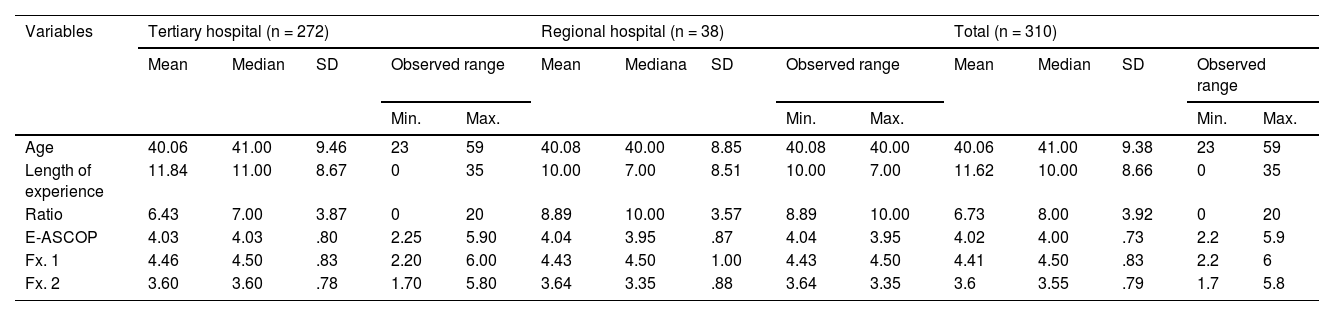
ResultsA total of 310 nurses took part. The mean age was 40.06 years (SD = 9.38), with a range between 23 and 59 years. Regarding the nurses’ level of education, 81.30% (n = 252) were educated to undergraduate level, while 18.70% (n = 58) were educated to a higher level with postgraduate studies. The mean length of experience as a nurse was 11.62 years (SD = 8.86), with a minimum of less than 12 months and a maximum of 35 years. Eighty-seven point seven percent (n = 272) worked in a tertiary hospital and 12.30% (n = 38) in a regional hospital. A total of 64.80% (n = 201) and 35.20% (n = 109) worked in medical-surgical wards and 35.20% (n = 109) in intensive care units. The mean nurse-to-patient ratio was 6.37 patients per nurse (SD = 3.92), with a range of 0–20 patients. Table 1 shows the descriptive characteristics of the sample grouped by hospital type, while Table 2 shows the mean scores of the Actual Scope of Practice Questionnaire and each of the dimensions.
Description of the sample in the different centres.
| Variables | Tertiary hospital (n = 272) | Regional hospital (n = 38) | Total (n = 310) | ||||||||||||
|---|---|---|---|---|---|---|---|---|---|---|---|---|---|---|---|
| Mean | Median | SD | Observed range | Mean | Mediana | SD | Observed range | Mean | Median | SD | Observed range | ||||
| Min. | Max. | Min. | Max. | Min. | Max. | ||||||||||
| Age | 40.06 | 41.00 | 9.46 | 23 | 59 | 40.08 | 40.00 | 8.85 | 40.08 | 40.00 | 40.06 | 41.00 | 9.38 | 23 | 59 |
| Length of experience | 11.84 | 11.00 | 8.67 | 0 | 35 | 10.00 | 7.00 | 8.51 | 10.00 | 7.00 | 11.62 | 10.00 | 8.66 | 0 | 35 |
| Ratio | 6.43 | 7.00 | 3.87 | 0 | 20 | 8.89 | 10.00 | 3.57 | 8.89 | 10.00 | 6.73 | 8.00 | 3.92 | 0 | 20 |
| E-ASCOP | 4.03 | 4.03 | .80 | 2.25 | 5.90 | 4.04 | 3.95 | .87 | 4.04 | 3.95 | 4.02 | 4.00 | .73 | 2.2 | 5.9 |
| Fx. 1 | 4.46 | 4.50 | .83 | 2.20 | 6.00 | 4.43 | 4.50 | 1.00 | 4.43 | 4.50 | 4.41 | 4.50 | .83 | 2.2 | 6 |
| Fx. 2 | 3.60 | 3.60 | .78 | 1.70 | 5.80 | 3.64 | 3.35 | .88 | 3.64 | 3.35 | 3.6 | 3.55 | .79 | 1.7 | 5.8 |
E-ASCOP: Actual Scope of Practice; Fx. 1: Dimension 1 Patient and family centred care; Fx. 2: Dimension 2 Quality of care and patient safety; SD: standard deviation.
Actual Scope of Practice questionnaire (E-ASCOP).
| Dimension | Scale | Mean | Median | SD | Observed range | |
|---|---|---|---|---|---|---|
| Min. | Max. | |||||
| 1. Patient and family centred care | 1−6 | 4.41 | 4.50 | .83 | 2.20 | 6.00 |
| 2. Quality of care and patient safety | 1−6 | 3.60 | 3.55 | .79 | 1.70 | 5.80 |
| E-ASCOP questionnaire | 1−6 | 4.03 | 4.00 | .73 | 2.20 | 5.90 |
E-ASCOP: Actual Scope of Practice; SD: standard deviation.
The mean scores were compared with the quantitative variables (age, years of experience, and nurse-patient ratio) and significant differences were found only for the relationship between age and each of the dimensions of the questionnaire (Table 3). The correlation found shows that older nurses were more likely to score lower than younger nurses in the dimension ''Patient and family centred care'', whereas in the second dimension ''Quality of care and patient safety'', younger nurses scored significantly lower.
Correlations between quantitative variables and scope of practice.
| Age | Length of experience | Nurse-patient ratio | ||||
|---|---|---|---|---|---|---|
| Pearson correlation | Sig. (2-tailed) | Sig. (2-tailed) | Sig. (2-tailed) | |||
| E-ASCOP | –.025 | .661 | .025 | .667 | .100 | .079 |
| Fx. 1 | –.147 | .01* | –.05 | .376 | .069 | .224 |
| Fx. 2 | .146 | .01* | .136 | .17 | .112 | .048 |
E-ASCOP: Actual Scope of Practice; Fx. 1: Dimension 1 Patient and family centred care; Fx. 2: Dimension 2 Quality of care and patient safety.
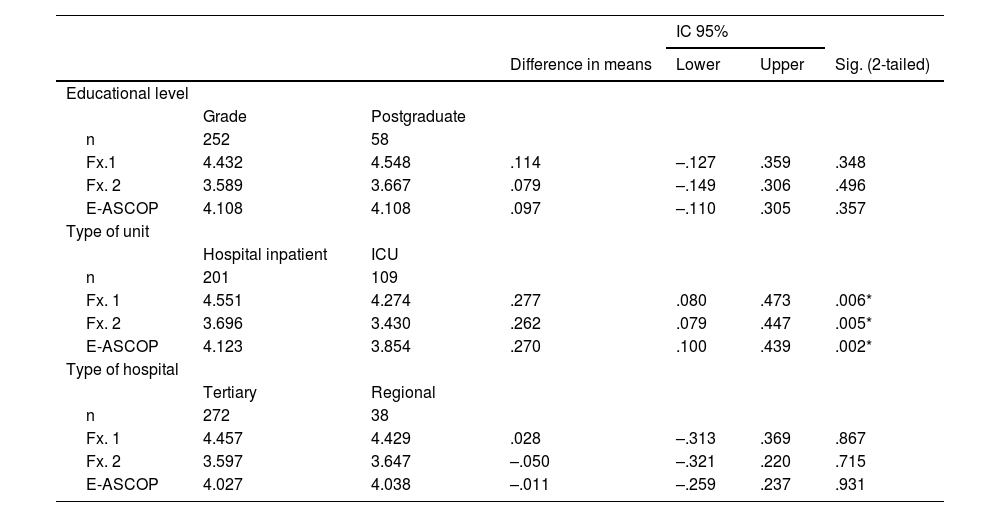
With regard to the qualitative variables, differences were found only with regard to the type of inpatient unit and ICU, with the latter reporting significantly lower scores (3.854 compared to 4.123 forward nurses) in their area of practice. (Table 4)
Relationship of the qualitative variables and scope of practice using the Student’s t-test.
| IC 95% | ||||||
|---|---|---|---|---|---|---|
| Difference in means | Lower | Upper | Sig. (2-tailed) | |||
| Educational level | ||||||
| Grade | Postgraduate | |||||
| n | 252 | 58 | ||||
| Fx.1 | 4.432 | 4.548 | .114 | –.127 | .359 | .348 |
| Fx. 2 | 3.589 | 3.667 | .079 | –.149 | .306 | .496 |
| E-ASCOP | 4.108 | 4.108 | .097 | –.110 | .305 | .357 |
| Type of unit | ||||||
| Hospital inpatient | ICU | |||||
| n | 201 | 109 | ||||
| Fx. 1 | 4.551 | 4.274 | .277 | .080 | .473 | .006* |
| Fx. 2 | 3.696 | 3.430 | .262 | .079 | .447 | .005* |
| E-ASCOP | 4.123 | 3.854 | .270 | .100 | .439 | .002* |
| Type of hospital | ||||||
| Tertiary | Regional | |||||
| n | 272 | 38 | ||||
| Fx. 1 | 4.457 | 4.429 | .028 | –.313 | .369 | .867 |
| Fx. 2 | 3.597 | 3.647 | –.050 | –.321 | .220 | .715 |
| E-ASCOP | 4.027 | 4.038 | –.011 | –.259 | .237 | .931 |
95% CI: 95% confidence interval; E-ASCOP: Actual Scope of Practice; Fx. 1: Dimension 1 Patient and family centred care; Fx. 2: Dimension 2 Quality of care and patient safety.
The aim of the study was to analyse the scope of practice of nurses in medical-surgical inpatient and intensive care units in the Spanish context. Higher scores (E-ASCOP = 4.03) were obtained for nurses' scope of practice than in the Canadian setting (ASCOP = 3.47).18 In both cases, scores greater than 3 indicated that the scope of practice was being carried out efficiently. However, the results obtained in a study carried out in Saudi Arabia showed a moderately higher level of practice (A-ASCOP = 4.59),19 even higher than in the study carried out in Lebanon (L-ASCOP = 4.42),20 which is still higher than the Spanish context. The difference observed can be explained by the nature of access to the health system in each country. In Spain, a bachelor's degree is sufficient to enter the profession, unlike in the Arab context, where it is also necessary to pass a competence test before starting work in a hospital.21 This requirement may make nurses more aware of the competences they need to possess and put into practice in order to get their job, and this may influence their subsequent implementation of their scope of practice.
The dimension ''Patient and family centred care'' scored a mean of 4.41, almost one point above the dimension ''Quality of care and patient safety'', results which are in line with the literature, as in situations of high workload it is the more indirect or less patient-centred activities which tend to be left undone and yet compromise the quality and safety of care.22 According to White et al.,23 nurses stop performing activities that add value to patient care and tend to take on tasks that could be performed by other professionals. Clinical assessment of the patient, discharge planning, and activities related to patient self-care education are examples of essential activities that are being omitted, which could be corrected if nurses delegated simpler tasks to nursing assistants and took over those activities that only they can perform.24 With regard to the variability of responses to the questionnaire, it is important to note that there were significant differences in both dimensions according to the age of the participants. Younger nurses stood out in that they undertake a greater number of activities related to ''Patient and family centred care'', whereas older nurses stood out for their contribution to activities related to ''Quality of care and patient safety''. More experienced nurses can often become more actively involved in evidence-based practice and take on roles in promoting research as their careers progress.25,26 Age, length of experience, level of education, nurse-patient ratio, and unit type, among many other factors, have been extensively studied in the literature in relation to nurses' scope of practice.27,28 In this sense, nurses with less experience and lower levels of education are associated with lower levels of implementation of the nursing process,27 while in our study age was the variable found to be associated with scope of practice. Other studies consider the ratio of nurses per patient as a crude indicator of available nursing time and associate higher staffing levels with better quality of patient care.29 However, our study did not find any significant differences in the ratio. It should be clarified that in both types of unit there are nurses who carry out support activities and who are not assigned patients.
Finally, working in ICU significantly decreased the E-ASCOP score in both dimensions. This may be because the specific competences of ICU nurses have evolved as a result of technological advances and increased care needs.30 This acquisition of new responsibilities may have affected work beyond their scope of practice and focused ICU nurses on more ICU-specific tasks, such as the care of specific devices and complex equipment. It would be interesting to analyse this group of nurses in particular in future work.
Limitations of the studyOne of the main limitations of the study is that it was carried out in a single limited geographical area in Spain, which does not necessarily reflect the regulatory and care variability of the national health system. All hospitals in the public network were included. In addition, most of the sample included were working in tertiary hospitals. In order to generalise the results, studies with a wider geographical distribution and with the inclusion of different professional profiles or roles are needed. Therefore, future studies could be considered that analyse the differences between the different geographical areas of the country, and even a study that includes hospitals in the private network, in order to assess both geographical and organisational differences.
ConclusionsThis study is a pioneer in quantifying the scope of practice of nurses in medical-surgical inpatient and intensive care units in the Spanish context.
The results showed acceptable levels of scope of practice for nurses in medical-surgical inpatient and intensive care units.
Age and working in ICU were determinants in identifying differences in the activities performed by nurses in their profession.
Nurses' scope of practice is critical to understanding that addressing the nursing shortage in health care systems is not simply a matter of increasing the number of nurses, but of ensuring that nurses are engaged in the specific functions of their profession.
FundingFunding obtained through the 1st call for research projects for professors from member centres of the Conferencia Nacional de Decanas de Enfermería (CNDE) [Grant codePI_013CNDE].
The authors have no conflict of interests to declare.
We would like to thank all the nurses who took part in this study.

