
We aimed to investigate the effect of obtaining follow-up blood cultures (FUBC) and persistent growth in FUBC on clinical outcomes in bacteremia cases caused by Escherichia coli and Klebsiella pneumoniae in the geriatric age group.
MethodsPatients over 65 years of age with E. coli or K. pneumoniae bacteremia were included in the study. Patients were grouped as those who obtained FUBC and those who did not. Patients with FUBC were grouped as persistent bacteremia or negative FUBC. Demographic, clinical characteristics and outcomes were compared between these groups.
ResultsA total of 142 patients were included. FUBC were obtained in 79 patients (55.6%) and persistent bacteremia was detected in 23 (29.1%). There were no significant differences in demographic data and clinical characteristics between patients with and without FUBC. There was no statistical difference in the outcomes between patients with of without FUBC. Patients with persistent bacteremia had a higher prevalence of diabetes mellitus, and the interval between index blood culture and FUBC was shorter (2.9 days versus 4.2 days). There was no difference between patients with persistent bacteremia and patients with no growth on FUBC in terms of length of hospital stay, need for intensive care unit, intubation, vasopressor therapy, and 14, 30, 90-day all-cause mortality.
ConclusionIn patients over 65 years of age with E. coli or K. pneumoniae bacteremia, neither obtaining FUBC nor persistent bacteremia on FUBC showed any difference in terms of outcomes such as mortality and need for admission to an intensive care unit.
Investigamos el efecto de la obtención de hemocultivos de seguimiento (FUBC) y el crecimiento persistente en FUBC sobre los resultados clínicos en bacteriemia causada por E. coli y K. pneumoniae en pacientes geriátricos.
MétodosSe incluyeron pacientes mayores de 65 años con bacteriemia por E. coli o K. pneumoniae. Se agruparon en aquellos a los que se les realizaron FUBC y a los que no. A los que se les realizaron FUBC se clasificaron según si presentaban bacteriemia persistente o si los FUBC fueron negativos. Se compararon las características demográficas, clínicas y los resultados entre estos grupos.
ResultadosSe incluyeron 142 pacientes. Se realizaron FUBC en 79 (55.6%) y se detectó bacteriemia persistente en 23 de ellos (29.1%). No se encontraron diferencias significativas en los datos demográficos y las características clínicas entre los pacientes con y sin FUBC. Tampoco hubo diferencias significativas en los resultados entre los pacientes a los que se les realizaron FUBC y aquellos que no. Los pacientes con bacteriemia persistente presentaron una mayor prevalencia de diabetes mellitus, y el intervalo entre el hemocultivo índice y el FUBC fue más corto (2,9 días frente a 4,2 días). No se observaron diferencias entre los pacientes con bacteriemia persistente y aquellos sin crecimiento en los FUBC en términos de duración de estancia hospitalaria, necesidad de cuidados intensivos, intubación, terapia vasopresora y mortalidad por todas las causas a los 14, 30 y 90 días.
ConclusiónEn pacientes mayores de 65 años con bacteriemia por E. coli o K. pneumoniae, ni la obtención de FUBC ni la bacteriemia persistente en los FUBC mostraron ninguna diferencia en términos de mortalidad y necesidad de cuidados intensivos.
Bacteremia caused by Gram-negative bacteria is a major problem in patients with both community-acquired and hospital-acquired infections. Despite effective antimicrobial drugs, it is still a major cause of morbidity and mortality. In a study including 20 years of bloodstream infections data from 45 countries worldwide, Escherichia coli (E. coli) and Klebsiella pneumoniae (K. pneumoniae) were found to be the second and third most common causative agents after Staphylococcus aureus (S. aureus).1 In different geographical regions, E. coli and Klebsiella spp. have been reported as the most common pathogens in bacteremia caused by Gram-negative bacteria.2–4 The prevalence of these two bacteria and the high mortality rates associated with bloodstream infections keep research focused on the management of these patients.
Since advanced age is a risk factor for both, an increase the frequency of infections and poor outcomes, the management of infections in elderly patients is important.5,6 The reasons for increased susceptibility to infection include: age-related immune system dysfunction, increased comorbid diseases, malnutrition and age-related anatomical disorders.5,7
Follow-up blood cultures (FUBC) are routinely recommended in the treatment of bloodstream infections caused by S. aureus and Candida spp.8–10 However, there is no consensus or guideline recommendation regarding its necessity in Gram-negative bacteremia. Different results have been reported regarding the effects of FUBC on disease-related outcomes.11–13 Previous studies have investigated the utility of FUBC in special hosts such as cancer patients and immunosuppressed patients.14,15 However, there is insufficient data on its place in a population such as geriatric patients, where poor outcomes are more common.
In our study, we aimed to investigate the effect of obtaining FUBC and persistent growth in FUBC on clinical outcomes in bacteremia cases caused by E. coli and K. pneumoniae in the geriatric age group.
MethodsStudy design and populationThe study was conducted retrospectively between January 2022 and October 2023 at Giresun Training and Research Hospital. Patients over 65 years of age who grew E. coli or K. pneumoniae in blood cultures and were considered as the causative agent of infection were included in the study. Patients with polymicrobial bacteremia, patients who died or were discharged within 24h after the index blood culture, and patients who refused hospitalization were excluded. Patients were grouped as those who had FUBC taken and those who did not. Patients with FUBC were grouped as persistent bacteremia or negative FUBC. Demographic and clinical characteristics and outcomes were compared between these groups.
Data collection and analysisData of patients with E. coli or K. pneumoniae bacteremia were obtained from electronic medical file records. Age, gender, comorbid diseases and conditions, Charlson comorbidity index (CCI), unit where the infection developed, source of infection, presence of central venous catheter (CVC), presence of urinary catheter, antibiotic susceptibility of bacteria, appropriateness of empirical antibiotic treatment, Pitt bacteremia score, FUBC collection status, FUBC growth status, index blood culture-FUBC interval, need for source control, duration of hospitalization, need for intubation, need for vasopressor treatment, need for intensive care unit stay, 14, 30 and 90-day all-cause mortality variables were collected and analyzed.
DefinitionsThe growth of E. coli or K. pneumoniae in the first blood culture obtained from a patient with clinical signs of bacteremia was defined as index blood culture. Blood cultures obtained for any reason between 24h and 7 days after the index blood culture were defined as FUBC. Growth of the same bacteria in the FUBC as in the index blood culture was defined as persistent bacteremia.
The cases in which no source could be detected for bacteremia and the bacteria directly entered the bloodstream were defined as primary bacteremia.
Hospital-acquired infection was defined as bacteremia developed in a patient who had been followed in the hospital for at least 48h after hospital admission.
Systemic corticosteroid treatment (pednisone 16mg/day or equivalent for more than 14 days), chemotherapy, history of organ transplantation, use of biological agents or neutropenia (neutrophil count<500/μL) were considered immunosuppression.
The appropriateness of antibiotic treatment was defined as the use of at least one in vitro active antibiotic against the bacteria isolated in blood cultures. The appropriateness of antibiotic treatment was assessed for empirical antibiotics in all patients and for antibiotics administered at the time of FUBC in those with FUBC taken.
Source control was defined as elimination of the infection source. Practices for source control were evaluated as abscess drainage, intervention for obstructive focus, central catheter removal and surgical debridement of infected/necrotic tissue.
MicrobiologyBlood cultures were incubated in BacT/Alert 3D (bioMérieux, France). Microorganism's identification and antibiotic susceptibility tests were performed with the Vitek 2-compact (bioMérieux, France) fully automated system. Susceptibility test results were reported according to the European Committee on Antimicrobial Susceptibility Testing (EUCAST) clinical breakpoints.
Statistical analysisIBM SPSS Statistics for Windows version 26.0 (IBM Corp., Armonk, NY, USA) was used for statistical analysis. Descriptive statistics of the data were expressed as mean, standard deviation, minimum value, maximum value and percentages. Normal distribution of numerical data was evaluated by Kolmogorov–Smirnov test. For the comparison of numerical data, independent sample t-test was used when the normal distribution condition was met, and Mann–Whitney U test was used when this condition was not met. Chi-square or Fisher's exact test was used to compare the ratios between two independent groups. Time to mortality in patients with persistent bacteremia and negative FUBC was compared by Kaplan–Meier survival analysis and log-rank test. Univariate and multivariate logistic regression analysis (backward:LR) was used to determine independent risk factors related to persistent bacteremia in patients with FUBC taken. A value of p<0.05 was accepted for statistical significance.
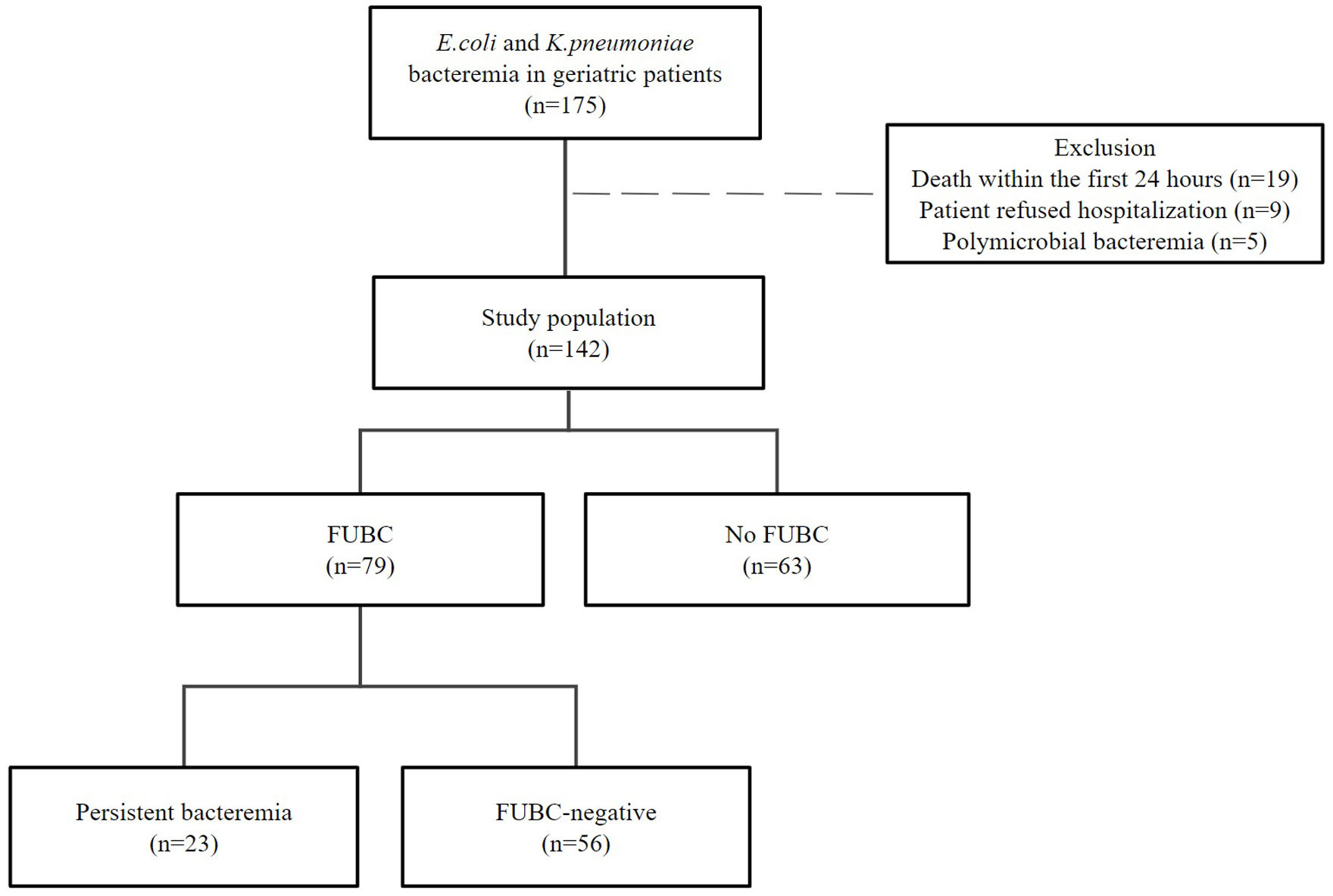
ResultsDuring the study period, 175 E. coli or K. pneumoniae bacteremia were detected in the population over 65 years of age. Nineteen patients were excluded because they died within the first 24h, 9 patients refused hospitalization, and 5 patients were excluded because polymicrobial bacteremia was detected (Fig. 1). A total of 142 patients were included in the study. Ninety-nine patients (69.7%) had E. coli bacteremia and 43 patients (30.3%) had K. pneumoniae bacteremia. The mean age of the patients was 77.9±8.6 years (65–100) and 78 (54.9%) of them were male. The most common infection sources were urinary tract infection in 50 patients (35.2%), primary bacteremia in 26 patients (18.3%), intraabdominal infection in 22 patients (15.5%) and pneumonia in 18 patients (12.7%). FUBC were obtained in 79 patients (55.6%) and persistent bacteremia was detected on FUBC in 23 patients (29.1%). The mean interval between index blood culture and FUBC collection was 3.8±2.1 (1–7) days.
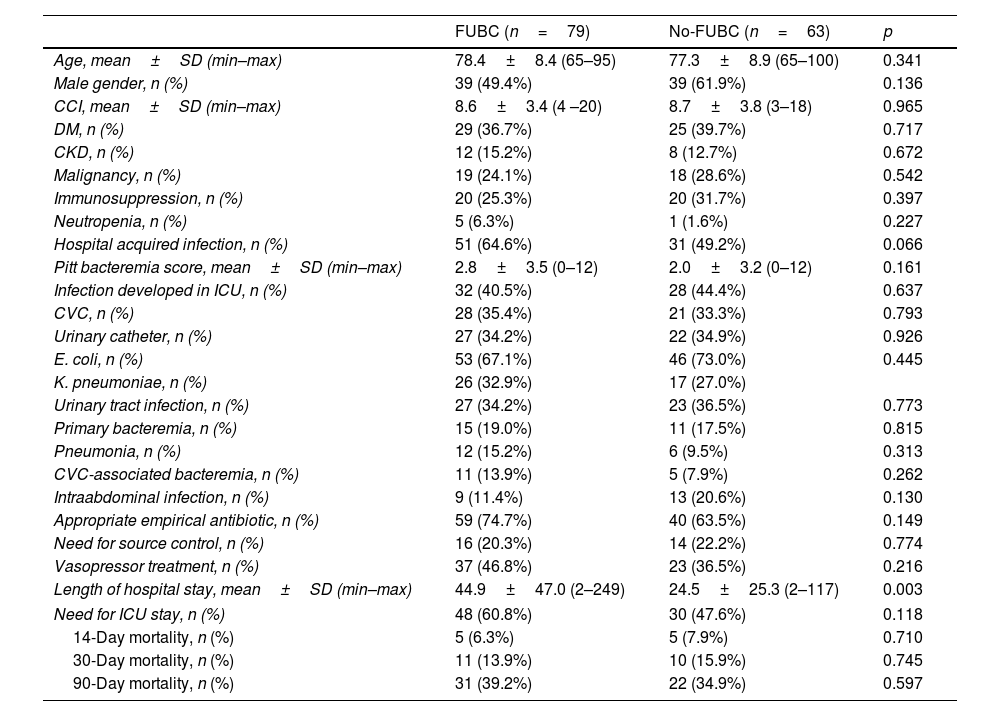
There were no significant differences in demographic data, comorbid diseases and clinical characteristics between patients with and without FUBC (Table 1). Bacteremia due to urinary tract infection was the most common source of infection in both groups. There was no statistical difference in the need for vasopressor therapy, need for intensive care unit and 14, 30, 90-day all-cause mortality between patients with FUBC taken and those who did not. The hospitalization period was longer in patients with FUBC.
Comparison of demographics, clinical characteristics, and outcomes of patients with and without FUBC.
| FUBC (n=79) | No-FUBC (n=63) | p | |
|---|---|---|---|
| Age, mean±SD (min–max) | 78.4±8.4 (65–95) | 77.3±8.9 (65–100) | 0.341 |
| Male gender, n (%) | 39 (49.4%) | 39 (61.9%) | 0.136 |
| CCI, mean±SD (min–max) | 8.6±3.4 (4 –20) | 8.7±3.8 (3–18) | 0.965 |
| DM, n (%) | 29 (36.7%) | 25 (39.7%) | 0.717 |
| CKD, n (%) | 12 (15.2%) | 8 (12.7%) | 0.672 |
| Malignancy, n (%) | 19 (24.1%) | 18 (28.6%) | 0.542 |
| Immunosuppression, n (%) | 20 (25.3%) | 20 (31.7%) | 0.397 |
| Neutropenia, n (%) | 5 (6.3%) | 1 (1.6%) | 0.227 |
| Hospital acquired infection, n (%) | 51 (64.6%) | 31 (49.2%) | 0.066 |
| Pitt bacteremia score, mean±SD (min–max) | 2.8±3.5 (0–12) | 2.0±3.2 (0–12) | 0.161 |
| Infection developed in ICU, n (%) | 32 (40.5%) | 28 (44.4%) | 0.637 |
| CVC, n (%) | 28 (35.4%) | 21 (33.3%) | 0.793 |
| Urinary catheter, n (%) | 27 (34.2%) | 22 (34.9%) | 0.926 |
| E. coli, n (%) | 53 (67.1%) | 46 (73.0%) | 0.445 |
| K. pneumoniae, n (%) | 26 (32.9%) | 17 (27.0%) | |
| Urinary tract infection, n (%) | 27 (34.2%) | 23 (36.5%) | 0.773 |
| Primary bacteremia, n (%) | 15 (19.0%) | 11 (17.5%) | 0.815 |
| Pneumonia, n (%) | 12 (15.2%) | 6 (9.5%) | 0.313 |
| CVC-associated bacteremia, n (%) | 11 (13.9%) | 5 (7.9%) | 0.262 |
| Intraabdominal infection, n (%) | 9 (11.4%) | 13 (20.6%) | 0.130 |
| Appropriate empirical antibiotic, n (%) | 59 (74.7%) | 40 (63.5%) | 0.149 |
| Need for source control, n (%) | 16 (20.3%) | 14 (22.2%) | 0.774 |
| Vasopressor treatment, n (%) | 37 (46.8%) | 23 (36.5%) | 0.216 |
| Length of hospital stay, mean±SD (min–max) | 44.9±47.0 (2–249) | 24.5±25.3 (2–117) | 0.003 |
| Need for ICU stay, n (%) | 48 (60.8%) | 30 (47.6%) | 0.118 |
| 14-Day mortality, n (%) | 5 (6.3%) | 5 (7.9%) | 0.710 |
| 30-Day mortality, n (%) | 11 (13.9%) | 10 (15.9%) | 0.745 |
| 90-Day mortality, n (%) | 31 (39.2%) | 22 (34.9%) | 0.597 |
CCI: Charlson comorbidity index, CKD: chronic kidney disease, CVC: central venous catheter, DM: diabetes mellitus, FUBC: follow-up blood culture, ICU: intensive care unit, SD: standard deviation.
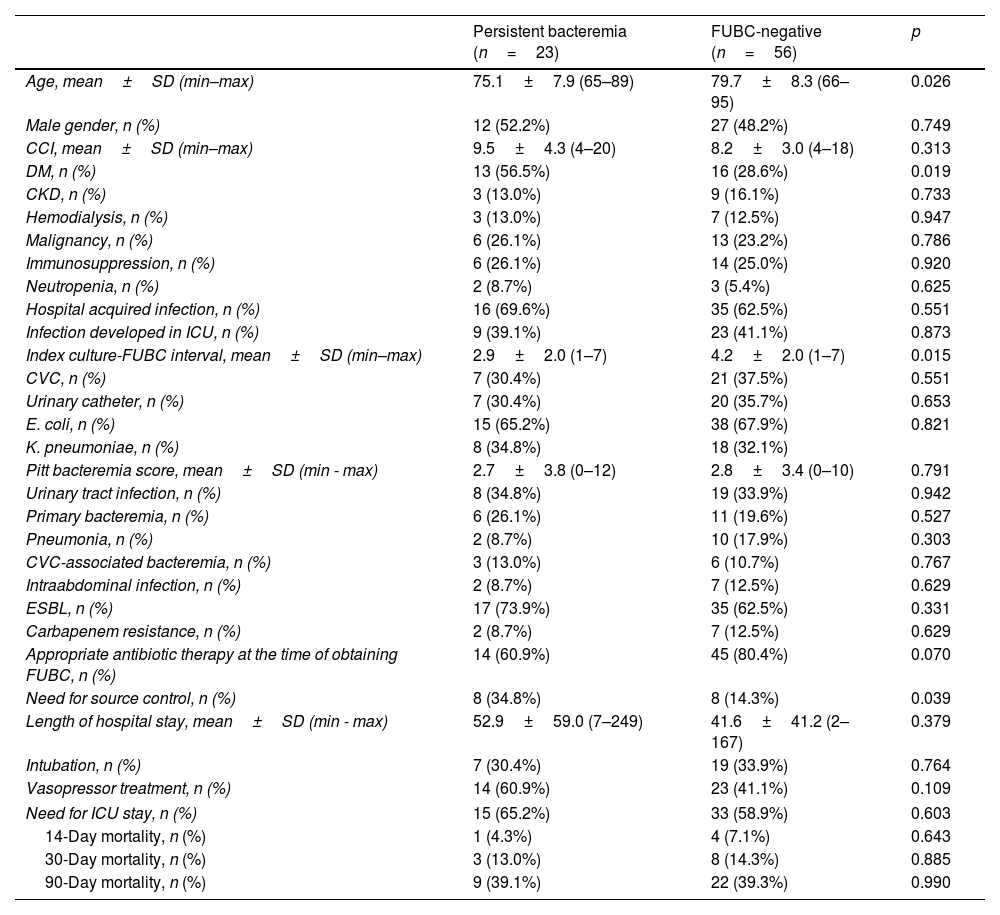
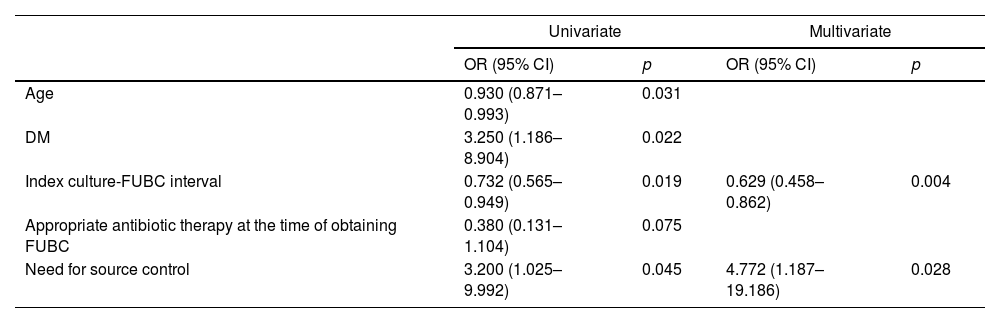
The comparison of demographic and clinical data, as well as outcomes, between patients with persistent bacteremia and those with negative FUBC is presented in Table 2. Patients with persistent bacteremia had a higher prevalence of diabetes mellitus (DM), and the interval between index blood culture and FUBC was shorter. The use of appropriate antibiotics at the time of FUBC was less frequent in cases of persistent bacteremia, but no statistically significant difference was observed. While the mean age was high in both groups, patients in the persistent bacteremia group were younger. In multivariate logistic regression analysis, bacteremia requiring source control was identified as a risk factor for persistent bacteremia, while prolonged index blood culture-FUBC interval was identified as a protective factor (Table 3). There were no differences between the two groups in terms of hospital stay, need for intensive care unit, need for intubation, need for vasopressor treatment, and 14, 30, 90-day all-cause mortality. The comparison of outcomes between patients with persistent bacteremia and those with negative FUBC results was also performed within the subgroup of 59 patients who received appropriate empirical antibiotic therapy. In this subgroup, no significant differences were observed between the two groups in terms of hospital length of stay, ICU admission requirement, intubation need, vasopressor therapy requirement, or 14-, 30-, and 90-day all-cause mortality (p>0.05 for all variables).
Comparison of demographics, clinical characteristics and outcomes of patients with persistent bacteremia and no growth on FUBC.
| Persistent bacteremia (n=23) | FUBC-negative (n=56) | p | |
|---|---|---|---|
| Age, mean±SD (min–max) | 75.1±7.9 (65–89) | 79.7±8.3 (66–95) | 0.026 |
| Male gender, n (%) | 12 (52.2%) | 27 (48.2%) | 0.749 |
| CCI, mean±SD (min–max) | 9.5±4.3 (4–20) | 8.2±3.0 (4–18) | 0.313 |
| DM, n (%) | 13 (56.5%) | 16 (28.6%) | 0.019 |
| CKD, n (%) | 3 (13.0%) | 9 (16.1%) | 0.733 |
| Hemodialysis, n (%) | 3 (13.0%) | 7 (12.5%) | 0.947 |
| Malignancy, n (%) | 6 (26.1%) | 13 (23.2%) | 0.786 |
| Immunosuppression, n (%) | 6 (26.1%) | 14 (25.0%) | 0.920 |
| Neutropenia, n (%) | 2 (8.7%) | 3 (5.4%) | 0.625 |
| Hospital acquired infection, n (%) | 16 (69.6%) | 35 (62.5%) | 0.551 |
| Infection developed in ICU, n (%) | 9 (39.1%) | 23 (41.1%) | 0.873 |
| Index culture-FUBC interval, mean±SD (min–max) | 2.9±2.0 (1–7) | 4.2±2.0 (1–7) | 0.015 |
| CVC, n (%) | 7 (30.4%) | 21 (37.5%) | 0.551 |
| Urinary catheter, n (%) | 7 (30.4%) | 20 (35.7%) | 0.653 |
| E. coli, n (%) | 15 (65.2%) | 38 (67.9%) | 0.821 |
| K. pneumoniae, n (%) | 8 (34.8%) | 18 (32.1%) | |
| Pitt bacteremia score, mean±SD (min - max) | 2.7±3.8 (0–12) | 2.8±3.4 (0–10) | 0.791 |
| Urinary tract infection, n (%) | 8 (34.8%) | 19 (33.9%) | 0.942 |
| Primary bacteremia, n (%) | 6 (26.1%) | 11 (19.6%) | 0.527 |
| Pneumonia, n (%) | 2 (8.7%) | 10 (17.9%) | 0.303 |
| CVC-associated bacteremia, n (%) | 3 (13.0%) | 6 (10.7%) | 0.767 |
| Intraabdominal infection, n (%) | 2 (8.7%) | 7 (12.5%) | 0.629 |
| ESBL, n (%) | 17 (73.9%) | 35 (62.5%) | 0.331 |
| Carbapenem resistance, n (%) | 2 (8.7%) | 7 (12.5%) | 0.629 |
| Appropriate antibiotic therapy at the time of obtaining FUBC, n (%) | 14 (60.9%) | 45 (80.4%) | 0.070 |
| Need for source control, n (%) | 8 (34.8%) | 8 (14.3%) | 0.039 |
| Length of hospital stay, mean±SD (min - max) | 52.9±59.0 (7–249) | 41.6±41.2 (2–167) | 0.379 |
| Intubation, n (%) | 7 (30.4%) | 19 (33.9%) | 0.764 |
| Vasopressor treatment, n (%) | 14 (60.9%) | 23 (41.1%) | 0.109 |
| Need for ICU stay, n (%) | 15 (65.2%) | 33 (58.9%) | 0.603 |
| 14-Day mortality, n (%) | 1 (4.3%) | 4 (7.1%) | 0.643 |
| 30-Day mortality, n (%) | 3 (13.0%) | 8 (14.3%) | 0.885 |
| 90-Day mortality, n (%) | 9 (39.1%) | 22 (39.3%) | 0.990 |
CCI: Charlson comorbidity index, CKD: chronic kidney disease, CVC: central venous catheter, DM: diabetes mellitus, ESBL: extended-spectrum beta-lactamase, FUBC: follow-up blood culture, ICU: intensive care unit, SD: standard deviation.
Logistic regression analysis for persistent bacteremia.
| Univariate | Multivariate | |||
|---|---|---|---|---|
| OR (95% CI) | p | OR (95% CI) | p | |
| Age | 0.930 (0.871–0.993) | 0.031 | ||
| DM | 3.250 (1.186–8.904) | 0.022 | ||
| Index culture-FUBC interval | 0.732 (0.565–0.949) | 0.019 | 0.629 (0.458–0.862) | 0.004 |
| Appropriate antibiotic therapy at the time of obtaining FUBC | 0.380 (0.131–1.104) | 0.075 | ||
| Need for source control | 3.200 (1.025–9.992) | 0.045 | 4.772 (1.187–19.186) | 0.028 |
CI: confidence interval, DM: diabetes mellitus, OR: odds ratio.
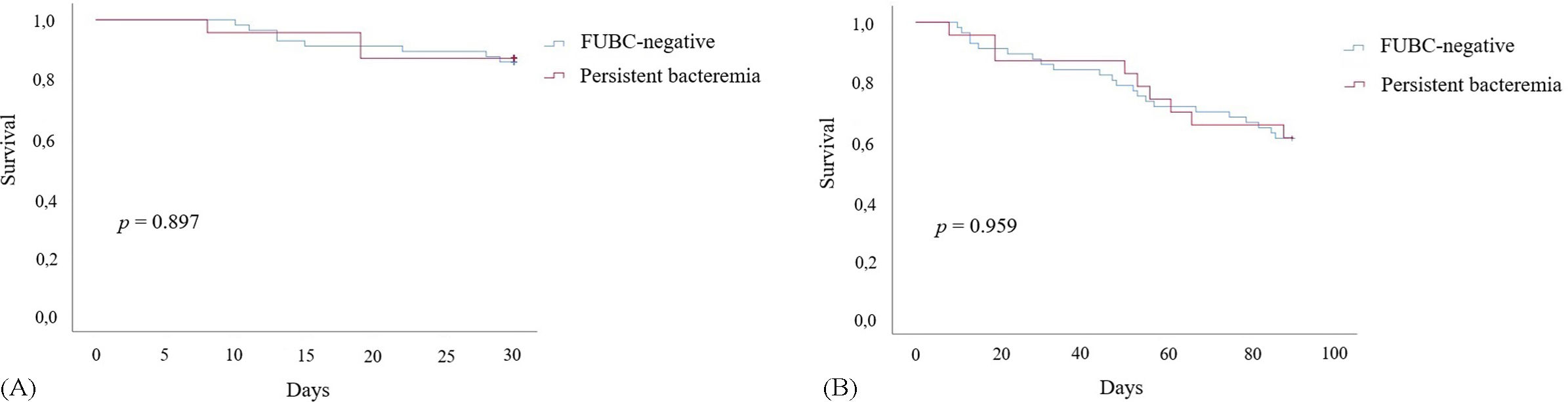
Among all patients, the 90-day all-cause mortality was 37.7% (n=53). In the Kaplan–Meier survival analysis conducted for patients with FUBC, no significant difference was observed in 30 and 90-day mortality between patients with persistent bacteremia and those with negative FUBC (Fig. 2).
DiscussionGram-negative bacteremia is a common condition and can be fatal. There are no guidelines that provide clear recommendations for FUBC in Gram-negative bacteremia. The observational nature of the existing studies and the lack of randomized controlled trials make it difficult to offer definitive recommendations. For the over 65 population, there are no studies investigating the association between FUBC collection and outcomes. In our study, we investigated the effect of FUBC and persistent bacteremia on outcomes in E. coli and K. pneumoniae bacteremia, the two most common causes of Gram-negative bacteremia in patients over 65 years of age. It was found that obtaining FUBC or absence of persistent bacteremia in FUBC did not have a positive effect on the outcomes.
Obtaining FUBC has been reported in many studies as a practice that reduces mortality.13,16–18 The exact mechanism by which this practice benefits mortality has not been clearly described. Possible reasons include the prediction of complications, the selection of patients who require source control, and the identification of correctable causes such as inappropriate antibiotic treatment.16 In addition, there are also studies reporting that FUBC collection did not show a significant effect on mortality.19–22 In a recently published study with a high sample size (34,100 patients from 101 centers), exclusion criteria to reduce bias and a narrower range for the day of FUBC collection than previous studies, it was found that FUBC collection had no effect on 30-day mortality.12 In our study, patients over 65 years of age with E. coli or K. pneumoniae bacteremias, were selected to investigate the effect of obtaining FUBC in a more homogeneous population. It was found that obtaining FUBC did not have a positive nor negative effect on mortality. The lack of any statistically significant differences in demographic data and clinical characteristics between patients over 65 years old with and without FUBC, unlike in many other studies, is important for the interpretation of these results. In our study, obtaining FUBC was found to be associated with prolonged hospital stay. The relationship between obtaining FUBC and extended hospital stay has been reported previously.12,19,20 In our study, the most common reasons for obtaining FUBC, based on the available information, were recurrent fever under treatment, worsening clinical condition (such as hypotension, tachycardia, etc.), deterioration in laboratory parameters (such as leukocyte count, C-reactive protein, lactate, etc.), and determining microbiological clearance. However, there was no difference in the need for source control and appropriateness of empirical antibiotic treatment as a factor that may prolong hospitalization in both groups. The main reason for prolonged hospitalization was thought to be the delay in treatment response in patients in the FUBC group, considering these variables.
In our study, the rate of persistent bacteremia among patients who had FUBC was 29.1%. Previous studies have reported rates of persistent bacteremia ranging from 6.8% to 38.5%.13,17,18,21,23,24 The selection of patients for whom FUBC are obtained influences the frequency of persistent bacteremia. Routine or frequent use of FUBC results in a lower rate of persistent bacteremia. However, as in our study, when FUBC are obtained due to reasons such as recurrent fever or lack of clinical response, the rate of persistent bacteremia is found to be higher. Additionally, it is thought that factors such as including elderly patients, a high rate of extended-spectrum beta-lactamase (ESBL)-producing microorganisms, hospital-acquired infections, and a higher frequency of bacteremia developing in intensive care units may increase the rate of persistent bacteremia in our study.
Different results have been reported regarding persistent bacteremia detected in FUBC obtained in Gram-negative bacteremias in the literature. It is challenging to make comparisons due to reasons that could lead to heterogeneity, such as the selection of pathogens and populations in these studies. Previous studies have reported factors associated with persistent bacteremia in Gram-negative bacteremias, including the presence of central catheters, antimicrobial resistance (ESBL or carbapenem resistance), end-stage renal disease, hemodialysis, inappropriate empirical antibiotic treatment, hospital-acquired infections, catheter-related bloodstream infections, the necessity of source control, a short interval between index culture and FUBC, and a high sequential organ failure score (SOFA).13,21–23 In our study, the frequency of DM and the frequency of infections requiring source control were significantly higher in the persistent bacteremia group, and the interval between index blood culture and FUBC was shorter in the persistent bacteremia group. Although the rate of ESBL and inappropriate antibiotic treatment at the time of FUBC were more frequent in the persistent bacteremia group, no statistically significant difference was observed. In the logistic regression analysis performed to determine the independent factors for persistent bacteremia, the presence of infection requiring source control and index blood culture-FUBC interval were found to be independent risk factors. Following the index blood culture, the longer the interval before obtaining FUBC, the lower the likelihood of persistent growth, which is expected to decrease with the antibiotic treatment received by the patient during this period. It has been thought that DM may be associated with persistent bacteremia due to its negative effects on neutrophil chemotaxis, phagocytosis, intracellular bactericidal activity, and cell-mediated immunity.25 In infections requiring source control such as abscess drainage, catheter removal, surgical debridement, clinical response is often not achieved when these interventions are not performed. Therefore, it is not surprising that persistent bacteremia is common in patients requiring source control.
In our study, the presence of persistent bacteremia has been evaluated in terms of various outcomes such as intubation, need for vasopressor treatment, need for intensive care unit admission, and mortality, and it has not been found to be indicative of poor outcomes associated with the disease. Studies have reported that persistent bacteremia does not have an increased effect on mortality in patients with Gram-negative bacteremia who undergo FUBC.23,26 In our study, this was also demonstrated in Kaplan–Meier survival analysis conducted for 30 and 90 days survival.
The retrospective design, sample size, single-center nature, and combined evaluation of community-acquired/hospital-acquired bacteremia are limiting factors of our study. Additionally, the cost relationship with FUBC and the duration of antibiotic treatment with FUBC were not investigated. Due to the retrospective design of the study, it may not have been possible to access all reasons for obtaining FUBC and the fact that FUBC was not obtained in all Gram-negative bacteremia patients could lead to selection bias.
Obtaining FUBC in patients aged 65 and older with E. coli and K. pneumoniae bacteremias did not show a positive effect on outcomes such as the need for intensive care and mortality. Additionally, longer hospital stay was observed in the group where FUBC were obtained. The selection of a specific population, such as elderly bacteremia patients with the two most common members of the Enterobacterales order, and the similarity of demographic and clinical characteristics between the two groups (FUBC group and no-FUBC group) are important strengths of our study. Considering the results regarding the status of FUBC collection and persistent bacteremia, routine FUBC collection in E. coli and K. pneumoniae bacteremias in patients aged 65 and older is thought not to contribute additionally to clinical outcomes and is not deemed necessary. Prolonged hospitalization and the additional workload and cost associated with FUBC collection should also not be overlooked. Prospective randomized controlled trials are needed in this regard.
Author contributionsSÇ and FÖ conceived and designed the study, conducted data analysis, and wrote the manuscript. SÇ, FÖ, AMŞ, MAY contributed to the study design, data collection, and interpretation, and provided critical revisions to the manuscript.
All authors have read and approved the final version of the manuscript and agree to be accountable for all aspects of the work, ensuring that questions related to the accuracy or integrity of any part of the work are appropriately investigated and resolved.
Ethical approvalApproval for the study was obtained from the ethics committee of our Training and Research Hospital with the date and decision number 20.11.2023/20.
FundingThis research did not receive any specific Grant from funding agencies in the public, commercial, or not-for-profit sectors.
The authors declare that they have no conflict of interest.