


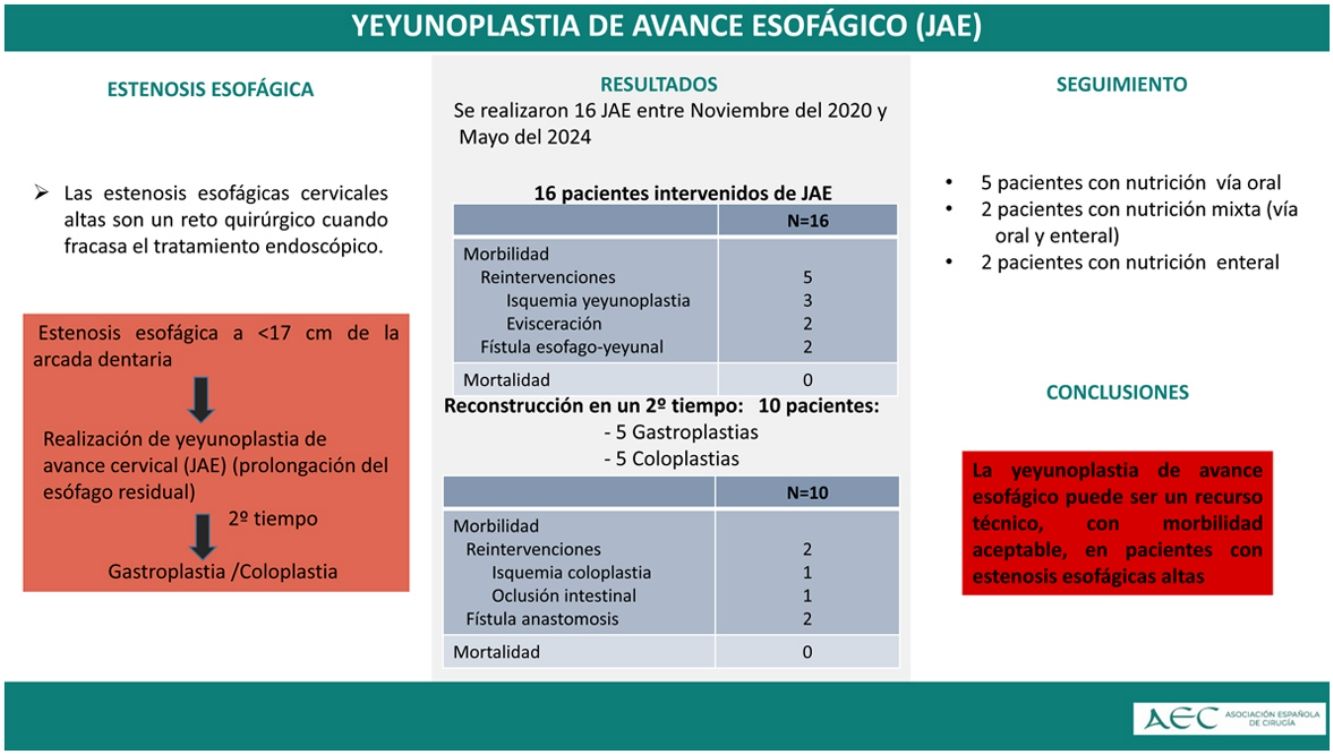


Las estenosis esofágicas cervicales son un problema de abordaje quirúrgico complejo cuando fracasa el tratamiento endoscópico. La distancia entre la estenosis y la arcada dentaria (AD) condiciona la necesidad de una plastia de mayor longitud, con aumento del riesgo de isquemia.
Nos planteamos, en pacientes con estenosis esofàgica a menos de 17 cm de la AD, el uso de una yeyunoplastia de avance esofágico (JAE) para «alargar» el esófago residual y, en un segundo tiempo, finalizar la reconstrucción del tránsito digestivo con una gastroplastia o coloplastia.
MétodosAnálisis descriptivo y retrospectivo de una base de datos prospectiva de pacientes que presentaban una estenosis esofágica a menos de 17 cm de la arcada AD y a los que se les indicó un JAE entre noviembre de 2020 y mayo de 2024.
ResultadosSe incluyeron 16 pacientes con una edad media de 52 años; 13 debido a caústicos y 3 a radioterapia; la distancia media entre la AD y la estenosis fue de 14cm. Se reintervinieron 5 casos y se diagnosticaron 2 fístulas esófago-yeyunales. No hubo mortalidad. Se completó el segundo tiempo de la reconstrucción en 10 pacientes (5 gastroplastias y 5 coloplastias). Se diagnosticaron 2 estenosis yeyuno-ileales y una esófago-yeyunal. Cinco pacientes se nutren exclusivamente por vía oral, 2 por alimentación mixta y 3 exclusivamente enteral.
ConclusionLa JAE puede ser un recurso técnico, con morbilidad aceptable, en pacientes con estenosis esofágicas altas para minimizar el riesgo de isquemia, que comporta una plastia de mayor longitud.
Cervical esophageal stenosis is a complex surgical problem when endoscopic treatment fails. The distance between the stenosis and the dental arch (DA) determines the need for a longer flap, with an increased risk of ischemia.
Our group proposed the use of an esophageal advancement jejunoplasty (JAE) in patients with esophageal stenosis less than 17 centimeters from the DA to «lengthen» the residual esophagus and, in a second stage, complete the reconstruction of digestive transit with a gastroplasty or coloplasty.
MethodDescriptive and retrospective analysis of a prospective database of patients who had esophageal stenosis less than 17 centimeters from the DA, who were indicated a JAE between November 2020 and May 2024.
ResultsA total of 16 patients with a mean age of 52 years were included. In 13 cases the stenosi was secundary to càustics and 3 to radiotherapy; the mean distance between AD and stenosis was 14cm. Five cases were reoperated and 2esophageal-jejunal fístulas were diagnosed. There was no mortality. The second stage of reconstruction was completed in 10 patients (5 gastroplasties and 5 coloplasties). Two jejuno-ileal stenosis and one esophageal-jejunal stenosis were diagnosed. Functionally, 5 patients are exclusively nourished orally, 2 through a mixed diet and 3 exclusively enterally.
ConclusionWe believe that JAE can be a technically feasible option, with acceptable morbidity, in patients with upper esophageal stenosis to minimize the risk of ischemia that involves a longer flap.