



The gender gap (GG) is a way of representing the disparity that exists between men and women in terms of rights, resources and opportunities.1 This concept does not distinguish between classes or professions, for example, despite the increase in the number of women entering the medical field and pursuing surgical specialties, there is still inequality in leadership roles and rank attained. For years, certain specialties have been considered men's, including General Surgery, suggesting gender stereotypes, which can be detrimental to women.1 We are currently experiencing a change in Spain. Increasingly, the specialty of General Surgery (GC) is being chosen by women, consequently reaching a percentage which was 50% female in 2010 for fifth-year residents and 58.7% in 2023.2 But this increase in the female representation in the new generations is not synonymous with gender equality. If the GG still exists in the workplace, it could affect the training of these new residents. For this reason, we decided to review the literature on the GG regarding the training of GS residents.
We conducted a PRISMA-based systematic review, using the Pubmed/Medline and sCIELO databases. The search strategy used was: "gender gap AND surgery AND resident" OR "gender AND general surgery AND resident". The publication period was January 2019–2023. The inclusion criteria were original articles in Spanish or English. We excluded all studies unrelated to the topic under study; articles that referred to other specialties or whose group of students were not residents; editorials; and letters to the editor.
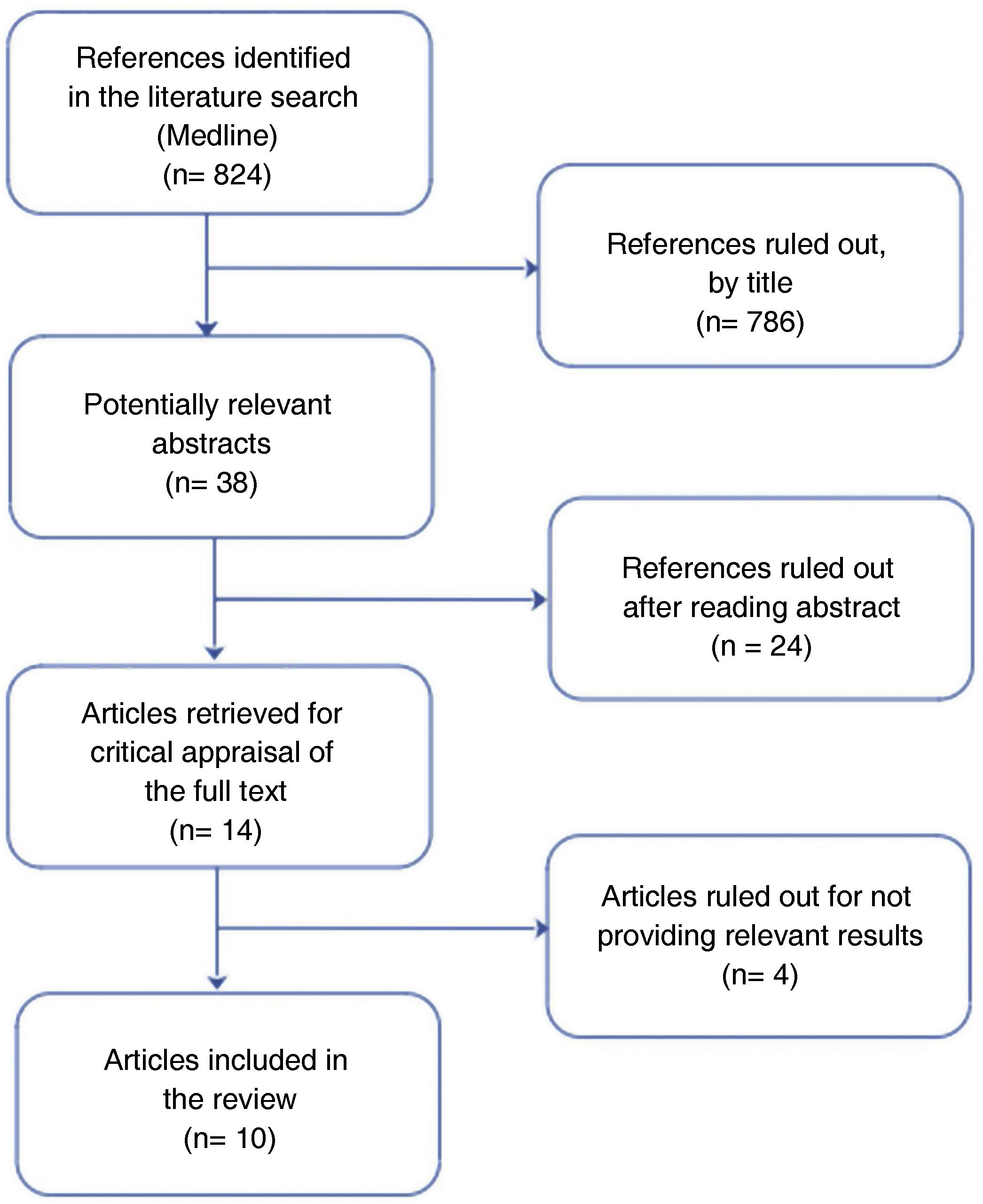
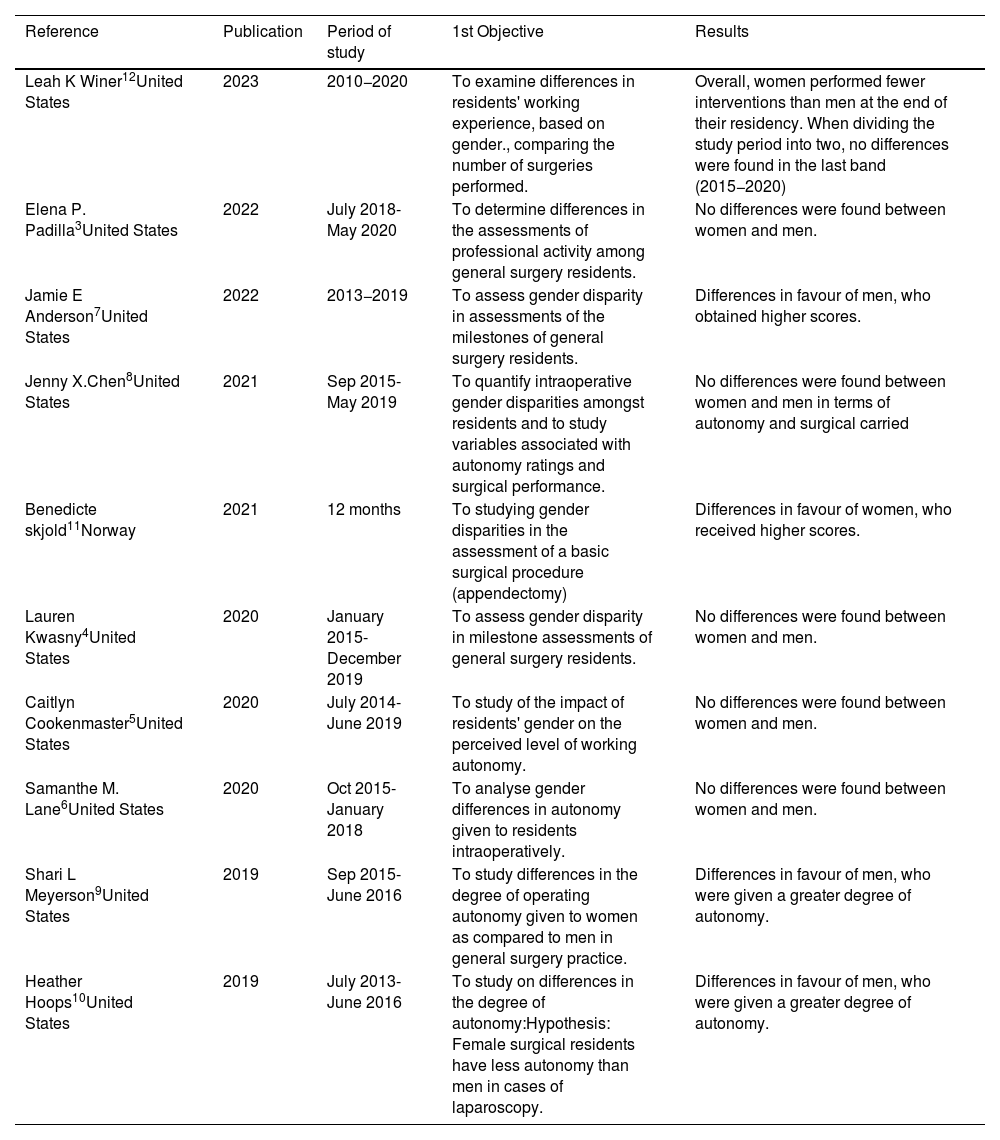
The search yielded a total of 824 citations, of which, after applying the inclusion and exclusion criteria mentioned above, we selected 38 potentially relevant articles. After the initial reading of these articles, we included 14 that were suitable for review, but excluded 4 articles as they did not provide relevant results with respect to our objective (Fig.1). Therefore, 10 articles were finally included in the systematic review (Table 1).

Summary table of the articles included in the review.
| Reference | Publication | Period of study | 1st Objective | Results |
|---|---|---|---|---|
| Leah K Winer12United States | 2023 | 2010−2020 | To examine differences in residents' working experience, based on gender., comparing the number of surgeries performed. | Overall, women performed fewer interventions than men at the end of their residency. When dividing the study period into two, no differences were found in the last band (2015−2020) |
| Elena P. Padilla3United States | 2022 | July 2018-May 2020 | To determine differences in the assessments of professional activity among general surgery residents. | No differences were found between women and men. |
| Jamie E Anderson7United States | 2022 | 2013−2019 | To assess gender disparity in assessments of the milestones of general surgery residents. | Differences in favour of men, who obtained higher scores. |
| Jenny X.Chen8United States | 2021 | Sep 2015-May 2019 | To quantify intraoperative gender disparities amongst residents and to study variables associated with autonomy ratings and surgical performance. | No differences were found between women and men in terms of autonomy and surgical carried |
| Benedicte skjold11Norway | 2021 | 12 months | To studying gender disparities in the assessment of a basic surgical procedure (appendectomy) | Differences in favour of women, who received higher scores. |
| Lauren Kwasny4United States | 2020 | January 2015-December 2019 | To assess gender disparity in milestone assessments of general surgery residents. | No differences were found between women and men. |
| Caitlyn Cookenmaster5United States | 2020 | July 2014-June 2019 | To study of the impact of residents' gender on the perceived level of working autonomy. | No differences were found between women and men. |
| Samanthe M. Lane6United States | 2020 | Oct 2015- January 2018 | To analyse gender differences in autonomy given to residents intraoperatively. | No differences were found between women and men. |
| Shari L Meyerson9United States | 2019 | Sep 2015- June 2016 | To study differences in the degree of operating autonomy given to women as compared to men in general surgery practice. | Differences in favour of men, who were given a greater degree of autonomy. |
| Heather Hoops10United States | 2019 | July 2013-June 2016 | To study on differences in the degree of autonomy:Hypothesis: Female surgical residents have less autonomy than men in cases of laparoscopy. | Differences in favour of men, who were given a greater degree of autonomy. |
All studies were conducted on U.S. populations except for one in Norway. A total of 100% of the studies have a woman as first author. Eight of the ten studies used ordinal scales to assess gender disparity in the autonomy granted to residents and/or surgical performance. Four of the eight studies found no gender differences [3; 4; 5; 6]. In four cases, the GG was observed with respect to the surgical autonomy granted by the assistant.[7; 8; 9; 10] Other noteworthy data are that the study run in Norway described higher performance scores in women compared to men.11 One of the studies evaluated the number of interventions by residents on 20 training courses in the United States over 10 years,12 and found that, over all, female residents graduated with fewer surgeries undertaken than male residents.12 In contrast, when studying by time periods, they found that in 2010–2015 there were differences, however in the period 2015−2020 none were identified.
The study of the GG within GS residency is a complicated topic and difficult to assess due to the implicit subjectivity it entails. Not only does gender influence the training of the resident but also their attitude, their tenacity and their enthusiasm etc., which act as confounding factors that can influence the treatment by doctors.
After the review, we have been able to verify that there no study has been run in Spain and only one in Europe on the GG in GC residents. Therefore, as these studies are mostly run in the United States, the data obtained may not be extrapolated to our society. The results obtained are inconclusive since GG was observed in four cases and in four cases it was not.
Only one of the articles evaluates the number of interventions, which can be considered non-subjective data.12 The Spanish Association of Surgeons (AEC in its Spanish acronym) is implementing a residents’ book in the coming years that would enable evaluation of whether or not the GG exists in this country, by comparing total surgical data. However, this would still involve personal and circumstantial factors that are difficult to assess. For example, in the case of emerge surgeries (appendectomy, cholecystectomy, etc.), where the number of operations he/she undertakes or sick leave due to pregnancy, etc., will depend on the particular day the resident is on call.
In conclusion, we can affirm that there is no scientific evidence to support a GG during the GS residency at international level. There are no studies on this subject in this country.
There is no conflict of interest.
No funding has been received.
This paper is not under review in any another journal.
This paper has not been published previously.

