





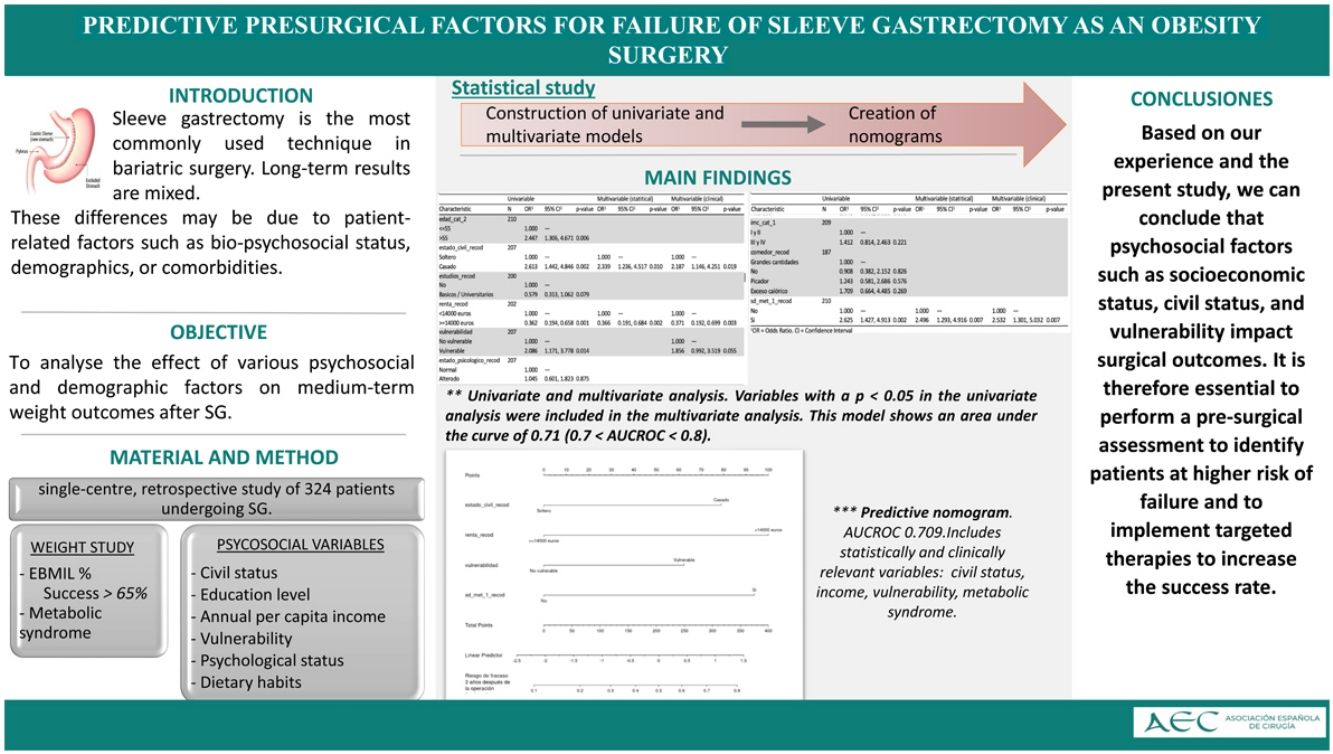


Sleeve gastrectomy (SG) is the most commonly performed bariatric procedure. However, long-term outcomes are heterogeneous due to the influence of multiple factors. The aim of this study was to analyse the effect of various psychosocial and demographic factors on medium-term weight loss outcomes.
Materials and methodsA retrospective study of a prospective, single-centre series of patients who underwent GV surgery between 2011 and 2020, with a minimum follow-up of 5 years; Failure was defined as EBMIL% <65%. Univariate and multivariate logistic regression models were developed to identify potential predictors of poor outcomes. A predictive nomogram was designed.
ResultsA total of 324 patients were analysed, 74% were women. Most patients were married (64.1%), had medium or higher education levels (73%), and belonged to a low-to-middle socioeconomic class (64.26%). High vulnerability (64.13%) and low physical activity levels (97.44%) were common. Anxiety/depressive syndrome was more prevalent in women (55.88% vs. 36.49%; p < 0.05), whereas metabolic syndrome was more frequent in men (43.9% vs. 28.51%; p = 0.015). Factors associated with weight loss failure included marital status, socioeconomic level, vulnerability, and metabolic syndrome (p < 0.05).
ConclusionSG achieves significant weight loss at 5 years post-surgery. Psychosocial factors such as socioeconomic status, marital status, and vulnerability significantly influence surgical outcomes. Pre-surgical evaluation is essential to identify patients at higher risk of failure, enabling targeted therapies to improve success rates.
La gastrectomía vertical (GV) es la técnica más empleada, no obstante, los resultados a largo plazo son heterogéneos debido a la influencia de múltiples factores. El objetivo del estudio fue analizar el efecto que tienen los diferentes factores psicosociales y demográficos en los resultados ponderales a medio plazo.
Material y métodos Estudio retrospectivo de una serie prospectiva y unicéntrica de pacientes intervenidos de GV entre 2011 y 2020, con un seguimiento mínimo de 5 años; considerando fracaso %EIMCP < 65%. Se ha creado un modelo de regresión logística univariante y multivariante para la identificación de posibles factores de mal pronóstico. Se ha diseñado un nomograma predictivo.
ResultadosSe analizaron 324 pacientes, siendo el 74% mujeres. La mayoría de los pacientes estaban casados (64,1%), tenían estudios medios o superiores (73%); con una clase socioeconómica media-baja (64,26%). Se observó alta vulnerabilidad (64,13%) y un bajo nivel de actividad física (97,44%). El síndrome ansioso/depresivo fue más frecuente en mujeres (55,88% vs. 36,49%; p < 0,05), mientras que el síndrome metabólico prevaleció en hombres (43,9% vs. 28,51%; p = 0,015). Las variables que han mostrado relación con el fracaso ponderan han sido el estado civil, el nivel económico, la vulnerabilidad y el síndrome metabólico (p < 0,05).
ConclusiónLa GV es una técnica que logra una adecuada pérdida ponderal a cinco años. Factores psicosociales como nivel socioeconómico, estado civil y vulnerabilidad influyen en los resultados quirúrgicos. Es imprescindible realizar una evaluación prequirúrgica para identificar pacientes con mayor riesgo de fracaso y poder aplicar terapias dirigidas para aumentar la tasa de éxito.


