metricas

Cirugía Española

Sugerencias
Cirugía Española Factores humanos en la práctica quirúrgica: estudio nacional
Información de la revista
Vol. 103. Núm. 12.
(Diciembre 2025)
Cita
Cita
Compartir
Descargar PDF
Más opciones de artículo
Visitas
1561
Vol. 103. Núm. 12.
(Diciembre 2025)
Original

Factores humanos en la práctica quirúrgica: estudio nacional

Human factors in surgical practice: a national study
Visitas
1561
Mireia Verdaguer-Tremolosa
Autor para correspondencia
Mireia.Verdaguer@uab.cat

Autor para correspondencia.
, Víctor Rodrigues-Gonçalves, Pilar Martínez-López, Manuel López Cano
Departamento de Cirugía, Unidad Docente de Medicina de Vall d’Hebron, Universitat Autònoma de Barcelona, Departamento de Cirugía General y del Aparato Digestivo; Unidad de Cirugía de la Pared Abdominal, Servicio de Cirugía General y del Aparato Digestivo, Hospital Universitari Vall d’Hebron, Barcelona, España
Contenido relacionado
Antonio Ríos
Este artículo ha recibido
Información del artículo
Resumen
Texto completo
Bibliografía
Descargar PDF
Estadísticas
Resumen
Introducción

En el entorno quirúrgico, el estrés, el «burnout» y los «non-technical skills» son cada vez más reconocidos ya que repercuten en la calidad asistencial, laboral y los costes económicos. Sin embargo, estos factores han sido poco estudiados en cirugía general y del aparato digestivo en España. Este estudio evalúa el «burnout», el estrés y los aspectos no cognitivos en este colectivo específico en España.

Métodos

Se diseñó una encuesta de 28 preguntas que evalúa distintos aspectos del «burnout» y los aspectos no cognitivos. Su participación fue voluntaria y se difundió a través de la Asociación Española de Cirugía (AEC).

Resultados

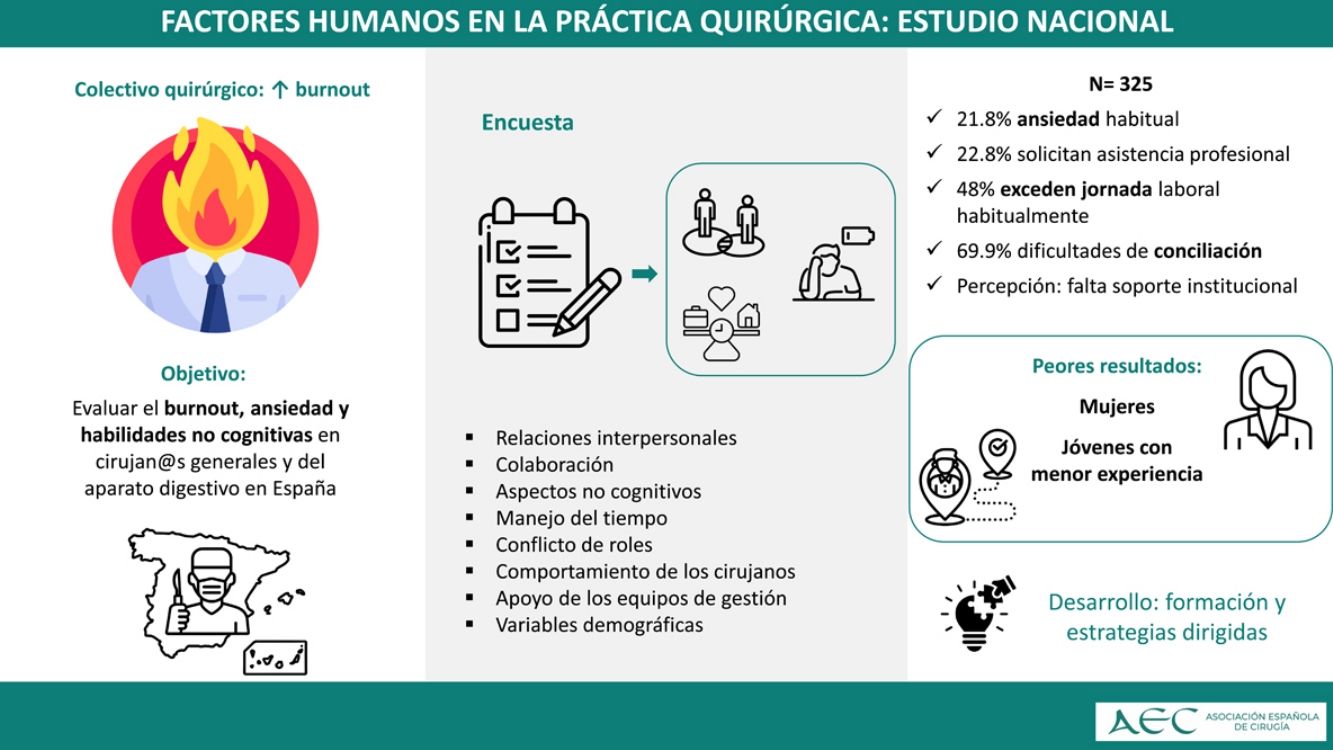
325 cirujanos participaron en la encuesta. El 57,5% fueron mujeres y el 95,1% trabajadores de hospitales públicos. Se detectó hasta un 21.8% de ansiedad habitual en situaciones diarias y una ausencia de formación en estos aspectos en el 63% de los encuestados. Hasta un 22,8% refirieron solicitar asistencia profesional relacionada con estos aspectos ocasional o frecuentemente. El 48% manifestaron exceder su jornada laboral habitualmente, el 69,9% reportaron dificultades en la capacidad de conciliación laboral y se identificó una notable percepción de ausencia de soporte institucional. Esta problemática fue significativamente más acusada entre los cirujanos jóvenes y en mujeres.

Conclusión

La prevalencia de ansiedad, «burnout», dificultades en la conciliación de la vida laboral y la percepción de ausencia de soporte institucional es elevada entre cirujanos generales y del aparato digestivo. Todo ello fundamenta la necesidad de desarrollar estrategias dirigidas a un enfoque de estos aspectos dentro de la especialidad.

Palabras clave:
Burnout
Ansiedad
Non-technical skills
Cirujanos generales
Encuesta
Abstract
Introduction

In the surgical setting, stress, burnout and the non-technical skills are increasingly recognized as factors influencing quality of care, workplace well-being and economic costs. However, these issues have been scarcely studied among general and digestive surgery in Spain. This study aims to assess burnout, stress and non-cognitive aspects in this specific professional group in Spain.

Methods

A 28-item survey was designed to evaluate different dimensions of burnout and non-cognitive factors. Participation was voluntary and it was distributed through the Spanish association of surgeons (Asociación Española de Cirugía).

Results

A total of 325 surgeons completed the survey. Women accounted for 57.5% of respondents and 95.1% worked in public hospitals. Up to 21.8% habitually experienced anxiety in daily situations, and 63% indicated a lack of training in these areas. Moreover, 22.8% acknowledged seeking professional assistance for related issues occasionally or frequently. Nearly 48% reported regularly exceeding their standard working hours, 69% experienced difficulties in achieving work-life balance, and a marked perception of insufficient institutional support was noted. These issues were significantly more prevalent among women and younger surgeons.

Conclusions

The prevalence of anxiety, burnout, work-life balance difficulties and perceived lack of institutional support is high among general and digestive surgeons. These findings underscore the need to develop targeted strategies addressing these factors within the specialty.

Keywords:
Burnout
Anxiety
Non-technical skills
General surgeons
Survey
Resumen gráfico

Artículo

Opciones para acceder a los textos completos de la publicación Cirugía Española
Suscriptor
Suscriptor de la revista

Si ya tiene sus datos de acceso, clique aquí.

Si olvidó su clave de acceso puede recuperarla clicando aquí y seleccionando la opción "He olvidado mi contraseña".
Comprar
Comprar acceso al artículo

Comprando el artículo el PDF del mismo podrá ser descargado

Comprar ahora
Contactar
Teléfono para suscripciones e incidencias
De lunes a viernes de 9h a 18h (GMT+1) excepto los meses de julio y agosto que será de 9 a 15h
Llamadas desde España
932 415 960
Llamadas desde fuera de España
+34 932 415 960
E-mail
Bibliografía
[1]
A. Pujol-de Castro, G. Valerio-Rao, P. Vaquero-Cepeda, F. Catalá-López.
Prevalencia del síndrome de burnout en médicos que trabajan en España: revisión sistemática y metaanálisis.
Gaceta Sanitaria., 38 (2024),
[2]
T.D. Shanafelt, C.M. Balch, L. Dyrbye, et al.
Special report: suicidal ideation among American surgeons.
Arch Surg., 146 (2011), pp. 54-62
[3]
F.M. Dimou, D. Eckelbarger, T.S. Riall.
Surgeon Burnout: A Systematic Review.
J Am Coll Surg., 222 (2016), pp. 1230-1239
[4]
T.D. Shanafelt, O. Hasan, L.N. Dyrbye, et al.
Changes in Burnout and Satisfaction With Work-Life Balance in Physicians and the General US Working Population Between 2011 and 2014.
Mayo Clin Proc., 90 (2015), pp. 1600-1613
[5]
D.A. Rogers, L. Lingard, M.L. Boehler, et al.
Surgeons managing conflict in the operating room: defining the educational need and identifying effective behaviors.
Am J Surg., 205 (2013), pp. 125-130
[6]
J.E. Berner, E. Ewertz.
Importancia de las habilidades no técnicas en la práctica quirúrgica actual.
Cir Esp., 97 (2019), pp. 190-195
[7]
S. Yule, S. Paterson-Brown.
Surgeons’ Non-technical Skills.
Surg Clin North Am., 92 (2012), pp. 37-50
[8]
T.D. Shanafelt, C.M. Balch, G. Bechamps, et al.
Burnout and medical errors among American surgeons.
Ann Surg., 251 (2010), pp. 995-1000
[9]
L.S. Rotenstein, M. Torre, M.A. Ramos, et al.
Prevalence of Burnout Among Physicians: A Systematic Review.
[10]
A.M. Delman, A.-F. Kassam, K.M. Turner, et al.
Incidence of attrition among early-career abdominal transplant surgeons.
Surgery., 173 (2023), pp. 1113-1119
[11]
S. Han, T.D. Shanafelt, C.A. Sinsky, K.M. Awad, et al.
Estimating the Attributable Cost of Physician Burnout in the United States.
Ann Intern Med., 170 (2019), pp. 784-790
[12]
P.F. Stahel, L. Cobianchi, F. Dal Mas, et al.
The role of teamwork and non-technical skills for improving emergency surgical outcomes: an international perspective.
Patient Saf Surg., (2022), pp. 16
[13]
E. Salas, G.F. Castillo, S. Tannenbaum.
The Heart of Surgery: Enhancing Surgical Practice Through Teamwork.
Semin Thorac Cardiovasc Surg., S1043-0679 (2025),
[14]
E. Nagle, I. Griskevica, O. Rajevska, A. Ivanovs, S. Mihailova, I. Skruzkalne.
Factors affecting healthcare workers burnout and their conceptual models: scoping review.
BMC Psychol., 12 (2024), pp. 637
[15]
G. Sanchez-Antolín, G. Blanco-Fernández, I. Campos-Varela, et al.
Burnout Among Physicians of Specialties Dedicated to Liver Transplantation.
Transpl Int., 37 (2024), pp. 13738
[16]
D.A. Rothenberger.
Physician Burnout and Well-Being: A Systematic Review and Framework for Action.
Dis Colon Rectum., 60 (2017), pp. 567-576
[17]
V. Lucas-Guerrero, M. Pascua-Solé, J.L. Ramos Rodríguez, et al.
Desgaste profesional o burnout en los residentes de Cirugía General Encuesta de la Asociación Española de Cirujanos.
Cir Esp., 98 (2020), pp. 442-449
[18]
I. Khansa, J.E. Janis.
A Growing Epidemic: Plastic Surgeons and Burnout—A Literature Review.
Plast Reconstr Surg., 144 (2019), pp. 298e-305e
[19]
C. Jiménez Alvarez, J.L. Morales Torres, C. Martínez Martínez.
Estudio del síndrome de «Burnout» en cirujanos pediatras españoles.
Cir Pediatr., 15 (2002), pp. 73-78
[20]
C.M. Møller, T. Clausen, B. Aust, J.W. Budtz-Lilly, J.P. Eiberg.
Burnout and Its Consequences among Vascular Surgeons and Trainees: A Danish National Survey.
J Am Coll Surg., 237 (2023),
[21]
R.A. Swendiman, A.C. Edmondson, N.N. Mahmoud.
Burnout in Surgery Viewed Through the Lens of Psychological Safety.
Ann Surg., 269 (2019), pp. 234-235
[22]
E. Von Elm, D.G. Altman, M. Egger, S.J. Pocock, P.C. Gøtzsche, J.P. Vandenbroucke.
The Strengthening the Reporting of Observational Studies in Epidemiology (STROBE) statement: guidelines for reporting observational studies.
Lancet., 370 (2007), pp. 1453-1457
[23]
Asociación Española de Cirujanos. Formación [Internet]. Madrid: Asociación Española de Cirujanos. [consultado 21 Sep 2025]. Disponible en: https://www.aecirujanos.es/Formacion_es_104.html.
[24]
C.C. Greenberg, S.E. Regenbogen, D.M. Studdert, et al.
Patterns of Communication Breakdowns Resulting in Injury to Surgical Patients.
J Am Coll Surg., 204 (2007), pp. 533-540
[25]
R. Galaiya, J. Kinross, T. Arulampalam.
Factors associated with burnout syndrome in surgeons: a systematic review.
Annals., 102 (2020), pp. 401-407
[26]
R.S. Guest, R. Baser, Y. Li, P.T. Scardino, A.E. Brown, D.W. Kissane.
Cancer surgeons’ distress and well-being, II: modifiable factors and the potential for organizational interventions.
Ann Surg Oncol., 18 (2011), pp. 1236-1242
[27]
L.N. Dyrbye, T.D. Shanafelt, C.M. Balch, D. Satele, J. Sloan, J. Freischlag.
Relationship between work-home conflicts and burnout among American surgeons: a comparison by sex.
Arch Surg., 146 (2011), pp. 211-217
[28]
S.P. Baral, P. Prasad, G. Raghuvamshi.
Mental Health Awareness And Generation Gap.
Indian J Psychiatry., 64 (2022), pp. 636
[29]
N. Granchi, Y.Y. Ting, K.P. Foley, et al.
Coaching to enhance qualified surgeons’ non-technical skills: a systematic review.
Br J Surg., 108 (2021), pp. 1154-1161
[30]
R.S. Chung, N. Ahmed.
How surgical residents spend their training time: the effect of a goal-oriented work style on efficiency and work satisfaction.
Arch Surg., 142 (2007), pp. 249-252
[31]
T.D. Shanafelt, K.L. Kaups, H. Nelson, et al.
An interactive individualized intervention to promote behavioral change to increase personal well-being in US surgeons.
Ann Surg., 259 (2014), pp. 82-88
[32]
C.P. West, L.N. Dyrbye, P.J. Erwin, T.D. Shanafelt.
Interventions to prevent and reduce physician burnout: a systematic review and meta-analysis.
Lancet., 388 (2016), pp. 2272-2281
[33]
L.E. Søvold, J.A. Naslund, A.A. Kousoulis, et al.
Prioritizing the Mental Health and Well-Being of Healthcare Workers: An Urgent Global Public Health Priority.
Front Public Health., 9 (2021), pp. 679397
[34]
A.E. Af Wåhlberg, L. Poom.
An Empirical Test of Nonresponse Bias in Internet Surveys.
Basic Appl Soc Psych., 37 (2015), pp. 336-347
[35]
C. Maslach, S.E. Jackson.
The measurement of experienced burnout.
J Organ Behav., 2 (1981), pp. 99-113
[36]
S. Yule, R. Flin, S. Paterson-Brown, N. Maran, D. Rowley.
Development of a rating system for surgeons’ non-technical skills.
Med Educ., 40 (2006), pp. 1098-1104
asdasdasd
Opciones de artículo
Herramientas
Material suplementario