


metricas
covid
Archivos de la Sociedad Española de Oftalmología (English Edition) New OCT sign in X-linked retinoschisis without macular schisis: "Inverted roof f...
Journal Information
Vol. 100. Issue 8.
Pages 476-480 (August 2025)
Vol. 100. Issue 8.
Pages 476-480 (August 2025)
Short communication
New OCT sign in X-linked retinoschisis without macular schisis: "Inverted roof fovea"
Nuevo signo OCT en retinosquisis ligada al X sin esquisis macular: “fóvea en tejado invertido”
P.B. Blasco Palacio
Corresponding author
polblascozaragoza@hotmail.com

Corresponding author.
, A. Aramburu-Gonzalez, I. Rodríguez García
Servicio Oftalmología, Hospital de Basurto, Bilbao, Spain
Article information
Abstract
Full Text
Bibliography
Download PDF
Statistics
Figures (3)
Show moreShow less
Abstract

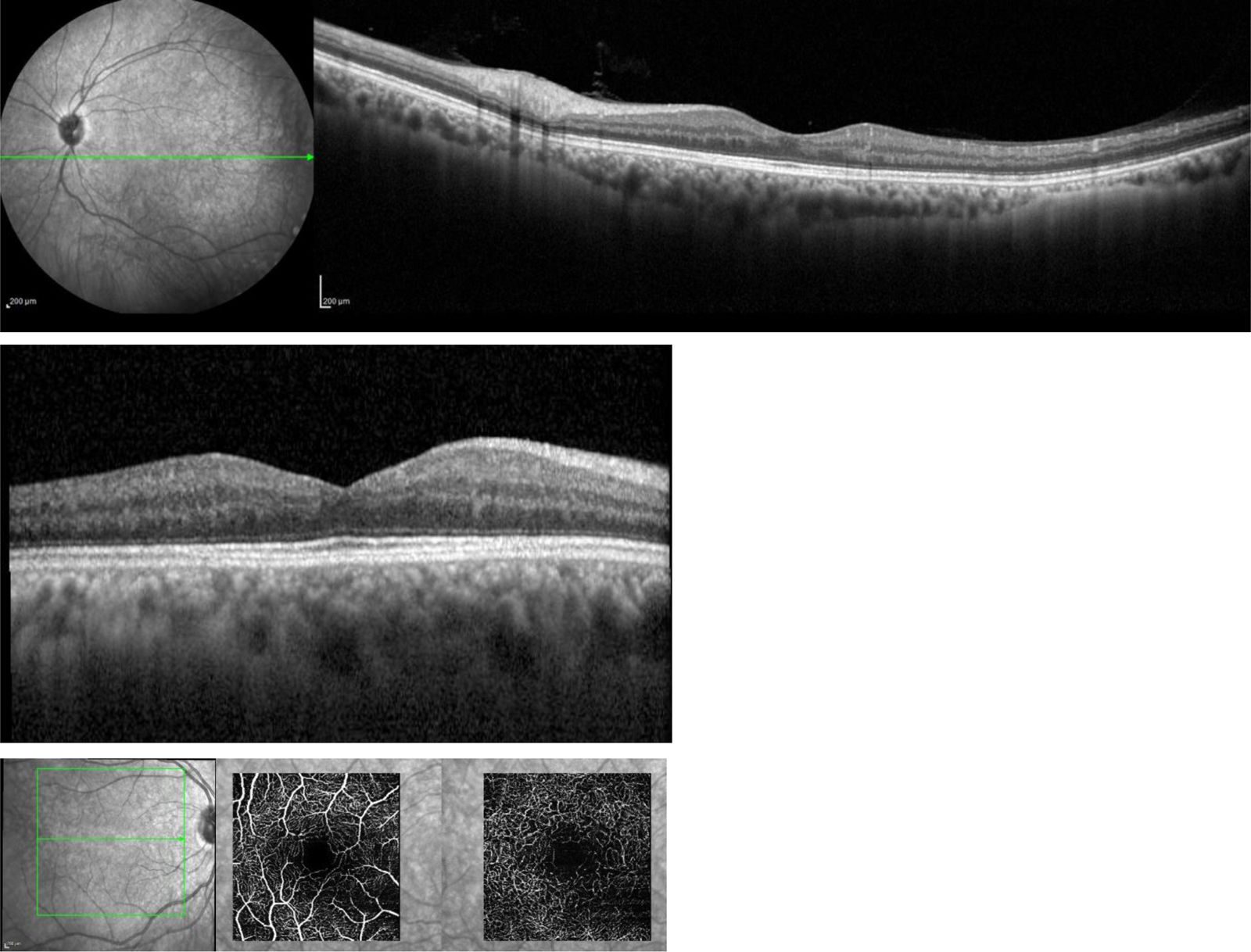
We present the case of a 52-year-old man with a stable ophthalmological follow-up for the last 10 years. Clinically asymptomatic, except for floaters in both eyes. In the fundus, bilateral peripheral retinoschisis was observed without associated macular schisis. The electroretinogram (ERG) is electronegative and shows a genetic confirmation of the pathogenic variant c.461A > G; p.(Gln154Arg) of the RS1 gene compatible with the diagnosis of juvenile X-linked retinoschisis (RSLX). The foveal architecture in Optical Coherence Tomography (OCT) presents "inverted roof fovea" not previously described, having found two similar cases in the literature. In males in whom we find the sign of "inverted roof fovea", we should check the fundus, and if we find peripheral retinoschisis, we recommend insisting on the family history, and increase its study with an ERG and molecular genetic analysis, ruling out RSLX.

Keywords:
Inverted roof fovea
Juvenile X-linked retinoschisis
Peripheral retinoschisis
Electronegative ERG
Optical coherence tomography
RS1 gene
Resumen

Presentamos el caso de un varón de 52 años de edad con un seguimiento oftalmológico estable durante los últimos 10 años. Clínicamente asintomático, salvo por miodesopsias en ambos ojos. En el fondo de ojo se observa retinosquisis periférica bilateral sin asociar esquisis macular. El electrorretinograma (ERG) es electronegativo y muestra una confirmación genética de la variante patogénica c.461A > G; p.(Gln154Arg) del gen RS1 compatible con el diagnóstico de retinosquisis juvenil ligada al X (RSLX). La arquitectura foveal en la Tomografía de Coherencia óptica (OCT) presenta “fóvea en tejado invertido” o “inverted roof fovea” no descrita previamente, habiendo encontrado dos casos similares en la literatura. En varones en los que encontremos el signo de “fóvea en tejado invertido”, deberemos revisar el fondo de ojo, y si encontramos retinosquisis periférica aconsejamos insistir en la anamnesis familiar, y aumentar su estudio con un ERG y análisis genético molecular descartando RSLX.


Palabras clave:
Fóvea en tejado invertido
Retinosquisis juvenil ligada al X
Retinosquisis periférica
ERG electronegativo
Tomografía de coherencia óptica OCT
Gen RS1

Article

These are the options to access the full texts of the publication Archivos de la Sociedad Española de Oftalmología (English Edition)
Subscriber
Subscriber

If you already have your login data, please click here .

If you have forgotten your password you can you can recover it by clicking here and selecting the option “I have forgotten my password”
Subscribe
Subscribe to

Archivos de la Sociedad Española de Oftalmología (English Edition)

Purchase
Purchase article

Purchasing article the PDF version will be downloaded

Purchase now
Contact
Phone for subscriptions and reporting of errors
From Monday to Friday from 9 a.m. to 6 p.m. (GMT + 1) except for the months of July and August which will be from 9 a.m. to 3 p.m.
Calls from Spain
932 415 960
Calls from outside Spain
+34 932 415 960
E-mail
Article options
Tools