






Pathophysiology of fibromyalgia is still not well known. There are certain theories than point out a possible neurodegeneration component.
ObjectivesTo evaluate variations in visual function parameters and in the macular ganglion cell layer (CGR) of patients with fibromyalgia (FM) over a period of 5 years, and compare these results with controls.
Methods85 patients with FM and 41 healthy subjects underwent a complete ophthalmic evaluation, including assessment of visual acuity (VA) with ETDRS, contrast sensitivity vision (CSV) with Pelli Robson, color vision with Farnsworth and Lanthony D15 tests and retinal evaluation using Cirrus HD-OCT 3000 (Carl Zeiss, California). All subjects were re-evaluated after 5 years. It was also analyzed the association between progressive structural, functional and disease severity changes. Furthermore, patients were classified into three groups (1, atypical; 2, depressive; 3, biologic).
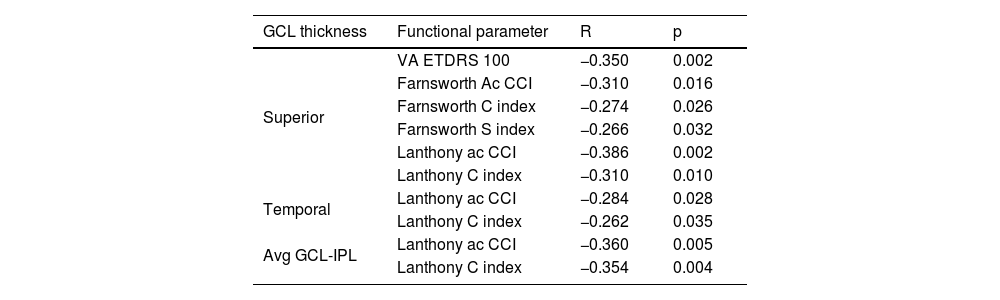
ResultsProgressive changes were detected in visual function parameters and CGR thickness in FM patients after 5 years. Patients with FM presented worse low contrast VA (p = 0.022), color discrimination (Lanthony’s C index, p = 0.006) and decreased CGR thickness (nasal inferior, p < 0.001) over the follow up time, compared with controls. Changes in color vision were associated with CGR thinning, but no correlations with disease severity were observed.
ConclusionsIt has been noticed progressive visual dysfunction and CGR loss in patients suffering from FM. The analysis of visual function parameters and CGR thickness using Cirrus OCT could be of value to control FM disease.
La fisiopatología de la fibromialgia todavía no es bien conocida. Existen ciertas teorías que señalan un posible componente neurodegenerativo.
ObjetivosEvaluar variaciones en los parámetros de la función visual y en la capa de células ganglionares (CCG) maculares de pacientes con Fibromialgia (FM) durante un período de 5 años, y comparar estos resultados con los de controles sanos.
Método85 pacientes con FM y 41 sujetos sanos se sometieron a una evaluación oftálmica completa, incluyendo evaluación de agudeza visual (AV) con ETDRS, visión de sensibilidad al contraste (VSC) con Pelli Robson, visión de colores con las pruebas Farnsworth y Lanthony D15 y evaluación de retina con el tomógrafo de coherecia óptica Cirrus HD-OCT 3000 (Carl Zeiss, California). Todos los sujetos fueron reevaluados 5 años después. También se analizó la asociación entre cambios progresivos estructurales, funcionales y de gravedad de la enfermedad. Además, los pacientes se clasificaron en tres grupos (1, atípicos; 2, depresivos; 3, biológicos).
ResultadosSe detectaron cambios progresivos en los parámetros de la función visual y el espesor del CCG en pacientes con FM después de 5 años. Los pacientes con FM presentaron peor AV de bajo contraste (p = 0,022), discriminación de color (índice C de Lanthony, p = 0,006) y disminución del grosor del CCG (nasal inferior, p < 0,001) durante el tiempo de seguimiento, en comparación con los controles. Los cambios en la visión del color se asociaron con el adelgazamiento del CCG, pero no se observaron correlaciones con la gravedad de la enfermedad.
ConclusionesSe ha observado disfunción visual progresiva y pérdida de CCG en pacientes que padecen FM. El análisis de los parámetros de la función visual y el espesor del CCG mediante Cirrus OCT podría ser valioso para controlar la FM.

