Abstracts of the 2025 Annual Meeting of the ALEH
More infoA blood test count is an accessible resource at all levels of healthcare. Few studies have evaluated its usefulness in patients with alcoholic hepatitis (AH).
The aim is to determine the association between the neutrophil-lymphocyte ratio (NLR), platelet-lymphocyte ratio (PLR) and systemic immune-inflammation index (SI-II) with 28-day mortality in patients with AH.
Materials and MethodsLongitudinal, retrospective, observational and descriptive cohort study. Subjects met criteria for AH. Patients with conditions that could alter the blood count were excluded. Absolute values of NLR: (neutrophils/lymphocytes), PLR: platelets/lymphocytes, SI-II (neutrophils x platelets/lymphocytes) were estimated.
Statistical analysis was performed with the Jamovi program. To compare clinical values, Student's T-test or Mann Whitney U test were performed. The association analysis between NLR, PLR and SI-II with 28-day mortality, were carried out using a point-biserial correlation. An ROC curve was performed using GraphPad Prism version 10.2.3 to establish the cutoff point of the NLR and determine the sensitivity and specificity.
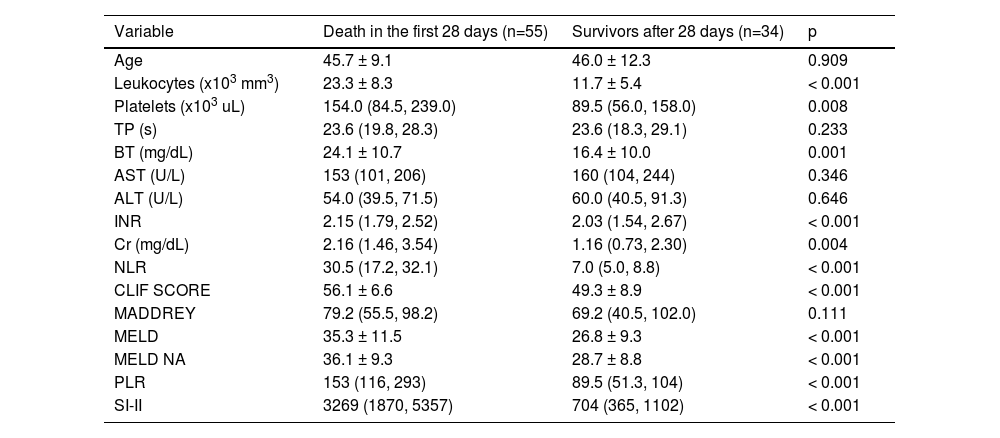
ResultsEighty-nine patients were included, 86 (96%) men and 3 (4%) women. The mean NLR value in patients who survived was four times the value presented in patients who died within 28 days, two times for the PLR and five times for SI-II (Table 1). The cutoff point of the NLR was >12.9 (AUC 0.986), with a p value <0.0001, sensitivity 92.7% and specificity 94.1% (95% CI).
ConclusionsA blood test count is an accessible resource that could be considered a useful prognostic factor in clinical practice for alcoholic hepatitis.
Conflict of interest: None
Table 1. Comparison table of survival at 28 days using prognostic scales.
Abbreviations: NLR: neutrophil-lymphocyte ratio, PLR: platelet-lymphocyte ratio, SI-II: systemic immune-inflammation index
ROC curve for NLR