


metricas
covid
Annals of Hepatology MELD 3.0 PERFORMANCE: EXTERNAL VALIDATION IN A LATIN AMERICAN TRANSPLANT LIVER C...
Journal Information
Vol. 30. Issue S2.
Abstracts of the 2025 Annual Meeting of the ALEH
(September 2025)
Vol. 30. Issue S2.
Abstracts of the 2025 Annual Meeting of the ALEH
(September 2025)
#23
Full text access
MELD 3.0 PERFORMANCE: EXTERNAL VALIDATION IN A LATIN AMERICAN TRANSPLANT LIVER COHORT
Visits
247
Josefina Pages Maronese1, Federico Piñero1, Graciela Castro Narro2, Yahvé Iván López Méndez3, Ignacio Roca4, Nicolas Dominguez4, Fernando Cairo4, Angelo Z. Mattos5, Natalia Baumgartner Ayres6, Bertha Eliana Cárdenas Ramírez7, Estefania Liza Baca8, Julio Benitez Perez9, Alejandra Villamil10, Alexandra Ginesta11, Rodrigo Zapata12, Gustavo Pereira13, Florencia Antinucci14, Aldo Torre Delgadillo15, Marcelo Silva1, Manuel Mendizabal1
1 Hospital Universitario Austral, Argentina.
2 Instituto Nacional de Ciencias Médicas y Nutrición “Salvador Zubiran”-Hospital Medica Sur, México.
3 Hospital Medica Sur, México.
4 Hospital El Cruce, Argentina.
5 Universidade Federal de Ciências da Saúde de Porto Alegre. Irmandade Santa Casa de Misericórdia de Porto Alegre, Brasil.
6 Irmandade Santa Casa de Misericórdia de Porto Alegre, Brasil.
7 Hospital Nacional Guillermo Almenara, Perú.
8 Hospital Nacional Edgardo Rebagliati Martins, Perú.
9 Complejo Asistencial Dr. Sotero del Rio, Chile.
10 Hospital Italiano de Buenos Aires, Argentina.
11 Clínica Alemana de Santiago, Chile.
12 Clínica Alemana de Santiago. Universidad del Desarrollo, Chile.
13 Hospital Federal de de Bonsucesso, Brasil.
14 Hospital Alemán, Argentina.
15 Centro Médico ABC, México.
Ver más
This item has received
Article information
Abstract
Full Text
Download PDF
Statistics
Figures (1)
Special issue
This article is part of special issue:
Vol. 30. Issue S2

Abstracts of the 2025 Annual Meeting of the ALEH

More info
Introduction and Objectives

The MELD 3.0 score has demonstrated superior discriminatory performance for predicting 90-day waitlist mortality among liver transplant (LT) candidates in the US. This study aimed to validate the MELD 3.0 in a Latin American cohort.

Materials and Methods

Retrospective cohort study including adults LT candidates listed between 2016-2023 across five Latin American countries. Baseline data were registered at listing. Cox regression model was performed, with 90-day mortality as the primary outcome and LT as censored observation. Discriminative performance was assessed using Harrell´s c-index for MELD, MELD-Na and MELD 3.0. Net Reclassification Index (NRI) was also calculated.

Results

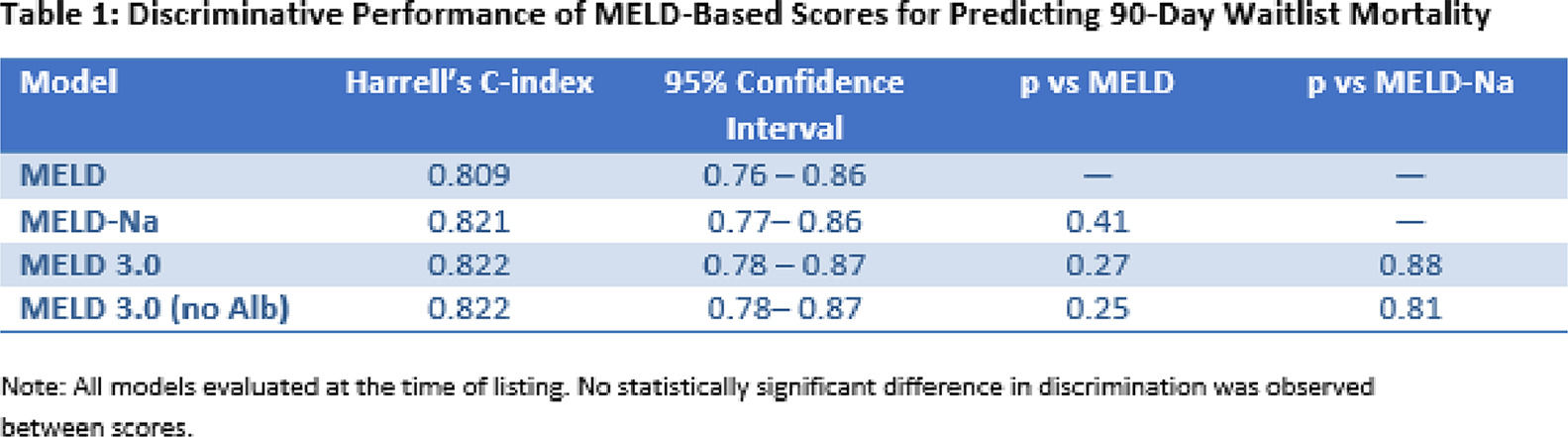
We included 1,013 patients: mean age 51 years (±11.8); 41.4% females, 25.8% obese, 58.1% ascites and 38.3% had encephalopathy were present in 58.1% and 38.3% of cases, respectively. Median MELD score was 16.9 (IQR 13.3–21.1), MELD-Na 18.3 (IQR 14.6–24), and MELD 3.0 19.5 (IQR 15.1–24.8). At 90 days, 26.3% underwent LT and 66.8% remained on the waitlist. The mortality incidence was 29.4 deaths per 1,000 patient-months, with a cumulative mortality of 8.3% (95% CI 6.6–10.4%) at 3 months. Hazard ratios for 90-day mortality were: MELD 1.15 (95% CI 1.12-1.19), MELD-Na 1.16 (95% CI 1.13-1.20), and MELD 3.0 1.15 (95% CI 1.12-1.19). Harrell’s c-index showed no significant differences (Table 1).NRI showed no significant improvement in risk reclassification using MELD 3.0.

Conclusions

In a region showing high waitlist mortality, MELD 3.0 did not demonstrate superior predictive performance over MELD or MELD-Na. These findings highlight the need for regional validation of predictive models before implementation in transplant priorization policies.


Full Text

Conflict of interest: None

Download PDF
Article options
Tools




