Abstracts of the 2025 Annual Meeting of the ALEH
More infoIntroduction: Quality indicators (QIs) for the management of acute variceal bleeding (AVB) encompass guideline-recommended interventions aimed at reducing mortality. However, the cumulative impact of full adherence to these measures remains unclear.
To evaluate whether complete compliance with five established QIs during AVB episodes is associated with reduced 6-week mortality.
Materials and MethodsThis retrospective observational study included 135 AVB episodes from 2017 to 2024. Adherence to five QIs was assessed: antibiotic administration within 24 hours, vasoactive agent used within 24 hours, diagnostic endoscopy within 24 hours, endoscopic treatment, and beta-blocker prescription at discharge. Full adherence was defined as compliance with all five interventions. The primary outcome was 6-week mortality. Descriptive statistics and multivariate logistic regression adjusted for MELD score (<15 vs. ≥15) and Child-Pugh class (A/B vs. C) were performed. An interaction term was included to evaluate whether the effect of QI compliance differed by Child-Pugh class.
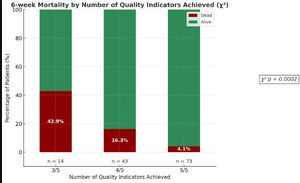
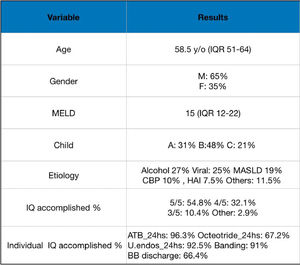
ResultsOverall 6-week mortality was 13.8%. Full adherence was achieved in 54.8% of episodes. Mortality rates by adherence level were 4.1% for full adherence, 16.3% for four QIs, and 42.9% for three or fewer QIs (p < 0.001). In multivariate analysis, full adherence was independently associated with lower mortality (OR 0.20; 95% CI 0.05–0.82; p = 0.025). Child-Pugh class C was also significantly associated with increased mortality (OR 9.68; p = 0.001). An interaction analysis showed that the protective effect of QI adherence did not differ significantly between Child-Pugh A/B and Child-Pugh C patients (interaction term p = 0.87), suggesting a consistent benefit across severity strata.
ConclusionsComplete compliance with evidence-based quality indicators significantly reduces 6-week mortality in patients with AVB, independent of baseline liver disease severity. Rigorous implementation of these measures should be prioritized as a standard of care in cirrhotic patients presenting with AVB.