



Abstracts Asociación Mexicana de Hepatología (AMH) 2024
More infoIt has been demonstrated that approximately 3% of pregnant women are affected by some type of liver disorder. The aim of this study is to determine the clinical and epidemiological characteristics of pregnant patients who developed liver disease during their pregnancy or liver pathology unrelated to pregnancy.
Materials and PatientsThe study is a retrospective and observational analysis of a cohort composed of 72 pregnant women diagnosed with liver pathologies. These patients were seen in the gynecology and obstetrics service of the Hospital General de México between January 2023 and May 2024. The selection of the participants was based on their admission during the aforementioned period and the presence of a diagnosis of liver disease associated with pregnancy or under investigation. Data collection was carried out using forms designed for this purpose, through the review of the patients' clinical records, which classifies the source of information as secondary. Data analysis was performed using SPSS statistical software version 23. A descriptive approach was used for the analysis, presenting qualitative variables in terms of frequency and percentage, while measures of central tendency, such as mean and standard deviation, were calculated for quantitative variables.
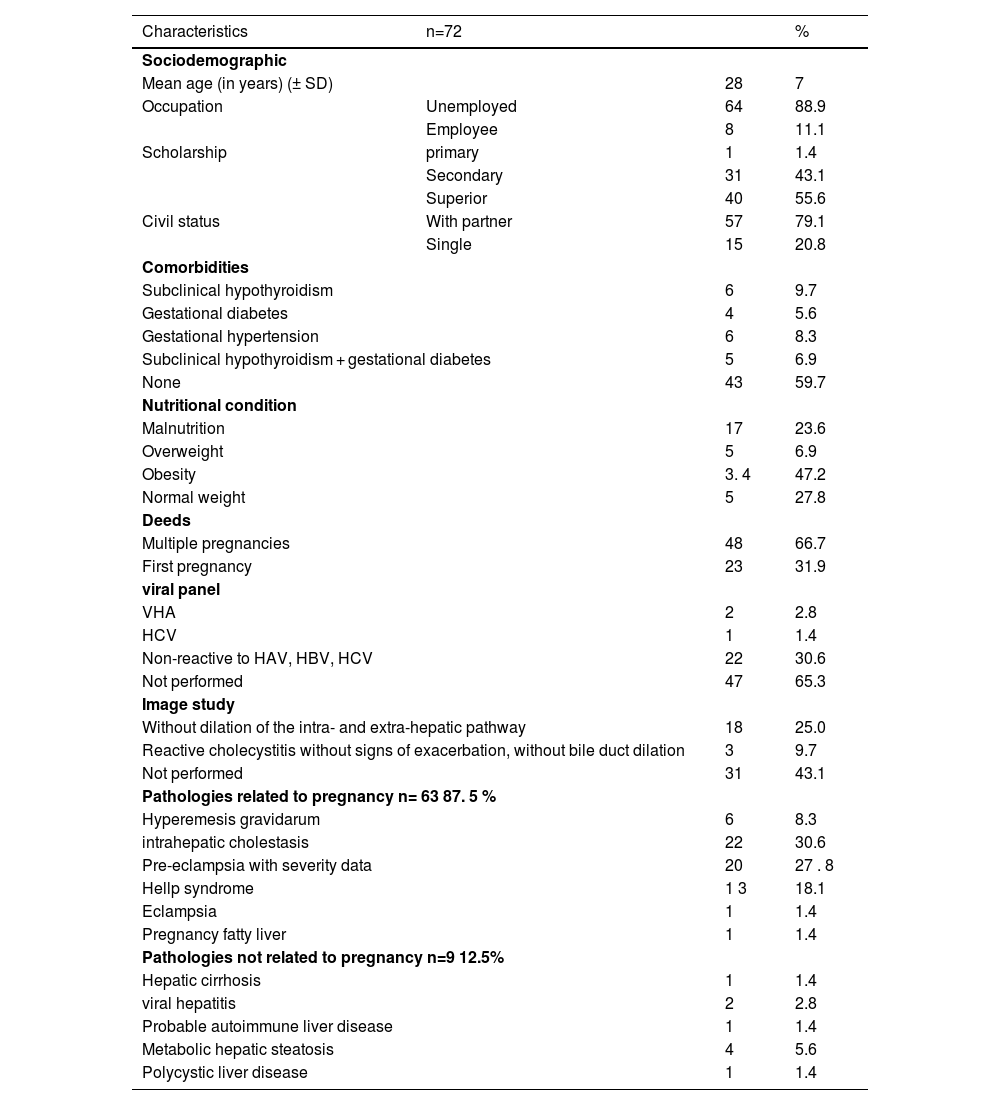
ResultsData were collected from 72 files of pregnant patients who developed liver disease during pregnancy or liver pathology unrelated to pregnancy. The average age was 28.36, 28.36+-6.96 (26.75-29.97). 66.7% were multipregnant and 31.9% were primigravida. Regarding associated comorbidities, 59.7% did not present any comorbidity, while 40.3% presented some comorbidity, with subclinical hypothyroidism being the most frequent at 9.7%. Regarding nutritional status, 40.3% were obese, 6.9% overweight, and 27.8% normal weight. In the viral panel, 30.6% were non-reactive for HAV, HBV, and HCV, and up to 65.3% were not tested. Imaging studies showed the absence of intra- and extra-hepatic duct dilatation in 25%, on the other hand, 31.1% did not undergo imaging studies. The 87.5% presented some pathology related to pregnancy, the main ones being intrahepatic cholestasis (30.6%), preeclampsia with severe features (27.8%), HELLP syndrome (18.1%), and only 13.9% pathologies not related to pregnancy, the main ones being metabolic hepatic steatosis (5.6%) and viral hepatitis (2.8%).
ConclusionsIn our study, liver pathology in pregnant women has similar characteristics to those reported in the world literature, with those related to pregnancy predominating over pre-existing pathologies. It should be emphasized that all pregnant women should be approached for such pathology and thus avoid complications in both mother and child.
Ethical statement: The research was conducted in accordance with the Helsinki Declaration (2013 revision).
Declaration of interests: None.
Funding: This research did not receive any specific grant from funding agencies in the public, commercial, or not-for-profit sectors.
DM, Diabetes mellitus; HAV, Hepatitis A virus; HBV, Hepatitis B virus; HCV, Hepatitis C virus.





