Abstracts of the 2025 Annual Meeting of the ALEH
More infoPrimary biliary cholangitis (PBC) is a chronic liver disease that significantly impacts patients’ quality of life due to persistent symptoms like fatigue, pruritus, and emotional or cognitive disturbances. Understanding these effects is vital for guiding patient-centered care.
This study aimed to assess quality of life in patients with PBC using the validated PBC-27 questionnaire, identifying the most affected domains.
Materials and MethodsWe conducted an cross-sectional, observational, and descriptive study in 50 adult patients with confirmed PBC, evaluated at a tertiary care center between March and May 2025. Variables included age, sex, comorbidities, disease duration, and PBC-27 domain-specific scores. Descriptive statistics were used, with medians and interquartile ranges for continuous variables, and absolute and relative frequencies for categorical data.
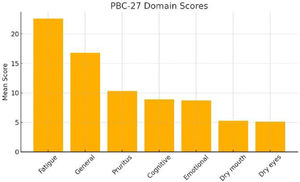
ResultsAll 50 patients completed the PBC-27 questionnaire. The mean overall score was 77.1 ± 4.2, ranging from 68.5 to 86.2. Fatigue was the most affected domain, with a mean score of 22.6 ± 3.2, followed by general symptoms (16.8 ± 2.9), pruritus (10.3 ± 2.1), and cognitive symptoms (8.9 ± 1.8). Emotional symptoms were also prevalent (8.7 ± 2.0). Domains related to dry mouth and dry eyes had the lowest impact, with mean scores of 5.3 ± 1.7 and 5.1 ± 1.5, respectively.
ConclusionsThese findings underscore the multidimensional burden of PBC on quality of life, particularly in physical and neurocognitive domains. Regular assessment using structured tools like the PBC-27 is crucial for tailoring follow-up and improving patient outcomes.