









To investigate the effects of symmetric and asymmetric sensorineural hearing loss (SSNHL and ASNHL) on speech discrimination abilities and binaural processing, including integration and interaction.
Materials and methodsThis cross-sectional study included 36 adult patients with bilateral sensorineural hearing loss, divided into two groups based on the symmetry of their hearing loss: ASNHL and SSNHL. Speech discrimination abilities were evaluated using the maximum speech discrimination score (SDSmax) with Arabic monosyllabic words. Binaural integration was assessed using the free-recall double dichotic digit test (DDT), while binaural interaction was evaluated through the binaural fusion test (BFT).
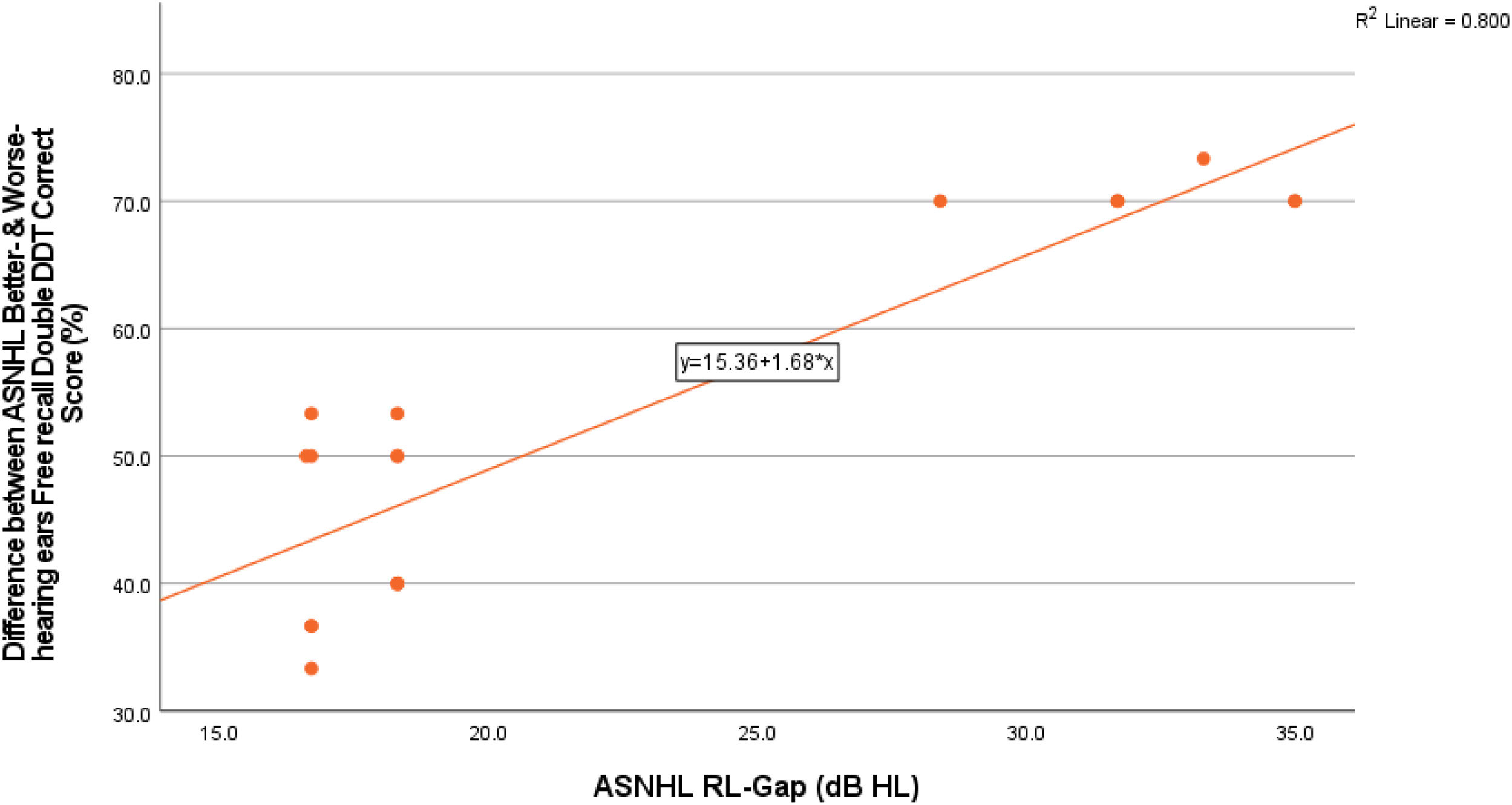
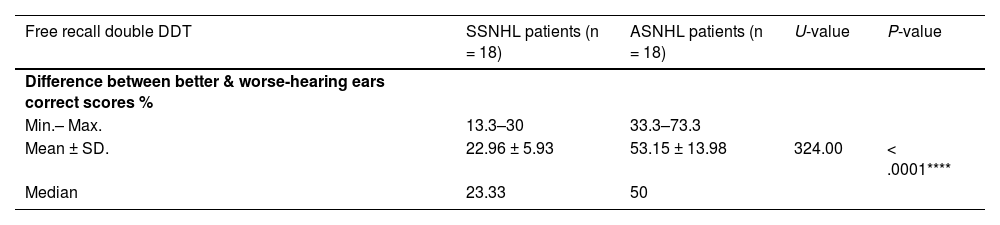
ResultsThe SDSmax of the worse-hearing ear in ASNHL patients (48.89 ± 10.13%) was significantly lower than in SSNHL patients (69.33 ± 7.97%) with comparable degrees of hearing loss. ASNHL patients exhibited a greater disparity between the better and worse-hearing ears in DDT scores (53.15 ± 13.98%) compared to SSNHL patients (22.96 ± 5.93%). Additionally, the BFT scores in ASNHL patients (55.14 ± 13.30%) were significantly lower than in SSNHL patients (72.92 ± 12.55%).
ConclusionsASNHL patients experience greater impairments in speech discrimination, binaural integration, and interaction compared to SSNHL patients. These differences likely stem from auditory deprivation and asymmetry-induced deficits. Developing tailored hearing rehabilitation strategies is critical to addressing the unique challenges posed by asymmetric hearing loss.
Investigar los efectos de la pérdida auditiva neurosensorial simétrica y asimétrica (SSNHL y ASNHL) en las habilidades de discriminación del habla y el procesamiento binaural, incluyendo integración e interacción.
Materiales y métodosEste estudio transversal incluyó a 36 pacientes adultos con pérdida auditiva neurosensorial bilateral, divididos en dos grupos según la simetría de su pérdida auditiva: ASNHL y SSNHL. Las habilidades de discriminación del habla se evaluaron mediante la puntuación máxima de discriminación del habla (SDSmax) utilizando palabras monosilábicas en árabe. La integración binaural se evaluó con la prueba dicótica de dígitos de recuerdo libre (DDT), mientras que la interacción binaural se analizó mediante la prueba de fusión binaural (BFT).
ResultadosEl SDSmax del oído con peor audición en pacientes con ASNHL (48,89 ± 10,13%) fue significativamente menor que en pacientes con SSNHL (69,33 ± 7,97%) con grados de pérdida auditiva comparables. Los pacientes con ASNHL mostraron una mayor disparidad entre los oídos con mejor y peor audición en las puntuaciones del DDT (53,15 ± 13,98%) en comparación con los pacientes con SSNHL (22,96 ± 5,93%). Además, las puntuaciones del BFT en pacientes con ASNHL (55,14 ± 13,30%) fueron significativamente más bajas que en los pacientes con SSNHL (72,92 ± 12,55%).
ConclusionesLos pacientes con ASNHL presentan mayores déficits en la discriminación del habla, la integración binaural y la interacción en comparación con los pacientes con SSNHL. Estas diferencias probablemente se deban a la privación auditiva y a los déficits inducidos por la asimetría. Es fundamental desarrollar estrategias de rehabilitación auditiva personalizadas para abordar los desafíos específicos que plantea la pérdida auditiva asimétrica.
