






Chronic rhinosinusitis (CRS) is a prevalent disease responsible for significant morbidity. Diagnostic criteria are well established but response to clinical and surgical treatment need greater consistency. The objective of this paper was to perform a cross-cultural adaptation of the CRS-PRO to the Spanish language for its use as a routine questionnaire in the evaluation of CRS.
MethodsThe CRS-PRO questionnaire was translated using a three-step procedure in 50 patients, following the recommendations of the International Society for Pharmacoeconomics and Outcomes Research (ISPOR). Native speakers of both European and South American Spanish participated in the translation.
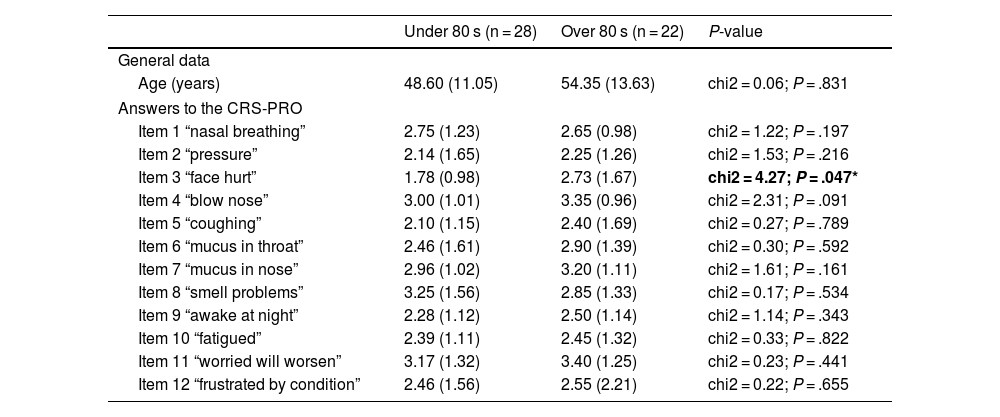
ResultsOf the initial 12 items, 4 were discordant among the three translators before a consensus was reached (Step 1). The item “breathe through the nose” (1/12) did not match between the back translation and the initial version of the CRS-PRO (Step 2). Step 3 generated a final revised Spanish version of the CRS-PRO. Fifty patients (average age 51.1, 48% male) completed the questionnaire. Significant gender differences were found in responses to “My face hurt” (P = .043). Significant differences in “My face hurt” also appeared for those completing the questionnaire in less than 80 s (P = .047). Differences in “problems with smell” (P = .039) were noted between chronic rhinosinusitis with and without polyposis.
ConclusionThis study presents the validated and Spanish-adapted version of the CRS-PRO questionnaire to evaluate CRS symptoms in the Spanish-speaking population.
La rinosinusitis crónica (RSC) es una enfermedad prevalente responsable de una morbilidad significativa. Los criterios diagnósticos están bien establecidos, pero la respuesta al tratamiento clínico y quirúrgico necesita una mayor consistencia. El objetivo de este trabajo fue realizar una adaptación transcultural del CRS-PRO al idioma español para su uso como cuestionario de rutina en la evaluación de la RSC.
MétodosEl cuestionario CRS-PRO se tradujo mediante un procedimiento de tres pasos en 50 pacientes, siguiendo las recomendaciones de la Sociedad Internacional de Farmacoeconomía e Investigación de Resultados (ISPOR). En la traducción participaron hablantes nativos de español europeo y latinoamericano.
ResultadosDe los 12 ítems iniciales, 4 fueron discordantes entre los tres traductores antes de llegar a un consenso (Paso 1). El ítem «respirar por la nariz» (1/12) no coincidía entre la traducción inversa y la versión inicial del CRS-PRO (Paso 2). El paso 3 generó una versión final revisada en español del CRS-PRO. Cincuenta pacientes completaron el cuestionario (edad media 51.1, 48% varones). Se encontraron diferencias significativas de género en las respuestas a «me duele la cara» (P = .043). También aparecieron diferencias significativas en «me duele la cara» para los que completaron el cuestionario en menos de 80 segundos (P = .047). Se observaron diferencias en «problemas con el olfato» (P = .039) entre la rinosinusitis crónica con y sin poliposis.
ConclusionesEste estudio presenta la versión validada y adaptada al español del cuestionario CRS-PRO para evaluar los síntomas de la RSC en la población hispanohablante.
