




To investigate the prognostic value of pretreatment 2-[18F]-fluoro-2-deoxy-d-glucose (18F-FDG) positron emission tomography/computed tomography (PET/CT) in patients with hepatic neuroendocrine tumors (HNET).
MethodsIn total, 41 patients were included in this study. PET-derived metabolic parameters, including maximum and mean standardized uptake values (SUVmax and SUVmean, respectively), metabolic tumor volume (MTV), and total lesion glycolysis (TLG), of the tumors were measured. Meanwhile, clinical data, including tumor pathological findings such as the Ki-67 index were also assessed. Progression-free survival (PFS) and overall survival (OS) were evaluated. Univariate and multivariate analyses were performed to predict the prognostic value of clinical variables and PET-derived metabolic parameters in HNET patients. Correlation between PET-derived metabolic parameters and Ki-67 was estimated.
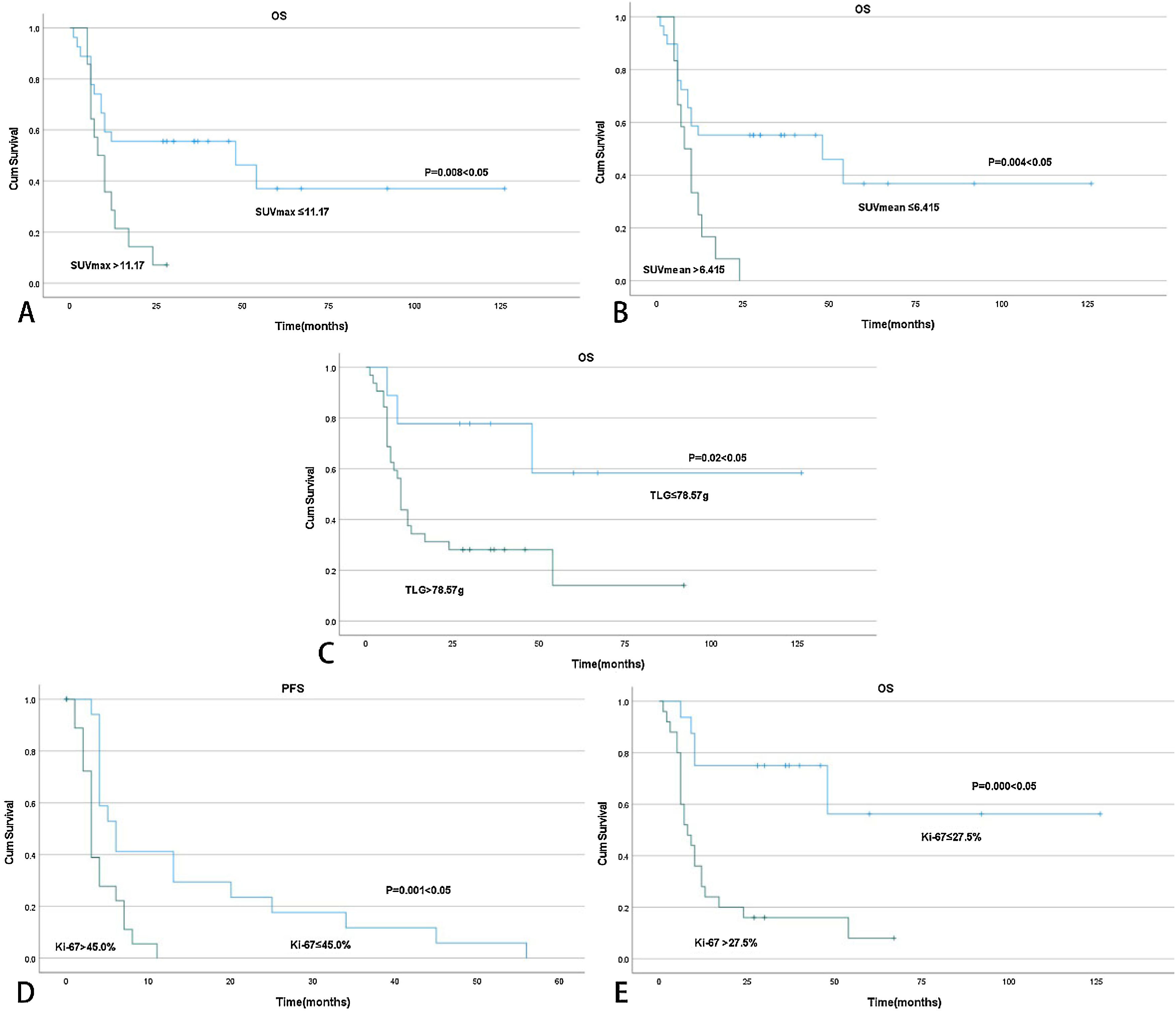
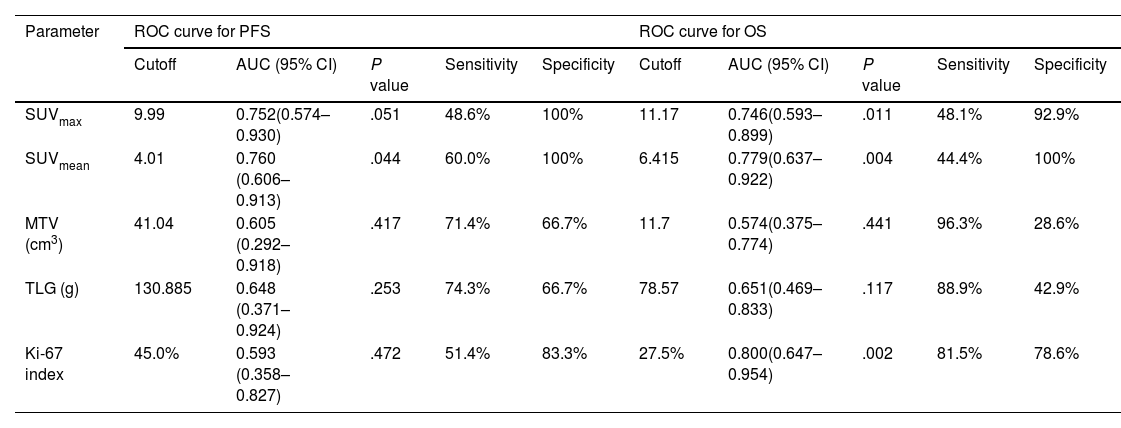
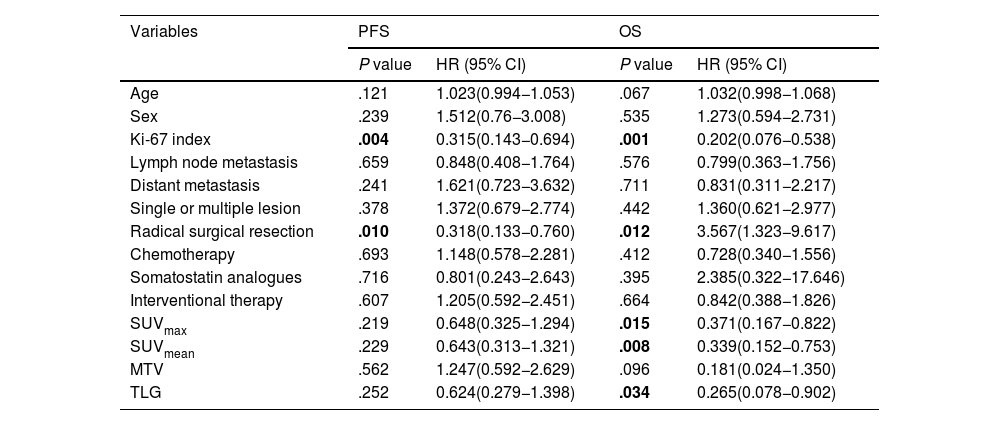
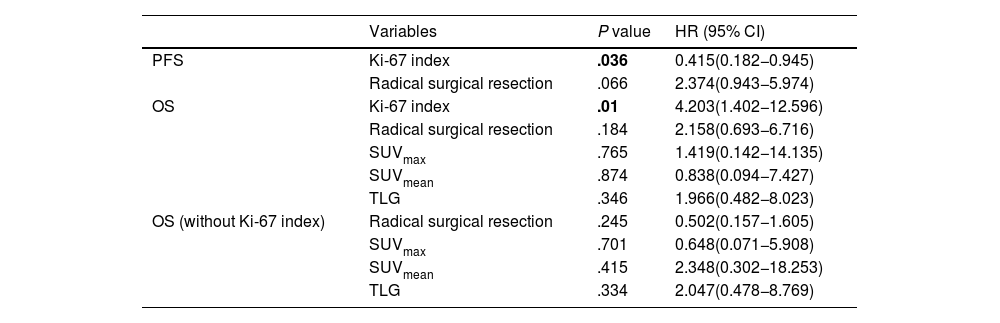
ResultsUnivariate analyses revealed that among PET-derived metabolic parameters, SUVmax, SUVmean, and TLG were significant prognostic factors for OS (P < .05). Among clinical variables, the Ki-67 index and radical surgical resection were significant factors for both PFS and OS (P < .05). In multivariate analyses, only Ki-67 index was an independent prognostic factor for both PFS and OS (P < .05). Ki-67 index presented correlates with SUVmax and SUVmean (R = 0.566, P < .001, R = 0.493, P = .001, respectively).
ConclusionsIn patients with HNET, the Ki-67 index was an independent prognostic factor for both PFS and OS, while SUVmax, SUVmean, and TLG measured on pretreatment 18F-FDG PET/CT scans were prognostic factors for predicting OS. Ki-67 index also presented correlates with SUVmax and SUVmean. 18F-FDG-PET may be useful as quantitative predicting prognostic imaging biomarkers, especially in poorly differentiated HNET.
Investigar el valor pronóstico de la tomografía por emisión de positrones/tomografía computarizada (PET/TC) pretratamiento 2-[18F] -fluoro-2-deoxy-d-glucosa (18F-FDG) en pacientes con tumores neuroendocrinos hepáticos (HNET).
MétodosSe incluyeron 41 pacientes en este estudio. Se midieron los parámetros metabólicos derivados de la PET/TC, incluidos los valores máximos y medios de captación estandarizada (SUVmax y SUVmean, respectivamente), el volumen tumoral metabólico (MTV) y la glucólisis total de la lesión (TLG) de los tumores. Mientras tanto, también se evaluaron los datos clínicos, incluyendo los hallazgos tumorales patológicos como el índice Ki-67. Se evaluaron la supervivencia sin avance (SSA) y la supervivencia general (SG). Se realizaron análisis univariables y multivariados para predecir el valor pronóstico de las variables clínicas y los parámetros metabólicos derivados de la PET/TC en pacientes con HNET. Se estimó la correlación entre los parámetros metabólicos derivados del PET/TC y el Ki-67.
ResultadosLos análisis univariados revelaron que entre los parámetros metabólicos derivados de la PET/TC, SUVmax, SUVmean y TLG fueron factores pronósticos significativos para la SG (P < ,05). Entre las variables clínicas, el índice Ki-67 y la resección quirúrgica radical fueron factores significativos tanto para la SSA como para la SG (P < ,05) En los análisis multivariados, solo el índice Ki-67 fue un factor pronóstico independiente tanto para la SSA como para la SG (P < ,05). El índice Ki-67 presentó correlaciones con SUVmax y suvmedia (R = 0,566, P < ,001, R = 0,493, P = ,001, respectivamente).
ConclusionesEn los pacientes con HNET, el índice Ki-67 fue un factor pronóstico independiente tanto para la SSP como para la SG, mientras que el SUVmax, el SUVmean y el TLG medido en la PET/TC pretratamiento con 18F-FDG fueron factores pronósticos para predecir la SG. El índice Ki-67 también presentó correlaciones con SUVmax y SUVmean. La 18F-FDG-PET/TC puede ser útil como predicción cuantitativa de biomarcadores pronósticos de imagen, especialmente en HNET poco diferenciados.
Article
If you experience access problems, you can contact the SEMNIM Technical Secretariat by email at secretaria.tecnica@semnim.es or by phone at +34 619 594 780.
Revista Española de Medicina Nuclear e Imagen Molecular (English Edition)

