



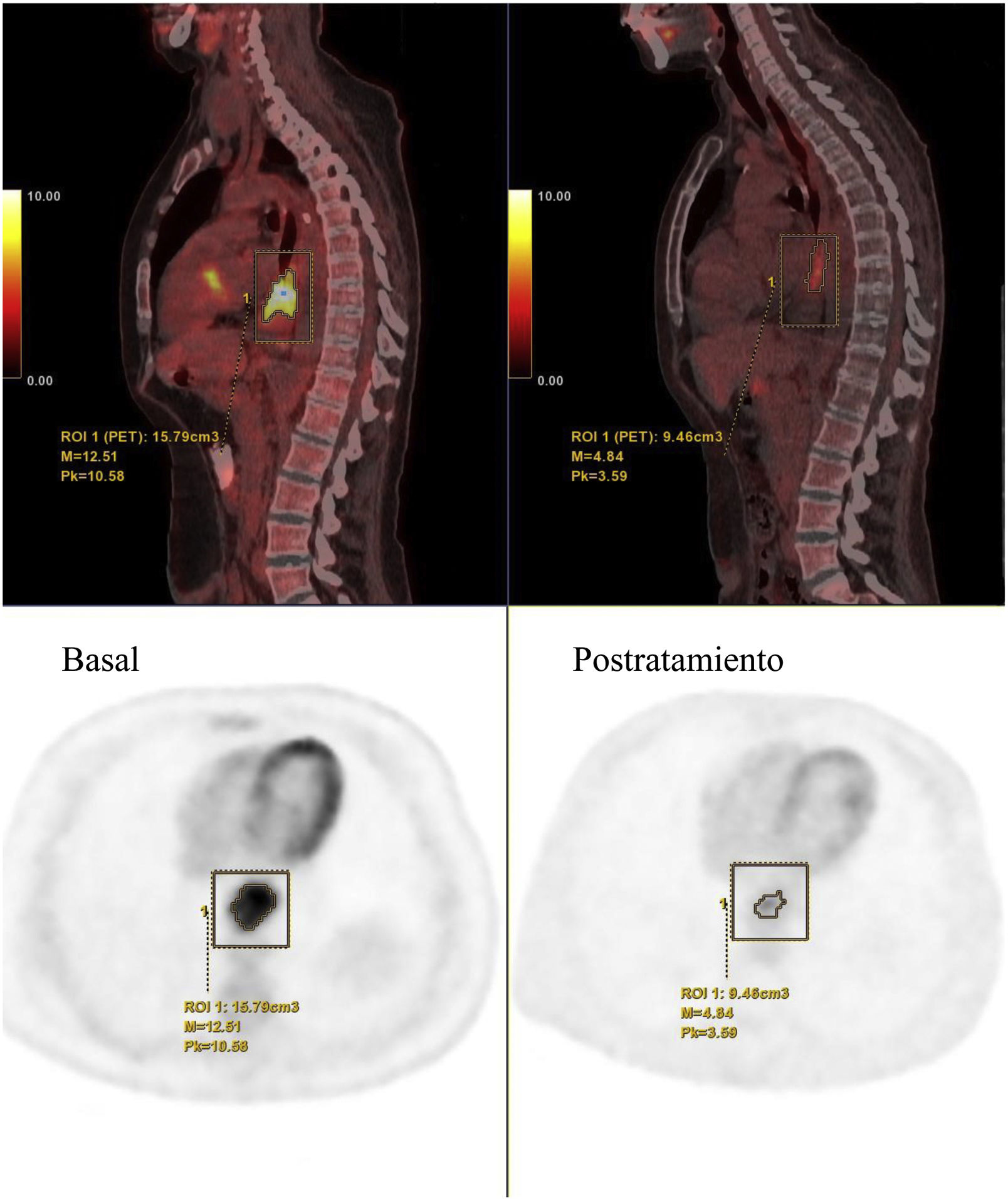




To assess the correlation between the result of the PET/CT study with [18F]FDG and the histological outcome in patients with esophageal cancer undergoing chemoradiotherapy and subsequent surgery.
Material and methods41 patients (35 men) diagnosed with esophageal cancer during a 10-year interval were retrospectively evaluated. PERCIST criteria and SULpeak (ΔSULpeak) variation between pre- and post-treatment PET/CT studies were used. After neoadjuvant treatment and subsequent surgery, histological response and patient survival were determined, correlating the findings with the result of the metabolic study. Different parameters related to patient and tumors lesion characteristics were compared with respect to histologic response. ROC curves and the Kaplan-Meier method were applied for the analysis of prognostic factors and survival curves.
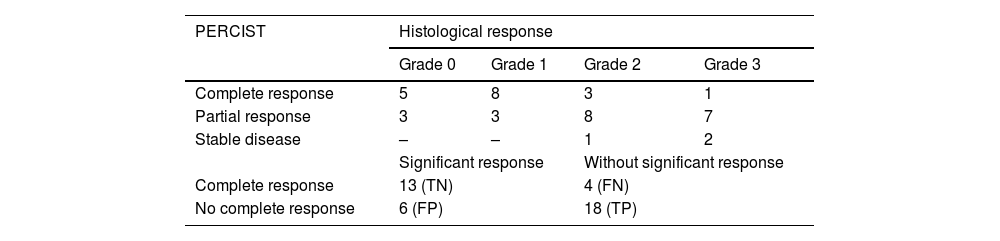
ResultsThe mean follow-up was 34.9 months, with 21 relapses-progressions and 25 deaths. Significant differences were demonstrated between histologic responses regarding PERCIST criteria and ΔSULpeak. Both showed adequate sensitivity and moderate specificity in relation to their histological correlation. No significant differences were found with respect to other parameters studied. Survival analysis showed significantly different progression-free survival curves for the ΔSULpeak and histologic outcome.
ConclusionPERCIST criteria and ΔSULpeak differentiated between patients with and without histological response. ΔSULpeak and histological results proved to be prognostic factors. The results could help to personalize treatment and, together with other determinations, allow an active surveillance approach could be contemplated.
Analizar la correlación entre el resultado del estudio PET/TC con [18F]FDG y el resultado histológico en pacientes con cáncer de esófago sometidos a quimiorradioterapia y posterior cirugía.
Material y MétodosSe valoraron retrospectivamente 41 pacientes (35 hombres) diagnosticados de cáncer de esófago durante un intervalo de 10 años. Se utilizaron criterios PERCIST y la variación en el SULpico (ΔSULpico) entre los estudios PET/TC pre y postratamiento. Tras tratamiento neoadyuvante y posterior cirugía, se determinó la respuesta histológica y la supervivencia de los pacientes, correlacionando los hallazgos con el resultado del estudio metabólico. Se compararon diferentes parámetros relacionados con las características de los pacientes y de las lesiones tumorales respecto a la respuesta histológica. Las curvas ROC y el método de Kaplan-Meier se aplicaron para el análisis de factores pronósticos y curvas de supervivencia.
ResultadosEl seguimiento medio fue de 34,9 meses, produciéndose 21 recidivas-progresiones y 25 muertes. Se demostraron diferencias significativas entre respuestas histológicas con respecto a criterios PERCIST y ΔSULpico. Ambos mostraron adecuada sensibilidad y moderada especificidad respecto a su correlación con la histología. No se encontraron diferencias significativas con respecto a otros parámetros estudiados. El análisis de supervivencia mostró curvas de supervivencia libre de progresión significativamente diferentes para el ΔSULpico y el resultado histológico.
ConclusiónLos PERCIST y ΔSULpico diferenciaron entre pacientes con y sin respuesta histológica. El ΔSULpico y los resultados histológicos demostraron ser factores pronósticos. Los resultados podrían ayudar a personalizar el tratamiento y, junto con otras determinaciones, permitirían plantearse una actitud de vigilancia activa.
Article
If you experience access problems, you can contact the SEMNIM Technical Secretariat by email at secretaria.tecnica@semnim.es or by phone at +34 619 594 780.
Revista Española de Medicina Nuclear e Imagen Molecular (English Edition)

