







Anaemia is an independent risk factor for poor perioperative outcomes after major abdominal surgery, and is associated with an increased risk of 30-day postoperative mortality after noncardiac surgery.
ObjectiveTo investigate the frequency of postoperative anaemia and short- and long-term survival after colorectal oncologic surgery at a centre with a well-established Enhanced Recovery After Surgery (ERAS) program.
MethodsWe conducted a retrospective cohort study of all patients undergoing elective colorectal oncologic surgery within an ERAS pathway at our institution between 2013 and 2017. Overall survival was calculated with the Kaplan-Meier log rank method and Cox proportional hazard regression based on anaemia at hospital discharge.
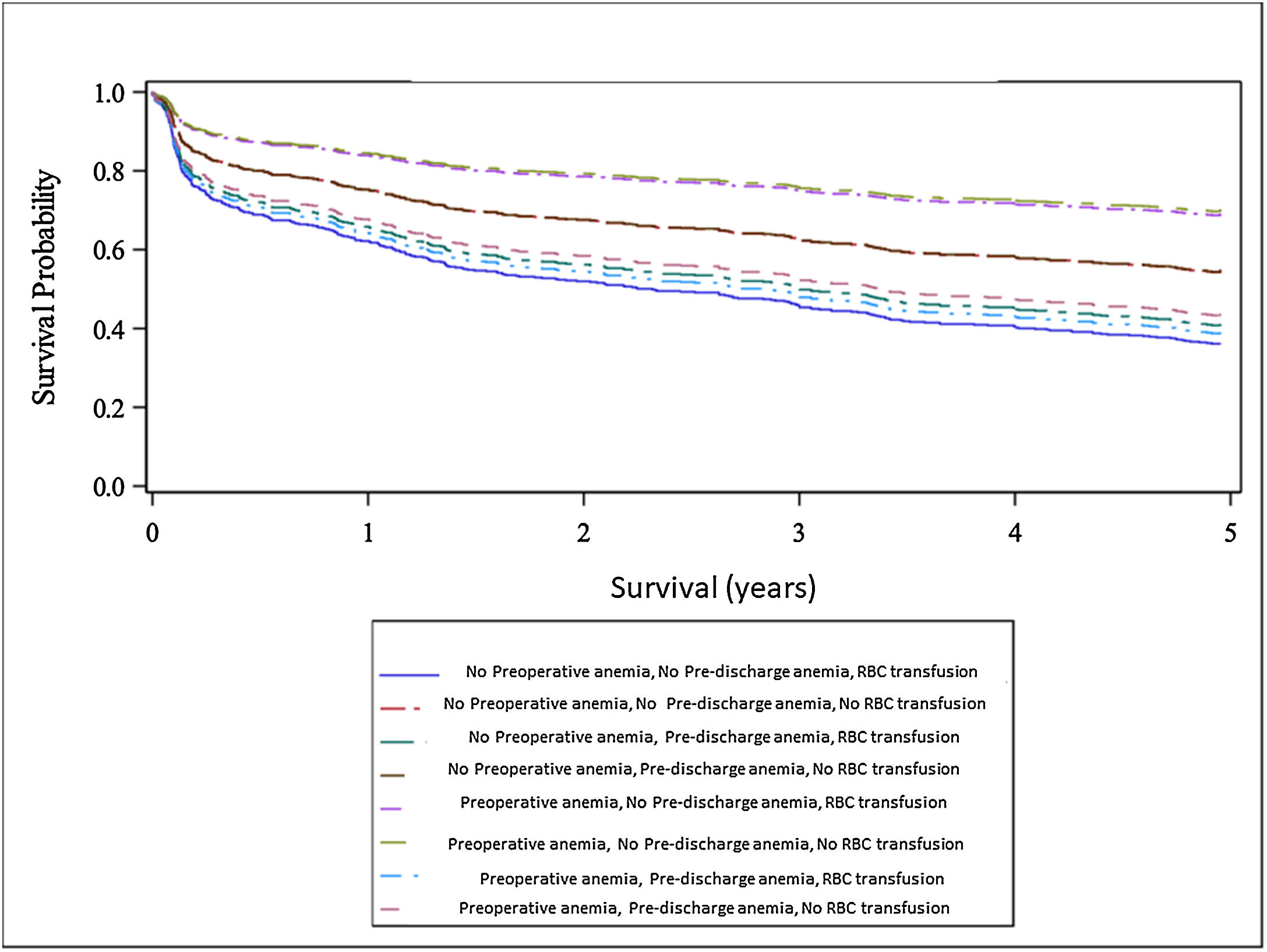
ResultsA total of 680 patients were included. Patients with anaemia at discharge showed a lower overall survival at 5 years (53.9% vs. 44%, p 0.05). Patients who were anaemic at discharge had a lower 5-year overall survival (hazard ratio [HR] 95% CI 2.663 [1.619–4.379], p < 0.001). Kaplan-Meier survival and Cox regression proportional hazard survival for overall survival in the combined preoperative, postoperative, and RBC transfusion model were 1.55 (1.038 2.318) p = 0.032.
ConclusionsThe combined prognostic value of preoperative anaemia, postoperative anaemia, and blood transfusion created a 40.7% higher risk of not surviving 5 years.
La anemia es un factor de riesgo independiente para malos resultados perioperatorios tras la cirugía abdominal mayor, y está asociada a un incremento del riesgo de mortalidad postoperatoria a 30 días tras la cirugía no cardiaca.
ObjetivoEstudiar la frecuencia de anemia postoperatoria y supervivencia a corto y largo plazo tras la cirugía oncológica colorrectal en un centro con un programa ERAS (Enhanced Recovery After Surgery) bien establecido.
MétodosRealizamos un estudio de cohorte retrospectivo de todos los pacientes sometidos a cirugía oncológica colorrectal electiva dentro de la ruta ERAS en nuestra institución entre 2013 y 2017. La supervivencia global se calculó con el método de rango logarítmico de Kaplan-Meier y el modelo de regresión con riesgo proporcional de Cox basado en anemia al recibir el alta hospitalaria.
ResultadosSe incluyó un total de 680 pacientes. Los pacientes con anemia al recibir el alta mostraron una supervivencia global menor a 5 años (53,9 frente al 44%, p 0,05). Los pacientes con anemia al recibir el alta tuvieron una supervivencia global menor a 5 años (hazard ratio [HR] 95% IC 2,663 [1,619-4,379], p < 0,001). El valor de supervivencia de Kaplan-Meier y de regresión con riesgo proporcional de Cox para supervivencia general en el modelo combinado preoperatorio, postoperatorio y de transfusión de eritrocitos fue de 1,55 (1,038 2,318) p = 0,032.
ConclusionesEl valor pronóstico combinado de anemia preoperatoria, postoperatoria y transfusión de sangre creó un riesgo superior del 40,7% de no supervivencia a 5 años.

