




Mineralizing angiopathy of lenticulostriate arteries has been reported as etiology of acute arterial ischemic stroke of basal ganglia after minor head trauma, mostly in infants. Patients present with focal neurological deficit, commonly hemiparesis, minutes to hours after head trauma. Diagnostic clue is the finding of ischemic stroke of basal ganglia after minor head trauma together with basal ganglia calcifications.
ResultsWe present a 21-month-old infant with an acute right hemiparesis preceded by mild head trauma 8h before. Neuroimaging studies showed an ischemic stroke of left basal ganglia together with bilateral basal ganglia calcifications. Other ancillary studies were normal. The patient received treatment with acetylsalicylic acid for antiplatelet therapy. Prognosis was excellent, he recovered the focal neurological deficit, and no recurrences nor neurological sequelae were found after a 6year follow-up.
ConclusionsA high index of suspicion is necessary to identify mineralizing angiopathy of lenticulostriate arteries as etiology of an acute arterial ischemic stroke of basal ganglia after minor head trauma in early infancy. Stroke recurrence is possible.
La angiopatía mineralizante de las arterias lenticuloestriadas es una entidad reconocida como causa de ictus arterial isquémico de ganglios de la base tras traumatismos craneoencefálicos leves en niños generalmente pequeños. Los pacientes afectados presentan un déficit neurológico focal (habitualmente hemiparesia) que comienza entre minutos y escasas horas después del traumatismo craneoencefálico. La clave para su diagnóstico es encontrar en el estudio de neuroimagen un ictus arterial isquémico en el área de los ganglios de la base junto al antecedente del traumatismo craneoencefálico menor y la identificación de calcificaciones puntiformes en los ganglios de la base.
ResultadosPresentamos un lactante de 21 meses con una hemiparesia aguda derecha precedida de un traumatismo craneoencefálico leve 8 horas antes. Los estudios de neuroimagen revelaron una lesión compatible con un ictus arterial isquémico de las arterias lenticuloestriadas izquierdas junto a calcificaciones puntiformes en ganglios basales de ambos hemisferios cerebrales. El resto de exámenes complementarios no mostraron hallazgos patológicos. El paciente recibió tratamiento antiagregante con ácido acetilsalicílico. El pronóstico fue excelente, con recuperación del déficit motor en semanas, sin recurrencias de ictus ni secuelas en el seguimiento tras 6 años del evento.
ConclusionesEs necesario un alto índice de sospecha para identificar a la angiopatía mineralizante de las arterias lenticuloestriadas como causa de ictus arterial isquémico ante traumatismo craneoencefálico menor en la infancia temprana. Su pronóstico es variable respecto a las recurrencias.
Mineralising angiopathy of lenticulostriate arteries is an infrequent condition that has been identified as a cause of arterial ischaemic stroke (AIS) in the basal ganglia in association with mild head trauma, specifically during childhood.1–8 In this study, we report the case of a 21-month-old boy who was attended at the emergency department due to right acute hemiparesis, progressing for approximately 8h after a minor fall from an armchair. A head CT scan revealed calcifications in the basal ganglia, and a subsequent brain MRI study showed a lesion compatible with AIS in the left lenticulostriate arteries.
Mineralising angiopathy of lenticulostriate arteries accounts for less than 2% of paediatric cases of stroke. This condition was described in 2014 in patients from India and China aged older than neonatal age and < 18 months, and its pathophysiology remains poorly understood.1–7,9 The prognosis of this type of AIS is generally good, although recurrence is not infrequent.2,4–6,9–11
Material and methodsWe present the case of a patient with AIS and diagnosed at the age of 21 months with mineralising angiopathy of lenticulostriate arteries manifesting as hemiparesis following minor head trauma, who was followed up at our centre for 6years. We performed a literature review of mineralising angiopathy of lenticulostriate arteries as a cause of AIS during childhood. The patient’s parents consented to the publication of the case.
ResultsThe 21-month-old patient was brought to the paediatric emergency department of our centre due to right acute hemiparesis. He presented minor head trauma after falling from an armchair, followed by crying with no loss of consciousness, somnolence, or vomiting; the fall occurred approximately 8h before onset of hemiparesis. He had no relevant personal or family history. The patient’s psychomotor development had been normal and he presented no remarkable prenatal or perinatal disease. The baseline assessment revealed brachial-predominant right hemiparesis that prevented voluntary grasping with the right hand and standing, with positive Babinski sign on the right side, and myotatic hyporeflexia in the right arm; the remaining neurological and physical examination findings were normal.
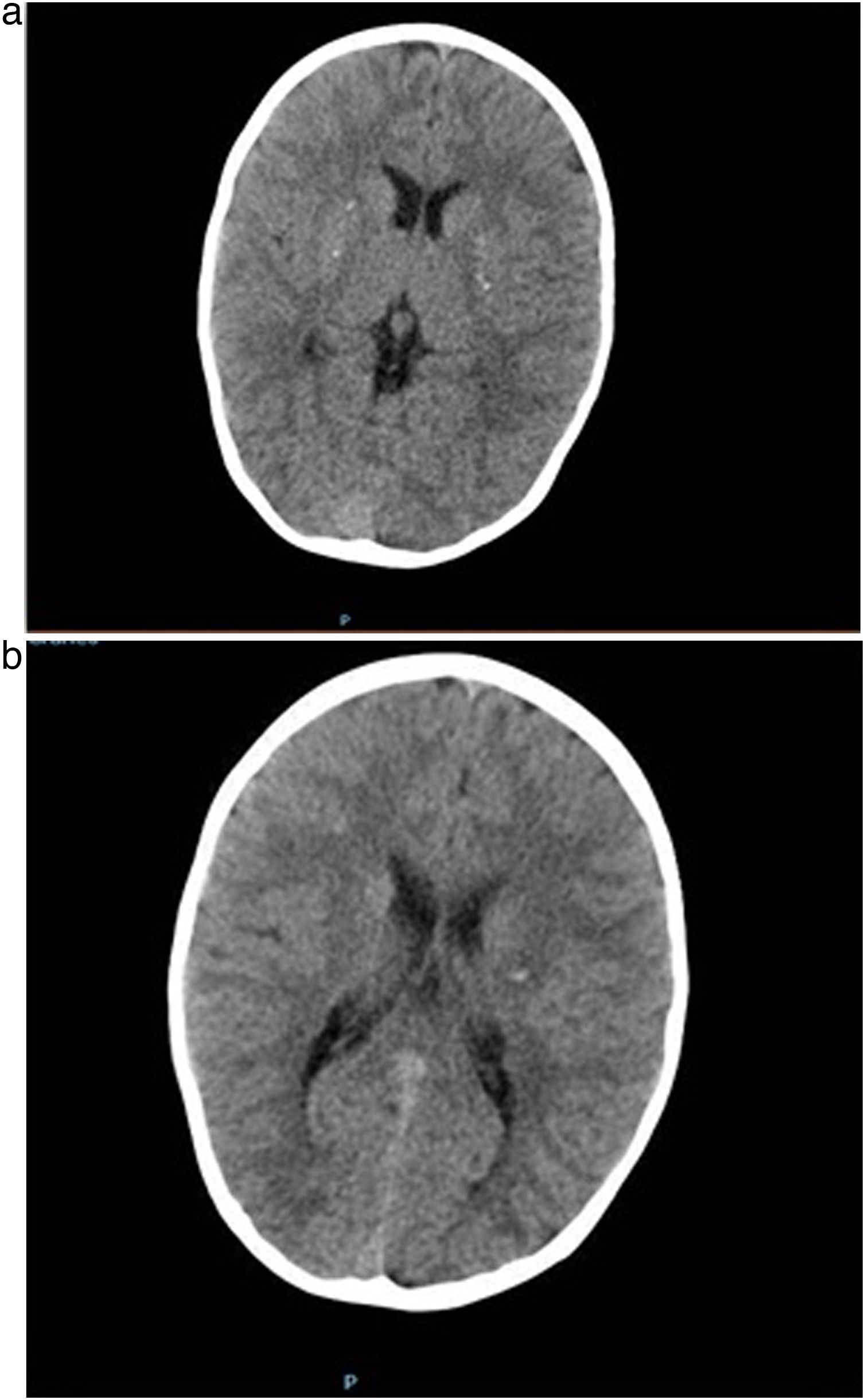
First, a head CT scan revealed no bleeding or fractures, but did display a hypodense lesion in the left corona radiata and punctiform calcifications in the basal ganglia of both brain hemispheres (Fig. 1). The following day, a head MRI study showed a lesion compatible with AIS of the left lenticulostriate arteries (Fig. 2). Complementary studies were requested to identify the etiology of stroke: complete blood count, coagulation study, complete serum biochemistry panel including calcium metabolism, serum homocysteine determination, and a study of thromboembolic disease that included antithrombin III, protein C, and protein S determination; mutation in the prothrombin gene and factor V Leiden were ruled out, and lupus anticoagulant was analysed. All studies yielded normal results. We also requested serology studies for toxoplasma, cytomegalovirus, Treponema pallidum, rubella, and HSV; urine toxicology test; brain MR angiography; electrocardiography; echocardiography, and electroencephalography. None of these studies revealed findings of pathological relevance.

The patient progressed favourably during hospitalisation, showing a progressive improvement of focal neurological deficit; rehabilitation treatment and antiplatelet therapy with acetylsalicylic acid were started. Upon discharge, right hemiparesis had improved, although he continued to present difficulties manipulating objects with the right hand, and needed assistance to walk. One month after discharge, he was followed up at an outpatient clinic, showing complete recovery of hemiparesis. The patient was followed up every 6 months for 6years, presenting no stroke recurrence or sequelae, with normal psychomotor development and neurological examination findings at all times. Five years after the AIS, a follow-up head MRI study showed no additional ischaemic lesions (Fig. 3) or any other type of pathological finding. After the MRI, we decided to discontinue treatment with acetylsalicylic acid.
Discussion
Mineralising angiopathy of lenticulostriate arteries is a known cause of AIS in the basal ganglia after mild head trauma in younger children.1–9 Patients present focal neurological deficits (generally hemiparesis) or transient hemidystonia,6,12 with onset minutes to hours after head trauma. Less frequently, stroke may also manifest with seizures.2,3,6 Head trauma is characteristically mild, as a result of minor falls, which are very frequent in children.1–15 The key to diagnosis is finding an AIS of the lenticulostriate arteries in neuroimaging studies and identifying punctiform calcifications in the basal ganglia, which are typically revealed in head CT studies and not visible in MRI studies; history of minor head trauma is also highly relevant.1–5,7,15 Although its pathophysiology is yet to be determined, it has been suggested that mineralising angiopathy may confer rigidity to the artery. This, together with the narrow angles at the origin of lenticulostriate arteries from the middle cerebral artery and the increased mobility of the extracerebral segment of these lenticulostriate arteries, which are characteristic of early childhood, favour the risk that sudden movements such as those caused by an (even minor) head trauma may cause vasospasm or in situ arterial thrombosis from a lesion to the tunica intima, therefore provoking an AIS.1–7,9,10 It is unclear whether genetic factors exist that may favour the onset of stroke in early childhood in association with this condition, and whether this may contribute to the greater frequency reported in South Asia.3,6,8,12 Iron deficiency has been shown to be a contributing factor,2,12 and higher proportions of men than women are reported in published series.2,6,9
A series including 14 paediatric patients with AIS due to mineralising angiopathy from a single centre in North America reported: mean age at presentation of 2 years, stroke onset beyond the age of 18 months in 8 cases, basal ganglia haemorrhage in 4 patients, multifocal basal ganglia infarcts in 3 children, brain calcifications in the parietal or thalamic area in 3 children, previous silent infarcts in the basal ganglia identified at the time of clinical presentation in 3 children, South Asian ethnicity in 3 children, and no history of head trauma in 3 children. Acute focal seizures were observed in 5 children. During a mean follow-up period of 3 years and a half, there were no recurrences of symptomatic strokes, although 7 children presented sequelae including moderate to severe neurological deficits (hemiparesis, dystonia, and learning difficulties). Different studies have reported variable prognoses, with sequelae manifesting in approximately half of cases, although follow-up was not prolonged.2,4–6,13 The majority of patients reported in the literature received treatment with acetylsalicylic acid and/or heparin. Recurrence is not infrequent, and is usually associated with new trauma; cases have been described up to 6years after the first AIS, regardless of treatment.2,12 Complete recovery is less probable.2,10,11 Onset of hemiparesis or dystonia is reported in 2 patients at 3–4 years after initial presentation.7 Mortality associated with this entity has not been described.1–15
Reports in the literature suggest a possible association between mineralising angiopathy of lenticulostriate arteries and lenticulostriate vasculopathy detected in ultrasound studies during the neonatal period, as cases have been described with history of this condition during the neonatal period.1–3,6,8 Lenticulostriate vasculopathy is a well-known entity in the neonatal period, and makes reference to the presence of transient linear hyperechogenicities detected in ultrasound studies, displaying a “chandelier” pattern in the arteries in the region of the basal ganglia or thalamus. An association was initially described between this entity and congenital infections and chromosomopathies; however, it is generally considered a benign and transient finding.3,7 Nevertheless, few prospective studies have assessed the presence, significance, and prognosis of lenticulostriate vasculopathy, and their findings are heterogeneous. It has been also considered a nonspecific marker of perinatal or postnatal brain injury associated with a great variety of aetiologies (infections, metabolic abnormalities, hypoxaemia, chromosomopathies, maternal alcohol/drug abuse, and premature birth). Between 0.4% and 7.4% of healthy neonates undergoing routine transfontanellar ultrasound present findings compatible with lenticulostriate vasculopathy.2,3 It has been suggested that mineralising angiopathy of lenticulostriate arteries may constitute a pathological persistence of the lenticulostriate vasculopathy identified in ultrasound studies during the neonatal period.6
In conclusion, we underscore the need for a high level of suspicion in identifying mineralising angiopathy of lenticulostriate arteries as the cause of AIS in cases of minor head trauma during early childhood. Performing a CT scan to complement the MRI study, or alternatively a brain ultrasound in patients with open anterior fontanelle, is essential to establish this diagnosis in cases of idiopathic childhood AIS, as calcifications are not frequently visible on MRI studies. Mineralising angiopathy of lenticulostriate arteries is a probable cause of AIS, specifically in early paediatric age, and its pathophysiology is yet to be well understood. Its prognosis is variable, recurrence is reported to be frequent in some series, and a high percentage of sequelae have been reported after the initial episode. Further studies are needed to improve our understanding of the nature of mineralising angiopathy of lenticulostriate arteries and its possible association with lenticulostriate vasculopathy of the neonatal period.
The authors have no conflicts of interest to declare.

