














Blockchain and digital technologies are transforming innovation and knowledge creation by reshaping how users interact with services, make decisions, and engage with digital ecosystems, particularly in the digital sector. This study examines the psychological and behavioural factors shaping the adoption of blockchain and digital technologies among digital natives. Drawing on the Technology Acceptance Model, Trust Theory, the Unified Theory of Acceptance and Use of Technology, the Diffusion of Innovations Theory, the Mobile Payments Technology Acceptance Model, and the Experience Paradox theory, this study develops and tests a comprehensive framework using Partial Least Squares Structural Equation Modelling (PLS-SEM). The findings highlight the central roles of trust, perceived utility, and perceived risk in adoption behaviour. On the other hand, previous digital experience is configured as a moderating factor in the relationship between perceived usefulness and adoption intention. More experienced users have a more critical attitude towards blockchain, demanding clearer advantages from such technology. This study seeks to contribute to the existing literature by refining technology adoption models. Practical recommendations are offered for businesses and policymakers, who seek to foster innovation processes through actions that build trust, address perceived risks, and help tailor strategies to the user experience.
Blockchain and other digital technologies reconfigure the way users interact with the services that they use, their purchasing decisions, and, in general, relate to digital ecosystems (Prados-Castillo et al., 2023). These technologies are key to understanding the psychological and behavioural factors that drive their adoption by consumers. Blockchain technology has emerged as a potentially transformative technology that promises to offer greater confidence in transactions, making them more secure, and reducing risk to users. These are critical attributes for purchasing decisions in sectors such as e-commerce, financial services, public institutions, and educational environments, among others (Baker & Werbach, 2019; Liu et al., 2023). However, the adoption of blockchain technology in most sectors remains largely unexplored (Blanco-González-Tejero et al., 2024; Prados-Castillo, Guaita Martínez et al., 2023), especially among younger groups, who, as digitally fluent individuals from the beginning of their professional careers, are key users driving the digital transformation of companies.
Digital natives (Prensky, 2001) represent a relevant demographic group for the study of the adoption of emerging technologies (Cano-Marin, 2024). These users, who are assumed to be very experienced with social networks and digital tools, are configured as potential early adopters of emerging technologies, such as blockchain technology (Prados-Castillo et al., 2024; Aslam et al., 2024). In any case, it should be considered that adoption behaviours are not fully explained by exposure to technology (Venkatesh et al., 2003). Rather, adoption processes are influenced by a set of variables such as trust, risk, and perceived usefulness, among others. Understanding how these variables interact to shape these adoption behaviours seems highly relevant, especially as the scarcity of academic literature is evident.
Therefore, the main objective of this work is to analyse the psychological and behavioural factors that influence the adoption of blockchain technology and other digital technologies among users considered to be digital natives. To this end, an integration of the Technology Acceptance Model (TAM) (Davis, 1989), Unified Theory of Acceptance and Use of Technology (UTAUT) (Venkatesh et al., 2003), and Trust Theory (Mayer et al., 1995) among others, which are described in the following section. These models are complemented by the Experience Paradox (Mick & Fournier, 1998) to better understand the role of prior technological exposure.
While the UTAUT offers a comprehensive framework to understand technology adoption, this study selectively utilizes its components. Specifically, we focused on the conceptual foundations of adoption intention and facilitating conditions, deliberately excluding the full array of constructs proposed in the original model, such as effort expectancy and social influence. This clarification is provided to prevent any potential misinterpretations regarding the model’s completeness. A mixed-methods approach was applied, combining qualitative (focus group) and quantitative (survey) techniques, analysing the quantitative data through Partial Least Squares Structural Equation Modelling (PLS-SEM). The results aim to offer insights for both academia and public/private organisations to improve the design of strategies for the adoption of blockchain technology.
This document is structured as follows: Section 2 presents the theoretical background and model; Section 3 explains the methodology; Section 4 discusses the main results; and Sections 5 to 8 present the discussion, practical implications, limitations, and future lines of research.
Theoretical backgroundDigital technologies and blockchain in businessTools such as social networks, e-commerce platforms, and educational applications aim to improve interactions between users, thus providing opportunities for the development of professional skills and preparation for professional life (Vitvitskaya et al., 2022). Blockchain technology offers enormous potential by guaranteeing secure, transparent data management, solving key issues for users, such as privacy and trust (Calvaresi et al., 2019). The Diffusion of Innovations (DOI) framework (Rogers, 1962; Shukla et al., 2024) can explain how digital natives tend to adopt these technologies, emphasising variables such as relative advantage, compatibility, and perceived complexity. Digital natives are more likely to adopt technological solutions when they perceive clear advantages over traditional systems (Prados-Castillo et al., 2024). However, this adoption of technology is not without risks and obstacles related to limited access to devices, lack of technical knowledge, and concerns about data security (Bag et al., 2021; Javadpour et al., 2023; Wang et al., 2023). These obstacles highlight the need to develop strategies aimed at building trust among users and minimising risks in the adoption of these new technologies.
Trust and risk in technology adoptionTrust Theory (Mayer et al., 1995) and Risk Theory (Featherman & Pavlou, 2003; Gefen et al., 2003; McKnight & Chervany, 2001) attempt to provide an understanding of the psychological mechanisms that encourage or hinder the adoption of technologies. In the case under analysis, digital technologies and blockchain were used. Specifically, trust reflects the belief in factors such as the reliability, security, and performance of a system or platform. Given its nature, blockchain technology has the power to build user trust through data privacy management. Perceived risk negatively affects the intention to adopt technology (Louis & Afgani, 2024). From the perspective of digital natives, risks related to privacy and usability are relevant and can become a positive factor in terms of technology adoption (Liu et al., 2022). Blockchain technology can address these concerns by fostering a feeling of greater security that can favour adoption in different contexts and business sectors (Prados-Castillo et al., 2023). In blockchain environments, trust and risk take on additional significance owing to the decentralised nature of the systems, the absence of central authority, and the technical complexity of smart contracts and cryptographic mechanisms. Unlike traditional centralised systems, where trust is placed in known and traditional intermediaries such as banks and regulatory bodies, blockchain shifts trust to the network itself and the reliability of peer-to-peer interactions (Ali et al., 2023). This brings with it new types of perceived risks, particularly those related to technology, system performance, and security, as this technology still requires trust in the proper governance of the underlying blockchain system (De Filippi et al., 2020). All of this can influence people’s willingness to adopt technology. In this sense, trust is largely based on characteristics such as the transparency and permanence of the ledger, consistency of the consensus mechanisms, and belief that the system can effectively prevent fraud and manipulation.
The technology acceptance model (TAM) and unified theory of acceptance and use of technology (UTAUT)The Technology Acceptance Model (TAM) (Davis, 1989) is still a key theory for understanding and explaining technology adoption, particularly in emerging contexts such as blockchain. It emphasises perceived usefulness and ease of use as crucial factors. On the other hand, the Unified Theory of Acceptance and Use of Technology (UTAUT) (Venkatesh et al., 2003) incorporates variables such as social influence and facilitating conditions. The introduction of these variables into the analysis is important, as they can positively motivate users considered digital natives to adopt the technologies analysed (Joa & Magsamen-Conrad, 2022), providing a robust framework for examining their behavioural intentions in adopting blockchain solutions.
Perceived utility and security: the role of MPTAMThe Mobile Payments Technology Acceptance Model (MPTAM) (Liébana-Cabanillas et al., 2014) analyses the importance of perceived usefulness and security from the perspective of the intention to adopt payment technologies. This model extends the classical TAM theory by integrating constructs particularly relevant to digital transaction environments, such as trust, risk, and perceived security. In terms of perceived usefulness, digital natives may consider blockchain technology valuable for secure transactions, supporting digital certifications, and different academic services (Kuleto et al., 2022). From a security perspective, blockchain’s decentralised architecture, transparent and immutable ledger, and smart contract automation offer enhanced data integrity and fraud prevention, which are central to fostering user trust and reducing perceived risk.
Diffusion of innovations and attitudes toward blockchainIn this research, the Diffusion of Innovations (DOI) model (Rogers, 1995; Nguyen & Nguyen, 2023) provides an interesting framework to understand how digital natives develop attitudes towards blockchain technology, considering variables such as perceived advantage, compatibility with the needs of users, and simplification of the use of these technologies. Within this framework, it can be considered that the attitudes of digital natives are determined by several factors. First, perceived advantage (a) is the ability of blockchain technology to improve the security of digital platforms. Second, usage alignment (b) means that digital natives are considered more likely to adopt blockchain technology if it aligns with their habits. Third, simplicity (c), that is, if blockchain technology is perceived as intuitive and easy to use, it can be adopted more easily, considering the technical diversity of users.
In this study, trust and perceived risk are integrated as moderating factors that influence attitudes towards blockchain. Positive attitudes emerge when trust in the technology is established, and risks, such as concerns over data privacy and usability, are mitigated. For instance, individuals who have grown up with digital technology and are exposed to secure and transparent applications of blockchain (e.g. academic credentialling and decentralised data sharing) are more likely to perceive tangible benefits and adopt these technologies (Miličević et al., 2024). DOI theory complements the other frameworks utilised in this study by focusing on the broader social and innovation-related processes that drive technology adoption, reinforcing the importance of addressing not only individual perceptions but also systemic barriers to adoption.
Synthesis of theoretical frameworksThis study integrates multiple frameworks to provide a holistic understanding of adoption behaviour. TAM and UTAUT explore perceived usefulness, ease of use, and facilitating conditions. However, we only incorporated those components that correspond to the streamlined framework of our conceptual model, focusing specifically on adoption intention to ensure parsimony and empirical clarity. Trust and Risk Theories address psychological barriers, emphasising the importance of trust and security. The MPTAM highlights the utility and security dimensions in blockchain adoption and DOI examines the diffusion process within a social system.
Based on the integration of the theoretical models presented, the following hypotheses were formulated to explore the psychological and behavioural mechanisms involved in adoption, as well as the influence of prior technological experience and demographic characteristics.
H1: Perceived security, privacy, and trust (PSPT) positively influences the perceived utility of blockchain technology (PUB).
H2: Perceived utility of blockchain (PUB) positively influences the intention to adopt blockchain technology (IAB).
H3: Perceived utility of blockchain (PUB) positively influences the intention to adopt digital technology (IADT).
H4: Perceived security, privacy, and trust (PSPT) positively influences the intention to adopt blockchain technology (IAB) through perceived utility (PUB) as a mediator.
H5: Intention to adopt blockchain (IAB) positively influences the intention to adopt digital technology (IADT).
H6: Previous experience in digital technology (EXP) moderates the relationship between PUB and IAB, weakening the effect for digital natives with more previous experience.
H7: Perceived security, privacy, and trust (PSPT) positively influences the intention to adopt digital technologies (IADT) through perceived utility (PUB).
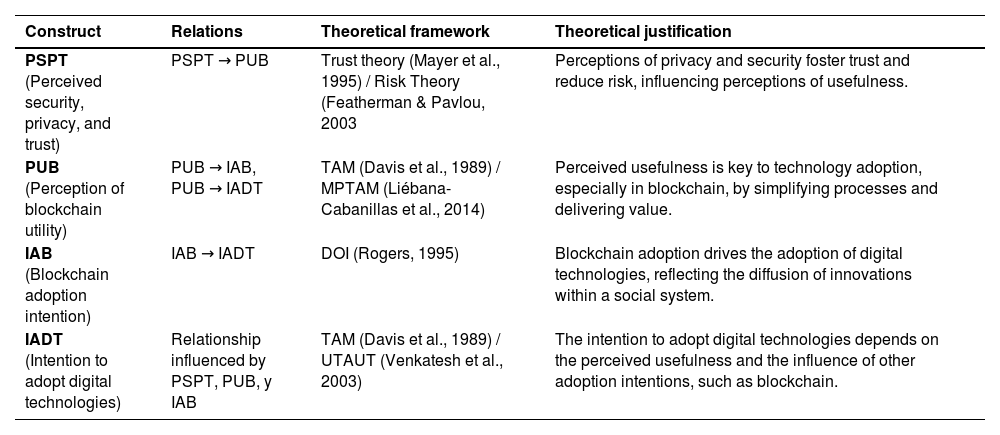
No direct effect of EXP on the intention to adopt blockchain (IAB) was proposed, as the construct was theoretically set up to function solely as a moderator. This pathway was included in the model estimation to control for possible confounding effects. Therefore, its importance is acknowledged in the results section but is not part of the hypothetical model. The theoretical relationships underlying these hypotheses are summarised in Table 1.
Relationship between the constructs of the initial model and their theoretical frameworks.
| Construct | Relations | Theoretical framework | Theoretical justification |
|---|---|---|---|
| PSPT (Perceived security, privacy, and trust) | PSPT → PUB | Trust theory (Mayer et al., 1995) / Risk Theory (Featherman & Pavlou, 2003 | Perceptions of privacy and security foster trust and reduce risk, influencing perceptions of usefulness. |
| PUB (Perception of blockchain utility) | PUB → IAB, PUB → IADT | TAM (Davis et al., 1989) / MPTAM (Liébana-Cabanillas et al., 2014) | Perceived usefulness is key to technology adoption, especially in blockchain, by simplifying processes and delivering value. |
| IAB (Blockchain adoption intention) | IAB → IADT | DOI (Rogers, 1995) | Blockchain adoption drives the adoption of digital technologies, reflecting the diffusion of innovations within a social system. |
| IADT (Intention to adopt digital technologies) | Relationship influenced by PSPT, PUB, y IAB | TAM (Davis et al., 1989) / UTAUT (Venkatesh et al., 2003) | The intention to adopt digital technologies depends on the perceived usefulness and the influence of other adoption intentions, such as blockchain. |
Source: The authors.
Research methodologyThis study employs a mixed-methods design, combining qualitative and quantitative techniques, to explore the adoption of blockchain and digital technologies among digital natives. The qualitative technique used was the focus group, which was particularly suitable for exploring shared perceptions, attitudes, and experiences among participants. The quantitative methodological approach employed a survey as an instrument and SmartPLS 4 as software to validate the measurement and structural models, ensuring robustness and reliability throughout the quantitative phase. This approach, which has been tested in previous studies (Venkatesh et al., 2016), provides relevant information that can be used to draw practical conclusions for both academia and industry. Finally, it should be noted that this dual approach was recommended by two professors with relevant experience in statistical methods prior to the data collection phase.
Methodology and objectivesSampling and data collection toolThe qualitative phase was designed to gather exploratory insights that could aid in the construction of a quantitative instrument. A purposive sampling strategy was used to select participants with recognised experiences in areas such as digitalisation, tourism, and technological innovation. Although the group was limited to eight participants, they were strategically chosen based on their institutional role and sectoral influence. The sample size is in line with qualitative research standards that favour depth and expertise over breadth (Hair et al., 2019).
Phase 1: Qualitative data collection
In the first phase (qualitative analysis), a discussion group was set up during an event called ‘Jornada Melavant’ held on 28 November 2024 in the city of Melilla (Spain). A total of eight participants took part, all of them leading entrepreneurs with relevance in the political management of the city, and experience in key areas such as tourism and new technologies. Table 2 shows the details of the participants in the first phase.
List of participants from business and political societies.
Source: The authors.
The session described above lasted approximately 60 min. A semi-structured format guided by questions previously designed by the researchers was followed, which allowed for exploratory insights into (1) previous knowledge of digital technologies and blockchain, (2) the applicability of these technologies to sectors such as education and tourism, and (3) the identification of barriers to and incentives for adoption.
The session was recorded and transcribed verbatim. A thematic analysis was conducted manually by the research team, identifying recurring categories related to knowledge, applicability, barriers, and incentives. These themes guided the initial pool of items used in the quantitative phase of the questionnaire. This sequential approach allowed insights from the qualitative phase to influence the design and content of the survey instrument, ensuring theoretical alignment and contextual relevance.
Phase 2: Quantitative data collection
The quantitative phase consisted of distributing the questionnaire. This was divided into four sections aligned with the theoretical frameworks analysed:
- 1.
Demographics and previous digital experience: Sociodemographic data (age, gender, area of study) were collected, and previous experience with digital tools such as social networks, e-commerce platforms, and educational applications was evaluated.
- 2.
Perceived security, privacy, and trust (PSPT): Participants were asked about their confidence in the security and reliability of digital technologies.
- 3.
Perceived usefulness of blockchain technology (PUB): Users’ perceptions of the usefulness of blockchain technology in simplifying administrative processes and improving academic and financial services were measured.
- 4.
Intention to adopt (IAB and IADT): Users’ likelihood of adopting blockchain technology and other digital technologies in the next 12 months was assessed.
Each construct was measured in almost all cases using a seven-point Likert scale. The items and scales were adapted from prior validated studies where available, particularly those aligned mainly with the TAM, Trust Theory, and MPTAM frameworks (for example, Davis, 1989; Gefen et al., 2003; Liébana-Cabanillas et al., 2014), and were reviewed by domain experts to ensure content validity.
Sample size analysisAn a priori power analysis was conducted using G*Power 3.1.9.7 (Faul et al., 2007, 2009). This determined the minimum sample size required for this study. Based on a model with 3 predictors, an effect size of 0.15 (medium), a significance level of 0.05, and a statistical power of 0.95, the required sample size was calculated to be 74 participants. The final sample size for this study was 307 participants, which exceeded the minimum requirement by 315 %. This oversampling also aligns with recommendations from Beck (2013), who suggests increasing the sample size by 20–30 % to account for potential data loss, outliers, and variability, and Reinartz et al. (2009). A larger sample ensures robust statistical validity and reliability of the findings.
Participant recruitmentData collection was carried out in two phases between 28 November and 28 December 2024:
- 1.
Sub-sample 1 (Melavant event): Phase 1 (Melavant event): Data were collected from university students aged between 18 and 30 who attended the Melavant event (28 November) in the city of Melilla (Spain). The participants at this event provided information relevant to the analysis through the questionnaire, having been previously presented the themes in the questionnaire in a detailed explanation of blockchain technology. The questionnaire was available for users to complete up to one month after the event.
- 2.
Sub-sample 2 (Prolific campaign): With the aim of guaranteeing the diversity of the sample, a campaign was carried out through the Prolific platform, segmented and focused on users who met the requirements of studying a university degree, being between 18 and 30 years old, and residing in Spain. The questionnaire was also available for one month from 28 November 2024.
For both subsamples, the inclusion criteria were as follows: (1) aged 18–30 years, digitally native (Prados-Castillo et al., 2024; Prensky, 2001). (2) residing in Spain; Spain was selected as the study setting due to its high levels of digital adoption among young adults (Digital Skills & Jobs Platform, 2024).
Research data: socio-demographic profile and question collectionConsidering Table 3, the sociodemographic profile of the respondents showed a balanced gender distribution, with men representing a slight majority (57 %). A high level of digitalisation was observed, measured by the high percentage of active social network users (90.6 %) and widespread use of digital tools (98 %). From the technology adoption perspective, some participants identified lack of time (17.3 %) and technical complexity (8.8 %) as limiting factors for learning about certain technologies. Regarding blockchain technology, only 18.6 % of the respondents had participated in related activities.
Sociodemographic profile of the respondents.
Source: The authors.
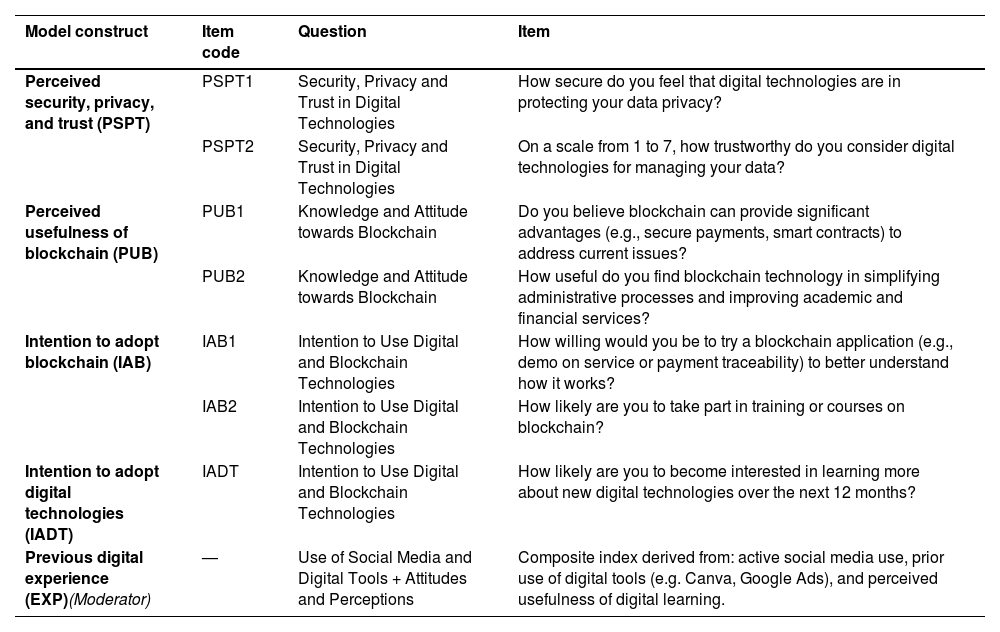
For the remaining sections of the questionnaire, responses were collected using a seven-point Likert scale. Rather than relying on previously validated scales, the items were developed ad hoc, influenced by insights gathered during Phase 1 of the study. Specifically, the focus group discussions provided rich qualitative input that supported the construction of context-specific questions, as detailed in Section 4.1. Table 4 shows the questions included in the questionnaire.
Questions included in the questionnaire.
Source: The authors.
Thematic analysis of the qualitative phase revealed several recurring topics among participants. First, participants showed varying degrees of awareness of blockchain applications, especially in sectors such as education and tourism. Second, trust and perceived risk emerged as central concerns, particularly in relation to privacy and data security. Third, participants identified time constraints and a lack of technical training as barriers to adoption. These categories were subsequently mapped to the main constructs of the proposed research model (perceived trust, perceived risk, privacy and security, perceived utility, and intention to adopt), thereby providing an empirical basis for the operationalisation of the hypotheses. For example, discussions on transparency, reliability, and information integrity related to items measuring perceived trust, whereas concerns regarding uncertainty, data misuse, and technological complexity aligned with perceived risk. Similarly, references to functional benefits and efficiency gains were used to refine perceived utility measures, and comments on prior exposure to similar digital tools were linked to the moderating role of previous experiences. These insights influenced the structure and content of the quantitative questionnaire, especially the inclusion of constructs such as perceived usefulness (PUB), privacy and security (PSPT), and intention to adopt (IAB and IADT).
Data analysisThe data collected were analysed using the structural equation model (SEM), which is useful for examining complex relationships between variables (Hoyle, 1995; Schumacker & Lomax, 2004). SEM is very effective in addressing potential problems arising from multicollinearity, missing values, and the evaluation of indirect effects (Westland, 2015). To improve the predictive approach and its flexibility, the partial least squares structural equation model (PLS-SEM) was used (Hair et al., 2019). These techniques are considered particularly relevant when examining the relationships between the different variables of the theoretical frameworks analysed (Sarstedt et al., 2020). More specifically, the data analysis was carried out using SmartPLS 4 software, which was considered to be suitable owing to its user-friendly interface and its ability to work with hypotheses (Ringle et al., 2023). This tool uses the PLS-SEM technique and incorporates bootstrapping techniques.
The analysis focused on two main areas. The first was the evaluation of the measurement model, which examines reliability using Cronbach’s alpha and composite reliability (CR). Second, the measurement of validity through the evaluation of convergent validity with average variance extracted (AVE) and discriminant validity, through the use of the Fornell-Larcker criterion and the hetero-trait-monotrait ratio (HTMT). The evaluation of the structural model measured the strength and importance of the relationships between the constructs proposed using path coefficients and explained variance (R²). This was used to evaluate the predictive relevance (Q²) and determine the goodness of fit of the model. It was considered effective for measuring the relationships between the proposed constructs, such as perceived security, privacy, and trust (PSPT), perceived usefulness in the use of blockchain technology (PUB), intention to adopt blockchain technology (IAB), and digital technologies (IADT). Empirical findings are offered on the analysis of the psychological and behavioural factors that influence the adoption of technology in users considered to be digital natives. These findings provide empirical support for the hypothesised relationships and set the foundation for further interpretation in the discussion section.
Reliability and composite reliability analysisIn accordance with Table 5, to analyse the reliability of the constructs (to guarantee the coherence and validity of the measurement model), Cronbach’s alpha and composite reliability (CR) were used. Both measurements attempt to evaluate the internal coherence of the elements of the construct to ensure that they reliably measure the underlying concept that is under analysis. Perceived security, privacy, and trust (PSPT) were first analysed. Perceived usefulness of blockchain technology (PUB) and the intention to adopt blockchain technology (IAB) and other digital technologies (IADT). In the model, Cronbach’s alpha, which assesses the internal consistency of a construct, had values greater than 0.70, indicating acceptable reliability (Hair et al., 2019). Composite reliability (CR), which evaluates the overall reliability of a construct considering the individual loadings of its indicators, yielded very high values, most of them above 0.90, suggesting excellent reliability (Hair et al., 2019; Sarstedt et al., 2020). Finally, all the average variance extracted (AVE) of the constructs were greater than 0.50, which indicates that most of the variance is explained by the proposed construct and not by measurement error, thus supporting convergent validity.
Table 6 measures discriminant validity. It can be seen that the square root of the AVE (diagonal values) of each construct is greater than its correlations with other constructs, thus fulfilling the Fornell-Larcker criterion. Constructs are distinct from each other, ensuring that they measure unique concepts. These results ensure that the constructs of the model are conceptually distinct and that there are no problems of overlap between them, providing confidence in the model’s ability to analyse the proposed theoretical relationships in a valid and reliable manner.
The results of the Cross Loadings (Table 7) confirm that each indicator has a higher factor loading on its corresponding construct, thus supporting the reliability of the indicators and the validity of the model. In addition, the Heterotrait-Monotrait Ratio (HTMT) (Table 8) confirmed the discriminant validity of the constructs, as all ratios were below the recommended threshold of 0.85.
The Collinearity Statistics (VIF) indicate that all VIF values were below the critical threshold of 5.0, suggesting that there were no multicollinearity problems between the indicators. The key findings are presented in Table 9.
In summary, the measurement model constructed using SmartPLS 4 demonstrated strong reliability, validity, and fit, making it suitable for further analysis. The constructs exhibit excellent internal consistency, with Cronbach’s Alpha and Composite Reliability (CR) values exceeding the recommended threshold of 0.70. Convergent validity was established through high Average Variance Extracted (AVE) values, all surpassing the 0.50 benchmark. Discriminant validity was confirmed through the Fornell-Larcker Criterion, HTMT ratios, and cross-loading analysis, indicating that the constructs were distinct and measure unique theoretical concepts. Regarding the model fit, the SRMR values for the saturated (0.056) and estimated (0.065) models fell well below the acceptable threshold of 0.08, and the discrepancy measures (d_ULS = 0.087/0.117; d_G = 0.146/0.149) also indicated a good model-data fit. Although the NFI values (0.691/0.687) fell below the traditional threshold of 0.90, this is a well-known limitation of covariance-based fit indices when applied to variance-based methods such as PLS-SEM. According to Henseler et al. (2016) and Hair et al. (2019), SRMR is considered a robust and appropriate measure of model fit in PLS-SEM. In our model, the SRMR values (0.056 for the saturated model and 0.065 for the estimated model) were well below the recommended cut-off of 0.08, indicating a satisfactory model-data fit. Overall, the model demonstrated an adequate level of fit (see Table 10).
Structural model overviewFig. 1 presents the structural equation model (SEM), illustrating the relationships between the key constructs: perceived security, privacy, and trust (PSPT), perceived beneficial use (PUB), intention to adopt digital technology (IADT), and intention to adopt blockchain (IAB). This model provides the foundation for subsequent path analysis and hypothesis testing, demonstrating how security perceptions and perceived utility influence adoption intentions.
Path coefficients and hypothesis testing
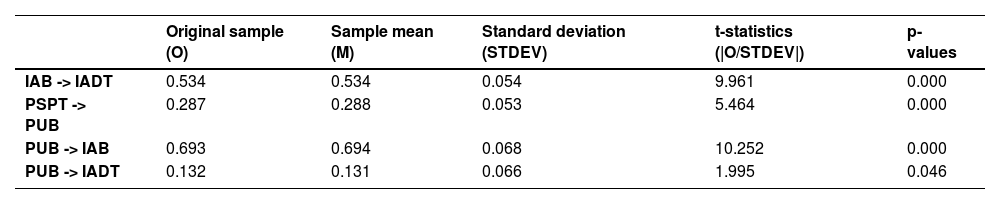
The structural model was estimated using SmartPLS 4, and the path coefficients revealed significant relationships between the constructs. IAB strongly predicted IADT (0.534), confirming that individuals’ behavioural attitudes significantly influence their intention to adopt digital technologies. PUB directly influenced IAB (0.563), highlighting the role of perceived utility in shaping blockchain adoption. However, its impact on IADT was weaker (0.132), suggesting that other factors may contribute to digital technology adoption. PSPT exerted a moderate effect on PUB (0.287), reinforcing the importance of security perceptions in driving favourable evaluations of blockchain technology.
The model demonstrated strong theoretical alignment and empirical support, with significant path coefficients confirming the hypothesised relationships. While the NFI indicated minor room for improvement, the results reinforce the importance of behavioural attitudes (IAB) and perceived utility (PUB) as key drivers of adoption intentions (IADT). The robustness of these relationships was further validated using bootstrapping analysis.
Bootstrapping and indirect effectConsidering Table 11, the bootstrapping analysis confirmed that all hypothesised relationships were statistically significant. Behavioural attitudes (IAB) were the strongest predictor of adoption intentions (IADT), with a path coefficient of 0.534, a T-statistic of 9.961, and a P-value of 0.000, reinforcing their pivotal role in shaping digital technology adoption. Similarly, perceived security (PSPT) significantly influenced perceptions of blockchain utility (PUB) (β = 0.287, T = 5.464, p = 0.000), highlighting the importance of security perceptions in fostering favourable evaluations of blockchain technology. Additionally, PUB strongly predicted IAB (β = 0.563, T = 12.868, p = 0.000), confirming that perceptions of blockchain utility are key drivers of behavioural attitudes. While the direct effect of PUB on IADT (β = 0.132, T = 1.995, p = 0.046) was statistically significant, its magnitude was relatively smaller, suggesting that utility perceptions primarily influence adoption intentions through behavioural attitudes. These results provide robust support for the proposed theoretical framework and underscore the interconnected nature of security perceptions, utility perceptions, attitudes, and intentions in driving technology adoption.
Bootstrapping coefficient path.
Source: The authors.
The variable EXP (prior experience with related technologies) was tested for its potential moderating effect within the structural model. Fig. 2 shows the results, including the p-value.

As shown in Table 12, the variable EXP achieved the required reliability and validity, confirming its role in influencing adoption behaviour. The results revealed a negative moderating effect of EXP on IAB (β = −0.203, p = 0.032), indicating that prior experience weakens the relationship between PUB and IAB. This suggests that individuals with greater technological exposure evaluate blockchain adoption more critically, requiring clearer benefits and stronger justification for adoption. Additionally, EXP had a direct negative effect on IAB (β = −0.306, p = 0.001), further reinforcing that users with greater technological exposure tend to be more sceptical when it comes to adopting blockchain, through the effect of perceived usefulness on the intention to adopt among more technologically experienced users. This suggests that individuals with extensive prior experience demand clearer advantages and more specific use cases before forming a positive attitude toward adoption. Despite the moderating effect, the direct path coefficients remained robust. These findings highlight the dual role of prior experience (EXP) in the adoption process as a direct inhibitor of adoption attitudes and a moderator that reduces the impact of perceived usefulness on adoption behaviour. The implications suggest that users with limited prior experience perceive blockchain as more useful and are more likely to develop favourable adoption attitudes, whereas experienced users evaluate the technology more critically.
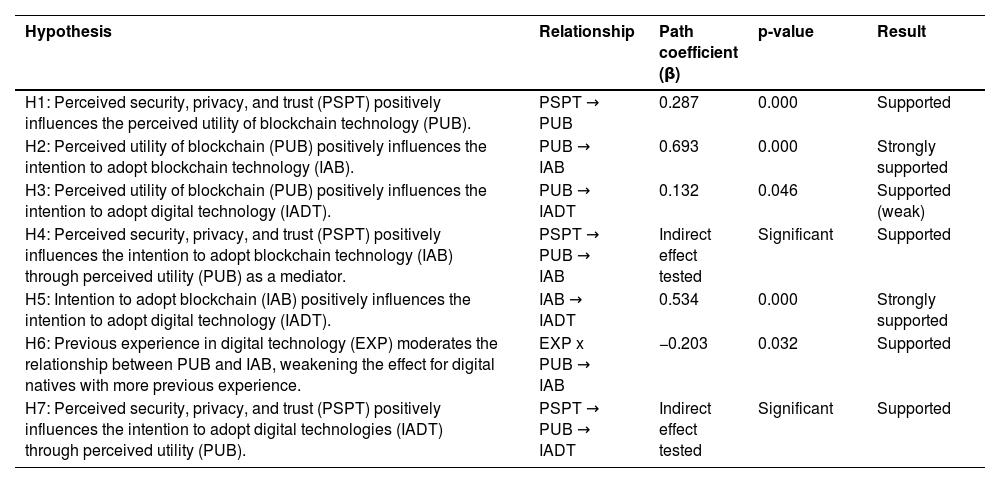
Hypothesis testing resultsThe structural model was evaluated to test the proposed hypotheses. The relationships between constructs were analysed using path coefficients, significance levels, and explained variance (R²). The findings validate the theoretical framework and highlight the importance of psychological and behavioural factors in the adoption of blockchain and digital technologies (Table 13).
Hypothesis Testing Results.
Source: The authors.
The increasing relevance of blockchain and digital technologies in reshaping consumer behaviours, decision-making, and engagement within digital ecosystems has been widely acknowledged (Prados-Castillo et al., 2023). This study contributes to the literature by analysing how psychological and behavioural factors influence blockchain adoption among digital natives (Prensky, 2001), integrating theoretical perspectives from TAM (Davis, 1989), Trust Theory (Mayer et al., 1995), Risk Theory (Featherman & Pavlou, 2003), UTAUT (Venkatesh et al., 2003), DOI (Rogers, 1962), and MPTAM (Liébana-Cabanillas et al., 2014). The results obtained show that the previous experience of digital natives with digital technologies negatively moderates (reducing the influence) the process of technological adoption, adding nuances to the traditional models of technology adoption that were analysed in the theoretical framework. This aligns with the Experience Paradox (Johnson et al., 2008; Mick & Fournier, 1998; Prados-Castillo et al., 2024), which suggests that while familiarity with digital tools can facilitate technological engagement, it can also lead to higher user expectations and a more critical evaluation of new technologies. Experienced digital natives may evaluate blockchain more cautiously, demanding clearer advantages over existing solutions, while less experienced users may perceive it as a novel and transformative tool, reinforcing its perceived usefulness. This underlines the need to adapt blockchain technology adoption strategies to newcomers who may be initially enthusiastic about trying out this technology.
Moderating role of prior experienceA novel contribution of this study is the identification of previous experience (EXP) as a key moderator in the adoption process, highlighting the experience paradox (Bolton & Drew, 1991). The results show that previous experience weakens the relationship between the perceived usefulness of blockchain (PUB) and the intention to adopt blockchain (IAB) (β = −0.203, p = 0.032), which suggests that digital natives with greater technological exposure are more critical in their evaluation of blockchain, in line with the diffusion of innovation theory (DOI) (Rogers, 1995). Experienced users tend to have higher expectations of emerging technologies, demanding clearer advantages and more specific use cases before adoption. However, no significant moderation was found in the Privacy and Security (PSPT) → PUB relationship, which reinforces the fact that trust continues to be a key factor in adoption at all levels of experience (Mayer et al., 1995). These findings indicate that perceived usefulness plays a more influential role for less experienced users, who may see blockchain as an innovative and valuable tool for them. Users with more experience in technology evaluate blockchain technology more critically (possibly because they expect more from the technology). This means that they need more complex and personalised strategies for the adoption of this technology that responds to their expectations and enthusiasm. Above all, it is recommended that the benefits of this technology be demonstrated in real applications. The results confirm that previous technological experience is a relevant and more important factor than demographic factors, once again reinforcing the need to carry out strategic segmentation. These findings reflect broader behavioural patterns observed in digital maturity contexts, where users with greater prior exposure tend to exhibit heightened expectations and scrutiny, a dynamic captured by the so-called experience paradox.
Key findings and theoretical implicationsConcerns regarding trust and security largely determine intention to adopt blockchain technology, as reflected in the relationship between privacy, security (PSPT), and perceived usefulness (PUB) (Mayer et al., 1995). This is in line with the theory of trust, emphasising that users are more likely to adopt the analysed technology when they perceive it as secure and reliable. However, perceived usefulness (PUU) is the most solid predictor of the intention to adopt blockchain technology (ITA) (Davis, 1989), which reinforces the central proposal of the TAM model. An indirect effect was also highlighted. Specifically, a greater perception of the usefulness of blockchain technology positively influences the intention to adopt other digital technologies (PUB → IADT) (Rogers, 1995). It is therefore suggested that familiarity with and trust in blockchain technology could foster a broader digital transformation among users that we consider digital natives.
It was found that previous experience with technology on the part of users moderates the relationship between PUB and IAB. This effect is attenuated in users with greater technological exposure (Prensky, 2001; Xiao et al., 2024). This reinforces the experience paradox (Bolton & Drew, 1991), which suggests that although familiarity with digital tools on the part of users can facilitate participation in their use, it can also lead to high expectations and a more critical perspective towards these technologies. However, demographic factors, such as gender and user education, do not show a significant influence on the adoption of blockchain technology (Vitvitskaya et al., 2022), implying that technological experience is a substantially more relevant determinant. These findings underline the need for segmentation in adoption strategies, reinforcing educational actions, and initiatives for less technologically experienced users and placing more value on complex demonstrations for more technologically experienced users.
Theoretical contributionsThree theoretical contributions are proposed to the field of technology adoption in digital markets, particularised in the context of blockchain technology and users considered to be digital natives. First, the analysis expands the Technology Acceptance Model (TAM) and the Theory of Trust, assuming that trust, security, and perceived usefulness are relevant factors for the adoption of blockchain technology (Davis, 1989; Mayer et al., 1995). The results reveal that previous experience moderates adoption decisions, adding a new dimension to traditional adoption models. It shows that more experienced users evaluate technology more critically despite recognising its usefulness, aligning with the experience paradox (Bolton & Drew, 1991). Second, the study can link the Diffusion of Innovations (DOI) framework (Rogers, 1995) with other models of technology adoption. In this sense, users in the early stages of adopting a specific technology tend to trust the technology more, which is influenced by its perceived usefulness. On the other hand, more technologically experienced users, assimilated to adopters in later stages, demand more tangible, real, and working evidence to demonstrate its value (Prados-Castillo et al., 2024). It is clear that the adoption of technology varies according to the characteristics of the market segments, which in this case, are configured according to the user’s experience and expectations. Finally, the findings indicate that perceived usefulness acts as a catalyst for deeper technological adoption, reinforcing the Mobile Payment Technology Acceptance Model (MPTAM) (Liébana-Cabanillas et al., 2014). These results suggest that the adoption of blockchain technology can foster spillover effects. In other words, users who perceive greater value in this technology are more likely to participate in other digital innovations. In this sense, technological adoption in digital markets is not homogeneous among users.
Practical implications for adoption strategiesThe importance of the need to carry out segmentation strategies based on the experience of users in digital knowledge should be emphasised. Recognising that users with little experience and users with a lot of experience require differentiated strategies for the correct adoption of blockchain technology. For users with little digital experience, it is key to highlight the security and decentralisation benefits offered by blockchain technology, thus reinforcing the reliability of digital transactions. Specific measures have to do with the design of educational resources, interactive tutorials, and fun learning experiences. For more experienced users, it is necessary to develop strategies to show more advanced use cases applied to the real world that show benefits over other technologies. These tools can go as far as showing the virtues of Decentralised Finance (DeFi).
Industry and policy recommendationsFrom a business perspective, differentiated marketing strategies should be adopted for these stakeholders (Bag et al., 2021). For example, for less experienced users, campaigns should focus on offering educational and training solutions to spread the benefits of the technology. For users with more technological experience, strategies could be aimed at technical demonstrations, case studies, and transparent performance metrics to gain confidence in the technology in sectors such as e-commerce, finance, and business loyalty platforms. At the policy level, regulations to increase trust are crucial for addressing privacy and security concerns that influence market confidence (Calvaresi et al., 2019). Governments and regulatory bodies must establish clear guidelines and legal frameworks to strengthen user confidence in blockchain applications, particularly in financial services, supply chain management (Wang et al., 2023) , and digital identity verification. It is with the provisothat such regulations do not limit the key functionality of technology, which can help accelerate the adoption of technology.
Limitations and future researchSeveral limitations are recognised in the context of blockchain adoption in digital markets. First, the sample was composed exclusively of digital natives, which limits the generalisation of the results to older generations or professionals in non-digital sectors (Vitvitskaya et al., 2022). Although digital natives represent a key demographic group in technology-driven markets, future studies could include a wider range of users, including industry professionals and policymakers, to assess whether adoption patterns differ between different market segments. Second, the study does not explicitly operationalise perceived risk as an independent construct. Although elements of risk are embedded in the ‘Privacy and Security’ dimension, future research should consider including a distinct risk factor to more accurately capture its influence on blockchain adoption behaviours (Louis & Afgani, 2024). While privacy and security were analysed as antecedents of perceived usefulness, perceptions of risk, such as concerns about financial losses, technological obsolescence, and regulatory uncertainty, could act as barriers or moderators in the adoption of the digital market. Future research should integrate perceived risk as a distinct construct to deepen our understanding of the drivers and inhibitors of adoption in digital markets. Third, the study is based on cross-sectional data, which captures adoption intentions at a given point in time. However, technology adoption is a dynamic process that evolves with technological advances, changing consumer confidence, and regulatory changes (McKnight & Chervany, 2001). Longitudinal studies would be beneficial to analyse how blockchain adoption patterns change over time in digital markets, especially as trust mechanisms, regulatory clarity, and technological scalability improve. Fourth, this study did not explicitly integrate the Unified Theory of Acceptance and Use of Technology (UTAUT), despite its relevance in research on technology adoption.
Several promising avenues for future research are suggested. First, a comparative analysis of emerging technologies could provide information on whether the patterns of adoption of blockchain align with those of other technologies that shape digital markets, such as artificial intelligence (AI), the Internet of Things (IoT), or non-fungible tokens (NFT) (Prados-Castillo et al., 2023). On the other hand, understanding whether trust, usefulness, and previous experience influence these technologies in a similar way could help develop broader technology adoption frameworks for digital markets. Second, greater experience-based segmentation is required to refine adoption models in digital markets. This study confirms that previous experience moderates blockchain adoption, but further research could examine how industry-specific factors, academic background, and regulatory environments shape adoption behaviours (Prensky, 2001). Third, UTAUT could be incorporated into future models to assess the role of social and organisational factors in blockchain adoption. Although this study focuses on individual cognitive and psychological factors, future studies could analyse whether the influence of peers, the support of leaders, and government regulations drive adoption in business environments. Finally, cross-cultural validation could be carried out to determine whether the adoption patterns observed in this study hold up globally, particularly in highly regulated versus decentralised digital markets (Joa & Magsamen-Conrad, 2022). Cultural differences in risk perception, trust in regulation, and digital literacy can significantly influence how blockchain is evaluated and adopted in different economies. Extending this research to diverse economic and regulatory environments would reinforce the applicability of blockchain adoption models in global digital markets.
ConclusionsThis study analysed the psychological and behavioural factors that shape the adoption of blockchain and digital technologies among digital natives using an integrated theoretical framework that combined TAM, Trust and Risk Theories, DOI, UTAUT, and MPTAM. The findings confirm that perceived usefulness and trust are key drivers of adoption, whereas prior digital experience plays a moderating role, conditioning how users evaluate the utility and credibility of new technologies. The results provide empirical support for the experience paradox and highlight the importance of segmenting adoption strategies according to technological maturity. From a theoretical standpoint, this study extends classical models by incorporating the role of prior experience and linking specific adoption patterns with broader digital transformation processes.
These findings offer theoretical insights and practical guidance for organisations and policymakers seeking to foster more inclusive and effective digital innovation strategies, particularly in the blockchain domain. While this study makes relevant contributions, it also invites further research to refine adoption models by including perceived risk, cross-generational perspectives, and longitudinal designs that reflect the evolving nature of digital ecosystems.
CRediT authorship contribution statementJuan Francisco Prados-Castillo: Writing – original draft, Validation, Software, Methodology, Investigation, Formal analysis, Data curation, Conceptualization. Jose María Martín Martín: Writing – original draft, Supervision, Methodology, Formal analysis, Conceptualization. Inna Alexeeva-Alexeev: Visualization, Validation, Supervision, Conceptualization. José Manuel Guaita-Martínez: Writing – original draft, Validation, Methodology, Investigation, Formal analysis, Conceptualization.
This study has been funded partially by the Unit of Excellence of the University of Granada - Campus of Melilla. Reference: UCE-PP202402. Funding for this work has also been provided by the following institutions: University of Granada, SANFI and Polytechnic University of Valencia.
